采矿业

Search documents
铜:中场休息
Xin Lang Cai Jing· 2026-01-14 01:20
Core Viewpoint - The logic supporting copper price increases has not significantly changed, and after the adjustment, there is still potential for a rebound. The first quarter is typically a slow season, and without new drivers, prices may fluctuate before the Spring Festival. Post-holiday, with resumption of work and tight spot supply, copper prices may rise again. The short-term price range is expected to be 94,000 to 120,000 CNY/ton for Shanghai copper and 12,000 to 15,000 USD/ton for London copper. The strategy remains to buy on dips [3][17][26]. Focus Point 1: US-LME Price Spread - The recent convergence of the US-LME price spread is primarily due to delayed or canceled expectations regarding US copper tariffs, influenced by the postponement of timber tariff increases and the upcoming results of the silver 232 investigation, which may exempt silver tariffs and similarly affect copper tariffs. Additionally, US copper imports concentrated at the end of December, with current COMEX inventories reaching 500,000 tons. Future tariff expectations may still fluctuate [6][20]. Focus Point 2: Ongoing Supply Disruptions - Recent disruptions at mining sites have intensified expectations of tight raw material supply. The Mantoverde copper mine in Chile experienced a strike in early January, halting production of approximately 74,000 tons, with a potential monthly impact of 6,000 tons if the strike continues. Furthermore, the Mirador copper mine in Ecuador has delayed its second phase due to political changes, affecting the signing of mining contracts, with the timeline for production now uncertain. This mine was initially expected to contribute an additional 90,000 tons this year [8][22][24]. Focus Point 3: High Prices Suppressing Downstream Consumption - High copper prices are significantly suppressing consumption, with the operating rate of refined copper rods dropping from an average of 64% in December to 48%, resulting in a weekly sample production decrease of nearly 20,000 tons. Domestic social inventories accumulated nearly 80,000 tons in December, with an additional 54,000 tons accumulated in January so far, as some downstream sectors prepare to enter the Spring Festival holiday early, leading to weak consumption. This weakness in demand is limiting the upward price momentum, and downstream sectors require time to accept current prices [10][11][25]. Summary of Macro and Supply-Demand Dynamics - On the macro level, recent US economic data shows mixed PMI results, with manufacturing weakening and services slightly strengthening. Non-farm employment numbers have decreased, but the unemployment rate and wage growth have exceeded expectations, indicating a continued soft landing for the US economy. The backdrop of loose liquidity remains unchanged. In terms of supply and demand, global copper concentrate supply-demand tightness persists, with ongoing mining supply disruptions. The expected surplus of refined copper is narrowing, but high copper prices are significantly suppressing downstream consumption, leading to unexpected inventory accumulation domestically. Structurally, the convergence of the COMEX-LME premium is influenced by tariff expectations, with ongoing trade flows of refined copper from non-US regions to the US. If the US-LME price spread expands again, structural shortages may continue to support copper prices [12][26].


12月非农数据点评:就业中性偏弱,政策取向谨慎
Guoxin Securities· 2026-01-10 11:05
Employment Data Overview - December non-farm payrolls increased by 50,000, below the expected 60,000, while the unemployment rate fell to 4.4%[2] - The labor force participation rate declined to 62.4%, which statistically suppresses the unemployment rate, diluting its actual significance[4] Employment Sector Insights - Private sector added 37,000 jobs, with leisure and hospitality, and education and healthcare contributing 88,000 jobs combined, significantly boosting overall non-farm employment[14] - Job losses were evident in the goods-producing sectors, with construction, manufacturing, and mining losing 11,000, 8,000, and 2,000 jobs respectively, indicating weakening demand in the real economy[14] Wage Trends - Average hourly earnings in the service sector rose by 3.7% year-on-year, while goods-producing sectors saw a 4.1% increase, driven more by structural factors than by demand[20] - The increase in average wages reflects a structural effect where low-wage positions are being eliminated, raising the average wage of remaining employees[20] Monetary Policy Outlook - The probability of a rate cut in January is near zero, with the Federal Reserve likely to maintain a cautious stance due to the current employment and inflation dynamics[24] - The Fed's policy decisions will be influenced by upcoming inflation data and potential changes in the Federal Open Market Committee (FOMC) membership, which could reshape market expectations[24]
“淘铜热”升温!力拓(RIO.US)洽谈收购嘉能可:欲成超级矿业巨头以争夺铜资源
智通财经网· 2026-01-09 02:23
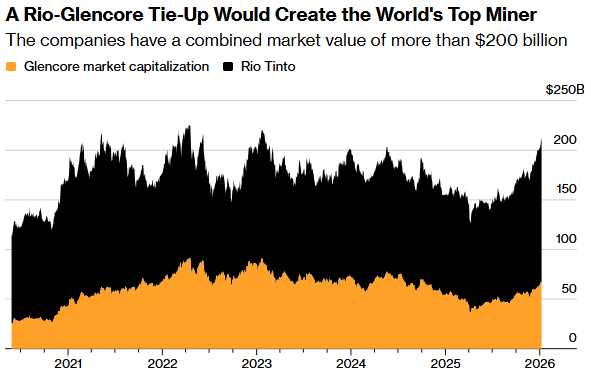
Core Viewpoint - Rio Tinto (RIO.US) is in talks to acquire Glencore, aiming to create the world's largest mining company with a combined market value exceeding $200 billion, marking a potential record deal in the industry [1] Group 1: Merger Discussions - The discussions between Rio Tinto and Glencore include the possibility of a full stock acquisition and the merger of part or all of their businesses [1] - Previous negotiations between the two companies broke down over valuation disagreements, and the gap in their valuations has since widened [1][6] - Glencore's CEO has indicated that a merger with Rio Tinto is the most obvious deal in the industry [1][6] Group 2: Industry Context - The mining sector is experiencing a wave of mergers and acquisitions, driven by the rising demand for copper, a key metal in energy transition, with prices recently hitting historical highs of over $13,000 per ton [2] - The industry is facing concerns about future copper supply due to insufficient new mining projects to meet the anticipated demand from sectors like artificial intelligence and defense [2] Group 3: Strategic Implications for Rio Tinto - Acquiring Glencore would significantly boost Rio Tinto's copper production and provide access to the coveted Collahuasi copper mine in Chile [6] - Rio Tinto's new CEO is focused on cost-cutting and simplifying operations, with plans to divest smaller business units [6] - The company has learned from past failed transactions and is now more open to acquisitions [6] Group 4: Glencore's Position - Glencore is the world's largest coal producer and has faced pressure from investors due to its poor stock performance last year, prompting a focus on its copper business [7] - The company has plans to nearly double its copper production over the next decade [7] - There is uncertainty regarding whether Rio Tinto is willing to acquire Glencore's coal and other non-copper assets, despite potential divestitures [7] Group 5: Regulatory Considerations - According to UK takeover rules, Rio Tinto must confirm whether it will make a formal offer by February 5, or it will exit the acquisition process for six months [8]


铜资源争夺白热化,嘉能可与力拓重启合并谈判
Jin Shi Shu Ju· 2026-01-09 01:24
Core Viewpoint - Glencore and Rio Tinto have resumed talks for a potential merger to create the world's largest mining company, valued at over $260 billion, amid a competitive landscape for copper resources [2][3]. Group 1: Merger Negotiations - The two companies confirmed they are in "preliminary discussions" regarding the possibility of merging part or all of their businesses, potentially through an all-stock merger [2]. - The last round of merger talks ended nearly a year ago due to valuation disagreements and other strategic issues [4]. - The current discussions were reignited at the end of last year, with no certainty on whether a final agreement will be reached [3][4]. Group 2: Market Context - The copper market is experiencing significant supply shortages, with copper prices recently exceeding $13,300 per ton, highlighting the urgency for companies to secure resources [3]. - Analysts predict a potential global copper market shortfall of 10 million tons by 2040, intensifying competition among mining firms [3]. Group 3: Company Strategies - Glencore is positioning itself as a growth-oriented copper company, aiming to become the largest copper producer globally, with plans to double its annual copper output to 1.6 million tons by 2035 [4]. - Rio Tinto has focused on cost reduction and business streamlining under its new CEO, Simon Trott, who took office in August last year [4][5]. - Glencore's stock has risen by 35% over the past six months, while Rio Tinto's shares have increased by 41%, driven by rising commodity prices and new copper strategies [5]. Group 4: Industry Dynamics - The recent friendly merger between Anglo American and Teck Resources has put pressure on competitors like BHP and Rio Tinto to accelerate their expansion efforts [3]. - Glencore's restructuring of its coal assets into a separate entity may facilitate future strategic decisions regarding its coal business [4].
大中矿业:1月6日召开董事会会议
Mei Ri Jing Ji Xin Wen· 2026-01-07 12:50
Group 1 - The company, Dazhong Mining, announced the convening of its 21st meeting of the 6th board of directors on January 6, 2026, which was held both in-person and via communication methods [1] - The meeting reviewed a proposal regarding the implementation of a lithium mining project at the Jijiao Mountain mining area, with an annual capacity of 20 million tons [1]
山金国际:目前正在对华盛采矿权外围的探矿权区域进行补充勘查
Zheng Quan Ri Bao· 2026-01-07 09:37
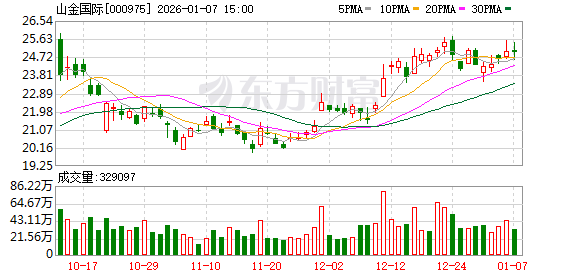
Group 1 - The core viewpoint of the article is that Shanjin International is currently undergoing a process to change its mining rights certificate, which requires the completion of a resource verification report review and filing [2] - The company is conducting supplementary exploration in the area surrounding the Huasheng mining rights, which is necessary for the resource verification report [2] - After the exploration is completed, the company plans to merge the newly explored resource quantities with the existing mining rights resources and resubmit the verification report for review [2]

巴西2025年贸易顺差达683亿美元
Xin Lang Cai Jing· 2026-01-07 06:53
Core Insights - Brazil's trade surplus is projected to reach $68.3 billion in 2025, with exports totaling $348.7 billion and imports at $280.4 billion [1] Group 1: Trade Performance - Brazil's Vice President and Minister of Development, Industry, Trade, and Services, Alckmin, stated that both exports and imports have reached historical highs despite the impact of U.S. tariffs and geopolitical tensions [1] - The growth in export value is primarily driven by the manufacturing, mining, and agricultural sectors [1] - The largest increases in import value are seen in capital goods, intermediate goods, and consumer products [1] Group 2: Market Expansion - Over 40 markets have set new records for purchasing Brazilian products, with notable performances from Canada, India, Turkey, Paraguay, Uruguay, Switzerland, Pakistan, and Norway [1]
爱沙尼亚2025年11月工业生产同比增长3.4%
Shang Wu Bu Wang Zhan· 2026-01-07 04:36
Core Insights - Estonia's industrial output increased by 3.4% year-on-year in November 2025, according to the Estonian Statistics Office [1] Group 1: Industry Performance - The mining sector experienced a significant growth of 10% year-on-year [1] - The manufacturing sector saw a growth of 4.5% year-on-year [1] - The energy sector, however, faced a decline of 8.7% year-on-year [1] Group 2: Manufacturing Sub-sectors - The production of motor vehicles, trailers, and semi-trailers surged by 57.7% year-on-year [1] - The computer and electronic equipment manufacturing sector grew by 4.4% year-on-year [1] - The wood processing industry recorded a modest growth of 1% year-on-year [1] - Conversely, the furniture manufacturing sector declined by 4.3% year-on-year [1] - The food manufacturing sector also saw a decrease of 4.1% year-on-year [1] - The metal products manufacturing sector experienced a slight decline of 0.7% year-on-year [1] - The electrical equipment manufacturing sector had a minimal decrease of 0.1% year-on-year [1]
金银大涨,委内瑞拉之后“人人自危” 避险情绪升温
Hua Er Jie Jian Wen· 2026-01-06 03:15
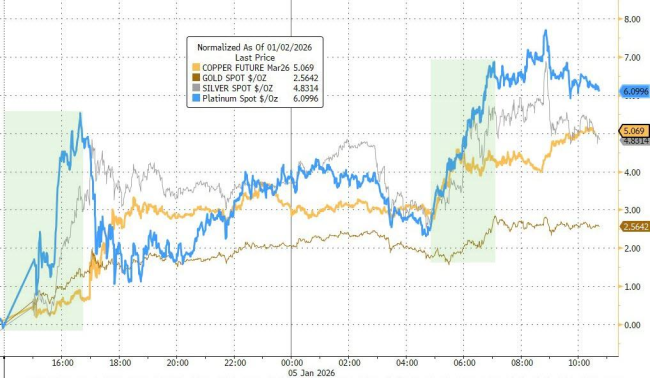
Group 1 - The arrest of Venezuelan leader Maduro has heightened risk aversion among investors, leading to a surge in demand for precious metals [1][5] - The recent fluctuations in commodity prices indicate a "metal war," with countries competing to secure key resources for the accelerating AI race [3] - Venezuela possesses significant gold and copper resources, which are now under increased scrutiny from the U.S. as it aims to control these assets [3] Group 2 - On Monday, safe-haven funds flowed into the precious metals market, with spot gold surpassing $4,400 and silver prices rising by 5%, with a peak increase of nearly 10% during the day [4] - Central banks have significantly increased their gold purchases in recent years, particularly after the Russia-Ukraine conflict in 2022, reflecting heightened concerns over asset security [5] - The recent surge in silver and copper prices is attributed to their designation as critical minerals by the U.S., emphasizing their importance to the economy and national security [5] Group 3 - Approximately 60% of global silver is used for industrial purposes, which enhances its strategic position in the AI race and energy transition [5] - A recent supply shortage has led to a nearly 45% spike in spot silver prices over the past month, indicating strong market dynamics [5] - The competition for key minerals is reshaping the commodity market landscape, necessitating close monitoring of resource nationalism's impact on supply chains and prices [5]
“GDP超日本”,印度世界第四含金量几何?
Huan Qiu Shi Bao· 2026-01-05 22:52
Economic Overview - India's GDP has reached approximately $4.18 trillion, surpassing Japan to become the world's fourth-largest economy, with projections to grow to $7.3 trillion by 2030 [1][2] - The growth trajectory suggests India may overtake Germany within three years, becoming the third-largest economy globally [1] Consumption and Demographics - A significant driver of India's economic growth is its demographic advantage, with consumption contributing nearly 55% to 60% of GDP [1] - The country has recently become the most populous in the world, with over a quarter of its population aged between 10 and 26, which is expected to bolster consumer spending and investment [1] Government Policies - The Modi government's "Production-Linked Incentive Scheme" aims to stimulate growth by incentivizing local manufacturing in strategic sectors such as electronics, defense, and pharmaceuticals [2] Economic Growth Rate Concerns - Despite reported growth rates of 8.2% for the second quarter of FY2025, some economists argue that the actual growth rate may only be between 2.5% and 3% due to discrepancies in data collection and economic modeling [4][5] - Critics highlight that the reliance on outdated benchmarks and the exclusion of informal sector activities may distort the true economic picture [4][6] Structural Issues - A review of 22 core economic indicators revealed that only 9 showed growth, indicating underlying structural issues within the economy [6] - Key sectors such as mining and energy are underperforming, with mining growth nearly stagnant at 0.04% and electricity demand declining to a growth rate of 4.4% [6] Comparison with Japan - While India's nominal GDP exceeds Japan's, the quality of growth is questioned, as India's expansion is largely driven by the service sector rather than a robust industrial base [6] - India's per capita GDP of approximately $2,800 suggests that the economy is still in a phase of scale expansion without sufficient depth in industrial development, highlighting a significant gap compared to mature East Asian manufacturing economies [6]