饮料

Search documents
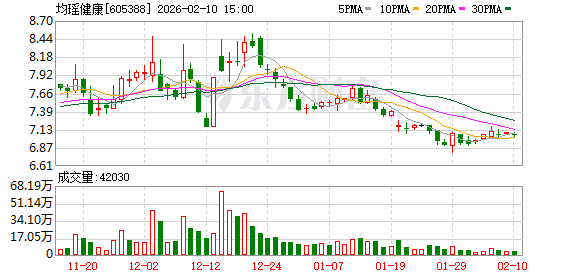
均瑶健康:2026年业务弹性主要来自饮料板块的提升
Zheng Quan Ri Bao· 2026-02-10 13:35
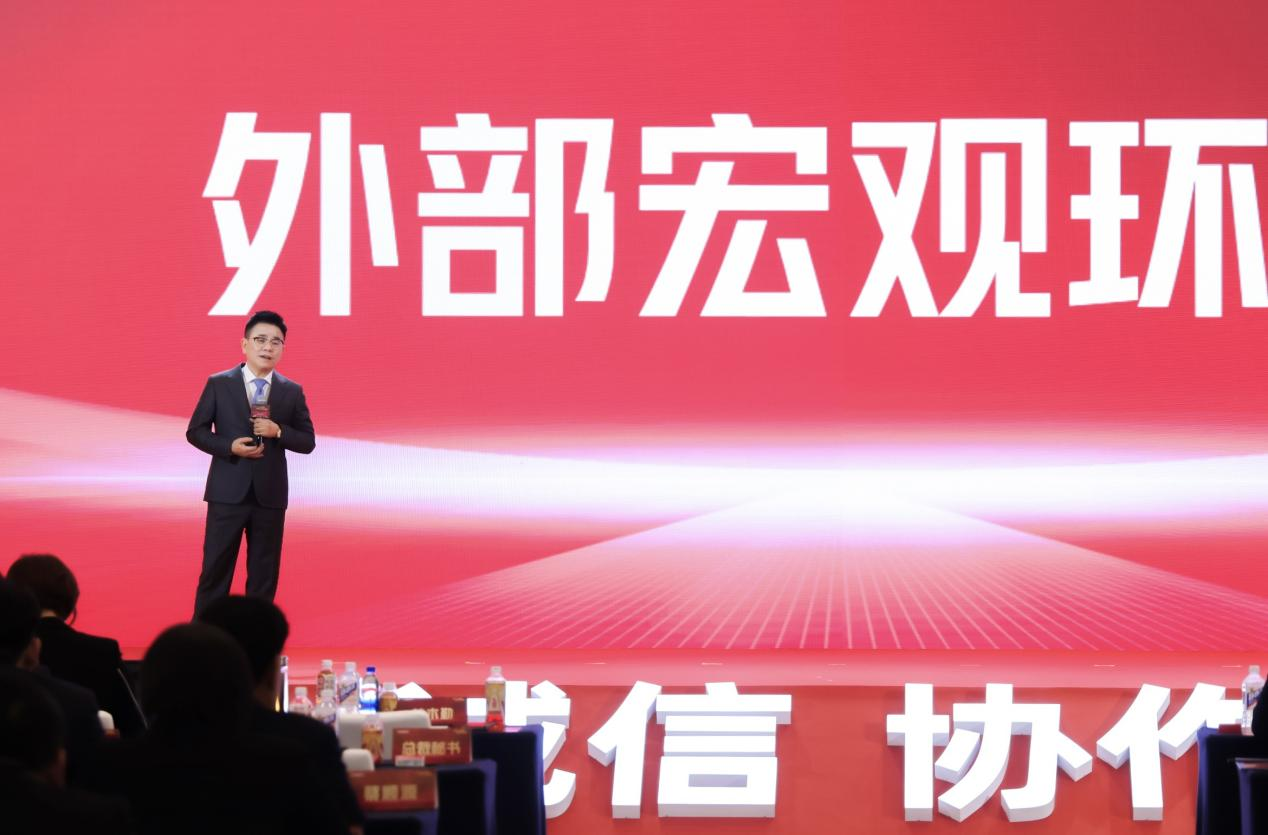
Core Viewpoint - Junyao Health aims to achieve profitability by 2026, focusing on core business, optimizing business structure, and pursuing development with a lean approach [2] Group 1: Business Strategy - The core strategy for 2026 includes focusing on the beverage sector, enhancing revenue through deepened cooperation in new channels, and launching new SKUs to match production capacity [2] - The probiotics segment will continue to advance overseas expansion, optimize production capacity, and strengthen clinical research to cultivate star strains [2] Group 2: Operational Focus - The company will maintain a focus on the health beverage main business, deepen channel engagement, and optimize the product matrix [2] - All core business segments will work collaboratively to drive the company towards healthy development [2]


BodyArmor减值拖累,可口可乐Q4 GAAP营业利润同比下滑32%,全年指引不及预期|财报见闻
Sou Hu Cai Jing· 2026-02-10 13:10
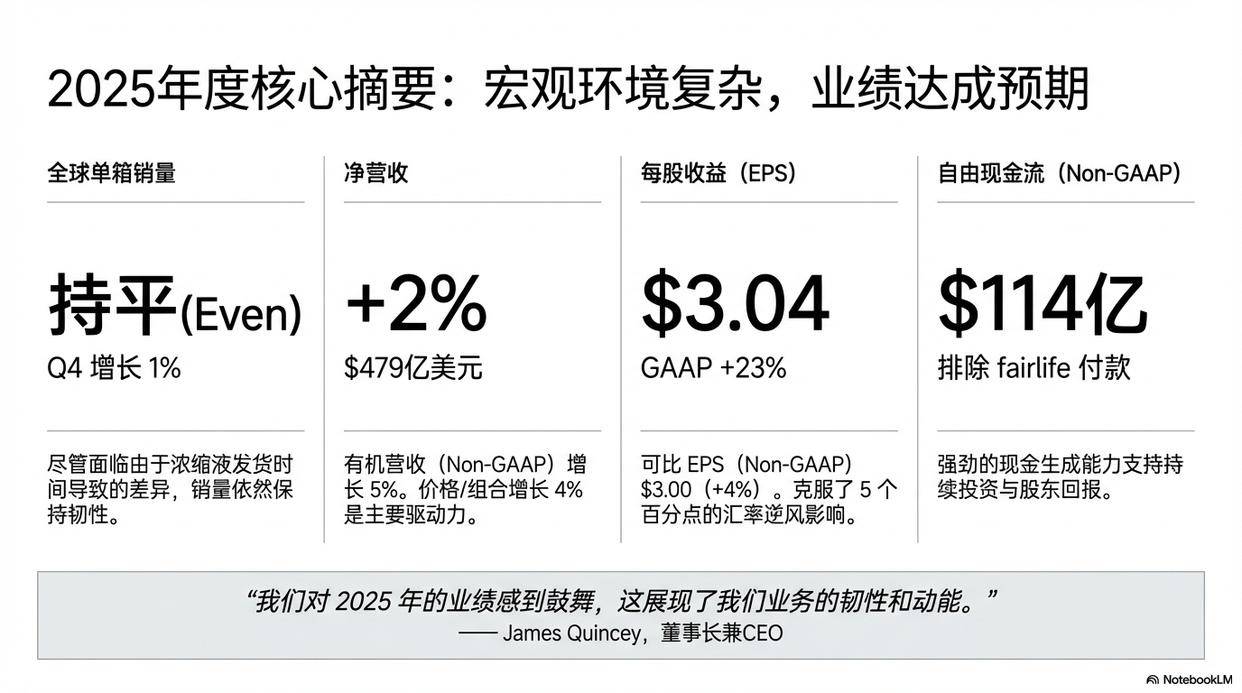
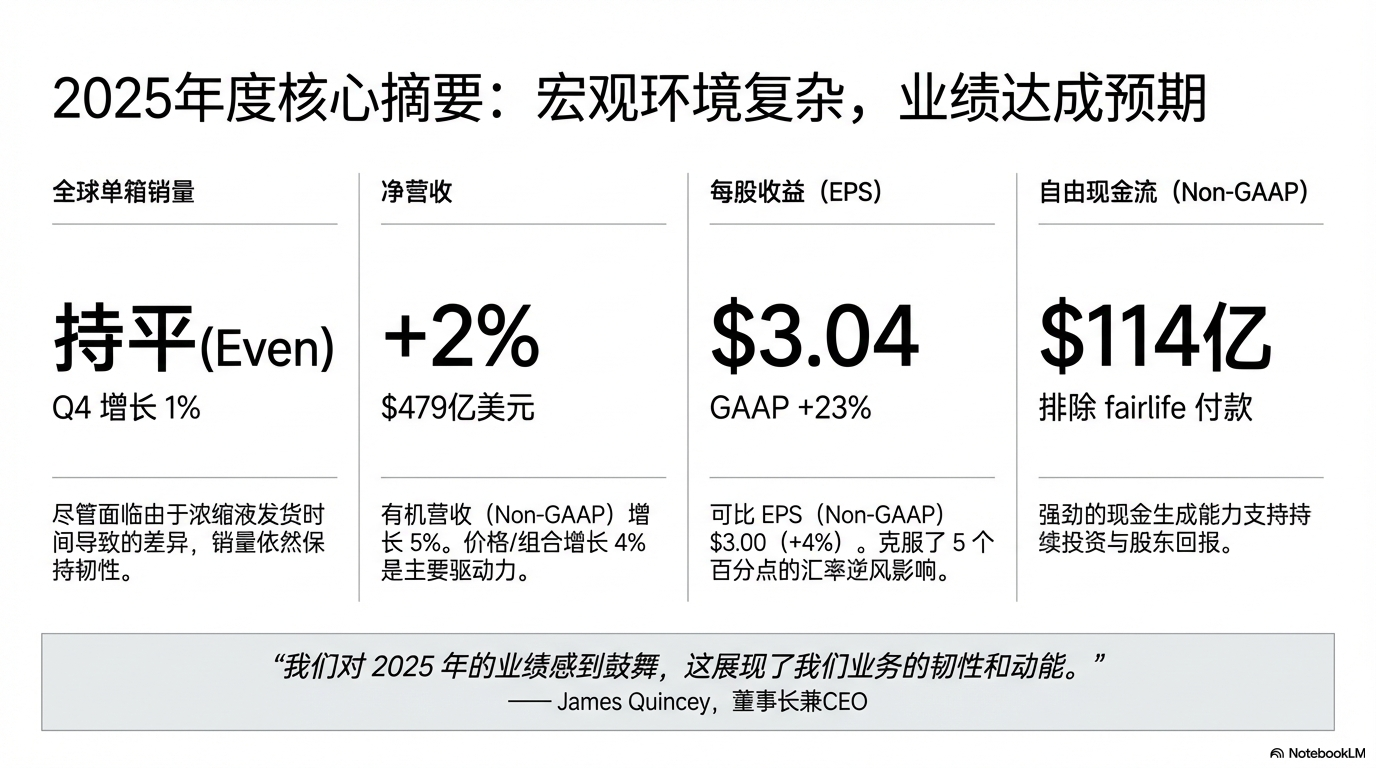
Core Viewpoint - Despite strong performance in the zero-sugar segment and slightly better-than-expected Q4 results, Coca-Cola's 2026 growth guidance appears weak, disappointing the market [1][3]. Financial Performance - Q4 revenue reached $11.82 billion, a 2% year-over-year increase, with organic revenue growth of 5% [1]. - Comparable EPS was $0.58, up 6% year-over-year, slightly exceeding analyst expectations [1]. - North America operating profit fell 65% year-over-year due to a $960 million non-cash impairment charge related to the BodyArmor brand acquisition [8]. Sales and Pricing - Global unit case volume grew by 1%, with price/mix growth of 1%, indicating maintained pricing power but at a reduced rate compared to previous years [9]. - Coca-Cola Zero Sugar was a standout product, with Q4 sales surging 13% and a 14% increase for the year [9]. - Traditional full-sugar soda sales faced pressure due to declining consumer demand, while Diet Coke remained flat for the year [9]. Future Outlook - Coca-Cola expects organic sales growth for 2026 to be between 4% and 5%, below Wall Street's average expectation of 5.01% [3][6]. - The company anticipates comparable EPS growth of 7% to 8% from a base of $3.00 in 2025, indicating a shift from the previous inflation-driven growth to a more moderate growth environment [6]. Market and Policy Challenges - The company faces increasing macroeconomic pressures, including health concerns regarding sugary drinks and state-level restrictions on soft drink purchases using food assistance benefits [5][11]. - Coca-Cola is diversifying its product portfolio to address these challenges, promoting healthier options and leveraging sports events for marketing [11].

可口可乐(KO.US)“涨价红利”消退:Q4营收、2026年有机销售额指引不及预期
智通财经网· 2026-02-10 13:02
Group 1 - The core viewpoint of the article highlights Coca-Cola's fourth-quarter financial performance, showing a revenue increase of 2.2% to $11.8 billion, which fell short of market expectations [1] - The comparable earnings per share rose by 6% to $0.58, exceeding the market consensus of $0.56, despite a 9% adverse impact from currency fluctuations [1] - Organic revenue growth was reported at 5%, surpassing the market expectation of 4.8%, driven by strong performance in Latin America (+10%) and Europe, the Middle East, and Africa (+6%) [1][3] Group 2 - Coca-Cola's unit case volume increased by 1% in the fourth quarter, primarily due to growth in Brazil, the U.S., and Japan, although growth in the EMEA region was offset by declines in the Asia-Pacific region [1] - The company noted that the sales of zero-sugar Coca-Cola remain strong, with an expected growth of 14% by 2025, while Diet Coke saw a 2% increase in the fourth quarter, remaining flat for the year [3] - Coca-Cola's pricing/product mix growth of 1% was mainly attributed to pricing strategies in the market, although it faced challenges from adverse product mix effects and rising input costs [3] Group 3 - The company provided a sales forecast for 2026, which was below Wall Street expectations, projecting organic sales growth of 4% to 5% and earnings per share growth of 7% to 8% [3] - Optimistic views suggest that under the leadership of incoming CEO Henrique Braun, Coca-Cola can attract consumers with its expanding beverage portfolio, including healthier options [4] - The stock price of Coca-Cola fell by 4% in pre-market trading following the earnings announcement, despite a year-to-date increase of nearly 12%, compared to a 2% rise in the S&P 500 index [4]
BodyArmor减值拖累,可口可乐Q4 GAAP营业利润同比下滑32%,全年指引不及预期 | 财报见闻
Hua Er Jie Jian Wen· 2026-02-10 12:58
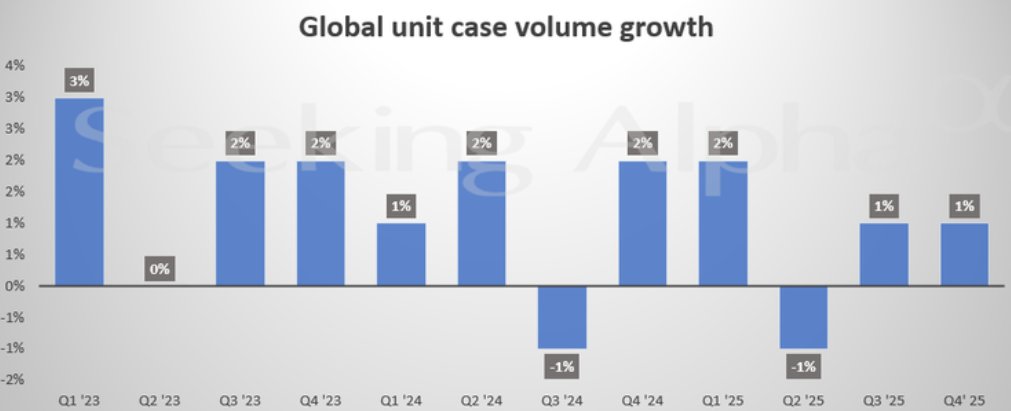
Core Viewpoint - Despite strong performance from the zero-sugar product line and slightly better-than-expected Q4 results, Coca-Cola's 2026 growth guidance appears weak, disappointing the market [1][4]. Financial Performance - In Q4, Coca-Cola reported revenue of $11.82 billion, a 2% year-over-year increase, with organic revenue growth of 5% [1]. - The comparable earnings per share (EPS) was $0.58, reflecting a 6% year-over-year growth, slightly above analyst expectations [1]. - However, GAAP operating profit fell by 32% year-over-year due to a $960 million non-cash impairment charge related to the acquisition of BodyArmor [4][11]. Future Outlook - Coca-Cola projects organic sales growth for 2026 to be between 4% and 5%, which is below Wall Street's average expectation of 5.01% [4][8]. - The company anticipates a 7% to 8% growth in comparable EPS from a base of $3.00 in 2025, indicating a shift from the previous high-inflation-driven growth to a more moderate growth environment [8]. Market Challenges - The company faces a complex macro policy environment, with signals from the Trump administration regarding the health implications of carbonated drinks and new state-level restrictions on soft drink purchases using food assistance benefits [7][14]. - As a result of the disappointing guidance and macroeconomic concerns, Coca-Cola's stock price dropped by 4.1% in pre-market trading [7]. Product Performance - Coca-Cola's core business showed resilience, particularly with its "no sugar" strategy, as Coca-Cola Zero Sugar saw a 13% increase in Q4 sales and a 14% increase for the year [9][12]. - In North America, despite a strong underlying performance, operating profit plummeted by 65% due to the impairment charge related to BodyArmor [11]. - Global unit case volume grew by 1%, with price/mix growth of 1%, indicating maintained pricing power but a narrowing increase compared to previous years [12]. Strategic Response - To address the challenges posed by changing consumer preferences and health trends, Coca-Cola is accelerating its diversification into non-sugar beverages, sports drinks, and water [8][14]. - The company is promoting innovative products like Powerade and Power Water and leveraging global sporting events for marketing to counteract the decline in traditional carbonated drink demand [14].
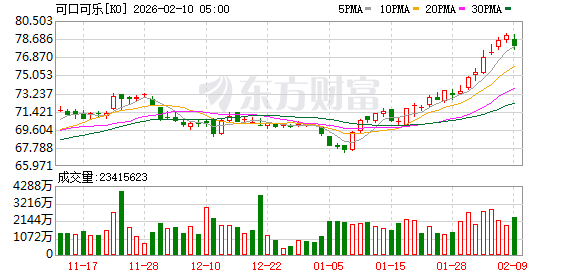
可口可乐股价跌幅扩大,盘前最新下跌3.9%
Mei Ri Jing Ji Xin Wen· 2026-02-10 12:28
每经AI快讯,2月10日,可口可乐股价跌幅扩大,盘前最新下跌3.9%。 ...
可口可乐美股盘前跌超2%
Mei Ri Jing Ji Xin Wen· 2026-02-10 12:16
每经AI快讯,2月10日,可口可乐美股盘前跌超2%,公司2025年第四季度净营收不及市场预期。 (文章来源:每日经济新闻) ...
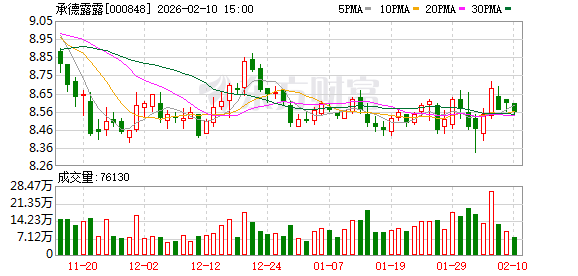
承德露露:为国民提供绿色、健康、可信赖的植物饮品
Zheng Quan Ri Bao· 2026-02-10 11:37
Core Viewpoint - The company, as a pioneer in the plant-based beverage sector and a leader in the almond milk niche, is committed to advancing its strategic focus on product innovation, brand promotion, and market expansion to ensure sustainable development and high-quality growth [2] Group 1: Strategic Focus - The company aims to lead the development of plant-based beverages through continuous product innovation [2] - The company emphasizes brand promotion as a key component of its strategy [2] - Market expansion is a priority for the company to enhance its competitive position [2] Group 2: Technological and Digital Initiatives - The company plans to leverage technology to empower the industry [2] - Digitalization is a critical aspect of the company's growth strategy [2] - The company is focused on optimizing its product structure to meet consumer demands [2] Group 3: Commitment to Quality and Sustainability - The company is dedicated to providing green, healthy, and trustworthy plant-based beverages to consumers [2] - The commitment to high-quality and sustainable development is a core principle of the company's operations [2]

养生水爆卖1亿瓶,对话好望水夏明升:我们为何不再追求高增长?
Sou Hu Cai Jing· 2026-02-10 09:14
Core Insights - The beverage industry is facing intense competition, particularly for new brands that struggle to establish themselves against established giants, especially in offline channels [4][5][6] - The shift in consumer behavior and market dynamics has led to a reevaluation of growth strategies, emphasizing product innovation and operational efficiency over aggressive expansion [5][7][10] Industry Overview - The beverage market is heavily reliant on scale and offline channels, making it difficult for new entrants to compete effectively [4] - The online growth opportunities have diminished, leading to a more challenging environment for new brands [4][5] Company Strategy - The company has experienced significant sales growth with its "望系列" and "照顾系列," achieving over 100 million yuan in sales within six months of launch [5] - The focus has shifted towards product quality and innovation, with an emphasis on understanding consumer needs and market realities [5][10][12] - The company aims to create micro-innovations within existing categories rather than attempting to create entirely new categories, which is seen as increasingly difficult [11][12] Market Challenges - The competitive landscape has intensified, with many brands entering the market after the success of the company's products, leading to a need for cautious decision-making regarding marketing and distribution [36][42] - The company recognizes the limitations of certain product categories and is adjusting its growth expectations accordingly [10][42] Consumer Insights - Consumers are increasingly looking for products that meet specific needs and preferences, which has led the company to focus on niche markets and tailored offerings [30][50] - The importance of brand perception and consumer trust is highlighted, with a long-term strategy aimed at building a strong brand identity through consistent product quality [61][62] Future Outlook - The company is exploring opportunities in new product categories, such as sports drinks, while maintaining a focus on traditional Chinese herbal ingredients [40][41][50] - The strategy includes a gradual approach to market penetration, emphasizing the importance of time in building brand recognition and consumer loyalty [46][47]

A+H双上市赋能:林木勤领航东鹏饮料再启全球化新篇
Sou Hu Wang· 2026-02-10 07:04
Core Viewpoint - Dongpeng Beverage has officially listed on the Hong Kong Stock Exchange, becoming the first domestic functional beverage company with both A and H shares, marking a new starting point for its global expansion mission led by Lin Muqin [1][12]. Group 1: Company Development - In 2003, Lin Muqin took over a struggling Dongpeng Beverage factory with an annual output value of less than 20 million yuan, initiating a challenging entrepreneurial journey [2]. - The company faced significant challenges in its early years, including funding shortages and market competition, but successfully navigated these issues by focusing on cost control and efficiency [2]. - Dongpeng Beverage has established itself as a leader in the energy drink market, with Dongpeng Special Drink ranking first in sales in China since 2021, supported by a diverse product strategy [6]. Group 2: Product Innovation - The introduction of Dongpeng Special Drink with a PET bottle and dust-proof cap addressed the needs of outdoor workers and long-distance drivers, allowing the company to penetrate lower-tier markets effectively [2]. - The company has expanded its product line with the "1+6" multi-category strategy, including successful products like "Dongpeng Water" and various tea beverages, responding to diverse consumer needs [6]. Group 3: Supply Chain and Digitalization - Dongpeng Beverage has developed a digital supply chain system that enhances operational efficiency and reduces market response time, establishing a competitive edge in the fast-moving consumer goods sector [9][10]. - The company has built 14 production bases across China, with a total designed capacity exceeding 4.8 million tons, supporting its national and international expansion [9]. Group 4: Global Expansion Strategy - In 2025, Dongpeng Beverage will officially begin its global expansion, targeting Southeast Asia and other regions, leveraging its established product system and supply chain capabilities [11]. - The company has invested $200 million in Indonesia to build a production facility, aiming to enhance its competitiveness in overseas markets through localized production and operations [11]. Group 5: Financial Performance and Future Outlook - Dongpeng Beverage is projected to achieve a revenue growth of 31.07% to 33.34% in 2025, reflecting its strong development resilience and commitment to high-quality growth [6]. - The successful listing on the Hong Kong Stock Exchange marks a significant milestone in the company's journey from a local leader to an international player, aligning with its vision of global expansion [12][14].