
房地产服务

Search documents
房地产服务板块12月30日跌1.25%,中天服务领跌,主力资金净流出8158.45万元
Zheng Xing Xing Ye Ri Bao· 2025-12-30 09:00
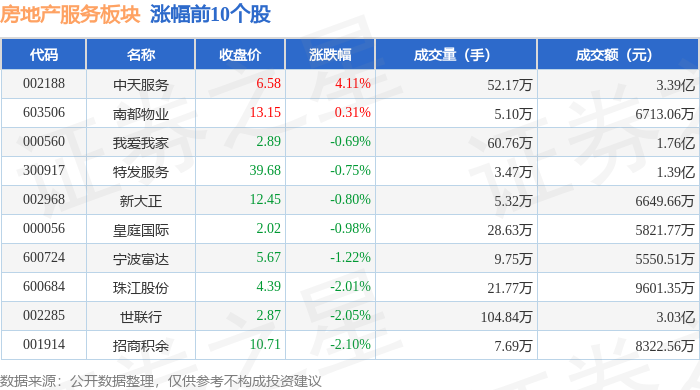
证券之星消息,12月30日房地产服务板块较上一交易日下跌1.25%,中天服务领跌。当日上证指数报收 于3965.12,下跌0.0%。深证成指报收于13604.07,上涨0.49%。房地产服务板块个股涨跌见下表: 从资金流向上来看,当日房地产服务板块主力资金净流出8158.45万元,游资资金净流出1960.5万元,散 户资金净流入1.01亿元。房地产服务板块个股资金流向见下表: | 代码 | 名称 | 主力净流入(元) | 主力净占比 游资净流入 (元) | | 游资净占比 散户净流入 (元) | | 散户净占比 | | --- | --- | --- | --- | --- | --- | --- | --- | | 600724 宁波富达 | | = 200.61万 | 3.32% | -19.17万 | -0.32% | -181.44万 | -3.00% | | 600684 珠江股份 | | 43.91万 | 0.60% | 249.78万 | 3.42% | -293.69万 | -4.02% | | 000056 皇庭国际 | | 17.51万 | 0.41% | 24.81万 | 0.58% | ...


房地产服务板块12月29日跌1.27%,ST明诚领跌,主力资金净流出5593.79万元
Zheng Xing Xing Ye Ri Bao· 2025-12-29 09:06
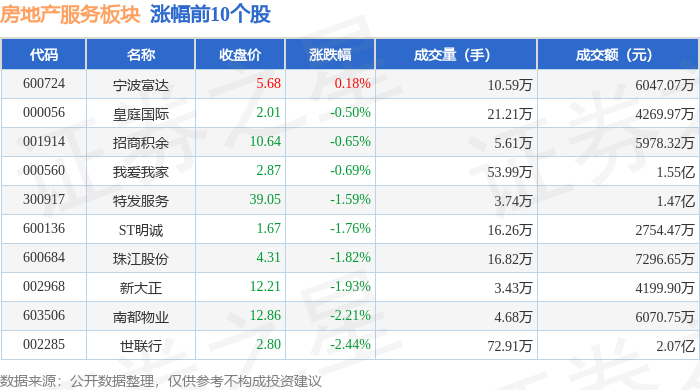
Market Overview - The real estate service sector declined by 1.27% compared to the previous trading day, with ST Mingcheng leading the decline [1] - The Shanghai Composite Index closed at 3965.28, up 0.04%, while the Shenzhen Component Index closed at 13537.1, down 0.49% [1] Individual Stock Performance - Zhongtian Service (002188) closed at 6.58, up 4.11% with a trading volume of 521,700 shares and a transaction value of 339 million [1] - Nandu Property (603506) closed at 13.15, up 0.31% with a trading volume of 51,000 shares and a transaction value of 6.71 million [1] - Wo Ai Wo Jia (000560) closed at 2.89, down 0.69% with a trading volume of 607,600 shares and a transaction value of 176 million [1] - Other notable declines include ST Mingcheng (600136) down 2.86% and Zhujiang Co. (600684) down 2.01% [2] Capital Flow Analysis - The real estate service sector experienced a net outflow of 55.94 million from institutional investors, while retail investors saw a net inflow of 38.17 million [2] - The overall capital flow indicates a mixed sentiment, with institutional investors pulling back while retail investors are more active [2] Detailed Capital Flow by Stock - Zhongtian Service had a net outflow of 22.80 million from institutional investors, while retail investors contributed a net inflow of 18.54 million [3] - ST Mingcheng saw a significant net outflow of 3.50 million from institutional investors, but retail investors contributed a net inflow of 3.88 million [3] - Other stocks like Zhujiang Co. and Ningbo Fuda also experienced notable net outflows from institutional investors, indicating a cautious approach from larger players [3]


贝壳-W斥资600万美元回购股份
Jin Rong Jie· 2025-12-29 00:33
Core Viewpoint - Beike-W announced a share repurchase plan, indicating confidence in its stock value and future prospects [1] Group 1: Share Repurchase Details - The company will spend $3 million to repurchase 557,900 shares on December 24, 2025 [1] - An additional $3 million will be used to repurchase 556,600 shares on December 26, 2025 [1]
股票行情快报:皇庭国际(000056)12月26日主力资金净买入98.36万元
Sou Hu Cai Jing· 2025-12-26 12:52
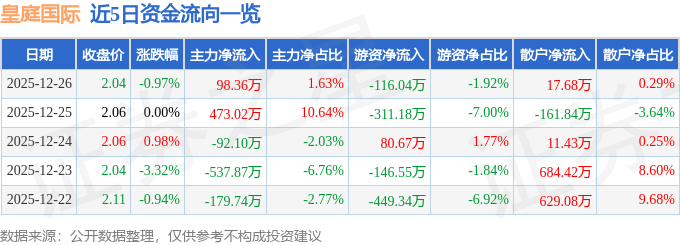
Core Viewpoint - The stock of Huangting International (000056) has shown a decline in price and mixed capital flow, indicating potential challenges in its market performance and investor sentiment [1][2]. Group 1: Stock Performance - As of December 26, 2025, Huangting International closed at 2.04 yuan, down 0.97% with a turnover rate of 3.26% and a trading volume of 294,300 hands, resulting in a transaction amount of 60.42 million yuan [1]. - Over the past five days, the stock has experienced fluctuations, with a notable drop of 3.32% on December 23, 2025, and a significant increase in trading volume on December 26 [2]. Group 2: Capital Flow Analysis - On December 26, 2025, the net inflow of main funds was 983,600 yuan, accounting for 1.63% of the total transaction amount, while retail investors saw a net inflow of 176,800 yuan, representing 0.29% [1][2]. - In contrast, the net outflow of speculative funds was 1,160,400 yuan, which constituted 1.92% of the total transaction amount, indicating a lack of confidence from speculative investors [2]. Group 3: Financial Metrics and Industry Comparison - Huangting International's total market value is 2.412 billion yuan, significantly lower than the industry average of 4.871 billion yuan, ranking 20th in the real estate service sector [3]. - The company reported a net profit of -2.444 billion yuan, which is a substantial decline compared to the industry average of -246 million yuan, also ranking 20th [3]. - The gross profit margin stands at 26.81%, which is above the industry average of 17.92%, ranking 5th in the sector [3]. - For the first three quarters of 2025, the company achieved a main revenue of 3.311 billion yuan, a year-on-year increase of 533.48%, but the net profit decreased by 834.48% to -2.444 billion yuan [3].

贝壳荣获第十四届金融界“金智奖”ESG践行卓越案例,以责任担当赋能新居住高质量升级
Jin Rong Jie· 2025-12-26 11:06
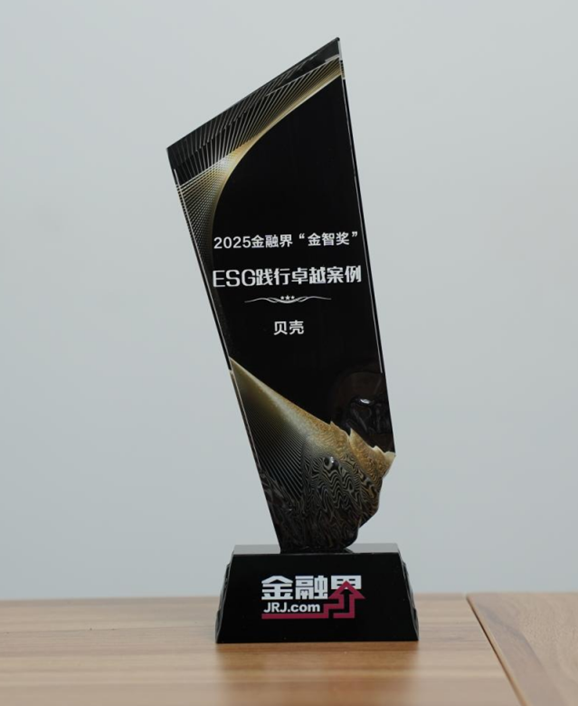
Group 1 - The "Qihang·2025 Financial Summit" was successfully held in Beijing on December 26, focusing on the theme of "New Starting Point, New Momentum, New Journey," gathering hundreds of leaders and guests from various sectors including regulatory bodies, industry associations, financial institutions, listed companies, and media [1] - The 14th "Golden Wisdom Award" results were announced, with Beike winning the "ESG Practice Excellence Case" for its outstanding performance in upgrading service quality in the new housing industry, talent training and development, low-carbon initiatives, and community welfare [1][4] - The award aims to set a benchmark for high-quality development and encourage listed companies to focus on their core business, innovate, and fulfill social responsibilities, aligning with the national strategy of the "14th Five-Year Plan" [3][4] Group 2 - The 2025 ESG Excellence Case awardees have made significant achievements in environmental sustainability, social value creation, and corporate governance optimization [4] - Beike has been recognized for its long-term commitment to ESG principles, having published ESG reports for five consecutive years, which have become an important measure of high-quality development in the real estate industry [4] - Beike's initiatives include green operations and community welfare, leveraging digital technology to promote low-carbon transformation in housing services and connecting residents with service providers [4][5] Group 3 - In the community service sector, Beike's "I Teach You to Use a Mobile Phone" project has become a notable feature of its community welfare efforts, training approximately 1.3 million elderly individuals across 130 cities since its launch in 2018 [5] - The project has conducted over 90,000 classes, showcasing Beike's commitment to social responsibility and its contribution to the industry ecosystem [5]
房地产服务板块12月26日跌0.11%,世联行领跌,主力资金净流出3770.53万元
Zheng Xing Xing Ye Ri Bao· 2025-12-26 09:07
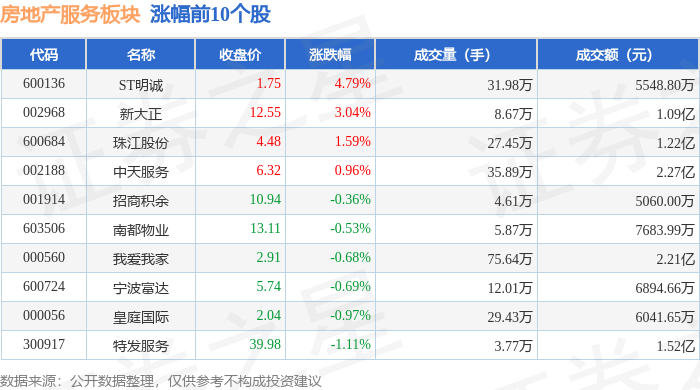
Core Viewpoint - The real estate service sector experienced a slight decline of 0.11% on December 26, with Shijie Holdings leading the drop [1] Group 1: Market Performance - The Shanghai Composite Index closed at 3963.68, up 0.1% [1] - The Shenzhen Component Index closed at 13603.89, up 0.54% [1] - The real estate service sector stocks showed mixed performance, with notable gainers and losers [1] Group 2: Individual Stock Performance - ST Mingcheng (600136) rose by 4.79% to close at 1.75, with a trading volume of 319,800 shares [1] - New Dazheng (002968) increased by 3.04% to 12.55, with a trading volume of 86,700 shares [1] - Zhujiang Shares (600684) gained 1.59% to 4.48, with a trading volume of 274,500 shares [1] - Shijie Holdings (002285) fell by 2.01% to 2.93, with a trading volume of 965,500 shares [2] - Other notable declines included Wangting International (000056) down 0.97% and I Love My Home (000560) down 0.68% [2] Group 3: Capital Flow - The real estate service sector saw a net outflow of 37.71 million yuan from institutional investors, while retail investors contributed a net inflow of 24.89 million yuan [2] - Zhujiang Shares had a net inflow of 10.24 million yuan from institutional investors, while New Dazheng experienced a net outflow of 1.54 million yuan [3] - I Love My Home faced a significant net outflow of 18.58 million yuan from institutional investors [3]


世联行:截至2025年12月19日公司股东人数为69871户
Zheng Quan Ri Bao Wang· 2025-12-25 10:43
Group 1 - The core point of the article is that the company, Shilianhang (002285), reported a total of 69,871 shareholders as of the market close on December 19, 2025 [1]
房地产服务板块12月25日涨0.04%,新大正领涨,主力资金净流出6356.11万元
Zheng Xing Xing Ye Ri Bao· 2025-12-25 09:08
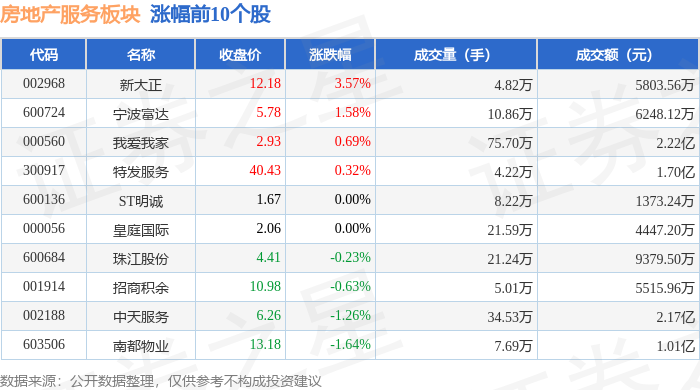
Group 1 - The real estate service sector increased by 0.04% on December 25, with Xin Dazheng leading the gains [1] - The Shanghai Composite Index closed at 3959.62, up 0.47%, while the Shenzhen Component Index closed at 13531.41, up 0.33% [1] - Key stocks in the real estate service sector showed varied performance, with Xin Dazheng rising by 3.57% to a closing price of 12.18 [1] Group 2 - The main funds in the real estate service sector experienced a net outflow of 63.56 million yuan, while retail investors saw a net inflow of 41.84 million yuan [2] - The trading volume and turnover for major stocks in the sector varied, with Wo Ai Wo Jia recording a turnover of 222 million yuan [2] - The net inflow of retail funds was significant for several stocks, indicating a mixed sentiment among investors [3]

股市“四辩”︱2026年重阳投资策略报告
Xin Lang Cai Jing· 2025-12-25 03:51
Core Viewpoint - The Chinese stock market is expected to rebound strongly in 2025, with the Shanghai Composite Index reaching a ten-year high, while the market structure remains highly differentiated. The outlook for 2026 involves identifying new opportunities through various debates [1][30]. Future Debate - China is unlikely to follow Japan's path of economic stagnation, primarily due to its superior innovation capabilities and irreplaceability in the global market. The market perception has shifted from being "uninvestable" to having "strategic allocation value" [5][9][10]. Allocation Debate - The incremental funds for the stock market are derived from asset reallocation by residents and financial institutions in a low-interest-rate environment. The real estate market has transitioned from being a source of capital diversion to a driving force for the stock market, marking a historical first [11][40]. - High-net-worth individuals and insurance funds are the main drivers of this asset reallocation, which is characterized by a rational and gradual approach rather than a speculative rush [12][41]. Current Debate - The expectations for AI capital expenditure are high, as AI is seen as a significant technological revolution. However, the industry faces challenges in reconciling high profit margins with the need for substantial capital investment, which may impact the pace of capital expenditure [17][23]. Strategy Debate - The market outlook for 2026 remains positive, but investors should temper their return expectations. The strategy focuses on defensive counterattacks and seeking alpha opportunities in technology and advanced manufacturing sectors, while also exploring contrarian investments in consumer, military, and real estate sectors [24][32][26].

太平洋房地产日报:北京市优化调整住房限购政策-20251224
Tai Ping Yang Zheng Quan· 2025-12-24 15:25
Investment Rating - The industry rating is optimistic, expecting overall returns to exceed the CSI 300 index by more than 5% in the next six months [11] Core Insights - The report highlights that the real estate sector is experiencing a positive market trend, with the Shanghai Composite Index and Shenzhen Composite Index rising by 0.53% and 1.04% respectively on December 24, 2025 [3] - The report notes significant individual stock performances, with top gainers including Hualian Holdings (up 9.95%) and Daming City (up 5.78%), while notable decliners include Zhongtian Services (down 3.06%) and Sanxiang Impression (down 2.05%) [4] - Recent policy adjustments in Beijing aim to optimize housing purchase conditions, including reduced social security or tax payment requirements for non-local families and support for multi-child families in purchasing additional properties [7][8] Market Performance - On December 24, 2025, the real estate sector index rose by 0.67%, indicating a positive sentiment in the market [3] - Chengdu successfully sold seven residential land parcels for a total of 1.494 billion yuan, while Zhengzhou sold three residential plots for a total of 1.025 billion yuan, reflecting active land transaction activities [5][6] Policy Changes - The Beijing government has implemented new housing purchase policies effective December 24, 2025, which include easing restrictions for non-local families and enhancing support for families with multiple children [7][8]