智能汽车

Search documents
三力齐发 助中国科技勇立潮头
Zheng Quan Ri Bao· 2026-01-06 23:31
Core Viewpoint - The International Consumer Electronics Show (CES) showcases China's technological advancements, highlighting a transition from "smart creation" to "ecological leadership" in the tech industry [1] Group 1: Technological Advancements - The exhibition features next-generation personal terminals with multi-modal interaction capabilities and embodied intelligent robots entering homes and businesses [1] - Smart vehicles are transforming driving experiences and reshaping human-vehicle relationships, while core computing chips and advanced solutions empower various industries [1] - Chinese tech companies are evolving from mere technology integrators to global leaders, launching defining technological architectures and open platforms [1] Group 2: Key Dimensions for Future Growth - Strengthening foundational research and frontier exploration is essential for maintaining a competitive edge in global technology, particularly in artificial intelligence, quantum information, and life sciences [2] - Enhancing the resilience and collaboration of the industrial chain is crucial, focusing on upgrading to high-end, intelligent, and green manufacturing, while addressing gaps in key components and advanced materials [2] - Optimizing capital supply to support technological innovation involves fostering "patient capital," ensuring smooth capital circulation, and enhancing global investment capabilities [2] Group 3: Future Outlook - The trajectory from "Made in China" to "Created in China" and now to "Leading in China" indicates a clear upward trend, positioning Chinese technology to significantly contribute to global economic development [3]
今日视点:三力齐发 助中国科技勇立潮头
Xin Lang Cai Jing· 2026-01-06 23:07
Core Viewpoint - The International Consumer Electronics Show (CES) showcases China's technological advancements, highlighting a transition from "smart creation" to "ecological leadership" in the tech industry [1][4]. Group 1: Technological Advancements - The exhibition features next-generation personal terminals with deep integration of artificial intelligence and multi-modal interaction capabilities [1][4]. - The emergence of embodied intelligent robots with autonomous perception and decision-making abilities marks their entry into both household and commercial applications [1][4]. - Smart vehicles and platforms are reshaping driving experiences and human-vehicle relationships, while core computing chips and advanced solutions empower various industries [1][4]. Group 2: Industry Development Strategies - Strengthening foundational research and frontier exploration is essential for maintaining a competitive edge in global technology, particularly in areas like artificial intelligence, quantum information, and life sciences [2][5]. - Enhancing the resilience and collaboration of the industrial chain is crucial, focusing on upgrading to high-end, intelligent, and green manufacturing, while addressing gaps in key components and advanced industrial software [2][5]. - Optimizing capital supply to support technological innovation involves fostering "patient capital," ensuring smooth capital circulation for core technology enterprises, and enhancing global investment capabilities [2][5]. Group 3: Future Outlook - The trajectory from "Made in China" to "Created in China" and now to "Leading China" indicates a clear upward trend in innovation, positioning China to contribute significantly to global economic development [3][6].
小米公关紧急道歉!雷军评论区彻底沦陷了
Sou Hu Cai Jing· 2026-01-06 15:35
Core Viewpoint - The article discusses the recent public relations challenges faced by Xiaomi, highlighting the tension between the company's marketing strategies and its relationship with loyal customers, particularly in light of controversies surrounding product issues and public statements made by the company [2][14]. Group 1: Public Relations and Marketing Strategies - Xiaomi's recent marketing efforts, including collaborations with influencers who have previously criticized the brand, have sparked backlash among its loyal customer base, raising concerns about the company's understanding of its core audience [14]. - The company's approach to addressing product-related issues, such as the "7000 legal issues" and "instant brake failures," has been perceived as insufficient, leading to a growing trust crisis among consumers [2][14]. - The article emphasizes the importance of transparent communication in public relations, suggesting that the company's recent actions may exacerbate existing dissatisfaction rather than resolve it [14]. Group 2: Industry Context and Consumer Sentiment - The article notes a shift in consumer sentiment towards brands, influenced by the rise of AI and changing perceptions of authenticity, which may affect how companies like Xiaomi engage with their audiences [3]. - There is a growing concern that the current marketing landscape, characterized by aggressive pursuit of online traffic, can lead to unintended negative consequences for brands, including the emergence of "black public relations" tactics [3]. - The discussion highlights the need for companies to balance marketing strategies with genuine engagement and support for their loyal customers, as failure to do so can lead to significant reputational damage [14].


智能汽车ETF大涨点评
Mei Ri Jing Ji Xin Wen· 2026-01-06 14:11
Core Viewpoint - The A-share market experienced a collective rise, with major indices showing significant gains, driven by advancements in the intelligent driving sector and the introduction of new technologies by Nvidia [1][2][4]. Market Performance - The Shanghai Composite Index rose by 1.50% - The Shenzhen Component Index increased by 1.40% - The ChiNext Index saw a rise of 0.75% - The North Star 50 Index climbed by 1.82% - Total market turnover reached 2.83 trillion yuan, showing an increase compared to the previous day [1]. Intelligent Driving Sector - The intelligent driving sector saw a notable surge, with the Intelligent Vehicle ETF (159889) rising by 4.16% in the afternoon session [2]. - Nvidia's CEO Jensen Huang announced the Alpamayo platform at CES, which enables vehicles to perform "reasoning" in real-world scenarios, with the first car featuring this technology expected to hit the roads in the U.S. in Q1 [4]. - The Alpamayo family integrates open-source models, simulation frameworks, and datasets, creating a comprehensive ecosystem for automotive developers [4]. Technological Advancements - Alpamayo 1 is the first reasoning VLA model designed for the autonomous driving research community, capable of handling complex driving scenarios and providing solutions in unexpected situations [4]. - Huang emphasized that the era of "physical AI" has arrived, allowing machines to understand and reason in real-world environments, which is foundational for safe and scalable autonomous driving [4]. Industry Outlook - The open-source nature of Nvidia's model is expected to significantly lower the barriers for algorithm development in intelligent driving solutions, accelerating the penetration of advanced driving technologies [5]. - Tesla's Robotaxi is nearing the stage of unsupervised operation, with plans for testing in Austin, indicating advancements in L4 automation capabilities [5]. - The Chinese Ministry of Industry and Information Technology has granted approval for the first batch of L3 autonomous driving vehicles, marking a transition from testing to early commercialization [5]. Future Projections - The entry of major players and the anticipated rollout of Tesla's FSD in China, along with the expansion of L3 policies, are expected to catalyze growth in the autonomous driving sector by 2026 [6]. - Investors are encouraged to monitor the Intelligent Vehicle ETF (159889) in A-shares and the Hong Kong Vehicle ETF (520720) for potential investment opportunities [6].


告别2025!业内头部公司2025年硬核工作总结(地平线/理想/英伟达等)
自动驾驶之心· 2026-01-06 09:17
Core Insights - The article discusses the evolution of autonomous driving technology in 2025, marking a transition from research to practical implementation, with significant advancements in various technical areas [2][3]. Group 1: Industry Trends - The year 2025 is characterized as a turning point for autonomous driving, with technologies like BEV perception, multi-sensor fusion, and trajectory prediction reaching maturity [2]. - The competition in the smart electric vehicle sector is intensifying, with companies like Horizon, Xiaomi, and Li Auto making notable advancements [4][22]. Group 2: Company Highlights - Horizon has made significant strides with its HSD technology, showcasing high potential in end-to-end solutions and innovative approaches like GoalFlow and ResAD [9]. - Xiaomi's autonomous driving development has rapidly progressed, with a team exceeding 1000 members and a series of iterative improvements leading to the release of HAD enhanced version [10][11]. - Li Auto has established itself in the domestic autonomous driving tier, although it faces challenges in transitioning from range-extended to pure electric vehicles [13]. - Xiaopeng Motors experienced a rebound in sales, doubling its volume to nearly 430,000 units in 2025, driven by the successful launch of VLA 2.0 technology [14]. - Bosch is actively investing in both research and production lines, focusing on end-to-end solutions and enhancing its engineering capabilities [16]. Group 3: Future Outlook - The competition in the smart electric vehicle market is expected to become more fierce in 2026, with a shift towards L3 and L4 autonomous driving technologies gaining traction [22][23].


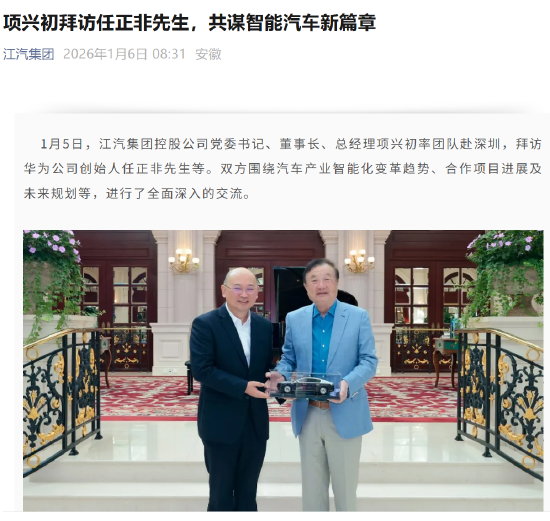
江汽集团项兴初赴深拜访华为任正非,共谋智能汽车新篇章
Xin Lang Cai Jing· 2026-01-06 05:44
Core Viewpoint - Jiangqi Group is enhancing its collaboration with Huawei to drive the intelligent transformation of the automotive industry and promote high-quality development in the new energy vehicle sector [1][4]. Group 1 - Jiangqi Group's Chairman and General Manager, Xiang Xingchu, led a team to Shenzhen to meet with Huawei's founder, Ren Zhengfei, to discuss trends in automotive industry intelligence and the progress of their cooperation projects [1][4]. - The discussions included a comprehensive exchange on future planning and the expansion of cooperation areas, particularly in automotive intelligence and enterprise digitalization [1][4]. - Jiangqi Group aims to inject new momentum into the construction of a strong automotive nation in China through this partnership [1][4].

新能源板块迎多重催化,智能汽车ETF(515250)盘中涨幅达3.79%
Mei Ri Jing Ji Xin Wen· 2026-01-06 05:32
Core Viewpoint - The A-share market indices collectively rose, with significant activity in sectors such as lithium mining, low carbon, and lithium batteries, driven by government initiatives to promote green consumption and support for the electric vehicle industry [1] Group 1: Market Performance - The smart car ETF (515250) saw an intraday increase of 3.79%, while the Sci-Tech Innovation Board New Energy ETF (588960) rose by 3.16% [1] - Several stocks within the smart car ETF, including Beidou Xingtong, Zhejiang Sebao, Lianchuang Electronics, and Desay SV, reached their daily limit [1] Group 2: Government Initiatives - A notice from the Ministry of Commerce and nine other departments was released on January 5, promoting green consumption and supporting the purchase of new energy vehicles, as well as strengthening the automotive supply chain [1] - The first national standard for solid-state batteries, titled "Solid-State Batteries for Electric Vehicles Part 1: Terms and Classification," is currently open for public consultation [1] Group 3: Market Forecast - According to the China Passenger Car Association, the sales volume of new energy passenger vehicles in China is expected to grow by approximately 25% by 2025 [1] - Preliminary monthly data estimates that cumulative wholesale sales of new energy passenger vehicles will reach 15.33 million units by 2025, representing a year-on-year increase of 25% [1] Group 4: Index Tracking - The smart car ETF (515250) closely tracks the CSI Smart Car Theme Index (930721), which selects companies providing terminal perception and platform applications for smart cars, as well as other representative A-shares benefiting from the smart car industry [1]
智能汽车ETF(159889)涨超1.4%,政策与技术双轮驱动成焦点
Mei Ri Jing Ji Xin Wen· 2026-01-05 23:59
Core Insights - The smart car ETF (159889) rose over 1.4% on January 5, driven by both policy and technological advancements [1] - The automotive industry policy in 2026 will focus on reducing competition and continuing national subsidies, with over five cities publicly selecting platforms for trade-in services [1] - The National Development and Reform Commission emphasizes supply chain governance for the new energy vehicle industry, ensuring payment to small and medium enterprises [1] Policy and Subsidy - The high-level government has clarified the optimization of the "two new" policy, with Shenzhen already selecting platform service companies for 2026 [1] - Despite the pressure from the reduction of new energy vehicle purchase tax exemptions, trade-in subsidies are expected to continue supporting sales [1] - The focus on reducing internal competition will limit disorderly price cuts, potentially improving the profitability of car manufacturers [1] Market Trends - Industry data indicates that by November 2025, the retail penetration rate of new energy passenger vehicles will reach 59.4%, with L2.5 and above intelligent driving penetration at 32.19% [1] - The trend towards intelligence and electrification in the automotive sector continues to strengthen [1] - Beijing has issued the first batch of L3-level special license plates for highway autonomous driving, marking the entry of autonomous driving into mass production [1] ETF and Index Information - The smart car ETF (159889) tracks the CS Smart Car Index (930721), which selects listed companies involved in terminal perception and platform applications related to smart cars [1] - The index covers multiple industries, including electronics, computers, and automobiles, to reflect the overall performance of China's smart car industry chain [1]
北京亦庄打造一流营商环境 22个重点项目签约落地
Zhong Guo Xin Wen Wang· 2026-01-05 14:07
Group 1 - The core focus of the news is the signing of 22 key projects in Beijing Economic-Technological Development Area, with over 80% of these projects being future industry initiatives [1][2] - The development strategy during the "14th Five-Year Plan" period aims to establish a robust ecosystem that enhances economic quality, urban appearance, and public welfare [1] - Notable projects include Baichang Intelligent Automotive's plan to establish a vehicle manufacturing company targeting L4 autonomous driving vehicles, with projected revenues reaching billions by 2030 [1] Group 2 - The AI sector is emphasized, with over 30% of the signed projects focusing on artificial intelligence, including ZTE's development of a 6G satellite payload production line [2] - The ten benchmark projects initiated include a biopharmaceutical raw material base by Sanofi, which will create a complete insulin production chain locally [2] - The development plan includes significant investments in urban infrastructure and ecological governance, reflecting a shift towards comprehensive regional development [2] Group 3 - The development strategy prioritizes talent and human creativity, with plans for enhanced living conditions, entrepreneurial support, and educational facilities [3] - The "2026 Ten Plans for Optimizing the Business Environment" aims to create a conducive environment for new productive forces, focusing on foundational improvements and innovation [3] - The future vision for the economic zone includes accelerated technological innovation, improved living standards, and enhanced integration of industry and urban development [3]

【智能汽车主线周报】特斯拉FSD V14无接管横穿美国,看好智能化
东吴汽车黄细里团队· 2026-01-05 13:30
Market Overview - The smart car index decreased by 6.2%, while the index excluding Tesla increased by 0.2%. As of December 31, 2025, the smart car index PS (TTM) is 14.1x, ranking in the 96th percentile since the beginning of 2023. The index excluding Tesla has a PS (TTM) of 6.4x, ranking in the 90th percentile since the beginning of 2023 [4][12][17]. Industry Core Changes - Pony.ai's Robotaxi fleet has surpassed 1,159 vehicles, exceeding the target of 1,000 Robotaxis by 2025. Tesla's FSD version 14.2 completed a 2-day, 20-hour journey across the U.S. without human intervention [6][12][21]. Investment Recommendations - The company maintains a strong outlook for the L4 RoboX theme in 2026, favoring B-end software stocks over C-end hardware stocks. Preferred H-shares include Xpeng Motors, Horizon Robotics, Pony.ai, WeRide, and Cao Cao Mobility. A-shares recommendations include Qianli Technology, Desay SV, and Jingwei Hirain [6][12][21]. Downstream Application Targets - For Robotaxi perspectives, the integrated model includes Tesla and Xpeng Motors, while the technology provider and operational sharing model includes Horizon Robotics, Baidu, Pony.ai, WeRide, and Qianli Technology. The transformation of ride-hailing and taxi services involves Didi, Cao Cao Mobility, Ruqi Mobility, and others [6][12][21]. Upstream Supply Chain Targets - Key targets in the B-end unmanned vehicle OEM sector include BAIC BluePark, GAC Group, Jiangling Motors, and others. Core upstream suppliers include testing services (China Automotive Research), chips (Horizon Robotics, Black Sesame Technology), domain controllers (Desay SV, Jingwei Hirain), sensors (Sunny Optical Technology, Hesai Technology), and others [6][12][21].