
汽车制造业

Search documents
2025年机械工业成绩单:产销形势好于上年,利润增速由降转增
2 1 Shi Ji Jing Ji Bao Dao· 2026-02-05 13:56
Core Viewpoint - The mechanical industry in China is projected to experience significant growth in 2025, with an increase in added value and production across various sectors, despite facing challenges such as price declines and structural supply-demand issues [1][3][4]. Group 1: Economic Performance - In 2025, the added value of large-scale mechanical enterprises is expected to grow by 8.2%, surpassing the national industrial and manufacturing growth rates by 2.3 and 1.8 percentage points respectively [1]. - The automotive manufacturing sector is anticipated to lead with a growth rate of 11.5%, while electrical machinery and general equipment manufacturing are expected to grow by 9.2% and 8.0% respectively [1]. - The overall production and sales situation in the mechanical industry is expected to improve, with 85 out of 122 monitored mechanical products showing year-on-year production growth, an increase of 13 products from the previous year [1]. Group 2: Key Product Performance - The automotive sector is projected to achieve record production and sales, with an output of 34.53 million vehicles and sales of 34.40 million vehicles, reflecting year-on-year growth of 10.4% and 9.4% respectively [2]. - Electrical and electronic products are expected to see significant production increases, with generator sets reaching 370 million kilowatts (up 37.6%) and solar cells at 830 million kilowatts (up 7.6%) [2]. - The production of industrial robots is forecasted to rise by 28.0%, reaching a new high of 773,000 units [2]. Group 3: Revenue and Profit - In 2025, the mechanical industry is projected to achieve a total revenue of 33.2 trillion yuan, marking a record high with a year-on-year growth of 6.0%, outpacing the national industrial growth rate by 4.9 percentage points [2]. - The total profit for large-scale mechanical enterprises is expected to reach 1.7 trillion yuan, with a year-on-year growth of 5.9%, reversing the previous year's decline [2]. Group 4: Challenges and Opportunities - The mechanical industry faces ongoing challenges, including a continuous decline in product prices, with a 1.5% year-on-year decrease in December 2025, marking 35 consecutive months of price declines [3]. - The industry is also experiencing a drop in profit margins, with a revenue profit margin of 5.14%, down 0.04 percentage points from the previous year [3]. - Despite these challenges, favorable conditions for high-quality development are accumulating, including supportive macroeconomic policies and a stable traditional market [4]. - The industry is expected to benefit from the ongoing technological revolution and the deepening of globalization, with leading companies enhancing their competitive edge in the global market [4].
机械工业经济运行稳中向好“向新+向优” 2026年有望继续保持平稳运行
Yang Shi Wang· 2026-02-05 13:06
Core Insights - The mechanical industry in China is experiencing stable growth supported by various government policies, with a notable increase in production and sales in 2025 [1][3][5] Group 1: Economic Performance - In 2025, the added value of large-scale enterprises in the mechanical industry grew by 8.2% year-on-year, surpassing the national industrial and manufacturing growth rates by 2.3 and 1.8 percentage points respectively [1] - The automotive manufacturing sector continues to lead the industry with a growth rate of 11.5% [1] - Among 122 monitored mechanical products, 85 showed year-on-year production growth, an increase of 13 products compared to 2024 [3] Group 2: Trade Performance - The total import and export value of the mechanical industry reached $1.27 trillion in 2025, marking an 8.4% year-on-year increase [5] Group 3: Future Outlook - Experts predict that favorable conditions for high-quality development in the mechanical industry are accumulating, suggesting continued stable operation and reasonable growth in 2026 [7] - The mechanical industry is expected to maintain a stable growth rate of around 5.5% for major indicators in 2026, driven by policies aimed at stabilizing growth and promoting transformation [9]

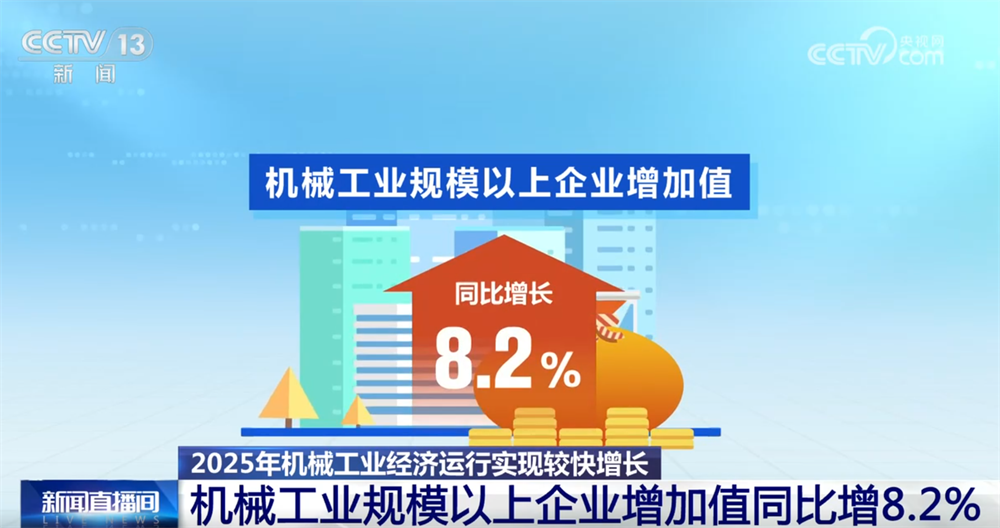
2025年机械工业运行稳中向好
Yang Shi Wang· 2026-02-05 12:20
Core Viewpoint - The China Machinery Industry Federation reported that by 2025, the value added of large-scale enterprises in the machinery industry is expected to grow by 8.2% year-on-year, outpacing the national industrial and manufacturing growth rates by 2.3 and 1.8 percentage points respectively [1] Group 1: Industry Growth - The automotive manufacturing sector continues to lead with a growth rate of 11.5% [1] - The value added in five major categories of the national economy, including automotive manufacturing, electrical machinery manufacturing, general equipment manufacturing, specialized equipment manufacturing, and instrumentation manufacturing, all achieved growth [1] Group 2: Trade Performance - The machinery industry's foreign trade demonstrated strong resilience, with total import and export volume reaching $1.27 trillion, marking a year-on-year increase of 8.4% and setting a historical record [1]
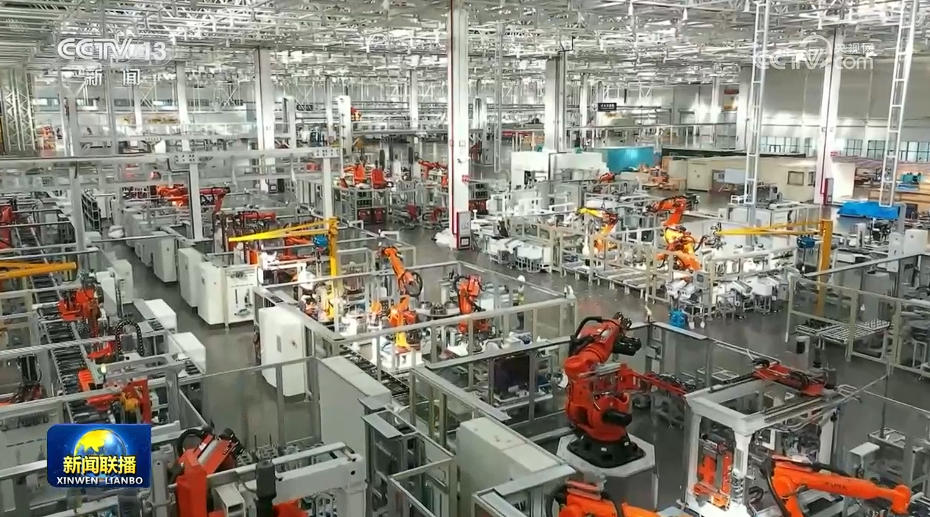
机械工业利好增多!多项指标“答卷”亮眼
券商中国· 2026-02-05 12:10
Core Viewpoint - The mechanical industry in China is expected to experience a stable growth trajectory in 2025, with key indicators showing positive trends despite challenges in the market [1][2]. Group 1: Economic Performance - In 2025, the added value of large-scale enterprises in the mechanical industry is projected to grow by 8.2% year-on-year, surpassing the national industrial and manufacturing growth rates by 2.3 and 1.8 percentage points respectively [1][2]. - The total operating revenue for the mechanical industry is expected to reach 33.2 trillion yuan, marking a record high with a year-on-year increase of 6.0%, which is 4.9 percentage points higher than the national industrial average [2]. - The total profit is anticipated to be 1.7 trillion yuan, reversing the previous year's decline with a year-on-year growth of 5.9%, outpacing the national industrial growth by 5.3 percentage points [2]. Group 2: Sector Performance - The automotive manufacturing sector continues to lead with a growth rate of 11.5%, while electrical machinery and general equipment manufacturing also show strong growth at 9.2% and 8.0% respectively [2]. - Among 122 monitored mechanical products, 85 showed a year-on-year increase in production, with a growth rate of 69.7% [2]. Group 3: Trade and External Factors - The mechanical industry achieved a total goods trade import and export volume of 1.27 trillion USD in 2025, reflecting a year-on-year growth of 8.4% [3]. - Exports to countries involved in the Belt and Road Initiative and RCEP members saw significant increases, with growth rates of 24.7% and 18.4% respectively [3]. Group 4: Investment Trends - Fixed asset investment in the mechanical industry is expected to decline by 2.3% year-on-year, a significant drop of 7.4 percentage points compared to the previous year [4]. - Investment in general equipment and automotive manufacturing remains positive, with growth rates of 6.2% and 11.7% respectively, while specialized equipment and electrical machinery sectors face declines [4]. Group 5: Challenges and Future Outlook - The mechanical industry faces challenges such as structural supply-demand contradictions and intense market competition, leading to a decrease in profit margins [3][5]. - The average collection period for accounts receivable has extended to 100.1 days, indicating cash flow issues within the industry [5]. - For 2026, the growth rate of key indicators is projected to be around 5.5%, supported by favorable macroeconomic policies and ongoing demand for high-end equipment and digital transformation [6].
安踏/波司登/美的/固特异等评委来了!「DT新叶奖」创新应用奖评委剧透!
合成生物学与绿色生物制造· 2026-02-05 11:58
Core Viewpoint - The 2026 DT New Leaf Award, known as the "Oscar" of the bio-based industry, is currently open for applications, with the first round of submissions ending on February 10, 2026, and the awards ceremony taking place at the 11th Bio-based Conference [2][14]. Group 1: Award Details - The DT New Leaf Award aims to recognize and promote innovative applications of bio-based materials and chemicals, focusing on their practical value in various industries [11][10]. - The award categories include Innovation Application Award, Innovation Material Award, Most Commercially Valuable Award, and Innovative Industry Solution Award, each with specific evaluation criteria [13][10]. - The evaluation process consists of an online voting phase and an expert review phase, with a total score of 100 points, where online votes account for 20 points and expert reviews for 80 points [13][12]. Group 2: Participating Companies and Experts - Over 30 companies, including Wanhua Chemical, Guanghua Weiye, and Lif Bio, have registered for the DT New Leaf Award [18]. - A panel of over 20 experts from various sectors, including sportswear, automotive, packaging, and home appliances, has been invited to judge the award submissions [3][4]. - Notable participants include Anta, which has launched a waterproof and breathable membrane with 20% bio-based content, and Midea, which is establishing a green supply chain using biodegradable materials [4][6][5]. Group 3: Application Scenarios and Sustainability - Bio-based materials are expected to provide higher added value, application adaptability, and feasibility for replacement, while also contributing to low-carbon sustainable practices [3]. - The award encourages the development of bio-based solutions that align with sustainability commitments from brands, promoting a circular economy [10][6].

欧盟强推“再生材料令”,中国车企出海需警惕“新门槛”
Guan Cha Zhe Wang· 2026-02-05 11:57
Core Viewpoint - The European Union (EU) is implementing new regulations aimed at promoting a circular economy in the automotive industry, focusing on the mandatory use of recycled materials in vehicle production and end-of-life management [1][2]. Regulation Overview - The new regulations will require a minimum of 15% recycled plastic in new vehicles within six years and 25% within ten years [2]. - At least 20% of the recycled plastic must come from end-of-life vehicles [3]. - The EU plans to introduce additional targets for recycled materials in steel, aluminum, magnesium, and other key materials after a feasibility study [3]. Industry Impact - The automotive sector is one of the most resource-intensive industries in the EU, consuming over 7 million tons of steel and 600 million tons of plastic annually [3]. - Current regulations have improved metal recycling rates but have only achieved a 19% recycling rate for plastics [3]. - The new regulations will impose additional responsibilities on automakers, including the costs associated with end-of-life vehicle recovery and stricter controls on illegal exports of scrapped vehicles [4]. Corporate Responses - BMW has begun integrating natural flax fiber composite materials into its production, aiming to reduce CO2 emissions by approximately 40% during manufacturing [5][6]. - Volkswagen plans to achieve a 40% recycled material usage rate in its vehicles by 2040, with some models already utilizing 100% recycled plastic from waste bottles [7]. - Toyota aims for a 30% recycled material usage rate by 2030, while Honda plans for 100% recyclable or sustainable materials by 2050 [7]. Challenges in Implementation - The automotive industry faces significant challenges in scaling the use of recycled materials due to performance and cost issues [9][10]. - The transition to using recycled materials requires extensive testing and development to meet safety and performance standards [9]. - The cost of bio-based materials remains a significant barrier, as they require high initial investment and may not be competitive until mass production is achieved [9]. Implications for Chinese Automakers - The new EU regulations will impact Chinese automakers' strategies for entering the European market, necessitating an accelerated adoption of recycled materials [11][12]. - Chinese companies currently face challenges in meeting EU standards for recycled material usage and certification [12]. - The evolving regulatory landscape in Europe will require a comprehensive restructuring of supply chains and material sourcing for automakers globally [12].
远景动力/海博思创/欣旺达/弗迪/因湃/蜂巢能源/汇川技术/中车时代等入围!工信部发布2025绿色工厂、绿色工业园区公示名单
中关村储能产业技术联盟· 2026-02-05 10:45
Core Viewpoint - The Ministry of Industry and Information Technology (MIIT) has released a public list of green factories and green industrial parks for the year 2025, highlighting the importance of sustainable development in the manufacturing sector [2]. Group 1: Green Factories and Industrial Parks - The list includes newly cultivated green factories and industrial parks, as well as those undergoing dynamic management adjustments, which were recommended by provincial industrial and information departments and reviewed by experts [4]. - Notable companies included in the list are Beijing Haibo Sichuang Technology Co., Ltd., Envision Energy Technology (Jiangsu) Co., Ltd., and Honeycomb Energy Technology Co., Ltd. [3][4]. Group 2: Contact Information and Public Notice - The public notice period for the list is from February 5, 2026, to February 19, 2026, during which any objections can be submitted to the MIIT [5]. - The contact unit for inquiries is the Energy Conservation and Comprehensive Utilization Department of the MIIT, with a provided contact number for further communication [5].






2025年中国机械工业规模以上企业增加值同比增长8.2%
Zhong Guo Xin Wen Wang· 2026-02-05 08:21
Core Viewpoint - In 2025, China's machinery industry is expected to see a significant increase in value-added output, driven primarily by the automotive manufacturing sector, which is projected to grow by 11.5% year-on-year [1][2]. Group 1: Industry Growth and Performance - The value-added output of China's machinery industry is projected to grow by 8.2% year-on-year in 2025, with all five major economic sectors involved in the machinery industry showing growth [1]. - The automotive manufacturing sector continues to lead the industry with a growth rate of 11.5%, while electrical machinery and general equipment manufacturing maintain a high growth level [1]. - The overall production and sales situation in the machinery industry is expected to improve compared to the previous year, with 85 out of 122 monitored major machinery products showing year-on-year production growth [1]. Group 2: Financial Metrics - The revenue of large-scale enterprises in the machinery industry is projected to reach 33.2 trillion yuan, marking a new high and a year-on-year increase of 6.0% [1]. - The total profit for the machinery industry is expected to be 1.7 trillion yuan, reversing the previous year's decline with a year-on-year growth of 5.9% [1]. - The machinery industry's total import and export trade is anticipated to reach 1.27 trillion USD, reflecting a year-on-year growth of 8.4% [1]. Group 3: Industry Indicators - The machinery industry prosperity index is expected to remain within a prosperous range throughout 2025, with an index of 104.3 at the end of the previous year, indicating a stable and positive economic operation [2]. - During the "14th Five-Year Plan" period, the average annual growth rate of value-added output for large-scale enterprises in the machinery industry is projected to be 7.4%, surpassing the national industrial growth rate by 1.5 percentage points [2]. - The number of large-scale enterprises in the machinery industry is expected to increase to 137,000, with an average annual growth of 8.3%, and total assets are projected to reach 42 trillion yuan, with an average annual growth of 8.8% [2].
捷豹路虎召回部分进口路虎揽胜、揽胜运动版系列汽车
Bei Jing Shang Bao· 2026-02-05 08:09
Group 1 - The core message is that Jaguar Land Rover (China) Investment Co., Ltd. has initiated a recall of certain imported 2025 models of Range Rover and Range Rover Sport due to a production assembly issue affecting the gear shift control module [1] - The recall affects a total of 16 vehicles produced between August 27, 2025, and August 29, 2025 [1] - The issue involves the gear position indicator light potentially failing to illuminate, which may prevent drivers from recognizing the vehicle's gear status, thereby increasing the risk of accidents [1] Group 2 - The company will provide free replacement of the gear shift control module for the affected vehicles to eliminate the safety hazard [1]
长安汽车拟10亿元至20亿元回购股份 1月全球交付170831辆
Zhong Zheng Wang· 2026-02-05 08:05
Group 1 - The company plans to repurchase shares using 1 to 2 billion yuan of its own funds, with a minimum of 700 million yuan and a maximum of 1.4 billion yuan for A-shares, and a minimum of 300 million yuan and a maximum of 600 million yuan for B-shares [1][2] - The repurchase is part of the company's strategic layout, aiming to achieve cumulative sales of 40 million vehicles by 2028 and an annual production and sales target of 5 million vehicles by 2030, positioning itself among the top ten global automotive brands [1] - The company expects its new energy vehicle sales to reach 1.109 million units by 2025, representing a year-on-year growth of 51.1%, and plans to launch 26 new products over the next three years, covering over 140 countries and regions [1] Group 2 - The repurchase reflects the company's confidence in its strategic outlook and intrinsic value, aiming to protect company value and shareholder rights, while addressing long-standing concerns about B-share liquidity [2] - In January, the company delivered 170,831 vehicles globally, with notable sales from the CS75 series and the Eado series, and significant contributions from its new energy segment [2] - The repurchase is expected to enhance earnings per share (EPS) and return on equity (ROE) by reducing share capital [2]
