
资本市场

Search documents
吴晓求:消费扩张需要深度重构三个核心函数
Xin Jing Bao· 2025-12-15 08:26
Core Insights - The "15th Five-Year Plan" aims for China's per capita GDP to reach the level of moderately developed countries by 2035, emphasizing the need for new economic growth drivers and ongoing financial reforms [1][14] - The transition from a "shortage economy" to a "surplus economy" necessitates a fundamental shift in governance logic, focusing on structural upgrades and technological advancements rather than mere scale expansion [4][18] Economic Characteristics - The "15th Five-Year" period will be characterized by significant historical changes, including a global technological revolution and a historic leap in China's economic structure [3][17] - The manufacturing sector's contribution to global value added is nearing 30%, maintaining the world's largest scale for 15 consecutive years, indicating strong supply-side capabilities [4][18] Consumption Dynamics - In a "surplus economy," consumption is viewed as a key force for maintaining economic balance, influenced by income, wealth, and social security [4][16] - Approximately 60% to 70% of household wealth is concentrated in real estate, leading to potential consumption contraction if property prices decline [5][19] Financial System Reform - The core task of financial reform during the "15th Five-Year" period is to adapt to the transition from a shortage to a surplus economy through innovation and openness [7][22] - There is a need for a robust, liquid, and high-credit-rated government bond market, which is essential for the internationalization of the RMB and the establishment of an international financial center [9][24] Capital Market Evolution - The capital market is expected to play a pivotal role in the economic ecosystem, transitioning from a financing market to an investment market that provides wealth management functions [10][25] - Enhancing the quality of listed companies is crucial, as they are the foundation of the capital market, and a strict delisting system is necessary to ensure market health [11][26] Regulatory Environment - A transparent regulatory framework is vital for rebuilding the capital market ecosystem, with a focus on increasing penalties for fraudulent activities to restore investor confidence [12][27] - The government should prioritize social security and public services over industrial investment funds to effectively release consumer purchasing power [6][21]


证监会:启动实施深化创业板改革,加快科创板“1+6”改革举措落地
Zheng Quan Shi Bao Wang· 2025-12-15 04:34
Core Viewpoint - The China Securities Regulatory Commission (CSRC) is focusing on enhancing the attractiveness and inclusivity of the capital market through various reforms and initiatives [1] Group 1: Reform Initiatives - The CSRC is initiating the deepening of the Growth Enterprise Market (GEM) reforms and accelerating the implementation of the "1+6" reform measures for the Sci-Tech Innovation Board [1] - There is a push for the high-quality development of the private equity fund industry and the prompt launch of commercial real estate REITs pilot projects [1] - The CSRC is also researching the introduction of new key futures varieties [1] Group 2: Investment Institutions - The meeting emphasized the importance of fostering high-quality investment banks and investment institutions while limiting underperformers [1] Group 3: Market Openness - The CSRC aims to steadily expand institutional openness by optimizing the Qualified Foreign Institutional Investor (QFII) system and the mutual market access mechanism, enhancing the efficiency of overseas listing filings [1]

以深化资本市场投融资改革为高质量发展注入新动能
Jin Rong Shi Bao· 2025-12-15 03:29
投资端改革的核心,在于吸引并培育更多长期、稳定、专业的机构投资者,改善投资者结构,强化市场 内在稳定机制,推动资本市场从"规模扩张"向"质量提升"转变。 当前,以社保基金、保险资金、国家级产业基金等为代表的"长钱""稳钱"正成为市场中坚力量。数据显 示,在私募创投市场中,国资背景的资本占比已近八成,充分发挥着市场"压舱石"的作用,这些资金存 续期长、秉持长期价值投资理念,其持续入场显著改善了市场流动性和稳定性。同时,银行系金融资产 投资公司(AIC)等新生力量加快布局,其百亿级注册资本及对硬科技、人工智能等战略性新兴产业的 聚焦,进一步壮大了服务国家战略的耐心资本阵营。 日前召开的中央经济工作会议在擘画"十五五"开局之年经济工作蓝图时强调,必须坚持政策支持和改革 创新并举,坚持创新驱动,加紧培育壮大新动能,并明确指出要"持续深化资本市场投融资综合改革"。 站在"十四五"圆满收官与"十五五"谋划开篇的历史节点,这一部署深刻揭示了在挖掘经济潜能、推动高 质量发展的关键阶段,资本市场肩负的历史使命与改革方向。投资与融资作为资本市场基本功能的一体 两面,必须协同推进,方能优化资源配置,促进创新资本形成,为经济持续回升 ...
美国砸出资本大招!私人市场向全民开放,全球资本要变天?
Xin Lang Cai Jing· 2025-12-13 21:16
Core Insights - The U.S. House of Representatives passed the Investment Act with a vote of 302, breaking down barriers for ordinary investors to access private markets, previously reserved for the wealthy [3][4] - The act allows individuals to invest in unicorns by passing an SEC-approved exam, eliminating the previous wealth threshold of $1 million in net assets or $200,000 in annual income [3][4] - The cap on venture capital fund sizes has increased from $10 million to $50 million, significantly expanding access to private market investments [3][4] Investment Landscape - The U.S. private market has seen a 15.7% annual return over the past decade, compared to 9.2% for the S&P 500, indicating a strong demand for alternative investment channels [4] - The number of publicly listed companies in the U.S. has decreased from 7,322 in 1996 to less than 4,000 in 2025, while the number of unicorns has surged from 39 in 2013 to 1,207 in 2025, highlighting a shift in asset availability [4][5] - The act aims to address capital misallocation by allowing ordinary investors access to high-potential startups, thus injecting capital into underfunded regions [5] Global Capital Flow - The reform is expected to attract high-quality startups to the U.S., with financing costs for U.S. startups projected to decrease by 15%-20% [7] - Foreign investors held $21.2 trillion in U.S. equities as of September 2025, and the act is anticipated to reverse the trend of capital outflow from the U.S. [7] - Other regions, including Europe and Southeast Asia, are beginning to explore similar reforms, indicating a potential global shift towards capability-based investor access [7] Implications for China - The reform presents both challenges and opportunities for China, with potential short-term capital outflows to the U.S. but a long-term need for China to enhance its capital market openness [8][9] - China's Qualified Foreign Institutional Investor (QFII) system could be optimized to allow more ordinary investors to participate in innovative enterprises [9] - The competition will push Chinese startups to enhance their core competencies and accelerate the evolution of the domestic venture capital industry [9][11] Strategic Insights for Entrepreneurs and Investors - Entrepreneurs must focus on core technologies and sustainable business models to thrive in a more competitive global capital environment [11] - Investors should leverage China's capital market openings to invest in high-growth companies benefiting from global capital flows [11] - The essence of the Investment Act is to innovate the system to release capital vitality, emphasizing the importance of efficiently matching capital supply and demand [11][12]

财信研究院宏观团队|目标积极务实,政策提质增效,内需主导强化——2025年中央经济工作会议解读
Xin Lang Cai Jing· 2025-12-13 07:10
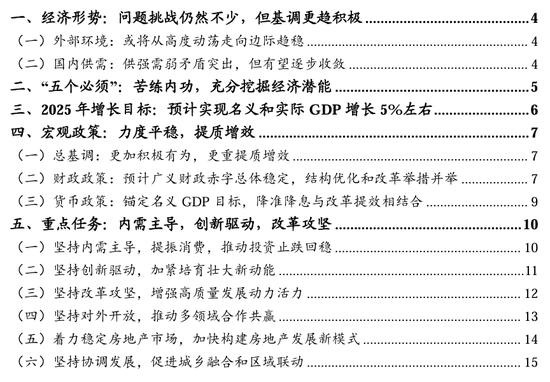
Economic Situation - The economic situation is characterized by persistent challenges, but the overall tone is becoming more positive. The external environment is expected to stabilize marginally, while domestic supply-demand imbalances are highlighted as a significant issue [2][10]. - The meeting emphasizes the need to address "development and transformation" issues, indicating that many challenges can be resolved through concerted efforts [10]. Five Musts - The meeting outlines "Five Musts" to enhance economic potential, focusing on internal capacity building to respond to external challenges and the importance of policy support alongside reform innovation [2][18]. - Key strategies include ensuring effective market regulation while promoting investment in both physical and human capital [19]. 2025 Growth Target - The growth target for 2026 is set at approximately 5% for both nominal and real GDP, reflecting a pragmatic approach to align with long-term goals and current economic conditions [3][21]. - The transition of growth drivers is expected, with the "three new economies" projected to surpass the real estate sector historically [21]. Macroeconomic Policy - The macroeconomic policy framework is shifting from "promoting stability through growth" to "enhancing quality and efficiency," indicating a focus on structural optimization rather than mere expansion [4][26]. - Fiscal policy is expected to maintain a deficit rate around 4%, with a focus on improving the efficiency of spending rather than just increasing the scale [30][31]. - Monetary policy will remain moderately accommodative, with expectations for potential rate cuts and targeted support for key sectors [36][40]. Key Tasks - The emphasis on domestic demand is paramount, with strategies to boost consumption and stabilize investment growth projected at 2-3% for 2026 [5][46]. - Innovation-driven growth is prioritized, with plans to strengthen the integration of education, technology, and talent development [6][50]. - Reforms will focus on eliminating barriers to development, enhancing market dynamics, and improving the business environment [7][57]. Real Estate Market - The policy focus is shifting towards stabilizing the real estate market, moving from demand stimulation to a balanced supply-demand approach [8][63].
吴晓求谈“一股独大”:有责任大股东比股权分散更重要
和讯· 2025-12-12 09:36
Core Viewpoint - The core of China's capital market reform lies in establishing a highly transparent market environment and a fair rule system, as emphasized by Wu Xiaoqiu, a prominent financial expert [2]. Group 1: Capital Market Reform - The reform must ensure transparency at the legal, regulatory, and institutional levels to combat fraudulent activities such as false disclosures and insider trading [2]. - The current regulatory guidelines for listed companies are insufficient and need to be elevated to the level of law to effectively deter severe violations [2]. - Wu advocates for severe penalties for violators to build genuine market trust, suggesting that penalties should be so severe that they lead to significant financial ruin for offenders [2]. Group 2: Three-Pronged Reform Approach - The asset side of the reform should shift from being centered on financing entities to focusing on the protection of investor rights [3]. - The funding side of the reform emphasizes the cultivation of institutional investors to change the market structure dominated by individual investors, which Wu argues lacks growth potential [4]. - The institutional reform requires a comprehensive restructuring of the legal system, including both criminal and civil compensation laws, to enhance the regulatory framework [4]. Group 3: Views on Shareholding Structures - Wu argues that there is no evidence that companies with dispersed shareholding are inherently superior to those with a responsible controlling shareholder, suggesting that a stable major shareholder can lead to better company performance [5]. - He proposes a "1+3" rule system for major shareholder reductions, which includes a three-year lock-up period, transparency in financial disclosures, advance notice of reductions, and restrictions on loss-making companies from reducing their stakes [5]. Group 4: Financial Structure Transformation - The current financial structure in China, with capital market assets around 250 trillion yuan and bank assets at approximately 300 trillion yuan, indicates a need for a long-term transition towards balance, which may take 20 to 30 years [6]. - As financial disintermediation deepens, both investors and financing entities are expected to increasingly favor market mechanisms, enhancing the capital market's role in financing high-tech enterprises [6]. - Wu reiterates that the fundamental solution for China's capital market lies in systematic institutional reforms to ensure market transparency and fairness [6].

田轩:真抓实干“十五五” | 立方大家谈
Sou Hu Cai Jing· 2025-12-12 03:06
Core Insights - The 2025 Central Economic Work Conference has established a clear policy blueprint for China's economic direction, emphasizing a "systematic thinking" and "effectiveness-oriented" approach to economic policy [2][3] Group 1: Economic Policy Focus - The conference highlights a shift from broad policy coverage to targeted and precise measures, integrating existing and new policies to address economic challenges [2] - Specific institutional designs and action plans have been introduced to tackle issues such as consumption restrictions, corporate debt, and real estate market fluctuations [2] Group 2: Identifying Challenges and Opportunities - The conference acknowledges the achievements of China's economy while also recognizing significant challenges, including external environmental changes and domestic supply-demand imbalances [3] - A consensus has been built around the long-term positive outlook for the economy, despite acknowledging transitional pains [3] Group 3: Practical Experience and Methodology - Five key principles for economic work have been identified: maximizing economic potential, balancing policy support with reform, ensuring effective governance, integrating investments in goods and people, and strengthening internal capabilities to face external challenges [4] - These principles provide a methodological framework for addressing economic governance and avoiding fragmentation [4] Group 4: Addressing Core Economic Issues - The conference identifies three main focus areas: expanding domestic demand, fostering innovation and reform, and managing risks in key sectors such as real estate and local government debt [5] - Measures to combat "involution" in competition and address deep-seated economic contradictions have been emphasized [5] Group 5: Policy Coordination and Expectations - The conference promotes a combination of proactive fiscal policy and moderately loose monetary policy, aiming for policy continuity while optimizing implementation strategies [6] - A focus on improving policy coherence and managing expectations is highlighted to stabilize market confidence [6] Group 6: Enhancing Domestic Demand - Specific actions to boost consumption include implementing a "Consumption Promotion Special Action" and a "Rural Residents Income Increase Plan," aimed at removing unreasonable restrictions and enhancing service consumption potential [7] - Investment strategies will focus on increasing central budget investments and optimizing local government bond usage to stimulate private investment [9] Group 7: Innovation and Reform Initiatives - The conference outlines plans for establishing three major international technology innovation centers and enhancing intellectual property protection in emerging fields [10] - A focus on integrating technology and industry innovation is emphasized, with a call for supportive policies for venture capital and long-term funding for early-stage projects [10] Group 8: Social Welfare and Employment - The conference emphasizes the importance of social welfare measures, including stabilizing employment for graduates and migrant workers, and enhancing social security for flexible employment [12] - Policies aimed at improving education, healthcare, and childcare support are highlighted to address public concerns and enhance living standards [12] Group 9: Risk Management Strategies - A targeted approach to risk management is proposed, particularly in the real estate sector and local government debt, with specific measures to control inventory and optimize debt restructuring [13][14] - The focus is on preventing systemic risks while addressing core risk areas through structured and effective measures [13] Group 10: Capital Market Development - The conference calls for continued deepening of capital market reforms to enhance market attractiveness and inclusivity, with a focus on long-term investment and institutional improvements [15][16] - Emphasis is placed on creating a multi-layered and differentiated market system to support various stages of enterprise development [16]

联合解读中央经济工作会议
2025-12-12 02:19
Summary of Key Points from the Central Economic Work Conference Industry or Company Involved - The summary pertains to the overall economic policies and strategies discussed during the Central Economic Work Conference, focusing on various sectors including real estate, consumer goods, and agriculture. Core Points and Arguments - **Consumer Demand and Investment**: The conference emphasized expanding domestic demand as a primary task for 2026, with measures to increase residents' income, remove consumption restrictions, and stabilize investment and the real estate market [2][5][12] - **Fiscal and Monetary Policy**: A commitment to maintaining an active fiscal policy and a moderately loose monetary policy was reiterated, with a focus on innovative drivers and supporting effective supply [1][3][8] - **Real Estate Market**: The conference provided a positive outlook on the real estate sector, emphasizing measures to stabilize the market, control supply, reduce inventory, and improve housing quality [5][9][10] - **Capital Market Reform**: There was a call for deepening capital market reforms, focusing on long-term investor returns and preventing market volatility, with a positive outlook on growth sectors like AI and new energy [6][11] - **Household Appliances Sector**: The government signaled a likelihood of extending national subsidies, which could boost domestic demand for household appliances, with expectations of a recovery in sales growth [11][13] - **Consumer Spending**: The conference highlighted the need to enhance consumer spending through various measures, including income growth and policy optimization, to drive economic growth [12][14] - **Pharmaceutical Industry**: Key discussions included optimizing drug procurement and reforming medical insurance payment methods, which are expected to stabilize and grow the pharmaceutical sector [15] - **Agricultural Development**: The focus was on ensuring food security and promoting high-quality development in the pig industry, with an emphasis on technological advancements in agriculture [16] Other Important but Possibly Overlooked Content - **Risk Management**: The conference addressed the need for proactive risk management in key areas, particularly in real estate and local government financing, to prevent systemic financial risks [5][9] - **Quality of Monetary Policy**: There was a shift towards emphasizing the quality of monetary policy rather than just the quantity, indicating a potential acceleration in monetary easing in 2026 [8][7] - **New Consumption Trends**: The conference acknowledged emerging consumption trends such as the "first launch economy" and "silver economy," which could create new growth opportunities in the consumer market [14]
经济观察|中央连续两年部署“资本市场投融资综合改革”有何深意?
Zhong Guo Xin Wen Wang· 2025-12-12 01:52
南开大学金融发展研究院院长田利辉认为,中央经济工作会议的这一安排是顶层设计对资本市场功 能定位的战略性升级,其核心考量有三层。一是服务新质生产力的迫切要求。二是破解当前经济核心矛 盾的现实需要。三是夯实金融强国建设的制度基础。"连续两年聚焦,表明这不是短期刺激,而是构建 安全、规范、透明、开放、有活力、有韧性的现代资本市场体系的'持久战',关乎国家金融竞争力的全 局。" 回顾过去一年中国资本市场投融资综合改革,薛洪言认为,改革在多方面取得扎实进展。一方面, 投资端呈现积极变化,中长期资金入市步伐加快,公募基金规模创下历史新高,保险资金权益投资比例 稳步上升。另一方面,融资端的制度包容性持续增强,科创板"1+6"改革允许未盈利硬科技企业上市, 并购重组"绿色通道"有效促进了产业整合,推动A股"含科量"显著提升。 中新社北京12月11日电 (记者 陈康亮)中央经济工作会议12月10日至11日在北京举行。会议提出, 持续深化资本市场投融资综合改革。这是中央经济工作会议连续两年部署"资本市场投融资综合改革"。 田利辉认为,过去一年的改革突出体现了"融资端激活"与"投资端筑基"的双向发力。但不足之处依 然明显,如投资端 ...
(经济观察)中央连续两年部署“资本市场投融资综合改革”有何深意?
Zhong Guo Xin Wen Wang· 2025-12-11 13:48
Group 1 - The core viewpoint of the Central Economic Work Conference is to continue deepening the comprehensive reform of capital market investment and financing, emphasizing the need for institutional innovation to enhance the capital market's role in serving the real economy [1] - The conference's focus on capital market reform for two consecutive years indicates a long-term strategy aimed at building a modern capital market system that is safe, standardized, transparent, open, vibrant, and resilient, which is crucial for national financial competitiveness [1] - The past year has seen solid progress in capital market investment and financing reforms, with significant increases in medium- and long-term funds entering the market, public fund sizes reaching historical highs, and a steady rise in insurance capital's equity investment ratio [1] Group 2 - The dual focus of the past year's reforms has been on activating the financing side and strengthening the investment side, although challenges remain, such as the depth of investment reforms lagging behind financing reforms and persistent market volatility [2] - Future reforms should aim to enhance the investment function of the capital market by promoting more long-term funds to enter the market and strengthening regulatory measures to protect investors' rights [2] - Key future reform directions include improving the inclusiveness and adaptability of capital market systems, enhancing coordination between investment and financing functions, and fostering a more attractive environment for long-term investments [2]