
金属矿业

Search documents
港股异动 | 佳鑫国际资源(03858)盘中涨超5% 钨市延续稳健行情 战略金属地位凸显
智通财经网· 2025-11-20 07:32
Core Viewpoint - The stock of Jaxin International Resources (03858) has seen a price increase, attributed to the stable performance of the tungsten market and rising prices of tungsten concentrates [1] Company Summary - Jaxin International Resources' stock rose over 5% during trading, currently at HKD 32.22, with a trading volume of HKD 30.83 million [1] - The company is positioned to benefit from the increasing demand for tungsten due to supply constraints and rising prices in the market [1] Industry Summary - The tungsten market continues to show a stable trend, with 65% black tungsten concentrate priced at CNY 327,000 per standard ton, up 128.7% since the beginning of the year [1] - The price for 65% white tungsten concentrate is reported at CNY 326,000 per standard ton, reflecting a 129.6% increase year-to-date [1] - Factors such as resource depletion, environmental regulations, and national control over tungsten mining contribute to limited tungsten supply, leading to a tight supply-demand balance and potential for further price increases [1]
秘鲁9月铜产量同比增加3.7% 9月铅锌银锡产量同比均增
Wen Hua Cai Jing· 2025-11-13 05:56
Core Insights - Peru's copper production in September increased by 3.7% year-on-year, reaching 240,995 tons [1] - For the first nine months of 2025, Peru's copper production totaled approximately 2.048 million tons, reflecting a year-on-year growth of 2.7% [1] Summary by Category Copper Production - September copper production: 240,995 tons, up 3.7% year-on-year [2] - Cumulative copper production from January to September: 2,048,395 tons, up 2.7% year-on-year [2] Other Metals Production - Gold production in September: 9,314,156 grams, down 4.6% year-on-year [2] - Zinc production in September: 127,555 tons, down 13.0% year-on-year [2] - Silver production in September: 326,746 kilograms, down 6.3% year-on-year [2] - Lead production in September: 27,791 tons, up 2.8% year-on-year [2] - Tin production in September: 3,009 tons, up 2.5% year-on-year [2] Year-to-Date Performance - Year-to-date gold production: 80,475,617 grams, up 0.1% year-on-year [2] - Year-to-date zinc production: 1,117,876 tons, up 17.5% year-on-year [2] - Year-to-date silver production: 2,778,168 kilograms, up 8.3% year-on-year [2] - Year-to-date lead production: 233,191 tons, up 7.5% year-on-year [2] - Year-to-date tin production: 25,423 tons, up 3.2% year-on-year [2]


盛屯矿业:11月12日召开董事会会议
Mei Ri Jing Ji Xin Wen· 2025-11-12 09:30
每经AI快讯,盛屯矿业(SH 600711,收盘价:11.1元)11月12日晚间发布公告称,公司第十一届第二 十三次董事会会议于2025年11月12日以通讯的方式召开。会议审议了《关于公司投资委员会成员调整的 议案》等文件。 2024年1至12月份,盛屯矿业的营业收入构成为:能源金属业务占比60.98%,基本金属业务占比 31.29%,金属冶炼及综合回收占比5.14%,其他业务占比2.58%。 截至发稿,盛屯矿业市值为343亿元。 每经头条(nbdtoutiao)——谁在替王家卫写《繁花》?揭秘影视剧本层层转包"枪手链" (记者 曾健辉) ...

能源金属板块11月11日跌1.71%,天齐锂业领跌,主力资金净流出21.28亿元
Zheng Xing Xing Ye Ri Bao· 2025-11-11 08:37
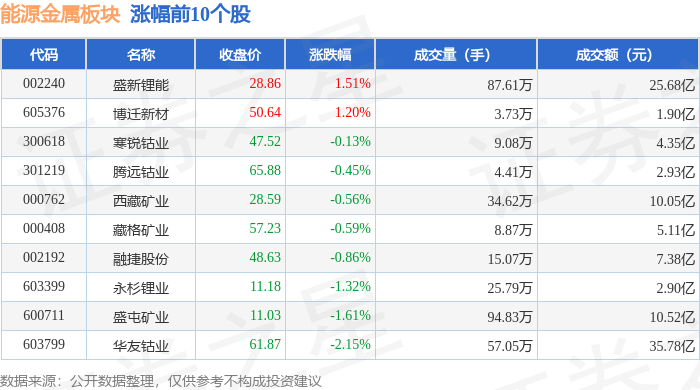
Market Overview - The energy metals sector experienced a decline of 1.71% on November 11, with Tianqi Lithium leading the drop [1] - The Shanghai Composite Index closed at 4002.76, down 0.39%, while the Shenzhen Component Index closed at 13289.0, down 1.03% [1] Individual Stock Performance - Shengxin Lithium Energy (002240) closed at 28.86, up 1.51% with a trading volume of 876,100 shares and a turnover of 2.568 billion [1] - Tianqi Lithium (002466) closed at 55.32, down 3.81% with a trading volume of 852,600 shares and a turnover of 4.801 billion [2] - Ganfeng Lithium (002460) closed at 67.74, down 2.34% with a trading volume of 771,400 shares and a turnover of 5.323 billion [2] - Huayou Cobalt (603799) closed at 61.87, down 2.15% with a trading volume of 570,500 shares and a turnover of 3.578 billion [2] Capital Flow Analysis - The energy metals sector saw a net outflow of 2.128 billion from institutional investors, while retail investors had a net inflow of 1.609 billion [2][3] - Tianqi Lithium experienced a net outflow of 763 million from institutional investors, accounting for 15.89% of its trading volume [3] - Ganfeng Lithium had a net outflow of 608 million from institutional investors, representing 11.42% of its trading volume [3]




最新!美元踢出人民币金属交易!全球金属定价权,今后就认美元?
Sou Hu Cai Jing· 2025-11-10 04:35
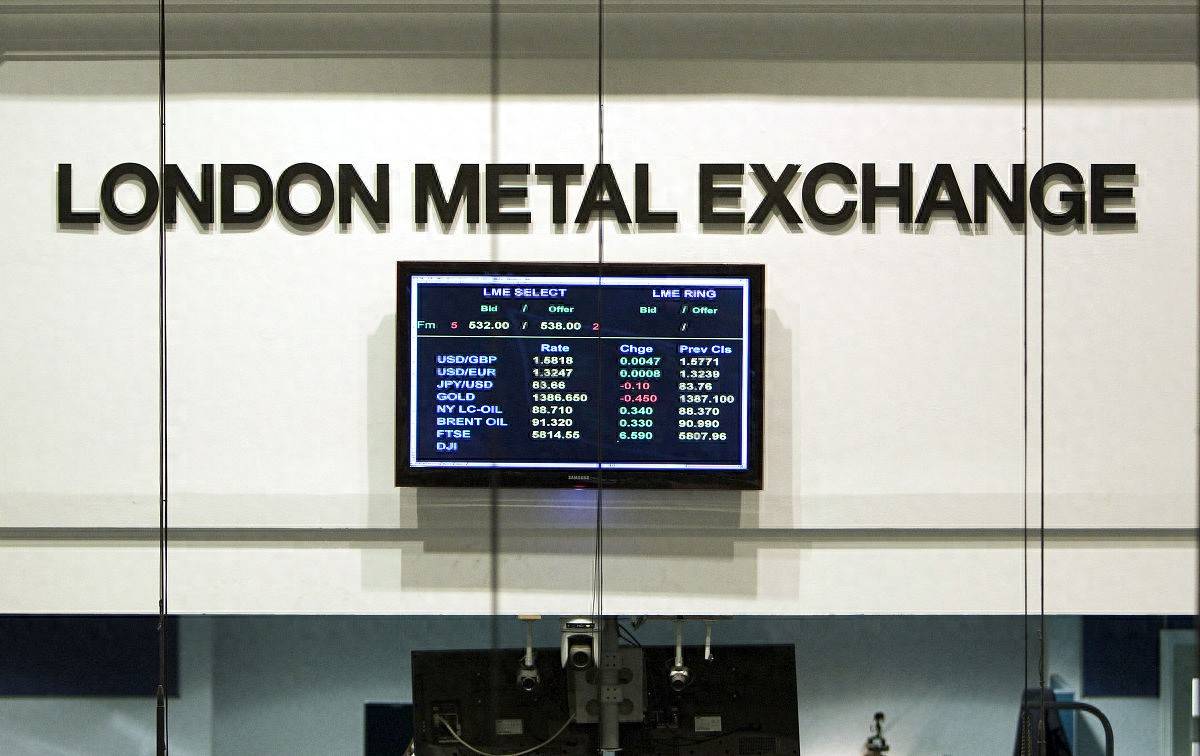
Core Viewpoint - The London Metal Exchange (LME) unexpectedly suspended all non-USD denominated metal options, including those in RMB, without prior notice or explanation, indicating a targeted approach towards the RMB market [1] Market Reaction - Following the announcement, the main aluminum and copper contracts on the Shanghai Futures Exchange hit the upper limit, while LME electronic trading saw a significant drop, with the price difference reaching $412 per ton, marking a historic occurrence in 38 years [3] - Traders noted that USD-denominated metals have become isolated, while RMB-denominated metals are gaining popularity, reflecting a shift in market dynamics [3] China's Position in Metal Trade - China contributes 70% of global rare earth oxides and 55% of electrolytic aluminum, with nearly half of copper consumption growth driven by China [3] - Major Middle Eastern steel manufacturers plan to reference Shanghai futures prices and settle long-term metal orders in RMB starting from Q4 2025, with Dubai also set to launch RMB-denominated metal futures in 2026 [3] Adoption of RMB in Global Trade - Major mining companies like BHP and Vale have begun accepting RMB for iron ore transactions, driven by the convenience and cost-effectiveness of using RMB in trade with China [5] - The cross-border RMB payment system has expanded to 32 countries, with bilateral currency swap agreements exceeding 4.5 trillion RMB, and RMB cross-border payment amounts reaching 35 trillion RMB in the first half of the year, a 14% year-on-year increase [5] LME's Weakness and Market Dynamics - LME's actions reveal its weaknesses, as actual trading has shifted to other markets, with contracts still being signed and settled despite the suspension [7] - The RMB's rise is attributed to its alignment with production, demand, and convenience, rather than an aggressive pursuit of dominance [7] Future Trends - The trend of using RMB for metal trade settlements is expected to grow, with more countries and companies likely to follow suit, indicating potential challenges for LME's traditional rules [8]
刘小涛会见欧莱雅集团首席执行官叶鸿慕、力拓集团首席创新官段巍
Xin Hua Ri Bao· 2025-11-07 23:20
Group 1 - The meeting with L'Oréal's CEO highlighted the company's nearly 30-year presence in Jiangsu, contributing to high-quality employment and products, and emphasized the state's commitment to providing a stable and transparent environment for foreign investment [1] - L'Oréal plans to deepen cooperation with Jiangsu in design, research and development, and e-commerce to better meet diverse consumer needs and expand market opportunities [1] - L'Oréal's first self-built smart operation center globally has been established in Jiangsu, significantly enhancing supply chain efficiency, with intentions to increase investment and launch more quality projects in the region [1] Group 2 - The establishment of a technology innovation industry fund was witnessed by the provincial governor, aiming to enhance collaboration between Rio Tinto, CITIC Investment Holdings, and Suzhou Industrial Park [2] - Rio Tinto is recognized as a long-term partner in Jiangsu, with a focus on leveraging low-carbon technology innovation for sustainable development and enhancing resource sharing and information exchange [2] - The new fund aims to accelerate breakthrough technology research and application, linking quality financial and industrial resources to support Jiangsu's technological innovation and industrial upgrading [2]


我在进博会
Zheng Quan Ri Bao Zhi Sheng· 2025-11-07 16:12
Core Insights - The eighth China International Import Expo (CIIE) showcases a significant increase in exhibitors and product diversity, particularly in the agricultural and food products sector, emphasizing the theme "From Global Farms to Chinese Tables" [2][3][4] - The event highlights a shift from global product launches to localized innovations, with companies focusing on establishing R&D centers and smart supply chains to cater to Chinese consumer preferences [2][6] - The expo serves as a platform for global brands to debut new products tailored for the Chinese market, reflecting the growing trend of localization in response to consumer demands [3][4][6] Group 1: Agricultural and Food Products - The agricultural and food products exhibition features over 2,000 companies, marking the largest participation in the event's history [2] - Notable product launches include Brazilian, Argentine, and Australian meat products, as well as innovative dairy products from Chinese brands [3][4] - Companies like Danone and Arla are showcasing new health-focused products, aligning with the increasing demand for nutritious options in the Chinese market [4][6] Group 2: Localization and Innovation - The trend of localization is evident as foreign companies adapt their offerings to meet the specific needs of Chinese consumers, moving from mere product display to localized production [6][8] - The integration of digital technology and precision nutrition is reshaping the agricultural value chain, enhancing product offerings and consumer engagement [2][6] Group 3: Sustainability and Green Development - The expo emphasizes sustainable development, with discussions on ESG (Environmental, Social, and Governance) principles and the promotion of green technologies [11][12] - Companies are showcasing innovations in energy efficiency, circular economy practices, and low-carbon technologies, reflecting a commitment to sustainability [11][12][14] Group 4: AI and Technological Innovations - The technology equipment section highlights advancements in AI and computing power, with companies like Dell and AMD presenting solutions that enhance industrial applications [16][17] - The focus is shifting towards energy-efficient solutions in data centers, with liquid cooling technologies gaining traction due to their effectiveness in managing heat [18][19]
美联储政策定生死!铜价突然“刹车”,全球资金正在悄悄转移?
Sou Hu Cai Jing· 2025-11-07 10:58
伦敦金属交易所的铜价最近有点"蔫",单日跌了1.8%,收在每吨10663.50美元。 不光是铜,铝价跌了1.5%,锌价也跌了0.4%,整个基本金属板块都跟着没了精气神。 作为工业领域的"晴雨表",铜价这波波动可不是小事,背后牵扯的因素说起来还真有点复杂。 铜价今年其实挺给力,累计涨幅已经超20%。 本来以为这涨势能接着延续,没成想半路杀出个"程咬金",美元突然走强把这股势头给摁住了。 现在美元指数都快摸到5月以来的最高水平,手里拿着其他货币的投资者想买铜,成本一下就上去了。 成本高了,大家自然就会犹豫,市场需求也就跟着被抑制住了。 美元这波强势,说到底还是美联储在背后"搅局"。 美联储主席鲍威尔之前说了,12月降息这事儿还没定死。 芝加哥联储主席古尔斯比更直接,他觉得通胀问题比就业市场更值得担心。 这些偏鹰派的言论一出来,美元立马就有了支撑。 美联储的政策风向历来都是大宗商品市场的"指挥棒",这次也不例外。 美元与政策博弈,铜价短期承压难逆转 全球大宗商品大多用美元计价,这是行业内的默认规则。 美元一值钱,大宗商品的吸引力自然就会下降,铜作为其中的代表,受到的影响尤为明显。 本来想单纯归因于需求疲软,但后来发 ...
五矿资源:欧盟委员会将启动对收购英美资源巴西镍业务的第二阶段合并调查
Zhi Tong Cai Jing· 2025-11-05 04:25
鉴于所有其他条件均已满足,欧盟委员会今日已宣布将启动对收购事项的第二阶段合并调查。第二阶段 将对相关资讯进行详尽审查,以确保欧盟委员会能确认收购事项不存在实质性反竞争疑虑。 五矿资源(01208)发布公告,内容有关有条件收购英美资源于巴西的镍业务。公司与英美资源完成收购 事项的义务须待若干先决条件已获满足或豁免后方可生效,包括:于多个司法管辖区取得合并管制批 准;获中华人民共和国国家发展和改革委员会接纳与收购事项有关的申报;以及获中华人民共和国商务部 接纳与收购事项有关的申报。 ...
供应链ESG转型卡在中小微企业: 资金与标准两道坎待破
Zhong Guo Zheng Quan Bao· 2025-11-02 21:39
Core Insights - The transition to ESG (Environmental, Social, and Governance) practices is becoming a critical requirement for small and medium-sized enterprises (SMEs) in the supply chain, but many face challenges due to funding and standards [1][2][3] - The lack of unified standards and recognition of ESG practices among SMEs is hindering their ability to contribute effectively to the overall supply chain ESG performance [2][3] - Leading enterprises in the supply chain are beginning to take on a guiding role, promoting collaboration and standardization to help SMEs overcome their transition challenges [4][5][9] Group 1: Challenges Faced by SMEs - SMEs are often seen as bottlenecks in the supply chain ESG performance due to limited resources and capabilities, which complicates overall collaboration [2][3] - Many SMEs have a limited understanding of ESG, viewing it primarily as a compliance cost rather than a strategic necessity, leading to inadequate frameworks for implementation [2][3] - The absence of standardized ESG requirements results in increased costs for SMEs as they must adapt to varying demands from different enterprises [2][3] Group 2: Role of Leading Enterprises - Leading companies are encouraged to establish unified ESG standards and share their technological and managerial expertise with SMEs to facilitate their transition [4][5] - Initiatives such as creating ESG management systems and participating in industry standard-setting are being adopted by leading firms to support their supply chain partners [4][5] - Collaborative efforts among leading enterprises can help build a sustainable value chain that integrates green procurement, responsible manufacturing, and low-carbon logistics [4][5] Group 3: Financial and Policy Support - Financial institutions are increasingly incorporating ESG factors into their lending decisions, providing incentives for companies with strong ESG performance [7][8] - The establishment of funds and innovative financial mechanisms is being proposed to support SMEs in their ESG transitions, enabling them to access necessary resources [6][7] - Regulatory frameworks and incentive policies are being called for to enhance ESG compliance and encourage investment in green technologies [7][8] Group 4: Future Outlook - The collective efforts of leading enterprises and financial institutions are expected to create a more conducive environment for SMEs to engage in ESG practices, ultimately contributing to high-quality economic development [9]
