保险资管

Search documents
长钱何以长投?资管掌门人如是说
Shang Hai Zheng Quan Bao· 2025-07-14 18:29
Core Viewpoint - The recent initiatives by the Ministry of Finance and other regulatory bodies aim to guide insurance funds towards long-term and stable investments, enhancing the performance evaluation system for state-owned commercial insurance companies, which is seen as a crucial step for stabilizing the capital market [6][9]. Group 1: Insurance Funds and Capital Market - Insurance funds are characterized as long-term and patient capital, making them naturally suitable for long-term investment needs in the capital market [8][9]. - As of the end of the first quarter, the balance of funds utilized by insurance companies reached 34.93 trillion yuan, indicating a significant potential for long-term investments [8]. - China Life Asset Management, as a major player, aims to reshape the value investment paradigm in the capital market by increasing equity investment proportions and providing stable long-term funding [7][9]. Group 2: Long-term Investment Initiatives - The "Honghu Fund," initiated by China Life and Xinhua Insurance, is a pilot fund with a total scale of 50 billion yuan, focusing on long-term investments in companies with strong competitive advantages [9]. - The push for long-term investment reform is a key focus for regulatory bodies, with China Life Asset Management being one of the first participants in this initiative [9][10]. Group 3: Challenges and Opportunities - The insurance sector faces challenges such as the need for improved risk management tools and a shift from short-term to long-term investment strategies [11][13]. - There is a call for enhancing the investment capabilities of insurance funds, particularly in navigating complex global capital markets and optimizing investment frameworks [13][15]. - The low interest rate environment and insufficient supply of quality assets highlight the necessity for insurance funds to increase their equity asset allocation [15][16]. Group 4: Bank Wealth Management - Bank wealth management is increasingly entering the capital market, with institutions like Everbright Wealth Management leading the way in equity investments [17][18]. - As of June, the proportion of equity products in Everbright's wealth management offerings exceeded 7%, reflecting a significant increase in equity asset allocation [19]. - The shift towards equity investment is seen as a necessary response to the limitations of fixed-income assets in a low-interest-rate environment [20][21]. Group 5: Regulatory and Structural Adjustments - There is a need for regulatory adjustments to support long-term investments, including optimizing accounting standards and enhancing the matching mechanism between client risk profiles and asset styles [30][31]. - The establishment of a multi-dimensional evaluation system for long-term investments is essential to support investment teams in maintaining a focus on fundamental research during market fluctuations [30][31].


金融监管总局“7号令”出台:金融产品严禁“操纵业绩”、“不当展示”
财联社· 2025-07-12 06:28
Core Viewpoint - The newly implemented "Regulations on the Appropriateness Management of Financial Institution Products" (referred to as "Regulation No. 7") aims to enhance the transparency and integrity of financial product sales, particularly those with uncertain returns and potential principal loss, by prohibiting misleading practices in product promotion and sales [1][4][5]. Group 1: Overview of Regulation No. 7 - Regulation No. 7 was officially released after a three-and-a-half-month consultation period, introducing stricter guidelines for financial institutions regarding the promotion and sale of investment products [1][2]. - The regulation specifically targets investment-type products, including asset management products and other financial products, which are primarily regulated by the former China Banking and Insurance Regulatory Commission [2][3]. Group 2: Prohibited Practices - Financial institutions are now prohibited from misleading or inducing customers to purchase products through performance manipulation or improper presentation [4][6]. - The regulation addresses practices such as obscuring product nature, confusing product categories, exaggerating product advantages, and selectively displaying performance data [6]. Group 3: Performance Disclosure and Management - The regulation emphasizes the need for clear performance disclosure, aligning with previous guidelines issued by the National Financial Regulatory Administration regarding asset management product information disclosure [7][8]. - The phenomenon of "new product ranking," where newly launched financial products exhibit inflated returns to attract investors, is highlighted as a concern that the regulation aims to mitigate [9]. Group 4: Investor Classification and Risk Assessment - Regulation No. 7 mandates the classification of investment products by risk level and requires an assessment of investors' risk tolerance, distinguishing between professional and ordinary investors [10][14]. - The regulation specifies that only products rated below an investor's risk level can be purchased, ensuring that investments align with the investor's risk capacity [14][15]. Group 5: Special Considerations for High-Age Clients - Financial institutions are required to exercise special care when dealing with clients aged 65 and above, implementing stricter operational procedures for high-risk product sales [18][19]. Group 6: Risk Assessment Frequency and Validity - The regulation standardizes the validity period for risk tolerance assessments to twelve months, limiting the frequency of assessments to prevent excessive evaluations aimed at selling high-risk products [20].

太平资产领678万元罚单 11名责任人同步受罚
Xi Niu Cai Jing· 2025-07-09 07:25
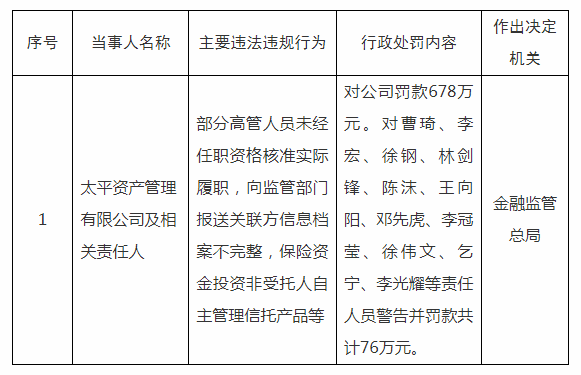
Core Viewpoint - The National Financial Supervision Administration has imposed a fine of 6.78 million yuan on Taiping Asset Management Co., Ltd. for multiple violations, including unapproved executive appointments and incomplete reporting of related party information [2][3][4] Group 1: Violations and Penalties - Taiping Asset Management was fined 6.78 million yuan for three main violations: unapproved executive appointments, incomplete related party information submissions, and investment of insurance funds in non-trustee managed trust products [2][4] - A total of 11 responsible individuals received warnings and were fined a combined total of 760,000 yuan, bringing the total penalties for Taiping Asset and its responsible parties to 7.54 million yuan [3][4] Group 2: Regulatory Context - The violations occurred between 2015 and 2021 and were identified during a risk management and internal control inspection by the former China Banking and Insurance Regulatory Commission [4] - The incident highlights a trend of increased regulatory scrutiny in the insurance asset management sector, as evidenced by recent penalties against other institutions like China Everbright Insurance Asset Management and Huaxia Jiuying Asset Management [4] Group 3: Company Background - Taiping Asset Management, established in September 2006, is a professional asset management institution under China Taiping Insurance Group and is one of the first nine insurance asset management companies in China [4] - As of 2024, the company has a management scale of 1.67 trillion Hong Kong dollars, reflecting an 8.4% year-on-year growth [4]

上半年“保险版ABS”登记规模超1800亿元 同比增长46%
Zheng Quan Ri Bao· 2025-07-08 15:54
Group 1 - The core viewpoint of the articles highlights the rapid growth of asset-backed plans registered by insurance asset management institutions, with a total registration scale reaching 230 billion yuan in July, reflecting a significant increase in the first half of the year, where 13 institutions registered 38 plans totaling 1,800.96 billion yuan, a year-on-year growth of 46% [1][2][4] - The asset-backed plan business is characterized as a means for insurance asset management institutions to issue beneficiary certificates based on cash flows from underlying assets, which are increasingly diversified, including factoring receivables, financial leasing, infrastructure revenue rights, consumer finance, and supply chain assets [2][3] - The shift from a registration system to a registration system in 2021 has led to a nearly twofold increase in the registration scale over three years, with a recovery in growth observed in 2023 after a decline in 2024 [2] Group 2 - The characteristics of asset-backed plans, such as stable cash flows, long durations, and lower risks compared to equity assets, align well with the investment needs of insurance capital, making them increasingly favored by insurance asset management institutions [1][4] - Recent policy support from regulatory bodies encourages insurance institutions to increase investments in asset-backed plans and other securitized products, further driving the growth of this market segment [2] - The expansion of the underlying asset categories for asset-backed plans indicates a move away from reliance on single asset types, enhancing the vitality and longevity of these financial products [3][4]
资金抄底了120亿
表舅是养基大户· 2025-07-07 13:34
Market Overview - Today's trading volume was below 1.3 trillion, a decrease of 200 billion, primarily due to the implementation of new quantitative regulations, leading to cautious behavior among market participants [1] - The market is currently experiencing a "burning money war" among major food delivery platforms, with Alibaba, Meituan, and JD.com showing significant stock price declines at the market open [3][4] Company Performance - Meituan experienced the largest decline among the three companies, dropping over 4%, while Alibaba and JD.com fell by 2.5% and 1.7%, respectively [3][4] - Despite the initial declines, Meituan's stock showed resilience, with a recovery after half an hour of trading [4] - The market has already factored in the impact of the "burning money" strategy, with Alibaba and Meituan's stock prices down 30% and 35% from their highs over the past four months [7] Investment Trends - There was a notable net inflow of over 12 billion from southbound funds, marking the first time since May 27 that net purchases exceeded 10 billion [5] - The market is advised to maintain a balanced investment approach, considering the potential for a prolonged battle among internet giants and the need for a higher margin of safety in dividend stocks [7] Industry Insights - The competition among internet giants is primarily for traffic entry points, with Tencent being highlighted as the strongest player in this regard, showing a rebound of over 1% today [8] - The recent surge in tea beverage companies, driven by subsidies, has resulted in significant stock price increases for brands like Nayuki and Heytea, with gains of up to 11.04% [12][13] Sector Analysis - The electricity sector is gaining attention due to record-high power loads, with the national grid reaching 1.465 billion kilowatts, a year-on-year increase of nearly 150 million kilowatts [20] - The public utility ETF has recovered to break even, indicating a potential undervaluation in the electricity sector, which has lagged behind other dividend sectors [21][22]

两家外资保险资管机构同时获批,资管产品发行或迎来高潮
Hua Xia Shi Bao· 2025-07-07 13:31
Group 1 - Nearly half of the world's 40 largest insurance companies have entered China, with recent approvals for two insurance giants to establish wholly-owned asset management companies in Shanghai [2][3] - AIA and Aegon have received approval to set up their asset management companies, with AIA's located in Pudong and Aegon's in Hongkou [2][4] - The establishment of these foreign asset management companies signals a positive outlook for international investors and contributes to the internationalization of China's insurance asset management market [2][4] Group 2 - AIA's establishment of its asset management company reflects its long-term commitment to the Chinese market and the results of China's high-level financial openness [3][4] - Aegon has been interested in entering the Chinese asset management market for two years, viewing it as a strategic growth market [4][5] - Aegon currently has a presence in China through a joint venture and is looking to enhance its business layout in the financial market [5] Group 3 - The approval of these two foreign asset management companies will increase the total number of operational insurance asset management institutions in China to 36, with a current ratio of domestic to foreign institutions at 9:1 [5][6] - The expansion of foreign asset management institutions may lead to increased competition, pushing domestic firms to innovate and improve their product offerings [6][8] - The insurance asset management sector is experiencing growth, with a significant increase in the number of registered products and positive performance metrics [7][8] Group 4 - The competitive landscape in China's asset management market is intensifying, with both domestic and foreign firms vying for a share of the substantial market size [8][9] - Insurance asset management companies face challenges such as limited funding sources and the need for differentiated competitive advantages [9][10] - The expansion of product distribution channels and targeting of B-end and qualified C-end clients are essential for insurance asset management companies to grow [9][10]



又有保险资管收百万罚单
Guo Ji Jin Rong Bao· 2025-07-07 11:51
Core Viewpoint - The insurance industry continues to face stringent regulatory scrutiny, as evidenced by recent penalties imposed on Taiping Asset Management Co., Ltd. for various violations [1][3]. Group 1: Regulatory Actions - Taiping Asset was fined 6.78 million yuan for violations including unapproved executive appointments and incomplete reporting of related party information [1][2]. - A total of 76,000 yuan in fines was imposed on several responsible individuals, including executives of Taiping Asset [1][2]. Group 2: Company Background and Financial Performance - Taiping Asset, established in September 2006, is a professional asset management institution under China Taiping Insurance Group and one of the first nine insurance asset management companies in China [3]. - In 2024, Taiping Asset reported revenue of 1.851 billion yuan, a year-on-year increase of 6.67%, while net profit was 932 million yuan, reflecting a year-on-year decline of 4.36% [3]. Group 3: Industry Trends - Recent trends indicate that insurance asset management companies are frequently receiving substantial fines, highlighting ongoing compliance issues within the sector [4]. - Other companies, such as Jiao Yin Insurance Asset Management Co. and Huaxia Jiuying Asset Management Co., have also faced penalties for various regulatory violations, indicating a broader issue within the industry [4][5].
太平资产因违规行为遭罚678万元
Guan Cha Zhe Wang· 2025-07-07 10:18
Core Viewpoint - The China Financial Supervisory Administration has imposed a fine of 6.78 million yuan on Taiping Asset Management Co., Ltd. for three major violations, marking the highest penalty in the insurance asset management industry this year [6]. Group 1: Violations and Penalties - Taiping Asset Management was penalized for three main violations: first, several senior executives performed duties without proper qualification approval from 2015 to 2021; second, there were significant omissions in the related party information submitted to regulatory authorities, leading to ineffective identification of related transaction risks; third, the company improperly invested insurance funds in trust products not managed by the trustee, breaching compliance boundaries for insurance fund utilization [1][3]. - A total of 11 responsible individuals received warnings and were fined a combined 760,000 yuan [1]. Group 2: Regulatory Context - The penalty against Taiping Asset Management is significantly higher than a previous fine of 2.66 million yuan imposed on Huaxia Jiuying Asset Management for similar issues in June 2025, indicating a tightening regulatory environment [6]. - The revised "Regulations on the Management of Insurance Asset Management Companies" set to be implemented in 2024 will require insurance asset management companies to establish a "three-line defense" internal control mechanism, embedding executive qualification reviews into the entire governance process [6]. - The financial regulatory authority is enhancing its monitoring framework through a combination of on-site inspections and off-site monitoring, focusing on the scale and concentration of non-standard assets such as trust plans and debt investment plans [6].

正念投资公式:投资业绩=专业认知*情绪管理,乘号是关键秘诀︱重阳Talk Vol.15
重阳投资· 2025-07-07 07:25
Group 1 - The article discusses the integration of mindfulness into investment practices, emphasizing its benefits for emotional management and decision-making [4][5][10] - It highlights the importance of both professional knowledge and emotional management in achieving long-term investment success, presenting a formula where investment performance equals professional knowledge multiplied by emotional management [9][10][12] - The discussion includes examples of market reactions to external events, such as tariffs imposed by Trump, illustrating how mindfulness can help investors maintain rationality during periods of fear and uncertainty [13][14][15] Group 2 - The article outlines the emotional states investors experience during different market phases, such as fear at market bottoms and euphoria at peaks, and how these emotions can negatively impact investment decisions [14][16][21] - It emphasizes the need for a stable emotional state among successful investors, suggesting that those who can manage their emotions effectively are more likely to achieve better long-term performance [18][22][24] - The concept of "reverse investment" is introduced, where investors maintain a positive outlook during market downturns and a rational approach during market highs [24][26] Group 3 - The article introduces the "Magic Happiness Model," which connects mindfulness, altruism, growth, meaning, and courage as essential components for achieving happiness in life and investment [48][49] - It stresses that mindfulness serves as a foundation for focusing on the present moment, which is crucial for effective decision-making in both personal and investment contexts [40][46] - The model suggests that engaging in altruistic actions and pursuing personal growth can enhance overall happiness, thereby positively influencing investment behavior [49][50]

生态跃迁——2025中国金融产品年度报告
华宝财富魔方· 2025-07-06 14:04
Core Viewpoint - The 2025 China Financial Products Annual Report titled "Ecological Leap" emphasizes the transformation of the wealth and asset management industry towards a service-oriented model, highlighting the need for industry-wide collaboration and the reconstruction of the wealth ecosystem [2][3]. Group 1: Insights on Wealth Ecosystem - The report reflects on the past year’s efforts and anticipates future explorations, marking the 14th consecutive year of publication [1][2]. - The concept of "ecological leap" signifies a comprehensive and profound transformation within the industry, requiring collective progress rather than isolated actions from individual institutions [2][3]. - The value of research services is underscored as essential for identifying trends and guiding industry transformation [2]. Group 2: Financial Product Overview - The report includes a detailed directory covering various financial products and market insights, such as the performance of bank wealth management, public funds, ETFs, trust markets, and private equity funds [3][4][5]. - Key topics include the challenges of net value fixed income products, the impact of structured products, and the evolution of private equity strategies [3][4][5][6]. Group 3: Future Directions - The report outlines the necessity for a buyer-centric perspective in research, aiming for a synergistic evolution of the financial ecosystem [3][6]. - It discusses the importance of adapting to new market conditions and the potential for innovative financial products to emerge in response to changing investor needs [4][5][6].