
海洋渔业

Search documents
上半年海洋经济稳中向好 海洋生产总值突破5万亿元
Xin Hua Wang· 2025-08-02 02:41
Core Insights - The marine economy in China has shown resilience and positive growth in the first half of the year, with a marine GDP of 5.1 trillion yuan, representing a year-on-year increase of 5.8% [1] Group 1: Marine Economic Performance - The supply capacity of marine resources has steadily increased, with a newly approved area for marine and island use of 167,000 hectares, up 25.2% year-on-year, involving investments exceeding 500 billion yuan [1] - Marine crude oil and natural gas production increased by 2.3% and 16.9% respectively [1] - The capacity and generation of offshore wind power saw significant growth, with new grid-connected capacity increasing by 199.4% and generation up by 2.2% [1] - The domestic marine aquaculture production increased by 4.8% [1] Group 2: Traditional Marine Industries - Traditional marine industries continue to play a stabilizing role in the marine economy, with the shipbuilding industry maintaining a leading position in the international market, accounting for 64.0% of new orders, 47.2% of completed orders, and 57.6% of hand-held orders globally [1] - The marine tourism sector's value added grew by 8.0%, with cruise ports receiving 40.1% more passengers year-on-year [1] - The marine transportation sector demonstrated resilience, with marine freight volume and cargo turnover increasing by 5.2% and 6.9% respectively [1] Group 3: Emerging Marine Industries - Emerging marine industries are also showing positive development, with marine engineering equipment deliveries and hand-held order amounts increasing by 39.3% and 9.7% respectively [2] - The "Sea Star Model" for marine drug research was launched in Qingdao [2] - The megawatt-level generator "Fengjin" has been continuously operating on the grid for over three years [2]
上半年海洋生产总值5.1万亿元 同比增长5.8%
Zheng Quan Shi Bao Wang· 2025-08-01 09:03
Core Viewpoint - The marine economy in China has shown resilience and positive growth in the first half of the year, with a marine GDP of 5.1 trillion yuan, reflecting a year-on-year increase of 5.8% [1] Marine Resource Supply - The capacity for marine resource supply has steadily improved, with a newly approved area for marine and island use of 167,000 hectares, marking a year-on-year increase of 25.2%, involving investments exceeding 500 billion yuan [1] - Marine crude oil and natural gas production increased by 2.3% and 16.9% year-on-year, respectively [1] - The newly installed capacity and electricity generation from offshore wind power grew by 199.4% and 2.2% year-on-year [1] - The domestic marine aquaculture production saw a year-on-year increase of 4.8% [1] Traditional Marine Industries - Major traditional marine industries continue to play a stabilizing role, with the marine shipbuilding industry maintaining a leading position in the international market, accounting for 64.0% of new orders, 47.2% of completed orders, and 57.6% of hand-held orders globally [1] - The marine tourism sector's added value increased by 8.0% year-on-year, with cruise ports receiving 40.1% more passengers compared to the previous year [1] - The marine transportation industry demonstrated resilience, with marine freight volume and cargo turnover increasing by 5.2% and 6.9% year-on-year, respectively [1] Emerging Marine Industries - The development of emerging marine industries is promising, with marine engineering equipment deliveries and hand-held order values increasing by 39.3% and 9.7% year-on-year, respectively [1] - The "Starfish Model" for marine drug research was launched in Qingdao, and the megawatt-level generator "Fengjin" has been continuously operating for over three years [1]
东营市海洋经济高质量发展新闻发布会召开
Qi Lu Wan Bao Wang· 2025-07-31 08:26
Core Viewpoint - Dongying City is committed to high-quality development of the marine economy, aiming to establish itself as a modern marine city while implementing various initiatives to enhance marine industry growth and ecological protection [3][9]. Marine Economic Development - The marine GDP of Dongying is projected to exceed 120 billion yuan in 2024, with a year-on-year growth of 7.1%, leading the province [3]. - In the first half of this year, the marine GDP reached 61.072 billion yuan, with 13 major marine industries contributing 46.2 billion yuan, reflecting a 7.6% increase [3]. - Emerging marine industries such as marine engineering equipment manufacturing and seawater desalination have shown significant growth, with a 9.8% increase in added value [3]. Modern Marine Industry System - Dongying is focusing on building a modern marine industry system by leveraging its marine resources and fostering industry clusters [4]. - Traditional marine industries are undergoing transformation, with a 4.6% increase in total aquatic product output, reaching 243,000 tons [4]. - The marine oil and gas industry is also growing steadily, with offshore crude oil production reaching 1.796 million tons per year [4]. Port and Logistics Development - The port's cargo throughput reached 45.95 million tons in the first half of the year, marking a 17.64% increase [6]. - Dongying Port is enhancing its capabilities with the completion of new berths and the establishment of a multi-modal transport system [6]. Technological Innovation - Dongying is prioritizing technological innovation in the marine sector, with 38 high-tech marine enterprises and several research centers established [7]. - Significant breakthroughs in high-end technology have been achieved, including advancements in underwater oil and gas production systems [7]. Ecological Protection - The city emphasizes ecological protection alongside development, implementing comprehensive marine pollution control measures [8]. - Efforts include the restoration of coastal wetlands and the management of marine biological resources, with 6 billion aquatic seedlings released during the current five-year plan [8]. Future Directions - The Dongying Marine Development and Fisheries Bureau aims to further enhance the marine economy while ensuring ecological protection and developing marine ports [9].

东营市印发海洋经济高质量发展行动方案
Qi Lu Wan Bao Wang· 2025-07-31 08:26
Core Viewpoint - The "Dongying City Marine Economy High-Quality Development Action Plan (2025-2027)" aims to guide the high-quality development of the marine economy in Dongying City, focusing on traditional industries, emerging industries, and marine services, with a target marine production value exceeding 145 billion yuan by 2027 [3][4]. Group 1: Industry Development - The plan includes three major actions: upgrading traditional marine industries, nurturing emerging marine industries, and developing marine services, with 19 specific tasks outlined [3][4]. - Traditional marine industries will focus on modernizing fisheries, enhancing the marine chemical industry, and promoting the development of marine aquaculture [4]. - Emerging marine industries will include the development of renewable energy projects, marine engineering equipment manufacturing, and marine pharmaceuticals [4]. - The marine service sector will aim to elevate marine tourism and develop new service formats to support marine industries [4]. Group 2: Port Development - The plan emphasizes the importance of ports as strategic support, aiming for a port cargo throughput exceeding 120 million tons by 2027 [5]. - Key projects include the planning and construction of major port facilities and enhancing the integration of port, industry, and city [5]. Group 3: Technological Innovation - The action plan highlights the need for technological innovation as a primary driver, proposing the establishment of marine technology innovation platforms and enhancing talent recruitment and training [6][7]. Group 4: Ecological Protection - The plan stresses ecological priority, proposing actions for marine pollution control, ecological restoration, and marine carbon sink research [8]. Group 5: Maritime Safety - The action plan includes measures for enhancing maritime safety through disaster prevention and risk control capabilities [9]. Group 6: Implementation Measures - The Dongying Marine Development and Fisheries Bureau will focus on effective implementation of the action plan through coordinated efforts and project-based approaches [10].

“蓝色经济”动力十足 三个关键词看海洋经济新活力
Zhong Guo Chan Ye Jing Ji Xin Xi Wang· 2025-07-30 23:33
Group 1: Marine Economy Overview - The national marine production value has surpassed 10 trillion yuan for the first time, growing by 5.9% year-on-year, accounting for 7.8% of the GDP [1] - The marine economy is becoming a new engine for economic growth, driven by the "blue economy" [2] Group 2: Marine Engineering ("Marine Engineering") - China's new ship order volume, completed ship volume, and hand-held ship order volume have all exceeded 50% of the international market share for the first time [4] - In the first quarter, the marine engineering equipment manufacturing industry saw significant growth, with new orders, delivered orders, and hand-held orders increasing by 57.1%, 114.3%, and 24.2% respectively [4] - The construction of green ship technologies is advancing, with a carbon capture system achieving over 80% CO2 capture rate [3][4] Group 3: Marine Aquaculture ("Marine Products") - The marine aquaculture sector is evolving into a modern "grain warehouse," with a 4.0% increase in marine fishery value added, reaching 488 billion yuan [6] - The average offshore distance for aquaculture has increased from 10 kilometers in 2018 to 18 kilometers currently, indicating a shift towards deep-sea and intelligent aquaculture [6][7] - The development of marine ranches is expanding, with new intelligent platforms and processing facilities being established [5][6] Group 4: Marine Renewable Energy ("Marine Wind") - The offshore wind power sector is entering a new phase of large-scale and clustered development, with a nearly 30% increase in offshore wind power generation in 2024 [9] - The marine new industries' added value has grown by 7.2% year-on-year, with significant advancements in marine pharmaceuticals and bioproducts [9] - The establishment of innovation platforms in marine engineering, offshore wind power, and marine pharmaceuticals is being actively pursued by coastal regions [9]

数读东部海洋经济圈 4.6万亿蓝色成绩单拿下近半壁江山
Zheng Quan Shi Bao· 2025-07-30 19:01
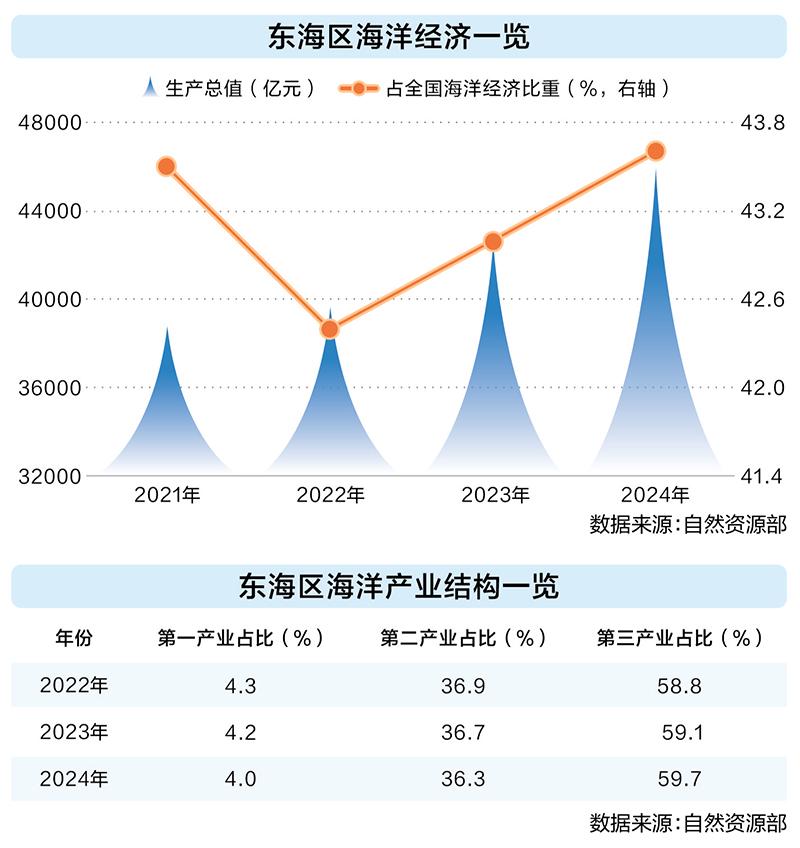
Core Viewpoint - The East China Sea Economic Zone, including Jiangsu, Shanghai, Zhejiang, and Fujian, is a vital area for China's marine economy, showing significant growth and structural optimization in marine industries, with a projected marine GDP of 45,992.9 billion yuan in 2024, a 7.1% increase year-on-year, accounting for 43.6% of the national marine GDP [9][10]. Group 1: Marine Economic Growth - Jiangsu's marine economy surpassed 1 trillion yuan for the first time in 2024, maintaining a steady growth trend since 2014 [11]. - Fujian's marine GDP exceeded 1.25 trillion yuan in 2024, marking a 6.1% year-on-year growth, ranking third nationally for ten consecutive years [15]. - Shanghai's marine GDP reached 1,138.7 billion yuan in 2024, contributing 10.8% to the national marine GDP, with a significant increase in advanced manufacturing [17]. Group 2: Industry Structure and Performance - In 2024, the East China Sea's marine industry structure showed a decline in the first and second industries' share, with the third industry increasing to 59.7% [10]. - Jiangsu's marine oil and gas industry led with a value-added of 7.73 billion yuan, growing by 37.5%, while other traditional industries also saw double-digit growth [10]. - Shanghai's marine shipbuilding industry achieved a value-added of 21.67 billion yuan, with significant increases in new orders and deliveries [17]. Group 3: Regional Highlights - Zhejiang's Ningbo-Zhoushan Port maintained its position as the world's busiest port, handling 1.377 billion tons of cargo in 2024, a 4% increase [13]. - Fujian is recognized as the "seafood granary," with a total aquatic product output of 9.246 million tons in 2024, leading the nation in various seafood exports [15][16]. - The establishment of the Marine Economic Development Bureau in Zhejiang aims to enhance the province's marine economic potential and support high-quality economic development [14].
打造2个万亿级产业集群!广东加力提速推进“百千万工程”
Nan Fang Nong Cun Bao· 2025-07-30 09:31
Core Viewpoint - Guangdong Province is accelerating the "Hundred Million Thousand Project" to develop two trillion-level industrial clusters, focusing on modern marine ranching and deep processing of agricultural products, along with ten billion-level and twenty hundred-billion-level industrial clusters [7][8]. Group 1: Project Overview - The Guangdong Provincial Government has reported significant achievements in advancing the "Hundred Million Thousand Project," although there are still challenges in resource exploitation, the strength of operating entities, and the overall development level of industrial chains [4][5]. - The government aims to enhance the agricultural sector by integrating all elements, increasing value across the entire chain, and promoting industrial convergence [6]. Group 2: Strategic Initiatives - The government will initiate comprehensive planning, including the "Strong Agriculture Province" plan and the "Fifteen Five" modernization plan, to guide future development paths and improve support policies in finance, technology, land use, and talent [11][12][13]. - Emphasis will be placed on stabilizing production and supply, ensuring food security, and enhancing agricultural productivity through modern facilities and ecological practices [14][15][16][18]. Group 3: Marine Ranching Development - The construction of modern marine ranches will focus on ecological development and advanced technologies, including deep-sea farming bases and innovative aquaculture equipment [20][21][22][23]. - The establishment of a national high-tech industrial innovation zone for fisheries is planned to promote smart and automated marine ranching [24][25]. Group 4: Strengthening Operational Entities - The government plans to cultivate 1,500 key agricultural enterprises and create a database of agricultural technology companies to enhance the capabilities of new agricultural operating entities [27][28][29][30]. - Initiatives will include the development of model family farms and cooperatives to support smallholder farmers [31]. Group 5: New Business Models in Rural Industries - The focus will be on improving product quality and safety, enhancing cold chain logistics, and leveraging media and e-commerce to boost agricultural product marketing [32][34][36][37][39]. - The integration of agriculture with cultural and tourism sectors will be explored to maximize rural value [39]. Group 6: Support for Industry Development - The government will promote technological advancements in agriculture and create a comprehensive financial support framework involving banks, insurance, and guarantees [41][42]. - Efforts will be made to address land use challenges and cultivate a skilled workforce to support rural industry development [43][44][45].

10万亿海洋经济崛起硬科技注入产业发展澎湃动力
Zheng Quan Shi Bao· 2025-07-28 17:59
Group 1 - The core viewpoint of the articles emphasizes the significant growth and strategic importance of China's marine economy, which is projected to exceed 10 trillion yuan in 2024, marking a historic milestone [1][2][8] - The marine economy is defined as economic activities centered around the development and utilization of marine resources, encompassing various sectors such as marine energy, fisheries, shipping, tourism, equipment manufacturing, biomedicine, and environmental technology [2][8] - The marine economy's contribution to China's GDP is increasing, with projections indicating it will account for 7.81% of GDP in 2024, the highest since 2020 [3][8] Group 2 - The marine economy's total output value has grown from 8 trillion yuan in 2020 to 10.54 trillion yuan in 2024, reflecting a growth rate that surpasses many traditional industries [2][3] - In the first quarter of 2025, the marine economy maintained a positive growth trend, with a preliminary marine production value of 2.5 trillion yuan, representing a year-on-year increase of 5.7% [3] Group 3 - Technological innovation is a key driver of growth in the marine economy, with emerging industries in this sector seeing an increase in added value of 7.2% in 2024, outpacing the overall marine production value growth [4] - The marine economy's industrial structure is being optimized, with the second industry's production value reaching 3.77 trillion yuan in 2024, accounting for 35.8% of the total [4] Group 4 - China has established a leading position in various marine sectors, with the country securing 69.4% of the global market share for newly contracted marine engineering equipment in 2024 [6][7] - The shipbuilding industry continues to dominate globally, with China maintaining the top position in shipbuilding completion, new orders, and hand-held orders for 15 consecutive years [6][7] Group 5 - The marine economy is not only a response to economic development needs but also a crucial component of national strategy, leveraging China's rich marine resources and technological capabilities for further breakthroughs [8]
2025年浙江省舟山市新质生产力发展研判:链群筑基强化新质根基,海洋领航促进产业兴盛[图]
Chan Ye Xin Xi Wang· 2025-07-25 01:17
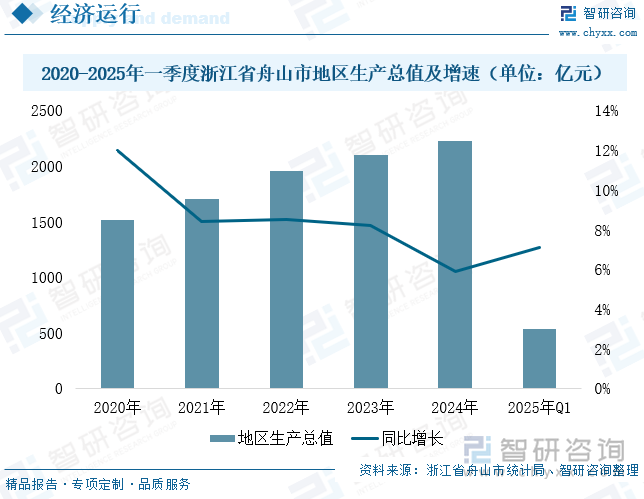
Core Viewpoint - Zhoushan City is leveraging its strategic position in the Yangtze River Delta to develop a modern marine industry cluster, focusing on three pillar industries: green petrochemicals, shipbuilding and marine engineering, and marine fisheries, while also promoting emerging industries such as clean energy and digital ocean technology [1][15]. Industry Overview - New Quality Productive Forces (新质生产力) is defined as an advanced productive force characterized by innovation, high technology, efficiency, and quality, aimed at driving high-quality economic development [2][3]. - The modern marine industry system in Zhoushan is structured around the "3+X" matrix, integrating traditional and emerging industries to enhance competitiveness and sustainability [1][15]. Economic Performance - In 2024, Zhoushan's GDP is projected to reach 222.62 billion yuan, with a year-on-year growth of 5.9%, driven by robust performance across all three industrial sectors [5][8]. - The industrial investment in Zhoushan is expected to total 60.8 billion yuan in 2024, with manufacturing investment growing by 6.4% [7][10]. Key Industries and Companies - The green petrochemical sector is represented by Zhejiang Petrochemical Co., which operates the world's largest integrated refining and chemical project, producing over 40 million tons annually [22][23]. - The shipbuilding industry includes companies like Zhoushan Xinya Shipbuilding and China COSCO Shipping Heavy Industry, focusing on high-end vessels and marine engineering equipment [22][23]. - Emerging industries such as clean energy and marine electronics are also gaining traction, with companies like Zhongguang Nuclear and Zhejiang Xincheng New Energy leading in offshore wind and LNG projects [22][23]. Policy Background - The local government has introduced a series of policies to support the development of new quality productive forces, including initiatives for economic quality improvement and low-altitude economy development [12][13]. - The focus is on creating a comprehensive policy framework that supports innovation, investment, and the integration of marine tourism and sports industries [12][13]. Development Trends - The development trends in Zhoushan highlight a shift towards high-end industrialization, digital innovation, and ecological collaboration, with traditional industries evolving into high-value sectors [25][26]. - The integration of technology and digitalization is expected to enhance productivity across various sectors, including marine equipment and fisheries [27][28]. - Regional collaboration with the Yangtze River Delta is emphasized to improve infrastructure and promote sustainable development [28].
走出一条具有中国特色的向海图强之路——我国推动海洋经济高质量发展深度观察
Ren Min Ri Bao· 2025-07-24 22:27
Core Viewpoint - The development of the marine economy in China is crucial for achieving high-quality growth and is supported by innovation, technology, and ecological protection [1][6][11]. Group 1: Marine Economy Development - The marine economy's total production value is expected to exceed 10 trillion yuan in 2024, doubling since 2012, indicating strong growth momentum [1]. - The marine economy's production value reached 2.5 trillion yuan in the first quarter of this year, with a year-on-year growth of 5.7% [7]. - The emerging marine industries' added value is projected to grow by 7.2% year-on-year in 2024, reflecting an increasing share in the marine economy [5]. Group 2: Technological Innovation - Companies like Hainan Chenhai Aquaculture Co., Ltd. invest over 20 million yuan annually in research for fishery species innovation, contributing to the marine economy's high-quality development [2]. - The "Fuxi No. 1" platform integrates wind and fishing, enhancing the construction of the "blue granary" [4]. - The establishment of a commercial underwater data center in Hainan demonstrates the efficiency and energy-saving potential of marine technology [5]. Group 3: Ecological Protection - The ecological restoration projects in Jiangsu Province aim to protect endangered species and enhance biodiversity, contributing to the development of eco-tourism [12][13]. - The establishment of the "blue carbon" trading project in Guangdong's mangrove reserve highlights the integration of ecological protection with economic benefits [15]. - Nationwide efforts have restored 1,780 kilometers of coastline and 53,000 hectares of coastal wetlands, showcasing China's commitment to marine ecological restoration [15]. Group 4: Marine Tourism - The cruise industry is experiencing significant growth, with over 80 cruise ships docking at Tianjin's port this year, reflecting a rising trend in marine tourism [8][9]. - The marine tourism sector is projected to achieve an added value of 1.6135 trillion yuan in 2024, growing by 9.2% compared to the previous year [9]. Group 5: Policy and Strategic Direction - The Chinese government emphasizes the importance of integrating land and sea development, resource sharing, and enhancing marine productivity [7]. - The focus on high-level self-reliance in marine technology aims to strengthen China's position in global marine industries [4][6].