
玻璃玻纤

Search documents
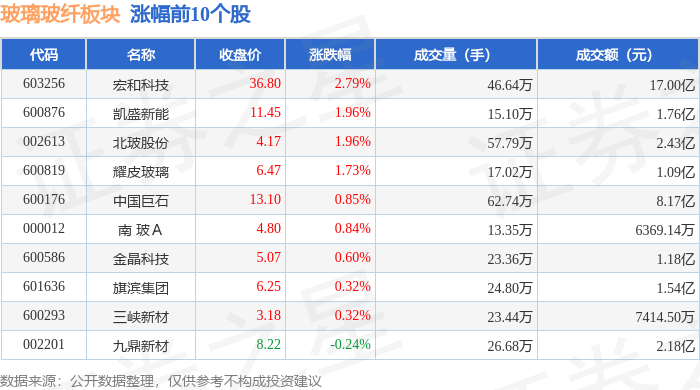
玻璃玻纤板块8月20日涨0.03%,宏和科技领涨,主力资金净流出2.95亿元
Zheng Xing Xing Ye Ri Bao· 2025-08-20 08:44
| 代码 | 名称 | 收盘价 | 涨跌幅 | 成交量(手) | 成交额(元) | | --- | --- | --- | --- | --- | --- | | 603601 | 再升科技 | 5.83 | -4.74% | 143.63万 | 8.40亿 | | 301526 | 国际复材 | 6.42 | -2.28% | 167.52万 | 10.85 Z | | 002080 | 中材科技 | 32.28 | -1.85% | 35.35万 | 11.50亿 | | 300196 | 长海股份 | 16.39 | -1.62% | P 23.86万 | 3.86亿 | | 605006 | 山东玻纤 | 8.44 | -1.06% | 30.31万 | 2.56亿 | | 002201 | 九鼎新材 | 8.22 | -0.24% | 26.68万 | 2.18亿 | | 600293 | 三峡新材 | 3.18 | 0.32% | 23.44万 | 7414.50万 | | 601636 | 旗滨隼厅 | 6.25 | 0.32% | 24.80万 | 1.54亿 | | 600586 | 金晶科 ...


长海股份(300196):量价齐升盈利改善,Q2业绩大幅增长
CAITONG SECURITIES· 2025-08-20 08:24
Investment Rating - The investment rating for the company is "Accumulate" (maintained) [2] Core Views - The company reported a significant increase in revenue and net profit for the first half of 2025, with revenue reaching 1.456 billion yuan, up 18.96% year-on-year, and net profit of 174 million yuan, up 42.30% year-on-year [8] - The second quarter of 2025 saw revenue of 692 million yuan, an increase of 7.75% year-on-year, and a net profit of 92 million yuan, up 28.42% year-on-year [8] - The company benefits from a favorable demand structure, particularly in the wind power and home appliance sectors, which has led to a good performance in production and sales [8] - The report anticipates continued growth in net profit for 2025-2027, with expected figures of 408 million yuan, 506 million yuan, and 583 million yuan respectively, representing growth rates of 49%, 24%, and 15% [8] Financial Performance Summary - Revenue for 2023 was 2.607 billion yuan, with a projected increase to 3.215 billion yuan in 2025, reflecting a growth rate of 20.80% [7] - The net profit for 2023 was 296 million yuan, with an expected increase to 408 million yuan in 2025, indicating a growth rate of 48.50% [7] - The company's earnings per share (EPS) is projected to rise from 0.72 yuan in 2023 to 1.00 yuan in 2025 [7] - The price-to-earnings (PE) ratio is expected to be 16.69 in 2025, indicating a reasonable valuation compared to historical performance [7] Market Performance - The company's stock has shown a strong performance compared to the CSI 300 index, with a notable increase of 54% over the past 12 months [4]
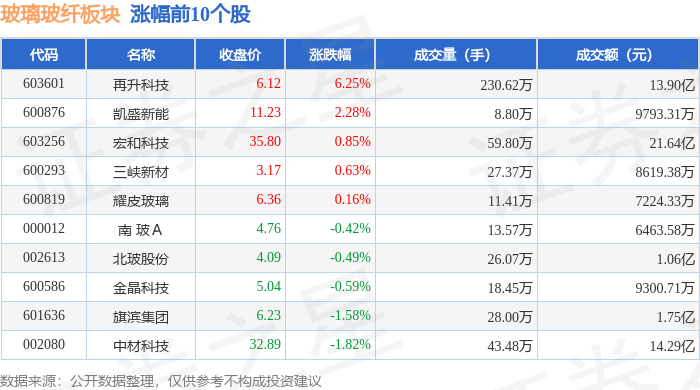
玻璃玻纤板块8月19日跌1.56%,国际复材领跌,主力资金净流出5.35亿元
Zheng Xing Xing Ye Ri Bao· 2025-08-19 08:33
证券之星消息,8月19日玻璃玻纤板块较上一交易日下跌1.56%,国际复材领跌。当日上证指数报收于 3727.29,下跌0.02%。深证成指报收于11821.63,下跌0.12%。玻璃玻纤板块个股涨跌见下表: | 代码 | 名称 | 收盘价 | 涨跌幅 | 成交量(手) | 成交额(元) | | --- | --- | --- | --- | --- | --- | | 301526 | 国际复材 | 6.57 | -6.28% | 285.31万 | 19.23 乙 | | 002201 | 九鼎新材 | 8.24 | -5.50% | 61.35万 | 5.06亿 | | 605006 | 山东坡纤 | 8.53 | -4.69% | 45.71万 | 3.92亿 | | 300196 | 长海股份 | 16.66 | -3.14% | P 21.63万 | 3.59亿 | | 600176 | 中国巨石 | 12.99 | -2.84% | 88.65万 | 11.65亿 | | 002080 | 中材科技 | 32.89 | -1.82% | 43.48万 | 14.29亿 | | 601636 | | ...


A股收评:三大指数小幅调整,北证指数涨1.27%续创新高,机器人、发电机概念走高
Ge Long Hui· 2025-08-19 07:08
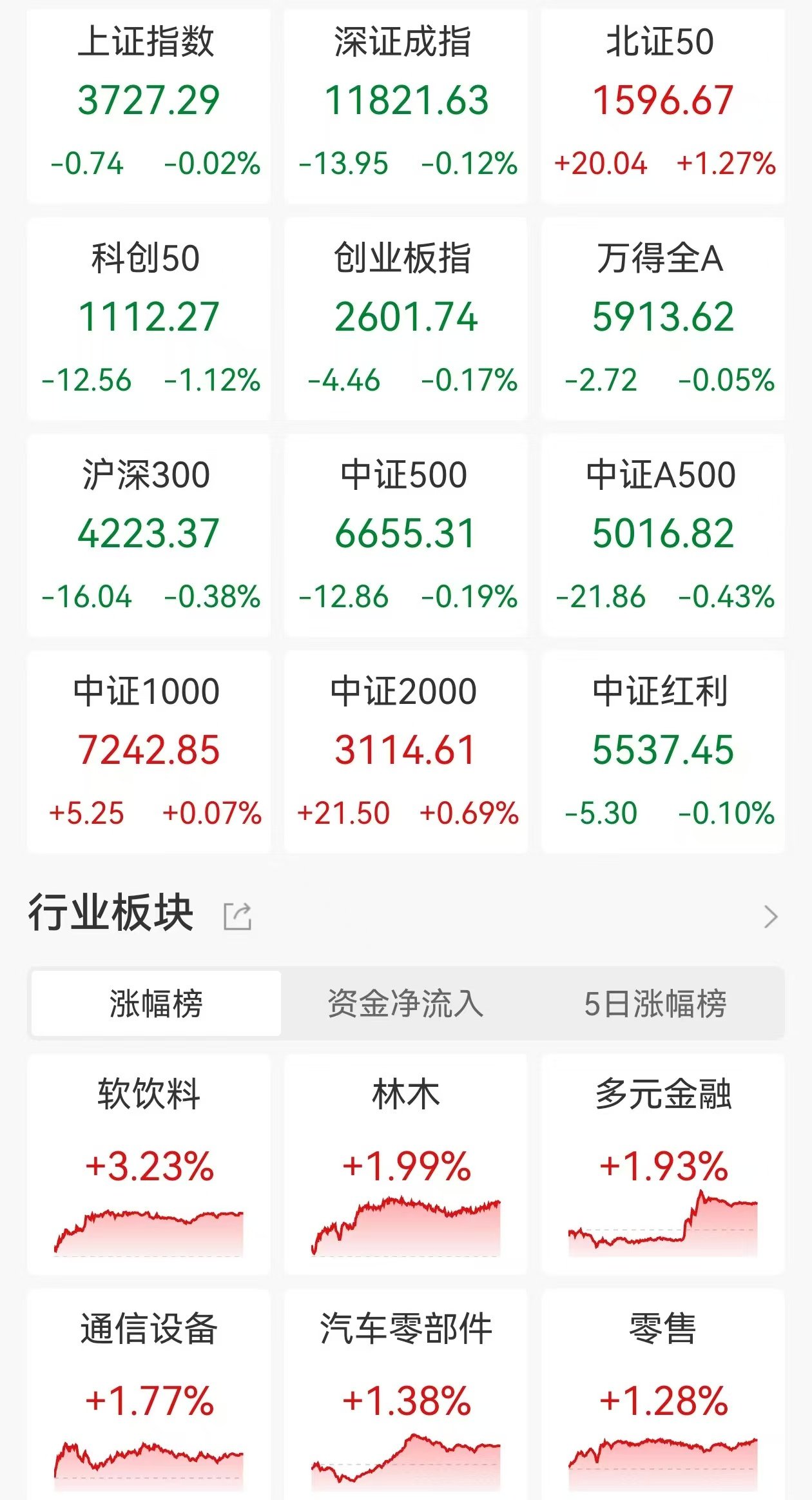
Market Overview - Major A-share indices experienced a pullback after an initial rise, with the Shanghai Composite Index down 0.02% to 3727 points, Shenzhen Component Index down 0.12%, and ChiNext Index down 0.17%. The North Star 50 Index rose 1.27%, reaching a new historical high [1] - The total trading volume for the day was 2.64 trillion yuan, a decrease of 168.5 billion yuan compared to the previous trading day, with over 2900 stocks rising across the market [1] Sector Performance - Strong performance was noted in the robotics and reducer sectors, with stocks like Xiaxia Precision, Lingyi Manufacturing, and Top Group hitting the daily limit [1] - The generator concept also saw gains, with stocks such as Fullchai Power and Taihao Technology reaching the daily limit [1] - The CPO concept remained active, with Cambridge Technology hitting the daily limit [1] - The liquor sector saw a rise, with Jiugui Liquor hitting the daily limit [1] - Other sectors with notable gains included weight loss drugs, automotive integrated die-casting, and decoration [1] Declining Sectors - Insurance stocks declined, with China Life leading the losses [1] - The PEEK materials sector weakened, with Xinhan New Materials dropping over 7% [1] - The glass and fiberglass sectors showed poor performance, with Linuo Pharmaceutical Packaging falling over 10% [1] - Other sectors with significant declines included electronic chemicals, shipbuilding, and securities [1] Top Gainers and Fund Inflows - The beverage sector led the gainers with a rise of 3.23%, followed by communication equipment and automotive parts [2] - The retail sector also showed positive performance with a 1.77% increase [2] - Net capital inflows were observed in the beverage and forestry sectors, indicating investor interest [2]

沪指创近十年新高 两市成交额2.76万亿
Chang Jiang Shang Bao· 2025-08-18 23:41
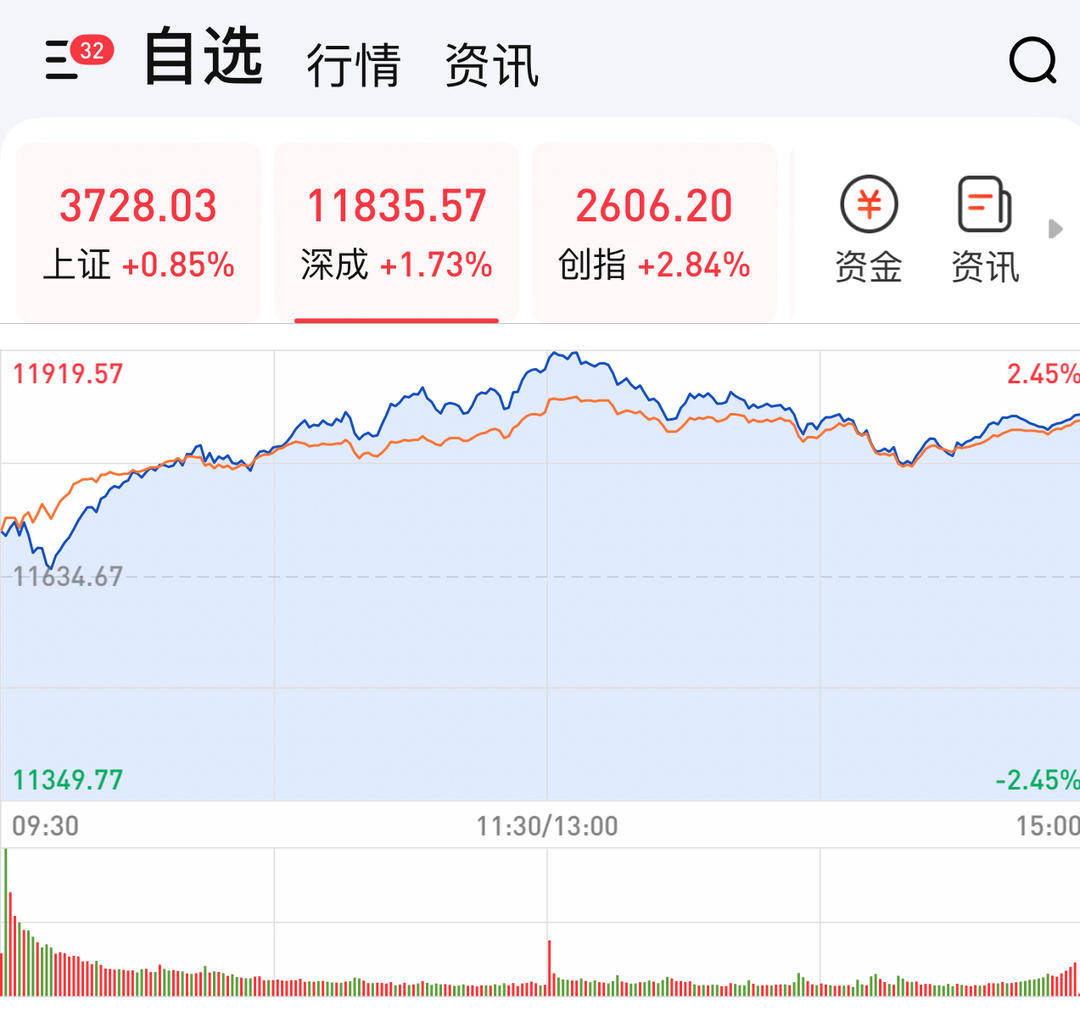
Core Viewpoint - The A-share market experienced a significant surge, with the Shanghai Composite Index reaching a nearly ten-year high, indicating a strong upward trend in the market [1] Market Performance - The Shanghai Composite Index closed at 3728.03 points, up 0.85% - The Shenzhen Component Index closed at 11835.57 points, up 1.73% - The ChiNext Index closed at 2606.20 points, up 0.84% - The total trading volume in the Shanghai and Shenzhen markets reached 2.76 trillion yuan, an increase of 519.6 billion yuan compared to the previous trading day, marking a new high for the year [1] Sector Performance - Most industry sectors showed positive growth, with notable gains in shipbuilding, consumer electronics, glass fiber, small metals, power equipment, software development, cultural media, communication equipment, motors, electronic components, and electronic chemicals - Conversely, the coal, precious metals, and fertilizer sectors experienced declines [1] Market Outlook - Industrial analysts at Industrial Securities suggest that the current market requires a "slow bull" phase, emphasizing the need for a healthy and sustainable market environment - With the market continuing to recover, institutional advantages are becoming more apparent, contributing to a positive feedback loop with the current "slow bull" and "healthy bull" trends [1] - According to Jifeng Investment Advisory, the overall market trend remains upward, and with policy support, the A-share market is expected to align with economic growth, potentially marking an upward turning point [1]
国际复材股价大幅拉升 盘中振幅接近19%
Sou Hu Cai Jing· 2025-08-18 10:33
资金流向方面,8月18日主力资金净流出2.49亿元,占流通市值的2.53%。近五个交易日主力资金累计净 流入7132.18万元,占流通市值的0.72%。 截至2025年8月18日15时30分,国际复材最新股价为7.01元,较前一交易日收盘价上涨0.63元,涨幅为 9.87%。当日开盘价为6.64元,最高触及7.50元,最低下探6.30元,成交量为413.87万手,成交金额达 27.58亿元,振幅为18.81%。 国际复材主营业务为玻璃纤维及制品的研发、生产和销售,产品广泛应用于建筑、交通、电子等领域。 公司所属板块包括玻璃玻纤、重庆板块等。 8月18日盘中,国际复材股价波动剧烈。早盘9点40分快速反弹,5分钟内涨幅超过2%;随后在11点00分 又出现快速回调,5分钟内跌幅超过2%。 风险提示:股市有风险,投资需谨慎。 来源:金融界 ...
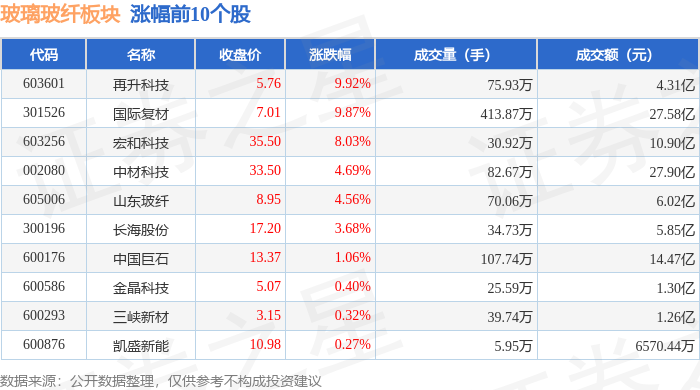
玻璃玻纤板块8月18日涨3.3%,再升科技领涨,主力资金净流出3.13亿元
Zheng Xing Xing Ye Ri Bao· 2025-08-18 08:39
Market Performance - The glass and fiberglass sector increased by 3.3% on August 18, with Zai Sheng Technology leading the gains [1] - The Shanghai Composite Index closed at 3728.03, up 0.85%, while the Shenzhen Component Index closed at 11835.57, up 1.73% [1] Stock Performance - Zai Sheng Technology (603601) closed at 5.76, up 9.92% with a trading volume of 759,300 shares and a transaction value of 431 million yuan [1] - International Composites (301526) closed at 7.01, up 9.87% with a trading volume of 4.1387 million shares and a transaction value of 2.758 billion yuan [1] - Honghe Technology (603256) closed at 35.50, up 8.03% with a trading volume of 309,200 shares [1] - China Jushi (600176) closed at 13.37, up 1.06% with a trading volume of 1.0774 million shares and a transaction value of 1.447 billion yuan [1] Capital Flow - The glass and fiberglass sector experienced a net outflow of 313 million yuan from institutional investors, while retail investors saw a net inflow of 121 million yuan [2] - The sector's overall capital flow indicates a mixed sentiment among different investor types [2] Individual Stock Capital Flow - Zai Sheng Technology had a net inflow of 61.029 million yuan from institutional investors, while it faced a net outflow of 32.6624 million yuan from speculative funds [3] - Longhai Co. (300196) saw a net inflow of 22.6047 million yuan from institutional investors, but also experienced outflows from both speculative and retail investors [3] - North Glass (002613) had a net outflow of 9.816 million yuan from institutional investors, while retail investors contributed a net inflow of 8.8834 million yuan [3]


沪指创近10年新高 两市成交额超2.7万亿!券商最新策略也来了!
Sou Hu Cai Jing· 2025-08-18 07:37
Market Performance - The Shanghai Composite Index reached a nearly 10-year high, while the North Stock 50 hit a historical peak, and both the Shenzhen Component Index and the ChiNext Index surpassed their October 8, 2022 highs [1][2] - The total trading volume across Shanghai, Shenzhen, and Beijing markets was 28,091 billion yuan, an increase of 5,363 billion yuan from the previous day, marking a new annual high [1] Sector Performance - Financial sectors, including brokerage and fintech stocks, experienced significant gains, with companies like Zhihui and Tonghuashun reaching historical highs [2] - AI hardware stocks, particularly liquid cooling servers, saw a strong surge, with over 20 stocks hitting the daily limit [2] - Rare earth permanent magnet stocks were active, with companies like Northern Rare Earth also hitting the daily limit [2] Investment Strategies - Galaxy Securities noted that market liquidity has improved, with margin trading balances continuing to grow, indicating increased investor participation and a positive market sentiment [3] - Caixin Securities highlighted that the market is currently in a "volume and price rising" trend, suggesting potential structural opportunities for investors while cautioning about increased market differentiation due to the upcoming mid-year report disclosures [3]



8月18日早间重要公告一览
Xi Niu Cai Jing· 2025-08-18 04:25
Group 1: Company Performance - Tongling Nonferrous Metals reported a net profit of 1.441 billion yuan for the first half of 2025, a year-on-year decrease of 33.94% [1] - Sanxia New Materials recorded a net loss of 26.993 million yuan, shifting from profit to loss compared to the previous year [1] - Yiming Foods achieved a net profit of 32.2172 million yuan, an increase of 21.73% year-on-year [1] - Xinyi Chang reported a net profit of 2.6157 million yuan, down 96.05% year-on-year [3] - Neusoft Carrier's net profit was 13.5246 million yuan, a decline of 76.36% year-on-year [4] - Sifang Optoelectronics posted a net profit of 84.1238 million yuan, up 103.41% year-on-year [5] - Ousheng Electric achieved a net profit of 115 million yuan, an increase of 18.52% year-on-year [7] - Xiaoming Co. turned a profit with a net profit of 185 million yuan, compared to a loss of 29.1663 million yuan in the same period last year [9] - Jingbeifang reported a net profit of 119 million yuan, a slight decrease of 0.91% year-on-year [19] - Shengnong Development's net profit surged to 910 million yuan, a remarkable increase of 791.93% year-on-year [19] - Huayou Cobalt's net profit reached 2.711 billion yuan, a year-on-year growth of 62.26% [20] - Xiaogoods City reported a net profit of 1.691 billion yuan, an increase of 16.78% year-on-year [21] Group 2: Industry Overview - Tongling Nonferrous Metals operates in the nonferrous metals industry, focusing on copper [1] - Sanxia New Materials is part of the building materials industry, specifically in glass manufacturing [1] - Yiming Foods is in the food and beverage sector, specializing in dairy products [1][2] - Xinyi Chang operates in the machinery equipment sector, focusing on intelligent manufacturing equipment [3] - Neusoft Carrier is involved in the communication equipment industry [4] - Sifang Optoelectronics is in the machinery equipment sector, focusing on gas sensors and analyzers [5][6] - Ousheng Electric operates in the home appliance sector, specializing in air power and cleaning equipment [7][8] - Xiaoming Co. is in the agriculture and animal husbandry sector, focusing on poultry farming [9] - Jingbeifang operates in the computer software development industry [19] - Shengnong Development is also in the agriculture and animal husbandry sector, focusing on meat processing [19] - Huayou Cobalt is in the nonferrous metals industry, specializing in lithium and cobalt materials [20] - Xiaogoods City operates in the retail sector, focusing on market development and online trading services [21]
华龙期货股指周报-20250818
Hua Long Qi Huo· 2025-08-18 02:41
1. Report Industry Investment Rating - Not provided in the given content 2. Core Viewpoints of the Report - Last week, the stock index futures continued to fluctuate upwards, but market differentiation intensified, showing the characteristic of "strong index, weak stocks". The core contradiction lies in the game between policy expectations and economic reality. The market presents a game feature of "policy support" and "fundamental pressure", and it is necessary to focus on the matching degree between policy implementation efficiency and marginal improvement of economic data. Maintain optimism in the medium - long term, but be vigilant against short - term fluctuations caused by repeated expectations of peripheral liquidity [31] 3. Summary by Relevant Catalogs Market Performance - On August 15, the three major A - share indexes continued their strong performance. The Shanghai Composite Index rose 0.83%, the Shenzhen Component Index rose 1.60%, and the ChiNext Index rose 2.61%. Most industry sectors rose, with only the banking sector falling. The trading volume of the Shanghai and Shenzhen stock markets exceeded 2 trillion for three consecutive days, with a turnover of more than 2.2 trillion on that day, slightly lower than the previous trading day [1] - Last week, treasury bond futures rose collectively. The 30 - year, 10 - year, 5 - year, and 2 - year treasury bond futures had respective price changes of - 1.48%, - 0.29%, - 0.15%, and - 0.02% [2] - Last week, the domestic stock index futures market strengthened collectively. The CSI 300 futures, SSE 50 futures, CSI 500 futures, and CSI 1000 futures had weekly increases of 3.09%, 2.19%, 4.88%, and 5.21% respectively [7] Fundamental Analysis - In July, the added value of industrial enterprises above designated size increased by 5.7% year - on - year, and by 0.38% month - on - month. From January to July, it increased by 6.3% year - on - year [8] - From January to July, the national real estate development investment was 535.8 billion yuan, a year - on - year decrease of 12.0%. Residential investment was 412.08 billion yuan, a decrease of 10.9%. Various indicators such as construction area, new construction area, and completion area all declined [8] - In July, the total retail sales of consumer goods was 3.878 trillion yuan, a year - on - year increase of 3.7%. From January to July, it was 28.4238 trillion yuan, a year - on - year increase of 4.8%. The central bank will focus on the supply - side to promote consumption [9] - Last week, the central bank conducted 711.8 billion yuan of reverse repurchase operations and had 1126.7 billion yuan of reverse repurchase maturities, with a net withdrawal of 414.9 billion yuan. It also carried out 500 billion yuan of 6 - month outright reverse repurchase operations. This week, there will be 711.8 billion yuan of reverse repurchase maturities and 22 billion yuan of treasury cash fixed - deposit maturities [10] Valuation Analysis - As of August 15, the PE, percentile, and PB of the CSI 300 Index were 13.42 times, 74.12%, and 1.42 times respectively; those of the SSE 50 Index were 11.55 times, 86.08%, and 1.28 times respectively; those of the CSI 500 Index were 30.95 times, 74.12%, and 2.09 times respectively; those of the CSI 1000 Index were 42.88 times, 69.8%, and 2.38 times respectively [14] - The stock - bond yield spread is the difference between the stock market yield and the treasury bond yield, with two calculation formulas provided [26] China - Buffett Indicator - On August 14, 2025, the ratio of total market capitalization to GDP was 81.59%. The percentile of the current "total market capitalization/GDP" in historical data was 78.56%, and in the last 10 - year data was 78.99% [29] Comprehensive Analysis - The consumer recovery momentum needs to be strengthened, but there are structural highlights in consumption. Industrial production is stable, and high - tech manufacturing continues to lead. Policy - wise, the loose tone of monetary policy remains unchanged, but the rebound of US PPI may restrict the inflow of foreign capital. Domestic fiscal policy is still being implemented, and the impact of special treasury bonds on infrastructure may appear in the third quarter. The market volatility remains low, and investors expect limited short - term breakthroughs [31] Operation Recommendations - Unilateral: Control risks, buy on dips, and avoid chasing highs [32] - Arbitrage: Wait and see [33] - Options: Consider the covered call strategy to increase returns [34]