
股债利差

Search documents
2026年3月股指期货市场运行报告
Hua Long Qi Huo· 2026-04-01 01:57
1. Report Industry Investment Rating - Not provided in the given content 2. Core View of the Report - In March 2026, the domestic stock index futures market weakened overall, with all major futures contracts closing down. Small and medium - cap related index futures declined more significantly than large - cap blue - chip varieties. The market sentiment remained weak throughout the month, and the index futures were under pressure [4]. - The full - bond futures showed a differentiated trend last month. The 30 - year Treasury bond futures declined, while the 10 - year, 5 - year, and 2 - year Treasury bond futures showed slight increases [5]. - In March, the manufacturing PMI, non - manufacturing business activity index, and comprehensive PMI output index all rose above the critical point, indicating an improvement in the overall business climate [8][11][15]. - The overall market valuation is at a relatively high level, and the valuation pressure of small and medium - cap varieties is more prominent. The high valuation restricts the upward space of the market, and if the performance fails to meet expectations, there will be greater valuation adjustment pressure [33][34]. - The trend of index futures deviates from the repair of the domestic economic fundamentals. The core suppression factors are the high overall valuation and the overseas geopolitical conflicts, which lead to a decline in market risk preference. The size - style differentiation is significant, with small and medium - cap varieties adjusting more than large - cap blue - chip varieties [34]. 3. Summary by Relevant Catalogs 3.1 Market Review - **Stock Index Futures**: In March, the domestic stock index futures market weakened. The CSI 300 futures (IF) closed at 4,375.8 with a monthly decline of 7.17% (-338.0); the SSE 50 futures (IH) closed at 2,804.0 with a monthly decline of 7.93% (-241.4); the CSI 500 futures (IC) closed at 7,425.0 with a monthly decline of 14.12% (-1220.4); the CSI 1000 futures (IM) closed at 7,379.4 with a monthly decline of 13.50% (-1152.0) [4]. - **Bond Futures**: The 30 - year Treasury bond futures closed at 111.690 with a monthly decline of 0.38% (-0.43); the 10 - year Treasury bond futures closed at 108.400 with a monthly increase of 0.01% (0.010); the 5 - year Treasury bond futures closed at 106.025 with a monthly increase of 0.11% (0.120); the 2 - year Treasury bond futures closed at 102.538 with a monthly increase of 0.09% (0.090) [5]. 3.2 Valuation Analysis - As of March 31, the PE of the CSI 300 index was 13.96 times, the quantile was 77.69%, and the PB was 1.44 times; the PE of the SSE 50 index was 11.30 times, the quantile was 75.34%, and the PB was 1.22 times; the PE of the CSI 500 index was 35.15 times, the quantile was 86.69%, and the PB was 2.42 times; the PE of the CSI 1000 index was 46.94 times, the quantile was 75.54%, and the PB was 2.55 times [18]. 3.3 Other Data - **Stock - Bond Spread**: There are two formulas for calculating the stock - bond spread. One is based on the reciprocal of the price - earnings ratio, and the other is based on the dividend yield [26]. - **China - Buffett Indicator**: The reasonable valuation range of A - shares is about 70% - 100%. As of March 30, 2026, the "total market value/GDP" was 88.43%, the quantile in historical data was 87.55%, and the quantile in the last 10 - year data was 91.34% [29][30]. 3.4 Comprehensive Analysis - **Policy**: The policy maintains a loose tone. The market liquidity environment is stable and loose, and the policy emphasizes the implementation of active fiscal policy and moderately loose monetary policy [32]. - **Domestic Fundamentals**: After the Spring Festival, enterprises resumed work and production, and the market activity increased. The manufacturing and non - manufacturing business climate improved, and the comprehensive economic climate returned to the expansion range [32]. - **Overseas Situation**: Geopolitical conflicts continued to ferment, leading to an increase in global risk - aversion sentiment, rising commodity prices, and increased production costs for domestic enterprises, which may affect the global supply chain and inflation expectations and disturb the policy rhythm [32]. 3.5 Operation Suggestions - **Single - Side Trading**: Be cautious and participate in bottom - fishing. Large - cap blue - chip index futures have a relatively higher safety margin. Pay attention to the layout opportunities after the shock correction. For small and medium - cap varieties, do not blindly chase the high and strictly control the position to prevent volatility risks [35]. - **Arbitrage**: Participate in the spread convergence strategy of going long on IH and short on IM/IC. Pay close attention to the progress of geopolitical conflicts and market style switching signals. If the risk - aversion sentiment continues to rise, the defensive attribute of the large - cap style will be dominant in the short term, and set stop - losses strictly [35]. - **Options**: In the context of expected market volatility, use the covered call strategy to increase the holding income. To prevent the downside risks caused by valuation decline and geopolitical conflicts, consider buying out - of - the - money put options for hedging [35].
股指期货市场回顾与后市展望
Hua Long Qi Huo· 2026-03-09 02:59
1. Report Industry Investment Rating - Not provided in the report 2. Core Viewpoints of the Report - The market showed a volatile trend last week, with a sharp decline at the beginning due to the escalation of the US - Iran conflict and a gradual recovery in sentiment later with the opening of the Two - Sessions policy window. The small - and medium - cap index futures declined significantly, while the large - cap blue - chip futures were relatively resistant to decline. In the short term, the market is expected to be in a relatively strong shock with structural opportunities, but the geopolitical situation remains uncertain, and market volatility may remain high [29][31][33] 3. Summary by Relevant Catalog 3.1 Market Review - **Stock Index Futures**: Last week, the domestic stock index futures market closed down. The IF contract of CSI 300 futures closed at 4,646.0 with a weekly decline of 1.44%; the IH contract of SSE 50 futures closed at 2,990.0 with a weekly decline of 1.82%; the IC contract of CSI 500 futures closed at 8,322.6 with a weekly decline of 3.73%; the IM contract of CSI 1000 futures closed at 8,211.8 with a weekly decline of 3.75% [6] - **Bond Futures**: Last week, the treasury bond futures closed up. The 30 - year treasury bond futures had a weekly increase of 0.59% and closed at 112.780 yuan; the 10 - year treasury bond futures had a weekly increase of 0.13% and closed at 108.535 yuan; the 5 - year treasury bond futures had a weekly increase of 0.12% and closed at 106.110 yuan; the 2 - year treasury bond futures had a weekly increase of 0.05% and closed at 102.496 yuan [7] - **A - share Market**: On March 6, the three major A - share indexes rose slightly. The Shanghai Composite Index rose 0.38% to close at 4124.19 points; the Shenzhen Component Index rose 0.59% to close at 14172.63 points; the ChiNext Index rose 0.38% to close at 3229.30 points. Most industry sectors closed up, with agricultural chemicals, chemical raw materials, and other sectors leading the gains, while ground military equipment, industrial metals, and other sectors leading the losses. The trading volume of the Shanghai, Shenzhen, and Beijing stock markets was 2.22 trillion yuan, a decrease of 193.4 billion yuan from the previous trading day [6] 3.2 Fundamental Analysis - **Policy News**: The chairman of the China Securities Regulatory Commission, Wu Qing, announced two new measures: deepening the reform of the ChiNext Board and optimizing the refinancing mechanism. The overall plan for the ChiNext reform is basically in shape. On March 6, the CSRC issued the "Several Provisions on the Supervision of Short - term Trading", which will come into effect on April 7, 2026 [9] - **US Economic Data**: The US non - farm payrolls in February decreased by 92,000, with an expected increase of 59,000. The unemployment rate rose to 4.4%, and other data also showed signs of economic weakness [9] - **Central Bank Operations**: Last week, the central bank conducted 161.6 billion yuan of reverse repurchase operations, with 1.525 trillion yuan of reverse repurchase maturing, resulting in a net withdrawal of 1.3634 trillion yuan. This week, 277.6 billion yuan of reverse repurchase will mature, and 150 billion yuan of one - month treasury cash fixed - deposit will mature on Tuesday [9][10] 3.3 Valuation Analysis - **Index Valuations**: As of March 6, the PE of the CSI 300 Index was 14.19 times, with a percentile of 86.27%, and the PB was 1.5 times; the PE of the SSE 50 Index was 11.56 times, with a percentile of 81.57%, and the PB was 1.27 times; the PE of the CSI 500 Index was 37.55 times, with a percentile of 88.04%, and the PB was 2.60 times; the PE of the CSI 1000 Index was 49.98 times, with a percentile of 82.94%, and the PB was 2.69 times [13] - **Stock - Bond Yield Spread**: There are two formulas for calculating the stock - bond yield spread: one is based on the reciprocal of the price - earnings ratio, and the other is based on the dividend yield [25] 3.4 China - Buffett Indicator - On March 6, 2026, the ratio of total market capitalization to GDP was 92.10%. The percentile of the current "total market capitalization/GDP" in historical data was 91.96%, and in the past 10 - year data, it was 96.00% [29] 3.5 Comprehensive Analysis - **Market Influencing Factors**: The escalation of the US - Iran conflict in the first half of the week led to a global risk - aversion sentiment, which put pressure on the A - share market. The opening of the Two - Sessions policy window in the second half of the week boosted market confidence. The US non - farm payroll data also disturbed market sentiment [32] - **Outlook and Suggestions**: As the impact of overseas geopolitical conflicts on the re - inflation expectation is gradually digested, the focus of the market has shifted to the Two - Sessions. The market is expected to be in a relatively strong shock with structural opportunities in the short term. For trading, one can consider buying on dips in the shock, pay attention to the spread arbitrage opportunities between IM, IC, and IH, and use covered call writing to increase returns or buy out - of - the - money put options to hedge risks [33][34]
2026年2月股指期货市场运行报告
Hua Long Qi Huo· 2026-03-02 07:18
1. Report Industry Investment Rating - Not provided in the given content 2. Core View of the Report - In February 2026, the domestic stock index futures market showed an overall oscillating upward trend with structural differentiation. After the Spring Festival, the market's trading activity rebounded significantly, and the small and medium - cap index futures continued to be strong. The bond futures all closed higher last month. In March, the market is expected to be in a relatively strong oscillation with structural opportunities, and the volatility may rise compared to February. The small - cap style may still have a relative advantage, but risks such as short - term over - rise and style switching due to geopolitical conflicts need to be watched out for [5][7][32] 3. Summary by Relevant Catalogs 3.1 Market Review - In February, the domestic stock index futures market showed an oscillating upward trend with structural differentiation. Before the Spring Festival, trading was light, and after the Spring Festival, trading activity rebounded. The small and medium - cap index futures (IC, IM) were strong, while the large - cap blue - chip futures (IF, IH) were weak. The CSI 500 and CSI 1000 index futures rose significantly, and the SSE 50 index futures fell slightly. All bond futures closed higher last month [5][6][7] 3.2 Fundamental Analysis - In 2025, the GDP was 140.1879 trillion yuan, a 5.0% increase from the previous year. The first, second, and third - industry added values increased by 3.9%, 4.5%, and 5.4% respectively. The average annual urban survey unemployment rate was 5.2%, and the year - end rate was 5.1%. The total number of migrant workers was 301.15 million, a 0.5% increase. The CPI was flat compared to the previous year, while the PPI, PPIRM, and agricultural product producer prices decreased by 2.6%, 3.0%, and 3.7% respectively [8][9][13] 3.3 Valuation Analysis - As of February 27, the PE and PB of the CSI 300, SSE 50, CSI 500, and CSI 1000 indexes were provided, along with their respective percentile positions. The overall valuation of the market was at a relatively high historical level, and the small - cap index futures had more prominent valuation pressure [14] 3.4 Other Data - The concept and calculation formulas of the stock - bond spread were introduced. The "Buffett Indicator" was mentioned, and as of February 27, 2026, the ratio of total market capitalization to GDP was 93.20%, with a high percentile position in historical and recent 10 - year data [25][28][29] 3.5 Comprehensive Analysis - At the macro - level, the policy is in a loose tone, and the US - Iran conflict has become a new variable. At the valuation level, the overall valuation is high, and the small - cap valuation pressure is more prominent. In March, the market is expected to be in a relatively strong oscillation with structural opportunities, and the small - cap style may still have an advantage, but risks need to be watched out for [31][32] 3.6 Operation Suggestions - For unilateral trading, participate cautiously and lay out on dips. For small - cap index futures, pay attention but do not chase highs. For arbitrage, consider the strategy of going long on IH and short on IM with strict stop - losses. For options, use the covered call strategy to increase returns and buy out - of - the - money put options for hedging [33]
股指期货春节前市场回顾与后市展望
Hua Long Qi Huo· 2026-02-24 03:01
Report Summary 1. Report Industry Investment Rating No information provided. 2. Core Viewpoints - The post - holiday A - share market will face a mixed situation. Supportive factors include robust consumption data, frequent industrial hotspots, and a warming overseas market, while disturbing factors are the huge post - holiday capital withdrawal pressure and uncertainties in US tariff policies. It is expected that the A - share market will show a relatively strong oscillation after the holiday, with structural opportunities likely concentrated in growth sectors such as AI and robotics with industrial catalysts. Investors should be flexible in operation and wait for the layout window after the capital pressure eases [34]. 3. Summary by Directory Market Review - On February 13, the last trading day before the Spring Festival, the three major A - share indexes collectively declined. The Shanghai Composite Index fell 1.26% to 4082.07 points, the Shenzhen Component Index dropped 1.28% to 14100.19 points, and the ChiNext Index decreased 1.57% to 3275.96 points. Most industry sectors declined, with the shipbuilding and aerospace sectors rising against the trend, and photovoltaic equipment, small metals, and other sectors leading the decline. The trading volume of the Shanghai, Shenzhen, and Beijing stock markets was 1999.1 billion yuan, a decrease of 161.9 billion yuan from the previous trading day [7]. - Last week, treasury bond futures showed a pattern of near - term decline and long - term increase. The 30 - year, 10 - year, 5 - year, and 2 - year treasury bond futures had weekly returns of 0.24%, 0.08%, 0.03%, and - 0.01% respectively, with closing prices of 112.840 yuan, 108.505 yuan, 105.975 yuan, and 102.436 yuan [8]. - Last week, the domestic stock index futures market closed down collectively. The CSI 300 futures (IF) fell 0.23% to 4627.0, the SSE 50 futures (IH) dropped 0.53% to 3020.0, while the CSI 500 futures (IC) rose 1.94% to 8274.8, and the CSI 1000 futures (IM) increased 2.48% to 8189.0 [10]. Fundamental Analysis - The central government's No. 1 document this year aims to build agriculture into a modern large - scale industry, with efforts from three aspects: integrating agriculture, forestry, animal husbandry, and fishery; connecting production, processing, and sales; and integrating agriculture, culture, and tourism [11]. - On February 24, the latest values of the 1 - year and 5 - year LPR will be announced. As of January 20, 2026, the 1 - year LPR was 3.0% and the 5 - year LPR was 3.5%, remaining unchanged for the 8th consecutive month [11]. - US President Trump signed an executive order to impose a 10% ad - valorem import tariff on imported goods starting from February 24, which may be raised to 15%. The US government also announced exemption ranges [11]. - The new round of negotiations between the US and Iran ended without easing the situation. The US is tightening the "time - table", and the situation remains uncertain [11]. - After the Spring Festival holiday, a total of 2252.4 billion yuan of reverse repurchases will mature in the central bank's open market in the first week, with 1452.4 billion yuan, 4000 billion yuan, and 4000 billion yuan maturing on February 24, 25, and 26 respectively. Additionally, 3000 billion yuan of MLF and 1500 billion yuan of treasury cash fixed - deposits will mature on February 25 [11]. Valuation Analysis - As of February 13, the PE of the CSI 300 index was 14.01 times, with a quantile of 80.2%, and the PB was 1.48 times; the PE of the SSE 50 index was 11.51 times, with a quantile of 80.59%, and the PB was 1.27 times; the PE of the CSI 500 index was 37.55 times, with a quantile of 87.84%, and the PB was 2.58 times; the PE of the CSI 1000 index was 50.18 times, with a quantile of 82.94%, and the PB was 2.68 times [14]. - The stock - bond yield spread is the difference between the stock market yield and the treasury bond yield, with two calculation formulas provided [26]. China - Buffett Index - On February 13, 2026, the ratio of total market capitalization to GDP was 91.18%. The quantile of the current "total market capitalization/GDP" in historical data was 91.04%, and in the last 10 - year data, it was 94.78% [30]. Comprehensive Analysis - In the week from February 9 to 13, the market showed a pattern of rising first and then falling, with significant differentiation in stock index futures. The CSI 1000 and CSI 500 futures rose, while the CSI 300 and SSE 50 futures fell slightly. The trading volume decreased daily, and the trading volume on the last trading day before the holiday was less than 2 trillion yuan [30][32]. - Pre - holiday factors dominated the market rhythm, with a decline in trading activity and a release of risk - aversion sentiment. After previous adjustments, the valuation quantiles of major broad - based indexes have declined, providing a certain safety margin for the post - holiday market. During the Spring Festival holiday, domestic consumption data was robust, industrial hotspots emerged, but there was a large - scale capital withdrawal pressure after the holiday. Overseas, the US stock market rose, the offshore RMB exchange rate appreciated, but the uncertainty of US tariff policies increased [33]. Operation Suggestions - Unilateral trading: Consider buying on dips during the oscillation, but pay attention to the post - holiday capital withdrawal pressure and control the position. - Arbitrage: Pay attention to the IM/IH spread convergence strategy, but be alert to style - switching signals. - Options: Use covered call writing to increase holding returns and consider buying out - of - the - money put options to hedge against post - holiday uncertainties [35].
证券行业报告(2026.02.02-2026.02.06):节前交投降温,衍生品细则或Q1落地值得期待
China Post Securities· 2026-02-09 11:30
Industry Investment Rating - The investment rating for the industry is Neutral, maintained [1] Core Insights - The current market environment for the brokerage industry is characterized by continued liquidity easing and a seasonal decline in trading activity ahead of the Spring Festival. The 10-year government bond yield has shown a slight decrease, indicating a stable and friendly funding environment for the capital market. The stock-bond spread remains high, suggesting relative value in equity markets, which may lead to increased brokerage activity post-holiday [4][5] - The average daily trading volume for stock funds has decreased by approximately 18.26% week-on-week, reflecting a seasonal cooling in market activity. However, the bond market remains robust with an average daily trading volume of around 30 trillion yuan [5][6] - The balance of margin financing and securities lending has shown a slight decline, indicating reduced willingness to use leverage as market activity cools. As of February 5, 2026, the balance was approximately 2.68 trillion yuan, down about 2.25% from the previous month [7][20] - The new comprehensive wealth index for bonds has continued to rise, indicating a solid liquidity foundation in the bond market, despite a slight decrease in trading volume as the market approaches the holiday [22][23] - The stock-bond spread has shown a slight increase, with an average of 4.98% this week, indicating a favorable environment for equities compared to bonds [24] Summary by Sections 1. Q1 Policy Focus - The derivatives regulations are expected to be implemented in Q1 2026, which may enhance the return on equity (ROE) for leading brokerages. The "14th Five-Year Plan" emphasizes the development of derivatives, signaling potential policy benefits for the industry [15] 2. Industry Fundamentals Tracking 2.1 SHIBOR3M Rate - The SHIBOR3M rate has stabilized around 1.60% from October to December 2025, further decreasing to 1.58% as of February 6, 2026, indicating a stable and loose interbank funding environment [16] 2.2 Stock Fund Trading Volume - The average daily trading volume for stock funds was 30,275 billion yuan, down from approximately 37,040 billion yuan the previous week, reflecting a seasonal decline in trading activity [17] 2.3 Margin Financing Situation - The margin financing balance was 26,808.60 billion yuan as of February 5, 2026, showing a continuous slight decline, which aligns with the decrease in trading activity [20] 2.4 Bond Market Index and Trading Amount - The new comprehensive wealth index for bonds rose from 250.0050 to 250.1665 over the week, while bond trading volumes showed a moderate decrease, maintaining a solid liquidity foundation [22] 2.5 Stock-Bond Spread - The 10-year government bond yield fluctuated between 1.81% and 1.82%, with the stock-bond spread averaging 4.98%, indicating a favorable environment for equities [24] 3. Market Review - The A-share brokerage index decreased by 0.65%, outperforming the CSI 300 index by 0.68 percentage points. However, the brokerage sector's performance over the past year lags behind the CSI 300 index [26][28]
华龙期货股指周报-20260202
Hua Long Qi Huo· 2026-02-02 01:48
1. Report Industry Investment Rating - No information provided 2. Core Viewpoints of the Report - In January 2026, the domestic stock index futures market showed significant structural differentiation. The large - cap blue - chip futures were relatively resilient, while the small and medium - cap index futures generally declined. The market experienced a process from high - sentiment and high - volume trading at the beginning of the month to style switching and shock convergence under the influence of macro - data in the second half of the month. The market was affected by short - term economic data disturbances and high overall valuations. In the future, the market is expected to shift from emotional fluctuations to a fundamental verification stage, and market opportunities may be more in a structural form [6][34][35] - The decline in macro - data suppressed the overall risk appetite of the market, which was the direct catalyst for the style switching and the adjustment of small and medium - cap index futures. High valuations amplified market volatility, and more unexpected positive factors were needed to drive the market up [35] 3. Summary by Relevant Catalogs 3.1 Market Review - **Stock Index Futures**: In January, large - cap blue - chip futures were resilient, with the Shanghai 50 futures (IH) rising slightly monthly. Small and medium - cap index futures generally declined, with the CSI 500 futures (IC) and CSI 1000 futures (IM) having significant monthly declines. The specific data of the main futures contracts are as follows: the closing price of the CSI 300 futures (IF) on January 30 was 4,711.0, with a monthly increase of 0.04% (1.8); the closing price of the Shanghai 50 futures (IH) was 3,074.0, with a monthly increase of 1.19% (36.2); the closing price of the CSI 500 futures (IC) was 8,362.4, with a monthly decrease of 3.42% (- 295.8); the closing price of the CSI 1000 futures (IM) was 8,260.6, with a monthly decrease of 3.01% (- 256.0) [6] - **Bond Futures**: In January, all bond futures declined. The closing price of the 30 - year Treasury bond futures on January 30 was 111.920, with a monthly decrease of 0.33% (- 0.37); the closing price of the 10 - year Treasury bond futures was 108.310, with a monthly increase of 0.10% (0.110); the closing price of the 5 - year Treasury bond futures was 105.890, with a monthly decrease of 0.01% (- 0.015); the closing price of the 2 - year Treasury bond futures was 102.394, with a monthly decrease of 0.02% (- 0.022) [7] 3.2 Fundamental Analysis - In January, the manufacturing purchasing managers' index (PMI) was 49.3%, a decrease of 0.8 percentage points from the previous month, indicating a decline in the manufacturing prosperity level [8] - In January, the non - manufacturing business activity index was 49.4%, a decrease of 0.8 percentage points from the previous month [12] - In January, the composite PMI output index was 49.8%, a decrease of 0.9 percentage points from the previous month, indicating that the overall production and business activities of Chinese enterprises slowed down compared with the previous month [13] 3.3 Valuation Analysis - As of January 30, the PE of the CSI 300 index was 14.18 times, the percentile was 85.88%, and the PB was 1.49 times; the PE of the Shanghai 50 index was 11.72 times, the percentile was 85.1%, and the PB was 1.29 times; the PE of the CSI 500 index was 37.93 times, the percentile was 87.65%, and the PB was 2.61 times; the PE of the CSI 1000 index was 50.27 times, the percentile was 82.94%, and the PB was 2.68 times [15] 3.4 Other Data - **Stock - Bond Yield Spread**: The stock - bond yield spread is the difference between the stock market return rate and the Treasury bond yield rate. There are two formulas for calculating the stock - bond yield spread: one is based on the reciprocal of the price - earnings ratio, and the other is based on the dividend yield [27] - **China - Buffett Index**: On January 30, 2026, the ratio of the total market value to GDP was 91.71%. The current "total market value/GDP" percentile in historical data was 91.68%, and in the data of the past 10 years, it was 95.67% [31] 3.5 Comprehensive Analysis - Macro - economically, the macro - economic data released in January affected market sentiment. The decline of PMI indices in manufacturing, non - manufacturing, and the composite index below the critical point indicated a short - term slowdown in economic activities, which triggered market concerns about the fundamentals and led to a shift of funds from high - elasticity sectors to defensive sectors. However, there were positive differentiations in the data: the PMI of high - tech manufacturing remained in a high - prosperity range, and the raw material and ex - factory price indices rebounded, indicating possible marginal improvement in corporate profit expectations [34] - In terms of valuation, although the market adjusted, the valuation pressure of major indices was still obvious. The valuation percentiles of the CSI 300 index and the Shanghai 50 index were at relatively high historical levels, the valuation percentile of the CSI 500 index was close to the historical high, and the ratio of the total market value to GDP was also in a high - percentile range. High overall valuations made the market more sensitive to negative information and limited the space for further rapid valuation increase [34] 3.6 Operational Suggestions - **Unilateral Trading**: It is recommended to be cautious and wait and see. Before the macro - signals and valuation pressure are significantly improved, wait patiently for clearer stabilization signals and avoid blindly chasing up or bottom - fishing [36] - **Arbitrage**: Pay attention to the spread - convergence strategy of going long on IH and shorting IM. If the market's expectation of economic recovery turns moderate, the large - cap style with stable profits and relatively reasonable valuations may continue to show its defensive allocation value [36] - **Options**: For investors holding spot stocks, they can use the covered - call strategy to increase returns. At the same time, to prevent uncertain risks, they can consider buying an appropriate amount of out - of - the - money put options for downside protection [36]
证券行业报告(2025.12.29-2025.12.31):2026头部券商FICC非方向性获利能力或将凸显重要性
China Post Securities· 2026-01-05 11:14
Industry Investment Rating - The industry investment rating is Neutral, maintained [2] Core Insights - The report indicates that the stock-bond spread is expected to fluctuate within a neutral range, lacking strong momentum for unilateral expansion or convergence, with the stock relative value not being prominent [5][9] - The bond trading volume has surged from an average of 2 trillion yuan at the beginning of 2024 to 3 trillion yuan in 2025, marking a shift from a "configuration market" to a "trading market" [5] - The report anticipates that the top brokers' FICC non-directional profit trading capabilities will become increasingly important in 2026 [5] Summary by Sections 1. Industry Fundamentals Tracking - The Shibor 3M rate is expected to remain at historical low levels in 2026, with a central estimate between 1.4% and 1.8%, primarily fluctuating around 1.6% [6][17] - The A-share market's stock fund trading volume is projected to enter a new phase of moderate growth, with daily average trading expected to range from 2.2 trillion to 3.2 trillion yuan, achieving a central estimate of 2.6 trillion to 2.8 trillion yuan [7][21] - The margin financing market is expected to transition from a "high-speed expansion period" in 2025 to a "high-quality growth period" in 2026, with balances projected to range from 2.6 trillion to 3.2 trillion yuan [23][24] - The bond market is expected to maintain high trading volumes, with daily average trading estimated between 2.5 trillion and 3.0 trillion yuan [8][28] - The stock-bond spread is anticipated to continue its "high volatility" pattern, with an expected range of 4.0% to 6.0% for 2026 [9][31] 2. Market Review - The A-share Shenwan Securities II industry index decreased by 0.29%, underperforming the CSI 300 index by 0.20 percentage points [33] - The securities II index has only increased by 2.59% compared to a 17.66% increase in the CSI 300 index over the past year [33] - In the Hong Kong market, the securities and brokerage sector ranked first, with a gain of 0.714%, outperforming the overall financial sector [34]
资产配置周报告|大金融发力,反攻节点出现!
Xin Lang Cai Jing· 2025-12-08 12:27
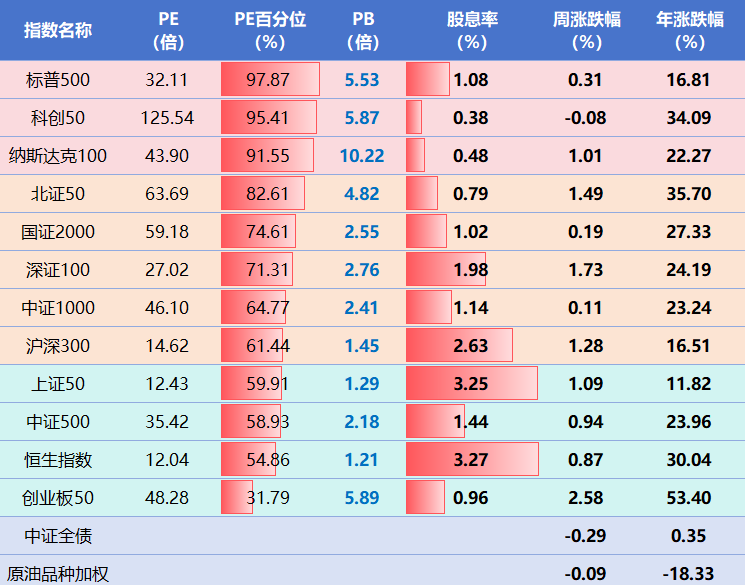
Market Overview - The overall market sentiment is cautiously optimistic, with a focus on the financial sector showing signs of recovery, particularly with major indices rebounding above key levels [1][39] - The current price-to-earnings (PE) ratio for the market is 22.92 times, with a significant stock-bond yield spread of 2.52%, indicating favorable conditions for equity investments [4][42] Sector Performance - The top-performing sectors last week included non-ferrous metals, oil and petrochemicals, and national defense and military industry, while media entertainment, household goods, and real estate saw declines [14][52] - The aerospace and Fujian sectors demonstrated sustained performance, while other sectors experienced rotation, indicating increased operational difficulty in the short term [2][40] Investment Strategies - Short-term strategies should focus on sectors highlighted in the 14th Five-Year Plan, such as controllable nuclear fusion, quantum technology, and commercial aerospace, with a recommendation to maintain trading discipline [2][40] - The long-term outlook remains bullish, with the expectation of a gradual recovery in the market, particularly in sectors with structural opportunities like consumer electronics and AI [9][47] Bond Market Insights - The bond market is currently experiencing low volatility, with the 10-year government bond yield at 1.85%, indicating a stable interest rate environment [11][49] - The yield curve is expected to remain stable unless influenced by significant policy changes or international events [11][49] Emerging Industry Opportunities - The marine economy is gaining attention, with government reports emphasizing the development of deep-sea technology, which is expected to drive growth in related sectors [16][19] - Solid-state batteries are projected to see significant advancements, with energy density potentially exceeding 500Wh/kg, positioning them as a key technology in the future of energy storage [23][28] - The humanoid robotics sector is poised for growth, with increasing demand expected to exceed 100 million units domestically, creating substantial market opportunities for related components [32][35]

11月股指期货市场运行报告
Hua Long Qi Huo· 2025-12-01 01:50
1. Report Industry Investment Rating - Not provided in the report 2. Core View of the Report - The market is expected to maintain a short - term volatile pattern. Although the economic fundamentals show structural improvement, the short - term repair market is insufficient to boost market confidence. The long - term positive trend remains unchanged, but valuation pressure and external uncertainties will restrict the upward space of the index. Investors should be patient and wait for clearer market signals [34]. 3. Summary by Relevant Catalog 3.1 Market Review - In November, the stock index futures market showed an overall volatile and corrective trend, with all major contracts recording monthly declines. Among them, the CSI 500 index futures had the most significant adjustment, followed by the SSE 300 index futures, while the SSE 50 and CSI 1000 index futures were relatively resilient. Specific data for major futures contracts on November 28th: SSE 300 futures (IF) closed at 4,505.8 with a monthly decline of 2.71% (125.6); SSE 50 futures (IH) closed at 2,963.2 with a monthly decline of 1.72% (52.0); CSI 500 futures (IC) closed at 6,974.2 with a monthly decline of 3.70% (- 268.2); CSI 1000 futures (IM) closed at 7,260.8 with a monthly decline of 1.46% (- 107.4) [5]. - In November, all bond futures declined. On November 28th, the 30 - year Treasury bond futures closed at 114.490 with a monthly decline of 1.60% (- 1.86); the 10 - year Treasury bond futures closed at 107.940 with a monthly decline of 0.43% (- 0.465); the 5 - year Treasury bond futures closed at 105.745 with a monthly decline of 0.32% (- 0.245); the 2 - year Treasury bond futures closed at 102.378 with a monthly decline of 0.12% (- 0.120) [6]. 3.2 Fundamental Analysis - In November, the manufacturing PMI was 49.2%, up 0.2 percentage points from the previous month, with improved business levels [7]. - In November, the non - manufacturing business activity index was 49.5%, down 0.6 percentage points from the previous month [11]. - In November, the composite PMI output index was 49.7%, down 0.3 percentage points from the previous month [12]. 3.3 Valuation Analysis - As of November 28th, the PE of the SSE 300 index was 13.94 times, the percentile was 80.2%, and the PB was 1.45 times; the PE of the SSE 50 index was 11.83 times, the percentile was 88.43%, and the PB was 1.29 times; the PE of the CSI 500 index was 32.03 times, the percentile was 76.47%, and the PB was 2.19 times; the PE of the CSI 1000 index was 46.44 times, the percentile was 73.33%, and the PB was 2.44 times [15]. 3.4 Other Data - Stock - bond spread: There are two calculation formulas. One is (1/Index static P/E ratio) - 10 - year Treasury bond yield, and the other is 10 - year Treasury bond yield - Index static dividend yield [28]. - China - Buffett indicator: On November 28, 2025, the ratio of total market capitalization to GDP was 88.25%. The current "total market capitalization/GDP" was at the 87.44% percentile in historical data and the 91.31% percentile in the past 10 - year data [32]. 3.5 Comprehensive Analysis - Macroeconomically, the official manufacturing PMI in November rebounded slightly but remained in the contraction range. The high - tech manufacturing PMI has been in the expansion range for 10 consecutive months, indicating continuous economic structural transformation. The non - manufacturing business activity index declined, with the construction industry showing obvious improvement in business levels and significantly improved market expectations [34]. - In terms of valuation, although the market has adjusted, the valuation percentiles of major indices are still at relatively high historical levels. The ratio of total market capitalization to GDP remains high, indicating that the overall market valuation pressure still exists [34]. 3.6 Operation Suggestions - Adopt a neutral approach, pay attention to layout opportunities after market adjustments, and closely monitor subsequent economic data and policy trends. For unilateral trading, consider bottom - fishing but beware of valuation risks; for arbitrage, stay on the sidelines; for options, consider covered strategies to increase returns [35][36].
10月股指期货市场走势分化
Hua Long Qi Huo· 2025-11-03 05:28
Report Industry Investment Rating - Not provided in the content Core Viewpoints of the Report - In October, the stock index futures market showed a structural differentiation trend. The market is expected to maintain a volatile pattern in the short - term. The economic fundamentals are resilient, and the non - manufacturing sector is expanding, with generally optimistic corporate expectations. However, manufacturing slowdown, external uncertainties, and high valuation levels may affect market confidence and limit the upside space of the index [28][29] - It is recommended to maintain a neutral mindset, pay attention to layout opportunities after market adjustments, and closely track subsequent economic data and policy trends [30] Summary by Relevant Catalogs 1. Market Performance - **Stock Index Futures**: In October, A - share major indices showed differentiation. The Shanghai Composite Index rose 1.85% and had a 6 - month consecutive positive line, while the Shenzhen Component Index and the ChiNext Index both fell by over 1%. Among stock index futures, the CSI 300 futures (IF) was basically flat, the CSI 500 futures (IC) and CSI 1000 futures (IM) closed slightly lower, and the SSE 50 futures (IH) performed outstandingly [5] - **Bond Futures**: In October, all bond futures closed higher. The 30 - year, 10 - year, 5 - year, and 2 - year bond futures had monthly increases of 2.44%, 0.77%, 0.41%, and 0.17% respectively [6] 2. Fundamental Analysis - In October, the manufacturing PMI was 49.0%, down 0.8 percentage points from the previous month, indicating a decline in manufacturing prosperity. The non - manufacturing business activity index was 50.1%, up 0.1 percentage points, entering the expansion range. The composite PMI output index was 50.0%, down 0.6 percentage points, indicating overall stable corporate production and business activities [7][9][12] 3. Valuation Analysis - As of October 31, the PE and PB of major indices such as the CSI 300, SSE 50, CSI 500, and CSI 1000, along with their percentile positions, showed that the overall market valuation attractiveness was limited [13] - The "total market capitalization/GDP" ratio's percentile in historical data was close to 90%, indicating that the overall market valuation pressure still existed [26][28] 4. Other Data - **Stock - Bond Yield Spread**: There are two formulas for calculating the stock - bond yield spread, using the reciprocal of the price - earnings ratio and the dividend yield respectively [21] - **China - Buffett Indicator**: The "total market capitalization/GDP" ratio was 89.80% on November 31, 2025, with a high percentile in historical data, suggesting relatively high market valuation [26] 5. Comprehensive Analysis and Outlook - The market is expected to maintain a volatile pattern in the short - term. Positive factors include economic resilience, non - manufacturing expansion, and positive policy signals. Negative factors include manufacturing slowdown, external uncertainties, and high valuation levels [28][29] 6. Operation Suggestions - **Overall Strategy**: Maintain a neutral mindset, pay attention to layout opportunities after market adjustments, and closely track economic data and policy trends [30] - **Specific Operations**: For single - side trading, buy on dips but beware of valuation risks; for arbitrage, participate in the IM/IH spread convergence strategy and pay attention to style - switching signals; for options, use covered call writing to increase returns or buy put options to hedge against volatility risks [31]