健康牛

Search documents
沪指冲击七连阳!A股融资余额续创新高,深市规模最大的证券ETF(159841)延续涨势,机构:非银金融有望成为春季行情的重要主线
2 1 Shi Ji Jing Ji Bao Dao· 2025-12-25 06:59
Group 1 - The A-share market showed strong performance in the afternoon of December 25, with the Shanghai Composite Index aiming for a seven-day winning streak, and financial stocks were notably active [1] - The CSI All Share Securities Company Index rose by 0.43%, with stocks like Northeast Securities, Caitong Securities, and Huashan Securities experiencing gains [1] - The Securities ETF (159841) aimed for a two-day increase, with a trading volume exceeding 170 million yuan, indicating sustained active trading [1] Group 2 - As of December 24, the latest circulating scale of the Securities ETF was 10.315 billion yuan, ranking first among similar products in the Shenzhen market [2] - The Securities ETF closely tracks the CSI All Share Securities Company Index, which focuses on large-cap securities leaders in the A-share market, including both traditional and fintech leaders [2] - The A-share financing balance reached a historical record of 2.514596 trillion yuan as of December 23, increasing by 14.859 billion yuan from the previous trading day, marking the first time it surpassed 2.5 trillion yuan since the establishment of the A-share margin trading market [2] Group 3 - Galaxy Securities noted that in the current environment, medium to long-term funds are accelerating into the market, maintaining high market activity, and indicating a "healthy bull" trend in the capital market [2] - According to Zhongtai Securities, the market is approaching a phase bottom, making it an optimal time to position for the key trading window before the Spring Festival in the first half of next year [2] - The technology sector, particularly in robotics, nuclear power, commercial aerospace, and the non-bank financial sector, is expected to be a significant focus for the spring market [2]
沪指再创十年新高 机构称股债相关性正在提升
Xin Hua Cai Jing· 2025-11-13 16:03
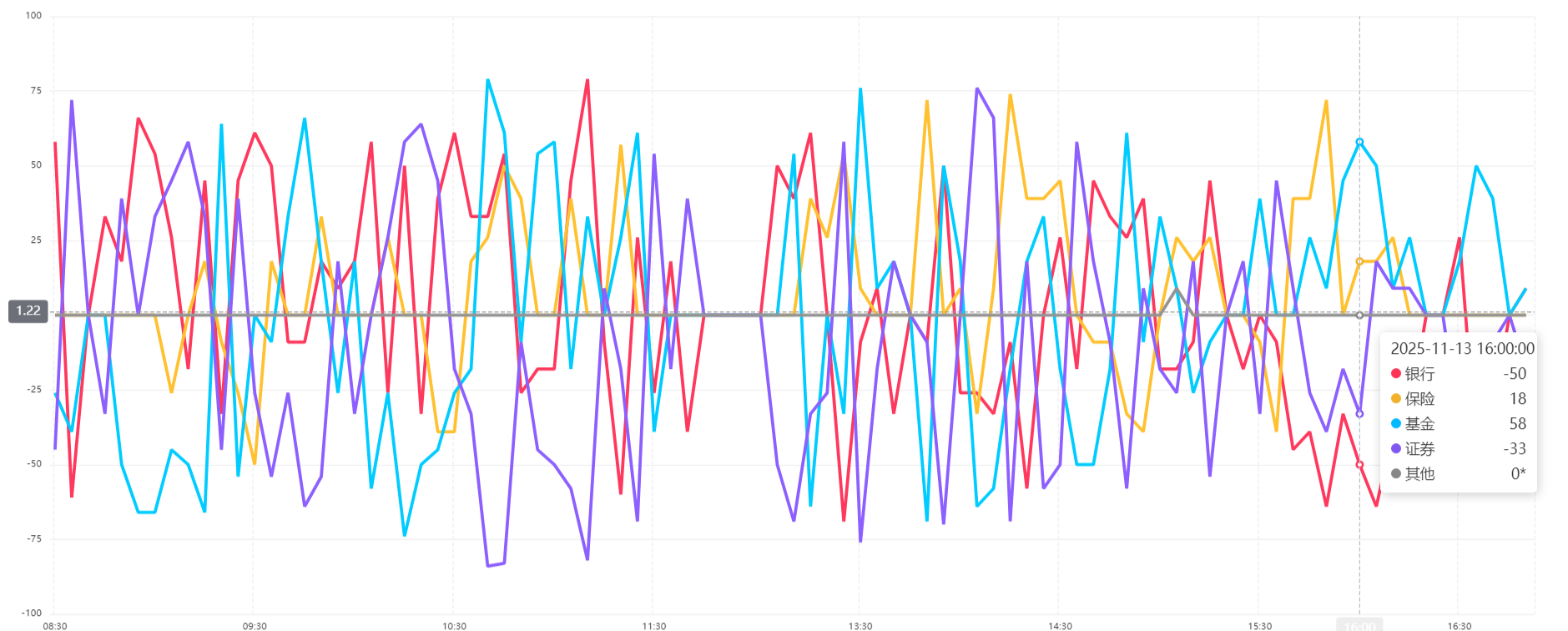
Core Viewpoint - The A-share market is experiencing a strong performance, with the Shanghai Composite Index reaching a ten-year high, indicating a "healthy bull" market driven by both policy and capital inflows [2][3]. Group 1: Market Performance - The Shanghai Composite Index fluctuated around 4000 points since late October and reached a new ten-year high of 4029.5 points on November 13, closing up 0.73% [2]. - The trading volume in the market has been increasing, reflecting heightened investor sentiment and significant capital inflows [2]. Group 2: Bond Market Dynamics - The bond market is under continuous adjustment pressure, with government bond futures showing a slight decline and most bond yields rising [2]. - On November 13, the 30-year, 10-year, 5-year, and 2-year government bond futures all experienced declines, with the 30-year contract down 0.26% [2]. - The yields on major interbank bonds have mostly increased, with the 10-year government bond yield rising by 0.4 basis points to 1.8050% [2]. Group 3: Correlation Between Stocks and Bonds - The correlation between the 10-year government bond yield and the Shanghai Composite Index has increased from -0.6 at the end of 2024 to 0.3 by early November 2025, indicating a significant enhancement in stock-bond correlation [3]. - The insurance sector's stock asset balance reached 3.07 trillion yuan, a year-on-year increase of 47.6%, contributing to the expansion of the "stock-bond seesaw" effect [3]. Group 4: Market Outlook - Analysts suggest that the "stock-bond seesaw" effect is likely to persist in the short term, with bond risk-return ratios declining and institutional rebalancing behavior potentially continuing [6]. - The central bank's monetary policy remains moderately accommodative, supporting market liquidity [6]. - Future projections indicate that the bond market may exhibit characteristics of "low interest rates + high volatility + a bottom and a ceiling," with a higher probability of a stable or slightly elevated interest rate center [6].

时隔十年,A股重返4000点!这次有何不同?
Sou Hu Cai Jing· 2025-10-28 04:38
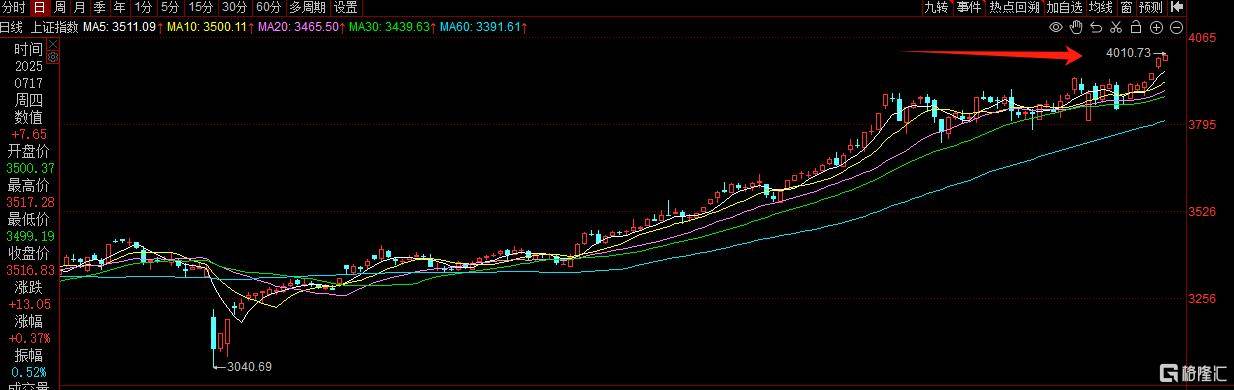
Market Overview - The Shanghai Composite Index has surpassed 4000 points for the first time in ten years, marking a new high since August 19, 2015 [1] - The Shenzhen Component Index and ChiNext Index increased by 0.52% and 1.35% respectively [1] Sector Performance - Coal, rare earths, optical modules, and memory sectors showed significant gains [3] - CPO concept stocks, such as New Yisheng and Zhongji Xuchuang, reached historical highs during the trading session [3] - Agricultural Bank of China saw its stock rise over 1%, approaching a total market value of 3 trillion yuan, while Xiamen Bank surged over 5% and Shanghai Pudong Development Bank dropped over 4% [3] Historical Comparison - The current market conditions differ significantly from previous instances when the index was above 4000 points in 2007, 2008, and 2015 [7] - A-share total market capitalization has increased from 52 trillion yuan in 2015 to 107 trillion yuan in 2025, a growth of 105% [9] - The number of stocks has risen from 2662 to 5440, and the total number of A-share investors has grown from approximately 93.3 million to over 240 million, representing a 157% increase [9] - Financing balance has increased from 1.4 trillion yuan to 2.4 trillion yuan, a 71% rise [9] - Northbound capital holding A-shares has surged to 2.58 trillion yuan, a 2500% increase from the previous billion scale [9] - Public fund holdings have grown from 2 trillion yuan to 7.2 trillion yuan, a 260% increase [9] Market Dynamics - The current market is characterized by a "technology bull" driven by economic transformation and upgrades, contrasting with the "leverage bull" of 2015 [10] - The communication sector, driven by AI computing power, has seen a cumulative increase of 77.5% over the past year, leading the market [10] - Traditional sectors such as consumption, real estate, and energy have underperformed compared to the technology sector [10] Future Outlook - The current market is expected to continue its upward trend, with analysts suggesting that the rise is sustainable and healthy [10] - Short-term fluctuations may occur, but the overall sentiment remains positive, with expectations for new highs in the market [10][11]
宋清辉:时隔十年,沪指重回4000点!或将进入更长期“健康牛”通道
Sou Hu Cai Jing· 2025-10-28 03:29
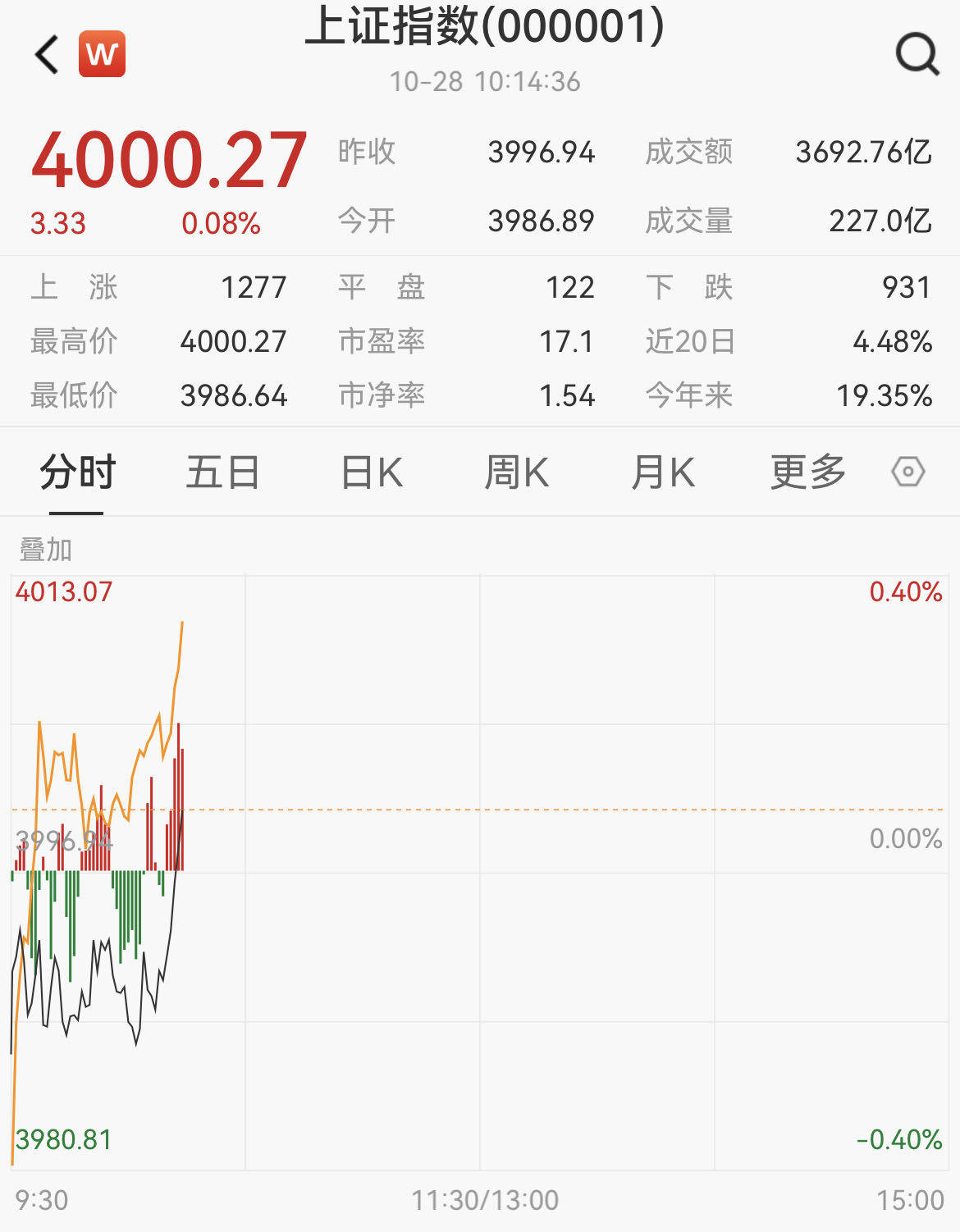
Core Viewpoint - The A-share market has broken through the 4000-point mark for the first time in ten years, indicating strong confidence in China's economic future and capital market reforms, and signaling the start of a new bull market [1][3][7]. Market Performance - On October 28, the Shanghai Composite Index reached 4000.27 points, marking a significant milestone since August 19, 2015 [3]. - The total market capitalization of A-shares increased from approximately 68 trillion yuan to 107.87 trillion yuan within a year, reflecting a surge of 39.87 trillion yuan [3]. - Daily trading volume has significantly increased, with average daily trading exceeding 20 trillion yuan for 40 consecutive trading days, and several days surpassing 30 trillion yuan [4]. Economic Drivers - The rise in the index is attributed to the transformation of China's economy, with a focus on hard technology and new production capabilities, leading to an influx of capital into the market [5][8]. - The current market dynamics differ from the 2015 bull market, which was driven by leverage; the present market is characterized by rational valuations and structural differentiation [8][10]. Future Outlook - Analysts suggest that the 4000-point level may serve as a starting point for a new market cycle, with expectations for continued upward movement in the index [8][10]. - The technology sector is expected to maintain strong performance, potentially leading to a prolonged "healthy bull" market if the current technology cycle continues [10][11]. - Historical data indicates that after minor adjustments in a bull market, sectors with upward trends, such as technology and cyclical industries, are likely to outperform [11].
时隔十年,沪指重回4000点!专家称或进入更长期健康牛通道
天天基金网· 2025-10-28 02:32
Core Viewpoint - The A-share market has entered a new bull market, marked by the Shanghai Composite Index breaking the 4000-point threshold for the first time in ten years, indicating strong confidence in China's economic future and capital market reforms [3][4]. Market Performance - The Shanghai Composite Index has risen significantly from around 2800 points in September 2024 to over 4000 points in October 2025, reflecting a substantial market recovery [3]. - The total market capitalization of A-shares increased from approximately 68 trillion yuan to 106.6 trillion yuan within a year, representing a growth of 38.6 trillion yuan [3]. - Daily trading volume has surged, with average daily trading exceeding 2 trillion yuan for 40 consecutive trading days, peaking at 3.48 trillion yuan [4]. Market Drivers - The current bull market is driven by "hard technology" rather than the "leverage bull" seen in 2015, leading to more rational valuations and significant structural differentiation [6]. - The technology and new energy sectors have been the primary contributors to market gains, with leading stocks like CATL, BYD, and Cambricon reaching new historical highs [3]. Future Outlook - Analysts suggest that the market may experience short-term fluctuations after breaking the 4000-point mark, as some investors may take profits [9]. - The sustainability of the bull market will depend on whether the "hard technology" sector can translate into continuous profit growth [9]. - Historical data indicates that after a bull market adjustment, sectors with upward trends, such as technology and cyclical industries, are likely to outperform [9].

时隔十年,沪指重回4000点!专家称或进入更长期健康牛通道
2 1 Shi Ji Jing Ji Bao Dao· 2025-10-28 02:26
Core Insights - The A-share market has reached a historic milestone with the Shanghai Composite Index surpassing the 4000-point mark for the first time since August 2015, indicating the start of a new market cycle [1][2] Market Performance - The Shanghai Composite Index has seen significant growth, rising from approximately 2800 points in September 2024 to over 4000 points in October 2025, marking a substantial recovery and growth phase [1] - The total market capitalization of A-shares has increased from about 68 trillion yuan to 106.6 trillion yuan within a year, reflecting a surge of 38.6 trillion yuan, driven primarily by emerging industries such as technology and new energy [1] Trading Activity - A-share trading volume and turnover have remained active, with daily trading volumes previously below 800 billion yuan, now reaching peaks of 3.48 trillion yuan, and maintaining over 2 trillion yuan for 40 consecutive trading days [2] - The market's heightened activity is seen as a sign of strong investor confidence in the Chinese economy and capital market reforms [2] Market Dynamics - The current market rally is characterized by a "hard technology-driven" logic, contrasting with the "leverage bull" market of 2015, suggesting a more rational valuation and structural differentiation [3] - Analysts predict that the current market adjustment phase is nearing its end, with expectations of a transition to performance-driven market dynamics in November [3] Future Outlook - Short-term fluctuations may occur following the 4000-point breakthrough, as some investors may take profits, but the long-term outlook hinges on the sustainability of growth in the hard technology sector [4] - Historical trends suggest that after a bull market adjustment, sectors with upward industry trends, particularly technology and cyclical industries, are likely to outperform [5]
A股午后大跳水!3.1万亿资金激烈对决 国家队被曝暗中压盘控节奏?
Sou Hu Cai Jing· 2025-09-22 07:43
Market Overview - On September 18, the A-share market experienced a dramatic reversal, with major indices initially rising but then collectively plunging in the afternoon, leading to a final drop of 1.15% for the Shanghai Composite Index, closing at 3831.66 points [1][6] - The market saw over 4300 stocks decline, with only 1027 stocks rising, indicating a significant sell-off [6] Impact of Federal Reserve's Rate Cut - The Federal Reserve's rate cut, which was expected to be a positive factor, instead triggered profit-taking among investors, as the market had previously risen too quickly [7][14] - The rate cut reduced the federal funds rate target range to 4.00%-4.25%, marking the first cut since 2025, which is expected to ease global liquidity pressures and attract more international funds to A-shares and Hong Kong stocks [14][16] Sector Performance - Despite the overall market decline, certain sectors performed well, particularly the technology growth sector, with AI, semiconductors, and computing hardware stocks showing strong activity [9][14] - The tourism and hotel sectors also saw notable gains, benefiting from government consumption plans and subsidies [9] - Conversely, gold stocks and financial technology stocks faced declines, indicating a mixed performance across sectors [9] Market Dynamics and Future Outlook - The market is undergoing a transition in capital allocation and valuation logic, with a significant focus on hard technology companies, as evidenced by the inclusion of pharmaceutical and AI companies in the FTSE China A50 index [17] - Analysts suggest that while short-term market sentiment may be under pressure, the long-term outlook remains positive due to improved global liquidity from the Federal Reserve's actions, which is expected to support A-shares [18]

兴业证券:A股“健康牛”是切换还是扩散?
智通财经网· 2025-09-21 11:49
Core Viewpoint - The report from Industrial Securities emphasizes the importance of sector rotation in the A-share market, suggesting that a diverse market with multiple sectors performing well is essential for sustainable growth. The current market environment, driven by incremental capital and favorable economic conditions, requires a focus on sector expansion rather than simple high-to-low switching strategies [1][3][6]. Group 1: Market Dynamics - Recent fluctuations in growth sectors indicate increased volatility and high-level oscillation, prompting discussions on whether to switch from high to low positions [1][3]. - The market's structural differentiation and concentrated consensus need to be digested and consolidated, with a recommendation for a rotational approach to manage rhythm fluctuations [3][6]. - The current market is characterized by an "incremental market" where capital behavior has shifted from "moving house" in a stock market to "expanding" in an incremental market, making the "expansion logic" more applicable [3][6]. Group 2: Sector Focus - Key sectors to watch include Hong Kong internet, military industry, innovative pharmaceuticals, new energy, new consumption, and "anti-involution" & cyclical sectors (non-ferrous metals, chemicals) [11][20][36]. - The Hong Kong internet sector is highlighted for its potential rebound, driven by external liquidity and AI expansion, with significant room for growth compared to A-share TMT sectors [11][14]. - The military sector is expected to benefit from upcoming five-year planning meetings, historically showing strong performance leading up to such events [17][20]. Group 3: Innovative Pharmaceuticals - The innovative pharmaceutical sector is experiencing a reduction in crowding, with a notable release of pressure and a shift towards commercialization, leading to improved performance from leading companies [24][25]. - The sector is witnessing a surge in product approvals and international licensing deals, indicating a strengthening global competitive position for domestic pharmaceutical companies [24][25]. Group 4: New Energy Sector - The new energy sector is positioned for growth due to technological breakthroughs and a focus on "anti-involution" policies, which are expected to attract funds seeking flexible returns [26][29]. - The sector's recovery is supported by improved supply-demand dynamics and a significant reduction in inventory levels, indicating a potential for performance stabilization [29][30]. Group 5: New Consumption Trends - New consumption sectors are anticipated to benefit from seasonal catalysts and improved economic outlooks, with a focus on structural changes driven by the rise of Generation Z [31][34]. - The current low crowding levels in new consumption sectors present opportunities for rotation and potential growth as consumer trends evolve [31][34]. Group 6: Anti-Involution and Cyclical Sectors - The "anti-involution" policy is seen as a long-term theme that will influence various sectors, particularly those with historical low profitability and capital expenditure [36][37]. - The report highlights the importance of evaluating sectors based on their willingness to participate in anti-involution efforts, with a focus on traditional industries like steel, glass, and new energy supply chains [36][37].

“健康牛”:以景气为锚作扩散
Sou Hu Cai Jing· 2025-09-16 08:05
Group 1 - The market has entered a rotation and diffusion phase, which is expected to continue in the near future [1][2] - Investment effectiveness is improving as the market shifts its focus towards economic conditions and industry trends [1][2] - The report suggests five key areas for investment: Hong Kong internet stocks, innovative pharmaceuticals, breakthroughs in new energy technology, new consumption, and cyclical industries driven by multiple catalysts [1][2] Group 2 - The report indicates that the market is looking for signs of economic improvement as it approaches the earnings season [1][2] - The sentiment towards innovative pharmaceuticals has fully digested, leading to a revaluation driven by business development and commercialization [1][2] - New consumption is highlighted as having high odds, with seasonal catalysts expected to enhance success rates [1][2]

兴业证券:健康牛结构比节奏重要 以景气为锚作扩散寻找机会
智通财经网· 2025-09-14 23:38
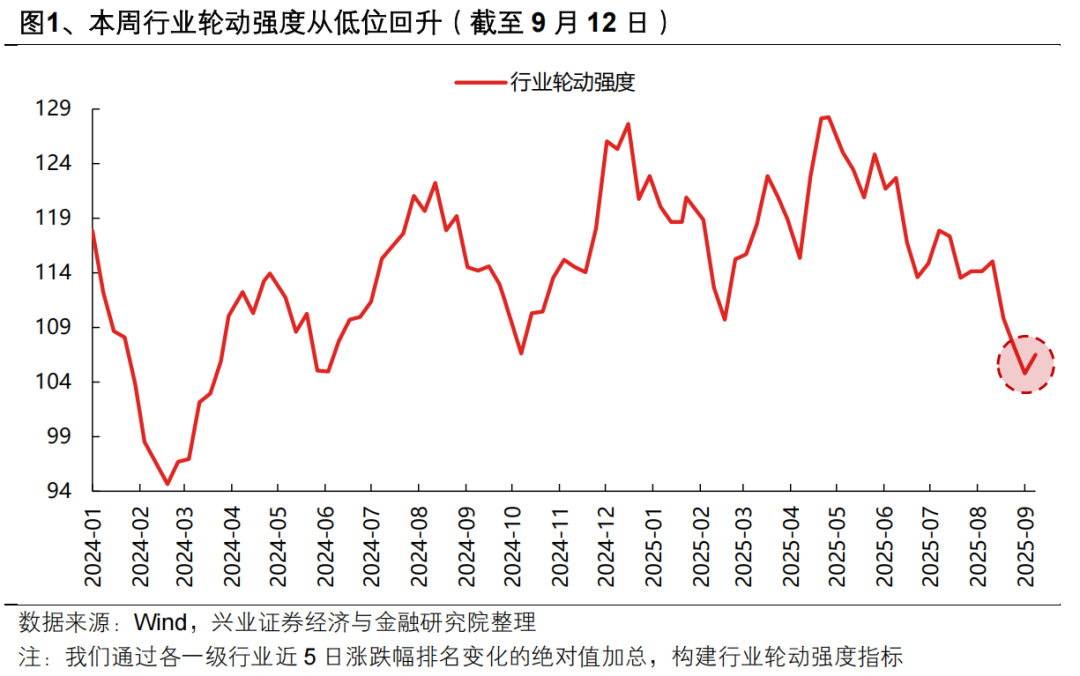
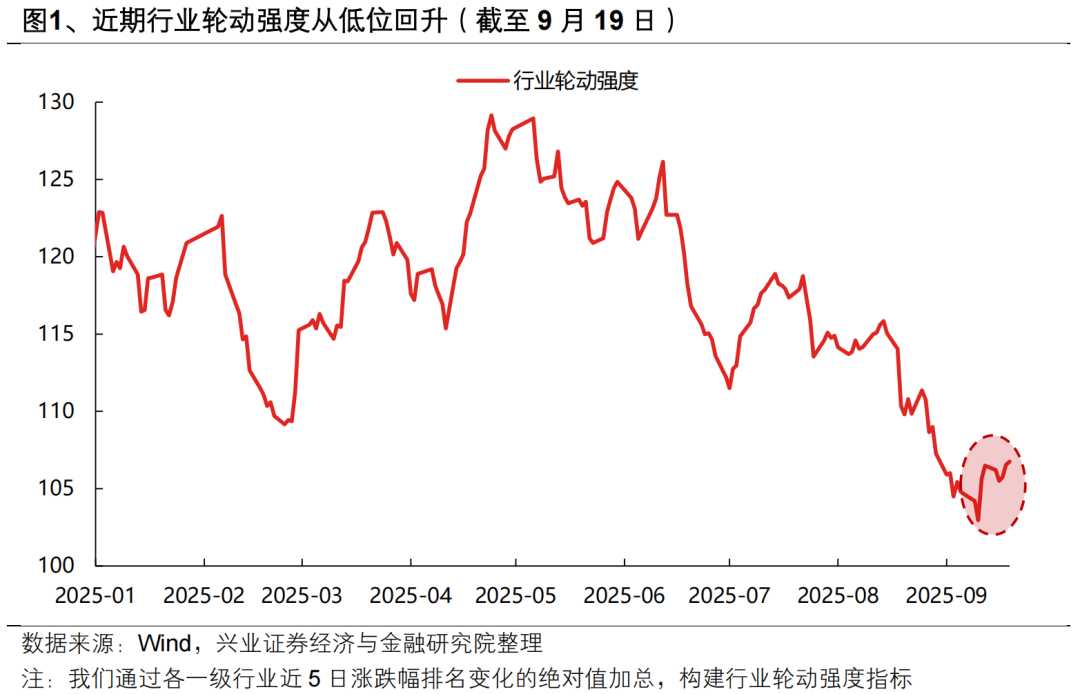
Group 1 - The market is transitioning from extreme differentiation to a phase of rotation and diffusion, with structural changes being more important than rhythm in a healthy bull market [1][4] - The industry rotation intensity indicator has started to recover from previous lows, indicating that the market is seeking opportunities through rotation and diffusion [1][4] - Seasonal patterns suggest that September is a traditional window for industry rotation to increase, providing opportunities for new growth directions [5][8] Group 2 - The focus should be on expanding based on economic and industrial trends rather than merely seeking low positions, enhancing the probability of success [8][10] - The second half of September to October is a period where the effectiveness of economic investments is expected to improve, with stock prices becoming more correlated with performance as the third-quarter reporting period approaches [8][10] Group 3 - Key sectors to focus on include Hong Kong internet, innovative pharmaceuticals, new energy, new consumption, and cyclical industries (non-ferrous metals, chemicals) [15][19] - The Hong Kong internet sector has significant room for rebound due to macroeconomic conditions and industry trends, particularly with the upcoming interest rate cuts and advancements in AI [16][19] - The innovative pharmaceutical sector has seen sufficient emotional digestion, with leading companies like BeiGene and WuXi AppTec showing strong performance [21][22] Group 4 - The new energy sector is expected to attract funds seeking flexible returns, driven by technological breakthroughs and a reversal of previous downturns [23][26] - The new consumption sector is positioned for potential gains due to low crowding and seasonal catalysts from upcoming holidays, making it a promising area for investment [29][32] Group 5 - The cyclical industries (non-ferrous metals, chemicals) are benefiting from overseas monetary easing and a reversal of previous competitive pressures, providing multiple catalysts for growth [35]