电商平台

Search documents
拼多多第三季度营收1082.8亿元,同比增长9%
3 6 Ke· 2025-11-18 12:25
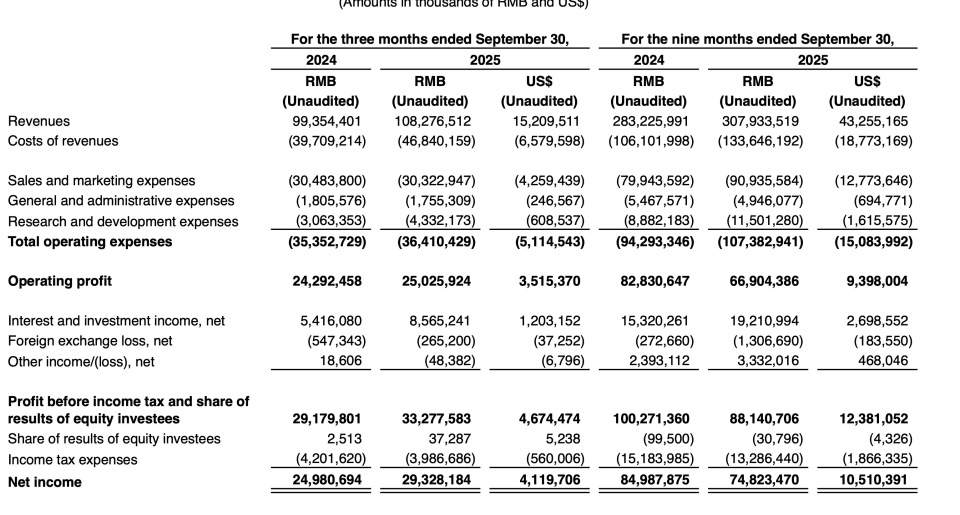
Core Viewpoint - Pinduoduo's Q3 earnings exceeded Wall Street expectations for earnings per share, but revenue fell short, leading to a pre-market stock price drop of over 4% [1] Financial Performance Summary - Total revenue for Q3 was RMB 108.3 billion (approximately USD 15.2 billion), a 9% increase from RMB 99.3 billion in the same period last year, but below Wall Street's average expectation of RMB 108.7 billion [2] - Revenue from online marketing services and others was RMB 53.4 billion (approximately USD 7.5 billion), an 8% increase from RMB 49.3 billion year-on-year; revenue from transaction services was RMB 54.9 billion (approximately USD 7.7 billion), a 10% increase from RMB 50.0 billion year-on-year [2] - Total cost of revenue was RMB 46.8 billion (approximately USD 6.6 billion), an 18% increase from RMB 39.7 billion year-on-year, primarily due to increased fulfillment costs, bandwidth and server costs, and payment processing fees [3] - Total operating expenses were RMB 36.4 billion (approximately USD 5.1 billion), compared to RMB 35.4 billion in the same period last year; sales and marketing expenses were RMB 30.3 billion (approximately USD 4.3 billion), slightly down from RMB 30.5 billion; general and administrative expenses were RMB 1.8 billion (approximately USD 0.25 billion), down from RMB 1.8 billion; R&D expenses were RMB 43.3 billion (approximately USD 6.1 billion), a 41% increase from RMB 30.6 billion [3] - Operating profit was RMB 25.0 billion (approximately USD 3.5 billion), compared to RMB 24.3 billion year-on-year; non-GAAP operating profit was RMB 27.1 billion (approximately USD 3.8 billion), compared to RMB 26.8 billion year-on-year [3] Net Income and Earnings Per Share - Net income attributable to ordinary shareholders was RMB 29.3 billion (approximately USD 4.1 billion), a 17% increase from RMB 24.9 billion year-on-year; non-GAAP net income attributable to ordinary shareholders was RMB 31.4 billion (approximately USD 4.4 billion), a 14% increase from RMB 27.5 billion year-on-year [4] - Basic and diluted earnings per American Depositary Share (ADS) were RMB 20.96 (approximately USD 2.94) and RMB 19.70 (approximately USD 2.77), respectively, compared to RMB 18.02 and RMB 16.91 year-on-year; non-GAAP diluted earnings per ADS were RMB 21.08 (approximately USD 2.96), compared to RMB 18.59 year-on-year, exceeding Wall Street's average expectation of RMB 16.57 [4] Cash Flow and Financial Position - Net cash provided by operating activities was RMB 45.7 billion (approximately USD 6.4 billion), compared to RMB 27.5 billion year-on-year [5] - As of September 30, 2025, Pinduoduo held cash, cash equivalents, and short-term investments totaling RMB 423.8 billion (approximately USD 59.5 billion), up from RMB 331.6 billion as of December 31, 2024 [5] Management Commentary - The Chairman and Co-CEO expressed commitment to social responsibility and long-term development in the e-commerce ecosystem as the company celebrates its tenth anniversary [6] - The Executive Director and Co-CEO emphasized a focus on long-termism and continued investment in merchant support programs to drive sustainable development [6] - The CFO noted that revenue growth is moderating, reflecting ongoing competitive dynamics and external uncertainties, with potential for quarterly fluctuations in financial performance [6]


拼多多:Q3营收1082.8亿元,同比增长9%
Feng Huang Wang· 2025-11-18 11:20
Core Insights - Pinduoduo reported Q3 2025 total revenue of 108.2765 billion yuan (approximately 15.2095 billion USD), a 9% increase from 99.3544 billion yuan in Q3 2024, driven primarily by online marketing services and transaction service revenue [1] - The company's operating profit reached 25.0259 billion yuan (approximately 3.5154 billion USD), compared to 24.2925 billion yuan in the same period last year, while non-GAAP operating profit was 27.0794 billion yuan (approximately 3.8038 billion USD) [1] - Net profit attributable to ordinary shareholders was 29.3282 billion yuan (approximately 4.1197 billion USD), a 17% increase from 24.9807 billion yuan in Q3 2024, with non-GAAP net profit at 31.3817 billion yuan (approximately 4.4082 billion USD), up 14% [1] Revenue Breakdown - Online marketing services and other income amounted to 53.3476 billion yuan (approximately 7.4937 billion USD), an 8% increase from 49.3510 billion yuan in Q3 2024 [2] - Transaction service revenue was 54.9289 billion yuan (approximately 7.7158 billion USD), reflecting a 10% growth from 50.0034 billion yuan in the same quarter last year [2] Cost and Expenses - Total revenue cost was 46.8402 billion yuan (approximately 6.5796 billion USD), an 18% increase from 39.7092 billion yuan in Q3 2024, primarily due to rising fulfillment costs, bandwidth and server costs, and payment processing fees [2] - Total operating expenses were 36.4104 billion yuan (approximately 5.1145 billion USD), compared to 35.3527 billion yuan in the same period last year [2]
拼多多“千亿扶持”半年耕耘成果初显
Sou Hu Cai Jing· 2025-11-18 11:14
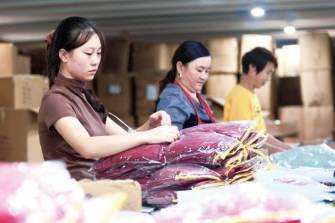
Core Insights - Pinduoduo's "100 Billion Support" initiative is driving high-quality development in e-commerce, enabling more regions to enjoy convenient online shopping services and share the benefits of e-commerce growth [1][3][10] Group 1: Business Strategy - The "100 Billion Support" program was launched in early April to invest heavily in building a high-quality e-commerce ecosystem, aiming for a win-win situation among users, merchants, and the platform [1][3] - Pinduoduo has increased support for small and medium-sized businesses, new quality merchants, and brand merchants, leading to a 51% year-on-year growth in quality product SKUs [3][5] - The number of merchants has accelerated, with a 42% increase in the number of merchants born in the 1995 and 2000 generations [3][7] Group 2: Agricultural Support - Pinduoduo is committed to promoting agricultural products, with the "Duoduo Good Specialty" initiative exploring new models for agricultural product sales and helping farmers increase income [4][5] - The initiative has successfully introduced customized development plans for hundreds of agricultural merchants across various regions, enhancing the value of agricultural products [4][5] - The sales of agricultural products on the platform have grown by 47% year-on-year, with a significant increase in the number of agricultural merchants [5][6] Group 3: Market Expansion - Pinduoduo is expanding its consumer base by reducing logistics costs for remote areas, allowing more consumers in western regions to access quality products [8][9] - The platform has eliminated logistics transfer fees for regions like Qinghai, Gansu, Tibet, and Inner Mongolia, significantly improving delivery times [8][9] - The initiative has led to a notable increase in orders from county-level areas, with consumers now enjoying the same online shopping conveniences as those in urban areas [8][9] Group 4: Future Outlook - Pinduoduo plans to continue focusing on sustainable development and expanding its services to cover broader regions, leveraging the "100 Billion Support" initiative [10]
拼多多:第三季度营收1082.8亿元,同比增长9%
Di Yi Cai Jing· 2025-11-18 10:49
拼多多财报显示,公司第三季度营收1082.8亿元,同比增长9%;调整后净利润313.8亿元,同比增长 14%。 ...
拼多多Q3营收1083亿元,同比增长9%
Xin Lang Ke Ji· 2025-11-18 10:44
责任编辑:何俊熹 新浪科技讯 11月18日晚间消息,拼多多发布了第三季度的财报,第三季度营收1083亿元,去年同期 993.54亿元,同比增长9%,预估1075.9亿元;调整后净利润313.8亿元,同比增长14%,环比下滑。本季 度,拼多多"千亿扶持"继续加大对生态建设的投入,持续为商家减免服务费,提供流量和资源扶持。随 着"千亿扶持"的重磅投入,或将持续影响拼多多未来几个季度的业绩表现。 ...
拼多多(PDD.US)“千亿扶持”半年记:聚焦价值,实现共赢
Ge Long Hui· 2025-11-18 07:15
Core Insights - The article discusses the transition of the e-commerce industry from a focus on traffic competition to high-quality development, emphasizing the dual themes of "supply upgrade" and "consumer inclusivity" [1] - Pinduoduo's "100 Billion Support" plan, launched in April, aims to invest over 100 billion yuan in resources to assist merchants in achieving high-quality growth, which has begun to show positive results within six months [1][6] Group 1: Supply and Demand Dynamics - The "100 Billion Support" plan focuses on enhancing both supply quality and demand potential, creating a resonant ecosystem through targeted investments [2] - On the supply side, Pinduoduo has shifted from traditional subsidy models to systematic cultivation of quality supply, with key initiatives in agricultural products and industrial upgrades [2] - The "Duoduo Good Specialty" initiative has provided comprehensive support to merchants, resulting in a 47% year-on-year increase in agricultural product sales and a 54% growth in quality agricultural SKUs [2][3] Group 2: Manufacturing Sector Transformation - In the manufacturing sector, the "New Quality Supply" initiative addresses transformation challenges, enabling local businesses to shift from wholesale to direct online sales, leading to significant operational improvements [3] - The report indicates that under the "New Quality Supply" initiative, the number of quality SKUs in industrial belts has increased by over 50%, highlighting the potential for brand development in traditional industries [3] Group 3: Consumer Inclusivity and Logistics Optimization - The demand-side investments focus on "consumer inclusivity," breaking down regional barriers through logistics optimization and subsidy upgrades [3] - Initiatives such as reducing logistics fees for remote areas and establishing new transfer warehouses have significantly improved delivery times and expanded coverage to previously underserved regions [3] Group 4: Strategic Shifts in Competition - Pinduoduo's support plan aims to shift the industry from low-level competition based on price and traffic to a high-quality development phase characterized by value and ecosystem competition [4] - The company is redefining the "cost-value" relationship, achieving sustainable high-quality price ratios through various strategies, including logistics optimization and data empowerment [4] - The platform is transitioning from a traditional intermediary role to an "ecosystem builder," providing comprehensive support to merchants and consumers while promoting digital transformation in agriculture and manufacturing [5] Group 5: Conclusion and Future Outlook - The "100 Billion Support" plan has demonstrated significant results in revitalizing supply and demand, enhancing product quality, and expanding consumer inclusivity [6] - This initiative serves as a viable case for high-quality transformation in the e-commerce industry, emphasizing supply upgrades, digital empowerment, and shared benefits as key components for sustainable growth [6] - The ongoing expansion of the "free shipping zone," acceleration of brand development in industrial belts, and the rise of young merchants will further refine the value co-creation ecosystem established by Pinduoduo [6]
漫长的季节:史上最长双十一,淘天和商家的十字路口
Sou Hu Cai Jing· 2025-11-18 01:45
Group 1 - The core point of this year's Double Eleven shopping festival is that it has become the longest in history, lasting 159 days, which is 4 days longer than last year, with major platforms averaging over 30 days of promotion [2][3] - During this year's Double Eleven, the total sales reached approximately 1.70 trillion yuan, a year-on-year increase of 14.2%, while the comprehensive e-commerce transaction volume grew by 12.3% [3][4] - The average daily sales during this year's Double Eleven were 462.6 billion yuan, indicating an 11% year-on-year decline, suggesting that the event has become less effective in stimulating consumer interest [4][8] Group 2 - The stagnation in the e-commerce market has led platforms to adopt strategies that may not be sustainable, as they attempt to maintain the appearance of growth [5] - The changing financial reporting metrics of major platforms, such as the shift from GMV to CMR and active buyer metrics, complicates the evaluation of their performance [7][8] - The lack of transparency regarding GMV growth in financial reports raises concerns about the competitive position of platforms like Taobao and Tmall [8][9] Group 3 - In response to limited GMV growth, platforms are increasing their take rates, which places additional financial pressure on merchants [9][10] - The introduction of new fees, such as a 0.6% technical service fee and full-site promotion costs, is aimed at increasing revenue from merchants [10][11] - Merchants are facing a complex fee structure that significantly reduces their profit margins, leading to dissatisfaction and potential exits from the platform [14][15][18] Group 4 - Other platforms, such as Xiaohongshu and Pinduoduo, are implementing measures to reduce costs for merchants, contrasting with Taobao's approach [26][27] - Alibaba's significant investments in AI and instant retail are driving the need for higher fees from merchants to support these initiatives [28][29][30] - The current strategy of increasing fees on merchants may lead to a long-term decline in merchant satisfaction and retention [30][31]


京东外卖APP上线!刘强东承诺京东点评永不商业化
Zheng Quan Shi Bao· 2025-11-17 15:04
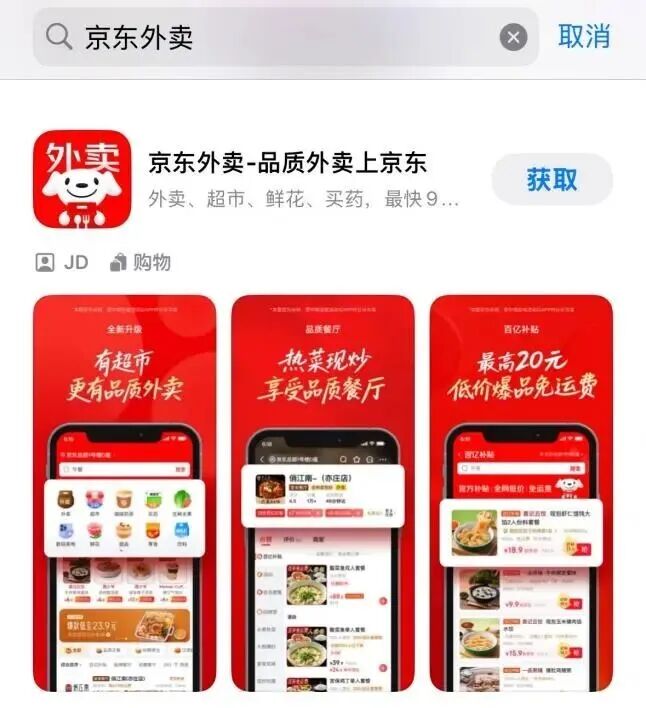
Core Insights - JD.com has launched an independent food delivery app to enhance user convenience and experience [1][2][4] - The company introduced several new products, including JD Review and JD True List, aimed at improving local life services and leveraging its "super supply chain" capabilities [1][4] - JD.com emphasizes that its review and ranking services will never be commercialized to ensure fairness and objectivity [1][5] Group 1: JD Food Delivery App - JD.com officially launched its independent food delivery app, which is now available for download on the Apple App Store [2] - The app aims to meet the growing demand for deep user engagement and enhance user experience through product innovation [4] - The JD Food Delivery App integrates with JD Review to provide comprehensive consumer references for dining and entertainment [4] Group 2: JD Review and JD True List - JD Review utilizes AI technology to analyze data from various sources, providing objective evaluations of restaurants, hotels, and attractions [4][5] - JD True List ranks dining and hospitality options based on user preferences and feedback, ensuring a diverse range of choices for consumers [5][6] - The company has committed to never commercializing its review services to maintain integrity and avoid biased rankings [5][6] Group 3: User Engagement and Quality Assurance - JD.com is recruiting 100,000 "JD Truth Officers" to conduct blind tests for the JD True List, ensuring unbiased evaluations [5][6] - The evaluation process includes a "buy-eat-separate" mechanism to eliminate external influences on food quality assessments [6][7] - The first blind testing event for the JD True List will take place in Beijing, with a list of qualifying dishes already announced [7]

“官僚主义”缠身的亚马逊,开始被多面夹击
虎嗅APP· 2025-11-17 13:49
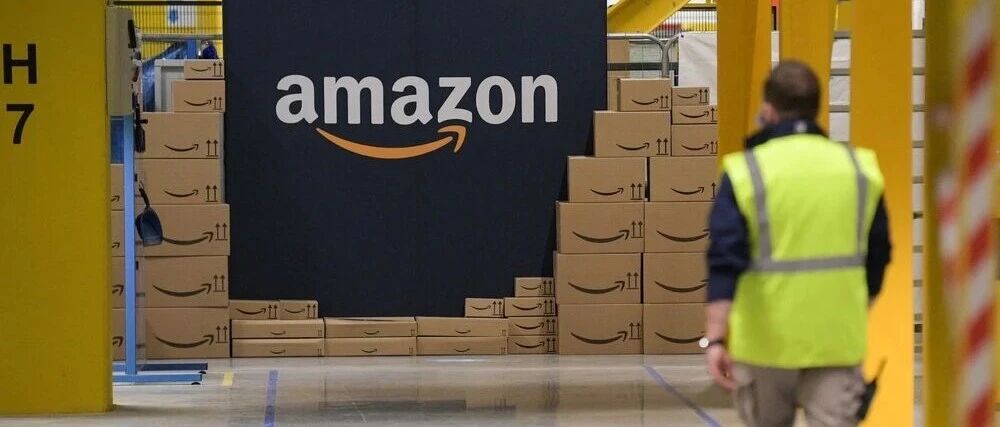
Core Insights - Amazon has announced a significant layoff of 14,000 corporate positions, marking its largest workforce reduction since 2022, primarily affecting human resources, cloud computing, and seller management teams [4][5][6] - The layoffs have raised concerns about the impact on Amazon's operations in China, where some departments have reportedly seen a 50% reduction in staff and management authority has shifted to the U.S. [6][7] - The competitive landscape for Chinese sellers is shifting, with platforms like Temu and AliExpress gaining traction, leading to a decline in Amazon's attractiveness to these sellers [8][10] Group 1: Layoffs and Internal Challenges - Amazon's layoffs are part of a broader restructuring effort, with the seller management team facing a 50% reduction in workforce [4][6] - The layoffs have exacerbated existing issues regarding customer service for Chinese sellers, who already faced challenges in accessing support from Amazon [7][10] - Internal reports indicate that Amazon's organizational culture has become bureaucratic, leading to slow decision-making processes and inefficiencies [22][23] Group 2: Competitive Landscape - Temu and AliExpress have emerged as significant competitors, with Temu capturing 17% of the U.S. e-commerce market in just two years, while AliExpress has launched initiatives to attract sellers with lower costs [8][12][13] - Walmart has also ramped up its efforts to recruit Chinese sellers, with the proportion of new sellers from China increasing from less than 1% in 2021 to 34% in 2025 [12][37] - The competition is intensifying, with platforms offering lower commission rates and better service capabilities to attract sellers away from Amazon [29][34] Group 3: Seller Sentiment and Financial Performance - Many sellers report increasing pressure from Amazon's high costs, with some stating that advertising budgets need to be significantly higher to achieve profitability [10][30] - Despite challenges, the number of Chinese sellers achieving over $1 million in sales on Amazon has grown by nearly 55% in the past two years, indicating that Amazon still provides value to some sellers [45] - The ongoing competition for Chinese sellers is forcing all platforms to enhance their offerings and reduce costs to retain seller loyalty [46]


电商平台如何做控价?控价关键方法解析!
Sou Hu Cai Jing· 2025-11-17 11:46
Core Viewpoint - The issue of product price chaos on e-commerce platforms like Taobao, Pinduoduo, and Douyin is becoming a significant obstacle for brand development, necessitating a dual control pricing system that combines self-management and professional assistance to stabilize pricing foundations [1] Group 1: Internal Control Mechanisms - Establishing robust internal pricing rules is the first line of defense against price chaos, requiring brands to create a comprehensive pricing control framework that defines baseline prices, promotional prices, and distribution price fluctuations [3] - Pricing control should be integrated into distributor agreements, clearly outlining penalties for price violations, which may include fines, reduced supply, or termination of authorization, thereby creating a tiered penalty system to regulate distributor behavior [3] Group 2: Distributor Engagement - Activating distributor cooperation transforms pricing control from a brand-centric approach to a collective effort, encouraging distributors to adhere to pricing through incentives such as rebates, advertising resources, and priority access to popular products [3] - Establishing a reporting channel for price violations allows distributors to report infractions, with cash rewards or points for valid reports, fostering a culture of mutual supervision and price protection [3] Group 3: Professional Tools and Third-Party Support - Brands face challenges in self-price control due to the difficulty of comprehensive monitoring and low complaint success rates, making the use of professional tools or third-party pricing agencies an efficient solution [4] - Implementing price monitoring systems enables 24/7 scanning across platforms to capture low-price and unauthorized links, while third-party agencies can leverage their industry expertise to enhance complaint success rates and provide tailored pricing control solutions [4] Group 4: Intellectual Property Protection - Strengthening intellectual property (IP) frameworks is essential for effective pricing control, as IP serves as a core basis for complaints on e-commerce platforms [4] - Brands should register trademarks, patents, and copyrights to establish a robust IP protection system, allowing for prioritized complaint processing and legal recourse against repeat offenders [4] Group 5: Dynamic Pricing Control Process - E-commerce pricing control is not a one-time effort but a dynamic process involving rule formulation, execution supervision, and optimization adjustments [5] - Brands must build a multi-dimensional, full-link pricing control system to maintain price integrity, protect brand image, and ensure distributor interests, which is crucial for steady growth in a competitive e-commerce landscape [5]