奢侈品

Search documents
高端运动补位奢侈品,读懂中国高端消费的变迁
36氪· 2025-12-17 15:18
Core Viewpoint - The article discusses the shift in high-end consumer behavior in China, highlighting the decline of traditional luxury brands and the rise of professional sports brands as key players in the retail space [2][31]. Group 1: Traditional Luxury Brands' Retreat - Major luxury brands, except for Hermès, have been closing stores in China since the second half of 2024, indicating a shift in market dynamics [5]. - Brands like LV and DIOR have already closed stores in key locations, reflecting the pressure on the luxury goods sector [5]. - The actions of these brands often precede their financial reports, signaling a challenging environment for the luxury industry [5]. Group 2: Rise of Professional Sports Brands - In contrast to luxury brands, high-end sports brands are expanding their presence in core urban areas, opening flagship stores and enhancing store specifications [6]. - These brands exhibit resilience during a period of slowing growth in the luxury sector, driven by high repurchase rates and strong user engagement within professional communities [6]. - DESCENTE's flagship store in Beijing, located in a prime commercial area, signifies a shift in consumer preferences towards professional sports brands [7][24]. Group 3: DESCENTE's Strategic Positioning - DESCENTE's approach is characterized by a systematic strategy that combines professional sports engagement with urban retail narratives [9][30]. - The brand's flagship store, "Future City," serves as a medium for expressing its values and connecting with consumers, moving beyond mere retail to become a space for brand storytelling [13][15]. - DESCENTE's strategy includes deepening connections with professional sports communities and establishing a presence in urban centers, thereby appealing to elite consumers [16][17]. Group 4: Changing Consumer Values - The luxury market is experiencing a transition from ostentatious consumption to more rational spending, with consumers reassessing what expenditures are worthwhile [32][33]. - The sports industry is projected to grow significantly, with the Chinese sports market expected to reach 5 trillion yuan by 2025, indicating a shift towards high-end sports consumption [35]. - As professional sports become more integrated into everyday life, brands like DESCENTE must provide not just products but also a lifestyle and community that resonate with new middle-class consumers [36].

中信证券:资本市场表现与黄金价格上行带来的财富效应为奢侈品、高端旅游及博彩等顺周期板块提供了需求支撑
Xin Lang Cai Jing· 2025-12-17 05:34
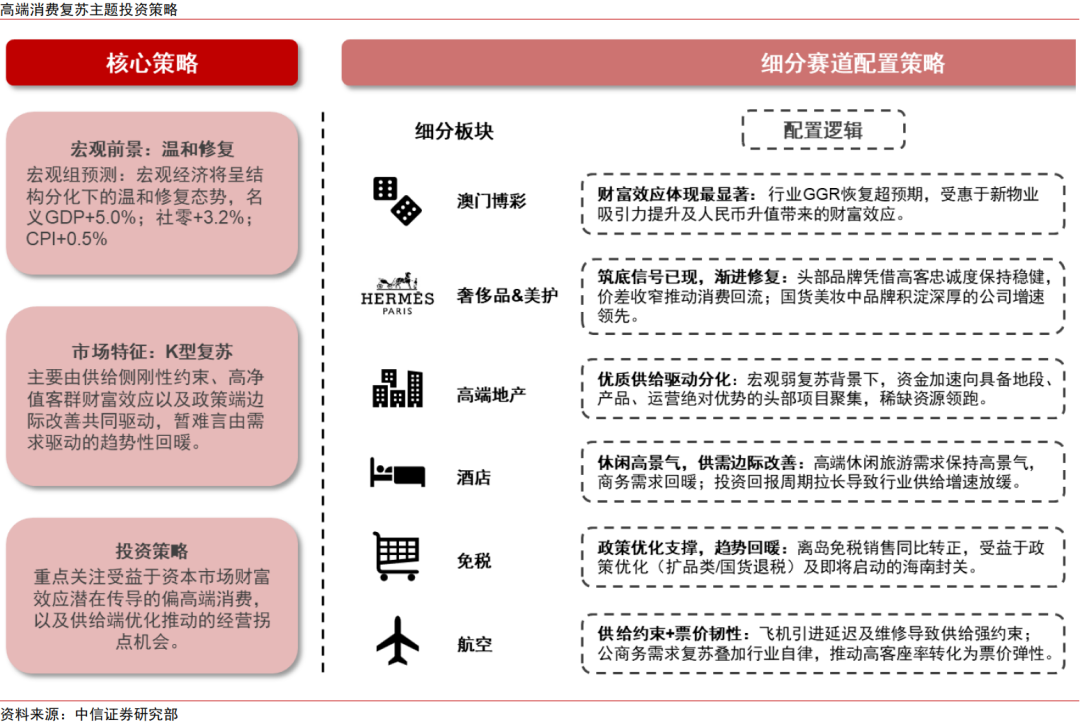
Core Viewpoint - The report from CITIC Securities indicates that the current Chinese consumer market exhibits a significant "K-shaped recovery" characteristic, with a clear divergence between the rebound in the consumption sector and the moderate recovery of mass consumption [1] Group 1: Market Dynamics - The divergence in the market is primarily driven by supply-side rigid constraints, the wealth effect from high-net-worth individuals, and marginal improvements in policy [1] - The aviation industry faces limitations in effective capacity growth due to delays in aircraft introduction and engine maintenance [1] Group 2: Sector Performance - High-end retail properties and luxury hotels are achieving leading recovery in foot traffic and revenue due to their scarce locations and brand barriers, despite pressure on demand [1] - The performance of the capital market and the rise in gold prices are providing demand support for cyclical sectors such as luxury goods, high-end tourism, and gaming [1] Group 3: Policy Impact - Industry self-regulatory agreements have effectively solidified the bottom line for airline ticket prices and yields [1] - The optimization of the offshore duty-free policy and the imminent closure of Hainan create potential incremental space for growth [1] Group 4: Investment Opportunities - The report suggests focusing on operational turning point opportunities driven by the transmission of wealth effects and supply-side optimization, particularly in high-end consumption sectors such as outbound tourism, hotels, gaming, duty-free, luxury goods, high-end beauty care, and premium real estate properties [1]

中信证券:消费市场体现“K型复苏”特征 关注财富效应传导、供给端优化推动的经营拐点机会
Zhi Tong Cai Jing· 2025-12-17 01:04
Core Viewpoint - The report from CITIC Securities indicates that certain high-end consumer sectors in China, including luxury goods, high-end beauty, air travel, and high-end residential markets in core cities, have generally outperformed previous market expectations, reflecting a significant "K-shaped recovery" in the consumer market [1] High-End Consumer Sectors - The luxury goods and high-end beauty market in China showed signs of stabilization in Q3 2025, entering a gradual recovery phase, with top brands like Hermès maintaining steady sales due to high customer loyalty [6] - The Macau gaming sector demonstrated a notable recovery, with gross gaming revenue (GGR) in November increasing by 14.4% year-on-year to 21.09 billion MOP, recovering to 92% of the levels seen in the same month of 2019 [4] - The high-end retail properties and luxury hotels have achieved a leading recovery in foot traffic and revenue due to their scarcity and brand barriers, despite overall demand pressures [1][4] Policy and Market Dynamics - Policy improvements, such as the optimization of the offshore duty-free policy and the upcoming closure of Hainan, are expected to create potential incremental space for growth in the luxury sector [1] - The report emphasizes the importance of wealth effect transmission and supply-side optimization in driving operational turning points, particularly in high-end consumption areas like outbound tourism, hotels, gaming, and luxury goods [1][15] Real Estate Market - The high-end real estate market is characterized by a "K-shaped recovery" driven by quality supply, with capital and purchasing power increasingly concentrating on top projects with absolute advantages in location, product, brand, and operation [9] - The overall recovery in the real estate market remains slow, with a complex macro environment and high unemployment rates impacting consumer confidence [7] Hotel Industry - The mid-to-high-end hotel sector saw an average RevPAR increase of approximately 4% year-on-year in October-November 2025, benefiting from strong leisure tourism and a slight recovery in business demand [11] - The supply growth in the hotel industry is expected to slow down from 7%-8% in 2025 to 5%-6% in 2026 due to extended investment return cycles [11] Duty-Free Market - The offshore duty-free sales in Hainan showed signs of recovery, with sales turning positive in September and expanding in October-November, supported by wealth effect transmission and policy optimization [12] - The upcoming full closure of Hainan in December 2025 is anticipated to further enhance the overall development of the tourism retail market [12] Aviation Sector - The aviation industry faces supply constraints due to delays in aircraft introductions and engine repairs, which limit effective capacity growth [14] - Demand recovery and structural optimization are expected to accelerate, with airlines optimizing route structures to enhance profitability [14]
顶级富二代,被骗150亿
36氪· 2025-12-17 00:09
Core Viewpoint - The article discusses the downfall of Nicolas Puech, the heir of Hermès, who went from having a fortune of $15 billion to losing it all due to betrayal by a close friend and financial advisor, Eric Fremont [5][7][28]. Group 1: Background of Nicolas Puech - Nicolas Puech, the heir of Hermès, was known for living off the dividends of the company since the mid-1990s [16]. - He had no children and was unmarried, relying heavily on his friend and wealth advisor, Eric Fremont, for financial management [19][21]. - Puech developed a close relationship with a Moroccan gardener, considering adopting him and transferring his wealth to him [21][22]. Group 2: Financial Betrayal - In 2022, Puech instructed Fremont to transfer 1 million Swiss francs to the gardener, but the funds were never received, raising Puech's suspicions [22][25]. - An independent audit revealed that 90% of Puech's shares had been transferred as early as 2008, with his stock account completely emptied by 2021 [28][29]. - Fremont lived lavishly while Puech's assets were drained, leading to a lawsuit filed by Puech against Fremont for large-scale fraud in 2023 [31][56]. Group 3: The LVMH Incident - In 2010, LVMH began acquiring shares of Hermès, alarming the family as it approached a critical ownership threshold [35][38]. - The Hermès family united to lock their shares in a holding company, preventing LVMH from gaining control [38]. - Puech was implicated in selling shares to LVMH without his knowledge, claiming Fremont orchestrated the transactions behind his back [41][42]. Group 4: Legal Proceedings and Aftermath - Fremont claimed that all transactions were authorized by Puech, presenting signed documents as evidence [50]. - The court ruled that since Puech voluntarily transferred wealth management to Fremont, it could not be classified as fraud [53]. - Fremont's suicide in July 2023 left the fate of Puech's wealth unresolved, highlighting the dangers of trust in close relationships [55][56]. Group 5: Broader Implications - The article illustrates a harsh reality for the wealthy: their greatest financial vulnerabilities often lie within their closest relationships [57]. - It emphasizes that trust can create blind spots, making affluent individuals prime targets for exploitation [91][92]. - The narrative serves as a cautionary tale about the importance of due diligence and the risks associated with relying on personal relationships for financial management [99][100].


今夜美股前瞻 美国11月非农报告今晚公布 大摩预计金价2026Q4达4800美元 三大股指期货齐跌
Jin Rong Jie· 2025-12-16 12:48
Market Overview - U.S. stock index futures are all down, with Dow futures down 0.02%, S&P futures down 0.05%, and Nasdaq futures down 0.11% [1] - Major European stock indices are also down, with the Euro Stoxx 50 down 0.28%, FTSE 100 down 0.46%, CAC 40 down 0.14%, and DAX 30 down 0.42% [1] - WTI crude oil is down 1.51% at $55.96 per barrel, and Brent crude is down 1.35% at $59.74 per barrel [1] - Gold prices are down 0.39% at $4318.3 per ounce [1] Market Insights - Morgan Stanley predicts gold prices will reach $4800 per ounce by Q4 2026, driven by increased central bank purchases, global growth concerns, and higher demand from stablecoin companies [1] - The OECD expects the AI investment boom to boost productivity, although trade uncertainties remain [1] - The Thai baht has reached a four-year high, prompting the Bank of Thailand to tighten scrutiny on dollar-selling transactions to prevent unwanted capital inflows [1] - The EU is reportedly proposing to relax new car emissions standards, potentially allowing the sale of plug-in hybrid vehicles and electric vehicles with fuel range extenders [1] Company News - TotalEnergies has signed a 21-year power agreement with Google to supply 1 TWh of renewable energy for Google's data center in Malaysia from a new solar power plant [1] - Apple has updated its Android Apple TV app to include Google Cast functionality, contrasting with Netflix's recent discontinuation of casting features [1] - Ford is recalling two vehicle types in the U.S.: 32,160 units of the 2022-2025 E-Transit due to axle detachment issues, and 780 units of the 2025-2026 Corsair and Escape for unfastened seatbelt retractors [1] - Volkswagen is recalling 3,138 units of the 2025 Tiguan in the U.S. due to a fault in the passenger detection system that may cause front airbags to fail [1] - Kering Group and Ardian have completed a real estate transaction on Fifth Avenue in New York, with Ardian holding 60% and Kering holding 40%, for a total of $900 million [1] - Ford is restructuring its electric vehicle business, halting production of the all-electric F-150 Lightning pickup and shifting focus to hybrid and range-extended models, incurring a $19.5 billion charge [1] Economic Data and Events - The U.S. non-farm payroll report for November is set to be released tonight at 21:30, with institutions warning that the data may be distorted due to government shutdowns, emphasizing the need to focus on private sector hiring [1]
这届年轻人,买奢侈品的逻辑彻底变了
3 6 Ke· 2025-12-16 11:12
Core Insights - The luxury goods market is experiencing a shift in consumer behavior, particularly among younger generations who prioritize value and discounts over brand prestige and logos [2][3][5][6] Group 1: Changing Consumer Preferences - Young consumers are increasingly seeking high-quality luxury items at lower prices, moving away from the traditional notion that higher prices equate to better quality [2][5] - Research indicates that nearly 50% of luxury goods users on platforms like Xiaohongshu are born after 1995, with a significant portion starting to pay attention to luxury brands before the age of 22 [3] - The trend shows that young consumers prefer discount channels, with a 30% year-on-year increase in luxury sales reported by discount e-commerce platform Vipshop from January to September this year [3][6] Group 2: Market Dynamics - Major luxury brands like LVMH and Kering are facing declining profits, with LVMH's operating profit down 15% and net profit down 22% in the first half of 2025 [3] - The discount luxury market is projected to grow at five times the rate of the full-price market between 2025 and 2030, indicating a significant shift in consumer purchasing behavior [6] Group 3: Trust and Quality Assurance - The need for third-party authentication has become essential in the discount luxury market, as consumers seek assurance of product authenticity and quality [10][11] - China’s inspection and certification authority, Zhongjian, is establishing itself as a key player in providing quality assurance for discounted luxury goods, enhancing consumer trust [10][11] - The collaboration between Zhongjian and e-commerce platforms aims to redefine quality standards for discounted luxury items, addressing consumer concerns about authenticity and value [11]
这届年轻人,买奢侈品的逻辑彻底变了
36氪· 2025-12-16 11:08
Core Viewpoint - The luxury goods consumption logic is undergoing a significant transformation, with younger consumers prioritizing value recognition over brand prestige and price, seeking high-quality products at lower prices [4][9][20]. Group 1: Changing Consumer Behavior - Young consumers are no longer attracted to luxury brands solely for their logos; instead, they value emotional connections and high cost-performance ratios [5][8]. - The trend of seeking discounts and third-party authentication for luxury goods is becoming prevalent, as evidenced by the growth of discount channels and the increasing importance of quality assurance [3][7][19]. - A Bain report indicates that while global luxury consumption is slowing, discount store sales are rising significantly, becoming the preferred channel for entry-level luxury purchases [3][6]. Group 2: Market Dynamics - Major luxury brands like LVMH and Kering are experiencing declines in profits, with LVMH's operating profit dropping by 15% and net profit by 22% in the first half of 2025 [6]. - Despite the downturn in traditional luxury sales, interest among younger consumers remains strong, with a significant portion of luxury goods users on platforms like Xiaohongshu being born after 1995 [6][14]. - The discount luxury market is projected to grow at five times the rate of the full-price market between 2025 and 2030, indicating a shift in consumer purchasing behavior [13]. Group 3: Trust and Quality Assurance - The need for independent, authoritative third-party institutions to provide quality assurance for discounted luxury goods is becoming critical, as consumers seek reliable authentication [17][19]. - The China Inspection and Quarantine (CIQ) has emerged as a key player in the luxury goods authentication industry, providing essential services to ensure product legitimacy [18][20]. - The collaboration between CIQ and e-commerce platforms to offer pre-sale inspections and certification reports is a significant step towards establishing a new quality standard in the discount luxury market [20].
奢侈品2025:确实复苏了,但问题很多
3 6 Ke· 2025-12-16 09:01
Core Insights - The luxury goods industry is experiencing a resurgence, marked by a wave of new store openings in major cities like Shanghai and Beijing, indicating a positive economic sentiment among consumers [1][3] - Despite the recovery signs, executives from major luxury groups remain cautious, highlighting ongoing uncertainties in the market [3][4] Market Performance - The Asia-Pacific market has shown significant recovery, with notable performance differences between China and Japan [4] - Hermès reported a 15.2% year-on-year sales increase in Japan, while LVMH and Richemont faced declines in the same market [5][6] - Overall, luxury brands are seeing improved sales, with Hermès, Prada, and Richemont all reporting positive growth figures in recent quarters [6] Business Segmentation - Different product categories are showing varied performance, with leather goods remaining a stronghold for brands like Hermès, which saw a 12.6% increase in sales [11] - Jewelry sales have rebounded significantly, with Richemont's jewelry brands experiencing a 17% increase, driven by rising demand for investment-grade jewelry [14] - The beauty segment presents a mixed picture, with some brands expanding while others, like Kering, are divesting from beauty lines [16] Channel Strategy - Luxury brands are focusing on core markets and reducing presence in non-core areas, with a strategy of "grabbing big and letting go of small" [18][21] - Major brands are investing in flagship stores in key locations, such as Louis Vuitton's "Louis Number" in Shanghai, which has exceeded sales expectations [19][21] - There is a trend towards closing underperforming outlets in lower-tier cities to concentrate resources on more profitable areas [21] Marketing Approaches - Luxury brands are increasingly localizing their marketing strategies, engaging with local culture and consumers through collaborations and street-level activities [22][24] - The emphasis on cultural resonance is seen as a key advantage for local brands, with a significant percentage of consumers valuing cultural connection [25] Resource Integration - The luxury sector is witnessing a wave of acquisitions and investments in supply chains, with brands like Chanel and Hermès actively acquiring suppliers to strengthen their market position [26][28] - This trend reflects a broader strategy of vertical integration as brands seek to enhance their resilience and market influence during the recovery phase [29][32]
博柏利股价上涨3.5%
Mei Ri Jing Ji Xin Wen· 2025-12-15 08:41
Group 1 - Burberry's stock price increased by 3.5%, outperforming the overall European luxury goods sector [1]

奢侈品巨头押注中国
21世纪经济报道· 2025-12-14 06:54
记者丨高江虹 编辑丨高梦阳 2025年末,北京三里屯太古里北区迎来一场高端零售变革。 12月11日,法国建筑大师克里斯蒂安·德·包赞巴克设计的迪奥之家在三里屯率先揭幕;紧挨着 迪奥的,是由知名建筑师青木淳操刀的路易威登之家,预计12月中下旬开业。而MVRDV与彼 得·马里诺联合打造的蒂芙尼旗舰店,据说今年12月初开始试营业,明年3月会正式开业。 市场销售趋势在第三季度得到了"显著改善"。 相比之下,开云集团虽仍录得5%的同比下滑,但较第二季度18%的跌幅已大幅收窄,开云新 任首席执行官卢卡·德梅奥欣慰地表示:"开云集团还在山腰,但终于能看到上行的方向。" 这些财报共同指向一个共识:行业的至暗时刻或许正在过去,但复苏的根基尚不牢固,市场正 进入一个以品牌价值深度和运营韧性为核心的分化阶段。 这三大高奢品牌集中亮相于2025年末,被业内解读为奢侈品巨头在经历市场波动后,向中国市 场释放的一个强有力的信号。 "扎堆开业,既是市场回暖的信号,也是奢侈品牌对未来充满信心的表现。"要客研究院院长周 婷向21世纪经济报道表示,扎堆开业容易造就势能,更容易吸引眼球,让奢侈品牌获得更多流 量与客户,同时能增加客户停留时间,增加 ...