软件

Search documents
NCE 外汇:软件板块震荡波及币市
Xin Lang Cai Jing· 2026-02-19 12:00
Core Viewpoint - The global financial market is exhibiting significant risk-averse characteristics, with Bitcoin (BTC) dropping below the $67,000 mark, influenced by the weakening of traditional tech stocks, particularly the iShares Tech Software ETF (IGV) [1][3]. Group 1: Bitcoin and Tech Stocks - Bitcoin's recent decline is attributed to its increasing correlation with traditional tech stocks, reaching a peak, as evidenced by a 3% drop in the IGV index [1][3]. - The previous trading range of Bitcoin between $68,000 and $70,000 has been disrupted due to sector-wide capital outflows from tech stocks [1][3]. Group 2: Software Sector and AI Impact - The software sector's collective downturn is primarily driven by the disruptive impact of artificial intelligence (AI) technologies, which are reshaping the competitive landscape for traditional software providers [4]. - The perception of Bitcoin as a "software-like" asset has led to a resonance of panic among investors, further exacerbating its price decline [4]. Group 3: Broader Market Trends - The Nasdaq and S&P 500 indices have seen declines of 0.8% and 0.6%, respectively, while stocks of companies like MicroStrategy and major mining firms have dropped by 4% to 5% [4]. - In the precious metals and commodities sector, gold prices have fallen to approximately $4,860 per ounce, a 3% decrease, while silver has plummeted by 6%, down nearly 40% from late January highs [4]. Group 4: Future Outlook - Analysts agree that cryptocurrencies, including Bitcoin, remain constrained by macroeconomic sentiments, with expectations of continued market volatility until a new growth narrative distinct from traditional tech stocks is established [5]. - Despite the technical appeal of Bitcoin below $67,000, significant capital inflows are unlikely without strong macroeconomic data support [5].
美股深V大反转,美联储官员密集发声:2026年降息空间还很大?
Sou Hu Cai Jing· 2026-02-19 05:23
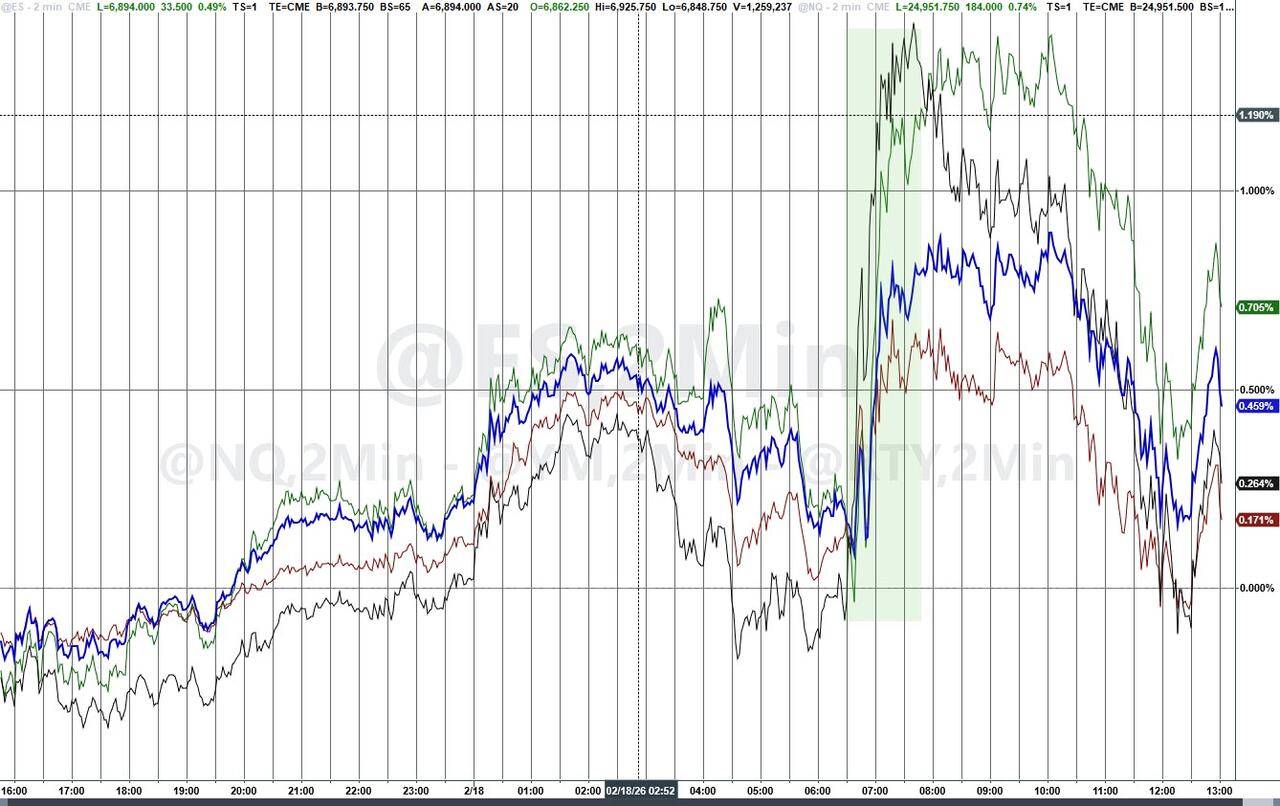
Core Viewpoint - The U.S. stock market experienced a dramatic turnaround from a significant drop to a recovery, primarily influenced by dovish signals from the Federal Reserve [1][4]. Market Reaction - The market opened with a fearful atmosphere, with major indices like the Dow Jones dropping over 300 points and the Nasdaq falling more than 1.2% due to concerns over AI and inflation [3]. - However, by the end of the trading day, the major indices managed to recover, with the Dow up 0.04%, Nasdaq up 0.14%, and S&P 500 up 0.1%, completing a "V-shaped" recovery [4]. Individual Stock Performance - Apple Inc. stood out with a significant increase of over 3%, acting as a key support for the indices, while Nvidia and Amazon also saw gains of over 1%. In contrast, Google and Microsoft experienced slight declines, indicating market hesitance [6]. Federal Reserve Signals - Chicago Fed President Goolsbee provided reassurance by stating that if inflation continues to decline towards the 2% target, there could be multiple rate cuts in 2026, which boosted market confidence [7]. - San Francisco Fed President Daly mentioned that there is approximately 75 basis points of rate cut potential before reaching neutral rates, further encouraging bullish sentiment [9]. - However, Fed Governor Barr expressed caution, emphasizing the need for more evidence of inflation moving towards the target before making any rate changes, indicating a delicate balance in the labor market [9]. AI Market Dynamics - Despite fears regarding AI's disruptive potential, Goldman Sachs reported that analysts are raising earnings expectations for software stocks, with a 5% increase in two-year forward earnings expectations over the past three months [11]. - The report suggests that software companies are effectively leveraging AI to enhance efficiency and meet earnings expectations, countering the narrative of impending disruption [13].


市值已蒸发超万亿美元,软件业会成为下一个“报纸”吗?
Jing Ji Guan Cha Bao· 2026-02-19 04:17
Core Viewpoint - The software industry is facing significant challenges due to the rise of AI technologies, leading to a market valuation decline of over $1 trillion since late January 2026, raising concerns about its future viability similar to the decline of the newspaper industry [1][3][4]. Group 1: Market Impact - The iShares Expanded Tech-Software Sector ETF (IGV) has seen a cumulative decline of over 23% since early 2026, significantly underperforming the S&P 500 index [1]. - Following the introduction of AI tools like Anthropic's Claude, the software sector has experienced a rapid market revaluation, with a notable drop in stock prices and a shift in investor sentiment [2][3]. - As of February 2026, the software and services sector has entered a bear market, with the IGV ETF experiencing a single-day drop of 5.4% on January 29, marking a decline of over 20% from recent highs [3]. Group 2: AI Disruption - Concerns have emerged that AI applications may replace a significant portion of traditional software, leading to a reevaluation of established business models in the software industry [2][4]. - J.P. Morgan's report indicates that the software sector is undergoing its largest non-recessionary pullback in 30 years, with a decline of 34% and a reduction in the S&P 500 software sector weight from 12% to 8.4% [4]. - High switching costs that have historically benefited software companies may diminish as AI programming tools lower development costs, posing a structural threat to the industry [5]. Group 3: Diverging Perspectives - While some analysts predict a bleak future for the software industry akin to the newspaper sector, others, like Deloitte, suggest that AI will create new opportunities rather than lead to a complete industry decline [6]. - Deloitte forecasts that by 2030, AI solutions could capture 60% of the software market, intensifying competition between native AI companies and traditional software giants [6]. - The impact of AI on software will vary by industry, with heavily regulated sectors like finance experiencing slower adoption compared to more creative or data-driven fields [6].
美股散户疯狂“抄底”软件股,“扫货”资金量创历史新高
智通财经网· 2026-02-19 02:06
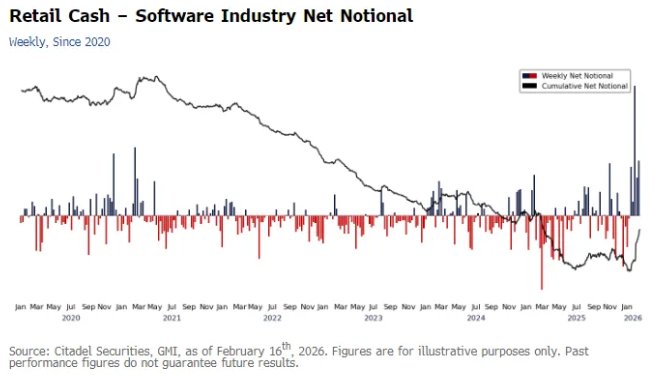
Group 1 - The software sector is experiencing a sell-off due to fears of being replaced by artificial intelligence tools, prompting Wall Street to reassess the potential for overselling, while retail investors are buying the dip [1][2] - Retail traders on the Castle Securities platform have reached a record high in spending on software stocks, with net nominal amounts hitting unprecedented levels, indicating strong demand from retail investors [1] - The sell-off has affected a wide range of companies, from small software developers to large wealth management firms, particularly after the launch of AI tools tailored for legal teams [1] Group 2 - The sell-off in the software sector has led to a broader market impact, with investors selling stocks perceived to be at risk from AI technology, despite minimal actual risk [2] - Retail demand has expanded beyond the tech sector, with increased interest in materials, real estate, finance, communication services, and industrial sectors [2] - Retail participation in the options market has reached historical highs, with daily options trading volume up nearly 50% compared to the average from 2020 to 2025, and 15% higher than the same period last year [2]
城堡证券:美股散户疯狂“抄底”软件股,“扫货”资金量创历史新高
智通财经网· 2026-02-19 01:11
Group 1 - The core viewpoint of the articles highlights a significant sell-off in software stocks due to fears of AI tools threatening these companies, leading to a reevaluation by Wall Street of the potential for overselling [1][2] - Retail investors are actively buying into software stocks at historically high levels, with spending on these stocks on the Castle Securities platform reaching unprecedented amounts since tracking began in 2017 [1] - The sell-off has affected a wide range of companies, from small software developers to large wealth management firms, particularly after the launch of AI tools tailored for legal teams [1] Group 2 - The sell-off in the software sector has extended across the market, with investors selling stocks perceived to be at risk of being replaced by AI technology, even if the risk is minimal [2] - From January 2 to February 13, the average daily dollar demand for U.S. stocks on the Castle Securities platform was approximately 25% higher than the peak in 2021, and double the average from 2020 to 2025 [6] - Retail demand has diversified beyond the tech sector, with increased interest in materials, real estate, finance, communication services, and industrial sectors, alongside a historical high in retail participation in the options market [6]
隔夜美股 | 三大指数收涨 明星科技股多数走高 英伟达涨1.63%
智通财经网· 2026-02-19 00:49
【欧股】德国DAX30指数涨264.43点,涨幅1.06%,报25,269.77点;英国富时100指数涨131.73点,涨幅 1.25%,报10,687.90点;法国CAC40指数涨67.57点,涨幅0.81%,报8,429.03点;欧洲斯托克50指数涨 80.81点,涨幅1.34%,报6,102.66点;西班牙IBEX35指数涨240.36点,涨幅1.34%,报18,195.76点;意大 利富时MIB指数涨565.43点,涨幅1.24%,报46,329.50点。 周三,三大指数收涨,科技股领涨。美联储最新会议纪要显示,官员们再次表达了对通胀的担忧,几位 政策制定者建议,如果通胀持续高于目标,央行可能需要加息。 【美股】截至收盘,道指涨129.47点,涨幅为0.26%,报49662.66点;纳指涨175.25点,涨幅为0.78%, 报22753.63点;标普500指数涨38.09点,涨幅为0.56%,报6881.31点。明星科技股多数走高,英伟达 (NVDA.US)涨1.63%,美光科技(MU.US)涨5.3%,微软(MSFT.US)涨0.69%。 城堡证券:软件股惨遭抛售之际,散户正以"前所未见"速度抄底。 ...

美联储1月议息会议纪要发布!与会人士首提加息的可能性
Sou Hu Cai Jing· 2026-02-19 00:48
Market Overview - The three major U.S. stock indices closed higher, with the Dow Jones up 129.47 points (0.26%) at 49,662.66, the Nasdaq up 175.25 points (0.78%) at 22,753.63, and the S&P 500 up 38.09 points (0.56%) at 6,881.31 [1] Federal Reserve Insights - The Federal Reserve's January meeting minutes revealed significant divisions among officials regarding the future of interest rates, with some suggesting further rate cuts if inflation decreases as expected, while others expressed caution about additional cuts [3][5] - Nearly all Federal Reserve officials agreed to maintain the key interest rate in the range of 3.5% to 3.75%, but two officials voted against this decision, favoring a 25 basis point cut [3][6] - Officials expect inflation to trend towards 2%, but the pace and timing of this decline remain uncertain, with warnings that progress may be slower and more uneven than anticipated [5][6] Sector Performance - The S&P 500 saw eight sectors rise and three decline, with the energy sector leading gains at 2.00% and consumer discretionary up 1.00%, while utilities and real estate sectors fell by 1.70% and 1.45%, respectively [8] - Major tech stocks mostly rose, with notable increases for ASML (over 3%), Amazon (1.8%), and Nvidia (1.6%), while some stocks like Intel and AMD fell over 1% [8][9] Company-Specific Developments - Meta Platforms announced it will use millions of Nvidia chips in its data centers, contributing to Nvidia's stock rise [9] - Amazon's stock increased after a significant investment from Bill Ackman's Pershing Square fund, which raised its stake by 65%, making Amazon its third-largest holding [9] - Micron Technology surged 5.3% following reports of increased holdings by hedge fund manager David Tepper's Appaloosa Management [10] - Google is entering the AI music creation space with its Gemini AI assistant, which can generate music based on user inputs, highlighting the growing integration of AI in consumer applications [10]
美股“两连阳”!“科技七巨头”齐涨,AI抛售潮临近尾声?
Di Yi Cai Jing· 2026-02-19 00:16
Market Overview - The short-term probability of interest rate cuts in the US stock market appears low, making it difficult to provide support [6] - After a recent sell-off in the artificial intelligence (AI) sector, US stocks have stabilized, with the S&P 500 index rising by 38.09 points, or 0.56%, to 6881.31 points as of February 18 [1] - The "Tech Seven" stocks, including Nvidia and Amazon, saw significant gains, with Nvidia's stock rising nearly 1.63% due to a new agreement with Meta [2] Technology Sector Insights - Despite some Wall Street firms believing the AI sell-off is nearing its end, skepticism remains among investors regarding the impact of large capital expenditures on tech giants' cash flow and buyback ratios [1][2] - The software sector has faced a significant decline, with a drop of approximately 24% over the past three months, although future earnings estimates are projected to be about 5% higher [2] - High capital expenditures from major cloud service providers are expected to account for 92% of their operating cash flow this year, surpassing investment intensity seen in the late 1990s [4] Earnings and Profitability - The S&P 500 is expected to report double-digit earnings growth for the fifth consecutive quarter, with profit margins reaching a record 12.6% [5] - The disparity in performance between the equal-weighted S&P 500 and the market-cap weighted index is attributed to the "Tech Seven" stocks' negative returns of -5.9% [4] AI and Software Market Dynamics - Traders are increasingly warming to the idea of buying software stocks at lower prices, despite the recent sell-off [3] - AI technology is viewed as a powerful enhancement rather than a fundamental replacement, relying heavily on existing record systems for data [3] Federal Reserve and Economic Outlook - The Federal Reserve's recent meeting minutes indicate a cautious approach to interest rate cuts, with a focus on inflation risks [7] - The labor market's stability and the anticipated growth in AI capital expenditures are expected to drive GDP beyond expectations, complicating the outlook for inflation [8]

隔夜美股 | 三大指数收涨 明星科技股多数走高 英伟达(NVDA.US)涨1.63%
智通财经网· 2026-02-18 23:27
Market Overview - Major indices closed higher, with technology stocks leading the gains. The Dow Jones increased by 129.47 points (0.26%) to 49,662.66, the Nasdaq rose by 175.25 points (0.78%) to 22,753.63, and the S&P 500 gained 38.09 points (0.56%) to 6,881.31 [1] - European markets also saw gains, with the DAX30 up by 264.43 points (1.06%) to 25,269.77, the FTSE 100 rising by 131.73 points (1.25%) to 10,687.90, and the CAC40 increasing by 67.57 points (0.81%) to 8,429.03 [1] Cryptocurrency - Bitcoin fell over 1.8% to $66,298, while Ethereum dropped more than 2% to $1,947.26 [2] Commodities - Spot gold briefly surpassed $5,000 before closing at $4,976.39 [3] - WTI crude oil rose by 4.6%, closing around $65 per barrel, while Brent crude surpassed $70 per barrel for the first time in over two weeks [4] Economic Data - U.S. industrial production growth reached its highest level in nearly a year, with a 0.7% increase driven by broad manufacturing growth and healthy utility output. Manufacturing output alone grew by 0.6%, marking the largest increase since February 2025 [5] - New housing starts in the U.S. rose to their highest level in five months, with a year-over-year increase of 6.2%, reaching an annualized rate of 1.4 million units [5] Federal Reserve Insights - The latest Federal Reserve meeting minutes revealed a shift in focus from labor market risks to inflation concerns, with officials warning that progress in reducing inflation may be slower and more uneven than expected [7] - There is little willingness among Federal Reserve officials to lower interest rates, with most preferring to see more progress on inflation before considering any cuts [8] Company News - Figma reported Q4 revenue of $300 million, a 40% year-over-year increase, exceeding guidance. The company anticipates Q1 revenue between $315 million and $317 million [10] - Bank of America is expanding its rewards program to attract more customers, allowing all checking account holders to enjoy rewards regardless of their balance, aiming to double profits in its consumer business to $20 billion by the end of the decade [11]




科技股力撑美股两连阳,美联储自曝通胀担忧,道指盘中闪跌,美伊风险助原油大反弹
Sou Hu Cai Jing· 2026-02-18 23:02
Group 1: Stock Market Performance - Technology and energy stocks were the main drivers of the US stock market's rise on Wednesday, with the "Magnificent Seven" tech stocks all closing higher, led by Amazon and Nvidia, which both saw intraday gains of nearly 3% [1] - Nvidia's stock price benefited from a new agreement with Meta to deploy millions of Nvidia chips over the coming years [1] - Amazon's stock was supported by a 65% increase in holdings from Bill Ackman's Pershing Square, despite a 77% cut in holdings by Berkshire Hathaway [1] - Major US stock indices showed gains, with the S&P 500 up 0.56% to 6881.31 points, the Dow Jones Industrial Average up 0.26% to 49662.66 points, and the Nasdaq up 0.78% to 22753.635 points [10] Group 2: Economic Data and Federal Reserve - Strong economic data, including December new housing starts and core capital goods orders, exceeded expectations, temporarily overshadowing AI-related concerns and supporting gains in major US stock indices [2] - The Federal Reserve's meeting minutes revealed internal divisions regarding interest rate decisions, with some officials advocating for the inclusion of potential rate hikes in guidance, which led to a reduction in stock gains [3] Group 3: Energy Sector - Energy stocks were boosted by a rebound in oil prices, with US oil prices rising over 5% at one point, marking the largest increase in nearly four months [33] - The potential for military action against Iran by the US has increased, contributing to the rise in oil prices, with WTI crude oil closing at $65.19 per barrel, up 4.59% [34] Group 4: Precious Metals - Gold prices initially rose above $5000 but fell back below this level after the Federal Reserve's meeting minutes were released, with spot gold closing at $4985.45, up 2.2% for the day [35][37] - Silver prices also saw significant gains, with COMEX silver futures rising 5.5% to $77.598 per ounce [38]