核聚变能

Search documents
今日看点|2026年低空资源和经济发展大会将举行
Jing Ji Guan Cha Bao· 2026-01-16 02:01
Group 1 - The 2026 Low Altitude Resources and Economic Development Conference will be held from January 16 to 17, focusing on exploring new paths for high-quality development in the low-altitude economy through the integration of resources, technology, capital, scenarios, and talent [1] - The 2026 Nuclear Fusion Energy Technology and Industry Conference will take place in Hefei, Anhui, on January 16 to 17, aiming to promote collaborative innovation and results transformation across the nuclear fusion industry chain [2] Group 2 - On January 16, a total of 6 companies will have their restricted shares unlocked, with a total of 737 million shares released, amounting to a market value of 5.285 billion yuan [3] - Among the companies, Huadian New Energy, Ruihua Technology, and Parallel Technology have the highest unlock volumes and market values, with Huadian New Energy alone accounting for 4.565 billion yuan [3] Group 3 - Seventeen companies disclosed stock repurchase progress on January 16, with 7 companies announcing new repurchase plans, 3 companies reporting on ongoing repurchases, and 7 companies completing their repurchase plans [4] - The highest repurchase amounts were reported by Xingchen Technology, Proya, and Maide Medical, with repurchase amounts of 29.9996 million yuan, 16.1193 million yuan, and 15.9186 million yuan respectively [4] Group 4 - Six companies announced progress on private placements on January 16, with 2 companies disclosing new private placement plans and 3 companies having their plans approved by shareholders [5] - Tianyuan Co. and Tiens New Materials have the highest proposed fundraising amounts, aiming for 700 million yuan and 253 million yuan respectively [5] Group 5 - Two A-shares will undergo equity registration on January 16, with both companies planning to distribute dividends [6] - The highest dividend payouts are from Vision Intelligence and Aladdin, with distributions of 3.00 yuan and 0.70 yuan per 10 shares respectively [6]
核聚变大会将举行,产业链发展受关注
Xuan Gu Bao· 2026-01-12 15:20
Group 1 - The 2026 Nuclear Fusion Technology and Industry Conference will be held in Hefei, Anhui on January 16, 2026, featuring key systems research facilities and a focus on collaboration among various stakeholders in the nuclear fusion industry [1] - The conference aims to accelerate funding and technological cooperation in the nuclear fusion sector, inviting government officials, scientists, research institutions, and financial entities [1] - The global fusion market is projected to exceed $100 billion by 2030, according to the International Energy Agency [1] Group 2 - Xinghuan Fusion announced the successful completion of a Series A financing round, raising 1 billion yuan, which will support the construction of next-generation fusion devices [1] - The financing will help the company achieve engineering validation by around 2028 and aim to establish a fusion demonstration reactor capable of generating electricity by around 2032 [1] - New Wind Power is actively engaging in the nuclear fusion sector, having established a dedicated team to advance related power business initiatives [1][2]


下周关注丨多个产业大会将召开,这些投资机会最靠谱
Di Yi Cai Jing· 2026-01-11 00:51
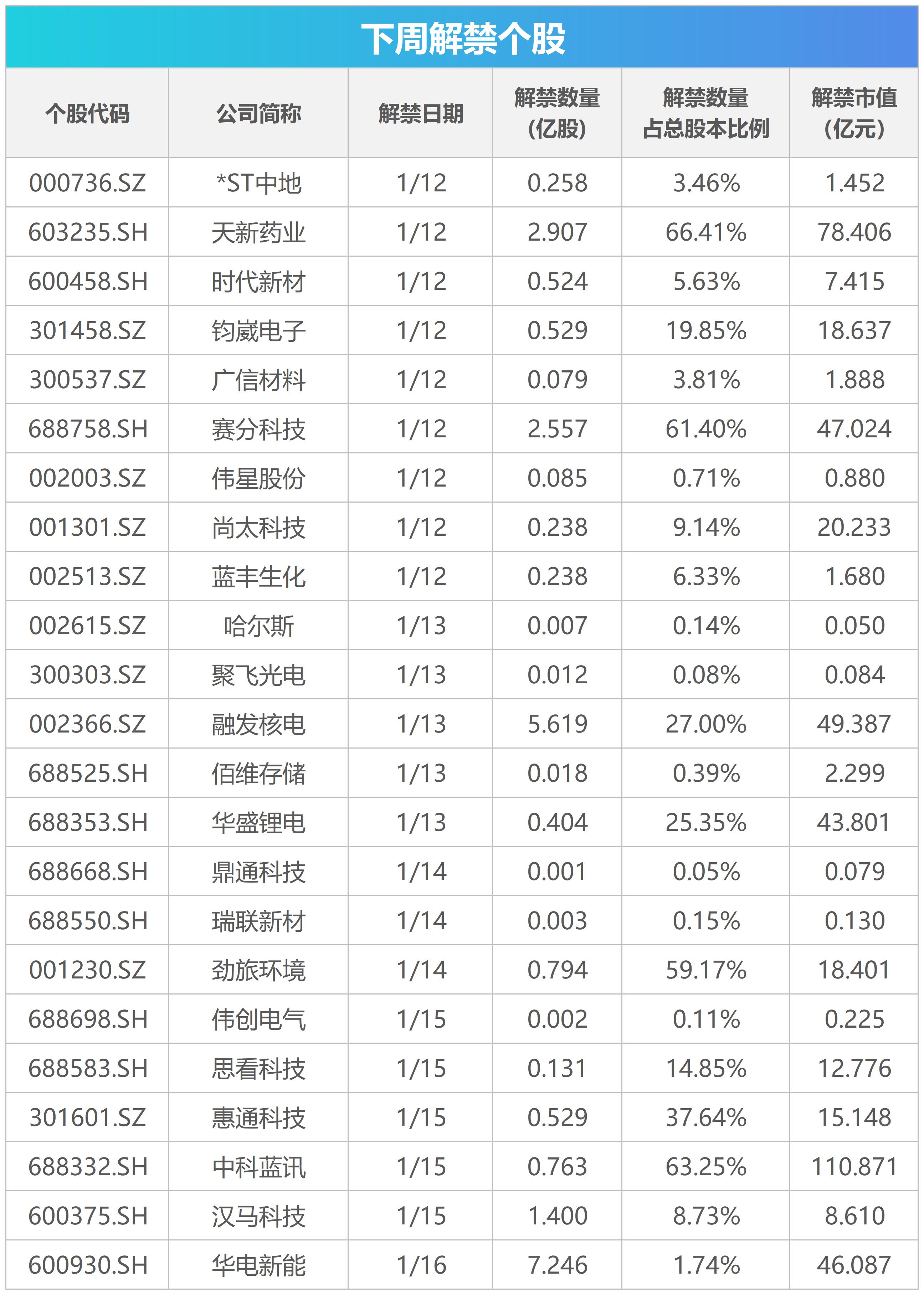
Group 1: Economic Data Releases - China will release its trade balance for December 2025 on January 14, with total goods trade value reaching 41.21 trillion yuan, a year-on-year increase of 3.6% for the first 11 months of 2025 [2] - In November 2025, China's goods trade showed a recovery with a total value of 3.9 trillion yuan, growing by 4.1%, including exports of 2.35 trillion yuan (up 5.7%) and imports of 1.55 trillion yuan (up 1.7%) [2] - The U.S. will announce its December 2025 CPI data on January 13, with November 2025 CPI showing a year-on-year increase of 2.7% and core CPI at 2.6% [4] Group 2: Financial Environment - November 2025 financial data in China indicated that M2 and social financing growth rates remained high, supporting a favorable monetary environment for economic recovery [3] - It is expected that China's monetary policy will continue to maintain a moderately loose stance in 2026, complemented by fiscal policy efforts [3] Group 3: Industry Conferences - The second China eVTOL Innovation Development Conference is scheduled for January 15-16, 2026, in Shanghai, focusing on "Innovation Leading, Smartly Opening the New Business Era of eVTOL" [5] - The fifth AIGC China Developer Conference will be held on January 17, 2026, in Beijing, themed "Ecology, Support, Domestic, Trend" [5] - The fourth China Petroleum and Chemical Industry Digital Transformation and Intelligent Development Conference will take place from January 13-15, 2026, in Beijing [5] Group 4: Stock Market Developments - Over 480 billion yuan in market value of restricted stocks will be unlocked in the A-share market from January 12-16, 2026, with 23 stocks facing unlocks [6] - Among these, Zhongke Lanyun has a restricted stock unlock value exceeding 10 billion yuan [6]

可控核聚变产业机遇不断涌现,关注永赢制造升级智选
Feng Huang Wang Cai Jing· 2026-01-09 03:23
Group 1 - The core viewpoint of the articles highlights significant advancements in China's controlled nuclear fusion sector, with two major breakthroughs reported in early January 2026 [1] - The EAST device achieved a major theoretical breakthrough by confirming the existence of the "Tokamak Density Freedom Zone," paving the way for higher performance in future fusion reactors [1] - The "Honghuang 70," the world's first commercially built high-temperature superconducting Tokamak, successfully operated a steady-state long pulse plasma for 120 seconds, validating the engineering reliability and operational stability of this technology [1] Group 2 - The long-term development of the nuclear fusion industry relies on continuous technological breakthroughs and strong national strategic support [1] - The 2026 Nuclear Fusion Energy Science and Industry Conference is scheduled for January 16-17, 2026, and will gather key stakeholders to discuss the development of fusion energy and disclose major project bidding progress and capital expenditure plans [1] - In the context of accelerating nuclear fusion industrialization and rising capital market interest, the Yongying Manufacturing Upgrade Intelligent Selection Fund is positioned as a rare proactive equity fund focusing on this sector [2]
1月8日主题复盘 | 航天再度掀起涨停潮,核聚变、脑机接口持续活跃
Xuan Gu Bao· 2026-01-08 08:46
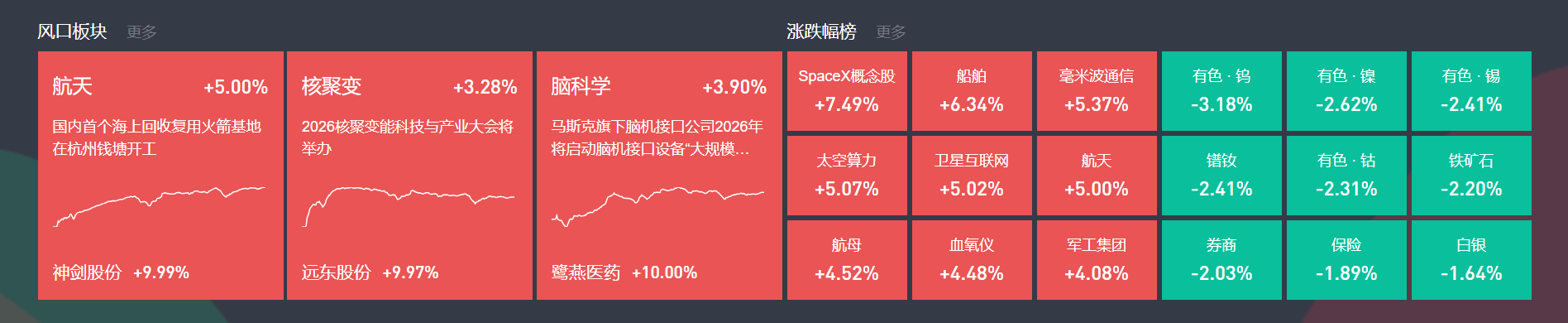
Market Overview - The Shanghai Composite Index experienced a narrow fluctuation, achieving a 15-day consecutive rise, while the ChiNext Index fell nearly 1%. The trading volume reached 2.82 trillion yuan, with approximately 3,700 stocks in the Shanghai and Shenzhen markets showing gains [1]. Aerospace Sector - The aerospace sector saw a significant surge, with multiple stocks such as Shenjian Co., Luxin Investment, and Nanjing Panda hitting the daily limit. The catalyst for this rally was the commencement of construction for China's first offshore reusable rocket recovery base in Hangzhou [4][5]. - Elon Musk announced an ambitious goal for SpaceX to produce 10,000 Starship rockets annually, indicating strong growth potential in the aerospace industry [4]. - The sector recorded a 5% increase overall, with notable performances from companies like Shenjian Co. (+9.99%) and Luxin Investment (+9.99%) [5]. Nuclear Fusion Sector - The nuclear fusion concept continued to perform well, with stocks like Far East Holdings and Hongxun Technology achieving consecutive gains. A nuclear fusion energy technology and industry conference is scheduled for January 2026 in Hefei, aiming to promote innovation and collaboration within the industry [7][9]. - The sector is viewed as a strategic development direction for China, with ongoing construction of various fusion devices [9]. Brain Science Sector - The brain science sector remained active, with stocks such as Pulit, Nanjing Panda, and Innovation Medical continuing to hit the daily limit. The global market for brain-computer interface applications is projected to reach approximately $3.19 billion by 2025, with significant growth expected in the medical application market by 2030 and 2040 [10][12]. - In China, the brain-computer interface market is anticipated to exceed 3.8 billion yuan by 2025, growing at an annual rate of about 20% [13].


新赛道升级 塑造发展新优势
Jing Ji Ri Bao· 2026-01-06 22:35
Core Insights - The "15th Five-Year Plan" emphasizes the cultivation and expansion of emerging and future industries, aiming to create new pillar industries and strategically position future industries for growth [1] Group 1: Emerging Industries - During the "14th Five-Year Plan," China's emerging industries accelerated development, forming significant scale effects with several trillion-yuan market opportunities emerging by 2025 [2] - The commercial aerospace industry is on the verge of explosion, with advancements such as the successful launch of the Zhuque-3 rocket and accelerated deployment of satellite internet constellations [2] - The low-altitude economy is entering a commercial phase, marked by the issuance of operational certificates for manned civil unmanned aerial vehicles and the promotion of typical application scenarios by the Ministry of Transport [2] - New materials are crucial for breakthroughs in aerospace performance, with innovations in high-strength stainless steel and carbon fiber composites being utilized in key projects [2] Group 2: Energy Transition - China's energy transition has accelerated, establishing the world's largest power infrastructure and renewable energy systems, with plans to increase the share of renewable energy significantly by 2026 [3] - The "15th Five-Year Plan" aims to enhance emerging pillar industries, focusing on innovation in sectors like renewable energy, new materials, aerospace, and low-altitude economy [3] Group 3: Future Industries - Rapid advancements in future industries such as artificial intelligence, quantum information, and biomanufacturing have been noted, with significant breakthroughs achieved during the "14th Five-Year Plan" [4] - The development of 6G technology is prioritized, with expectations for commercial applications to begin around 2030, indicating a deep integration with AI [4][5] - Future industries are characterized by their potential to create new demands and economic forms, with quantum technology and nuclear fusion energy expected to play pivotal roles [6] Group 4: Market Opportunities and Challenges - Emerging industries are entering a rapid growth phase, with key scenarios being validated and replicable business models established, while future industries are still in the exploratory phase [7] - The uncertainty in future industries stems from both technological and commercial aspects, requiring significant R&D investment and policy support [8] - The collaboration between emerging and future industries is essential for driving new economic engines, with a focus on innovation and long-term value creation [9]
新赛道活力迸发 塑造经济发展新优势
Zheng Quan Ri Bao· 2026-01-06 16:28
Core Insights - During the "14th Five-Year Plan" period, China has made significant strides towards high-level technological self-reliance, with emerging and future industries showing robust vitality and growth potential [1][3] Emerging Industry Development - The emerging industries in China have rapidly developed and formed scale effects, with multiple trillion-yuan markets accelerating formation [2] - By 2025, China's commercial aerospace industry is on the brink of explosion, with significant advancements in reusable launch vehicles and satellite internet applications [2] - The low-altitude economy is also gaining traction, with the issuance of operational certificates for manned civil unmanned aerial vehicles marking the entry into commercial use [2] New Energy Industry - China has established the world's largest power infrastructure and renewable energy system, creating the most complete new energy industry chain globally [3] - The "15th Five-Year Plan" emphasizes the development of emerging pillar industries, including new energy, new materials, aerospace, and low-altitude economy [3] Future Industry Breakthroughs - Significant progress has been made in future industries such as artificial intelligence, quantum information, and biomanufacturing, with key breakthroughs achieved [4] - The integration of 6G and AI is becoming a consensus in the industry, with clear development directions emerging [4] - The biomanufacturing industry has expanded steadily, reaching a total scale of 1.1 trillion yuan, becoming a new economic growth point [4] Dual-Engine Development - Emerging and future industries, while both part of the "long slope, thick snow" track, have different development stages, leading to varying market opportunity release rhythms [6] - Emerging industries are entering a rapid growth phase, with vertical segments expected to explode in the next 3 to 4 years, while future industries will focus on technology and application exploration in the early stages of the "15th Five-Year Plan" [6] Investment and Market Dynamics - The future industries face challenges related to technological and commercial uncertainties, with unclear business models and long investment return cycles [7] - The "15th Five-Year Plan" period is seen as a critical window for future industries, with policy support and technological breakthroughs expected to drive development [7] - Investors are advised to focus on companies' core technology reserves and their progress in validating business value through application scenarios [8]
中金上汽新兴产业基金2025年度运营情况汇报会顺利召开
Xin Lang Cai Jing· 2026-01-04 11:30
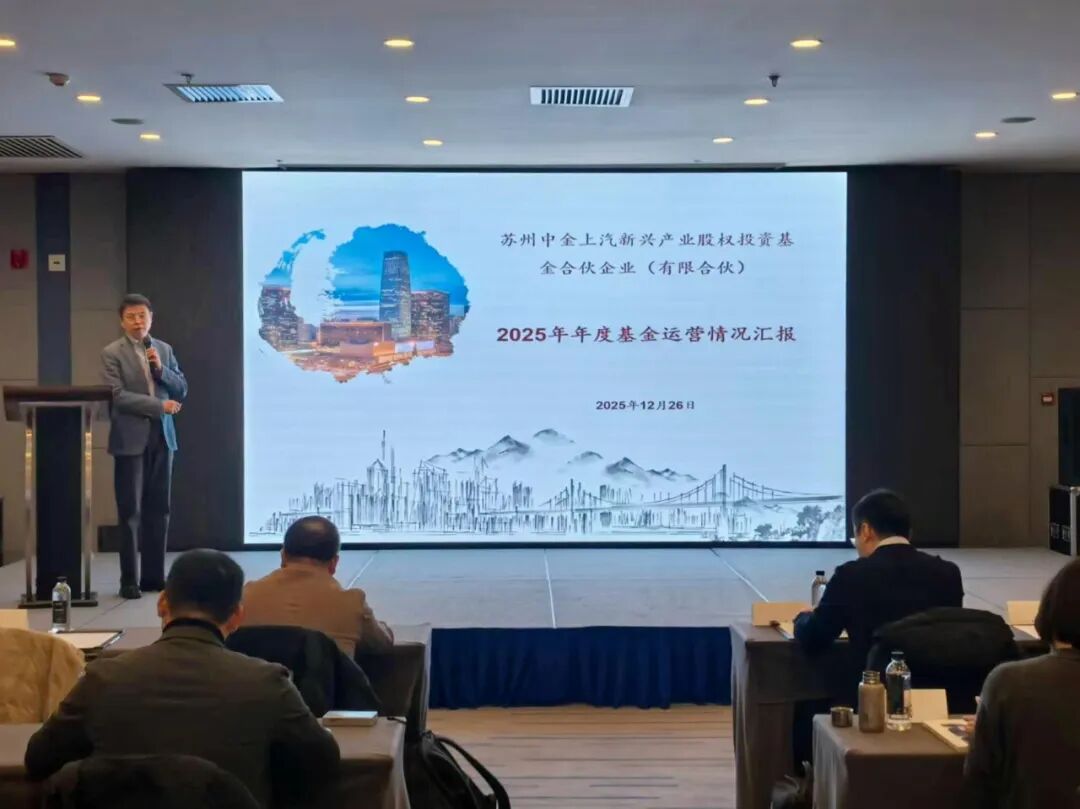
Core Insights - The annual operation report meeting of the CICC SAIC Emerging Industries Fund for 2025 was successfully held in Xi'an, focusing on future industries and transformation upgrades [1][13] - The fund has a subscribed scale of 5 billion yuan and has shown stable and healthy operations in 2025, with excellent business performance [3][15] - The fund's investment portfolio covers advanced manufacturing and strategic emerging industries, including sectors like semiconductors, robotics, new energy, artificial intelligence, commercial aerospace, and quantum technology [3][15] Fund Performance - Three star portfolio companies, Zhengli New Energy (03677.HK), Dongyangguang Pharmaceutical (06887.HK), and Muxi Co., Ltd. (688802.SH), successfully went public in 2025 [3][15] - Several portfolio companies have applied for IPOs on A-shares or Hong Kong stocks, including MiniMax, Magnesium Technology, Shenghe Jingwei, and Lingong Heavy Machinery [3][15] - An additional five portfolio companies are expected to apply for IPOs in the first half of 2026 [3][15] Industry Trends - The CICC Capital's representative highlighted key emerging industries and international development trends, including aerospace, quantum technology, nuclear fusion energy, and embodied intelligence [3][15] - The analysis of artificial intelligence development indicated that China's AI industry has formed a systematic and phased development path, with advantages in large model open-source ecosystems and application scenarios [5][17] - The commercial aerospace sector has seen validated business feasibility with the growth of SpaceX, while the low-altitude economy is still in the introduction phase but has clear policy support [7][19] Investment Strategy - The investment strategy emphasizes long-term growth potential in future industries, despite facing uncertainties, compared to mature industries where new entrants face significant challenges [11][23] - The CICC Capital and partners will continue to strengthen collaboration and systematically advance investments in cutting-edge technology fields to support industrial upgrades and development [11][23] - The meeting participants agreed that deepening industry engagement, forward-looking layouts, and open collaboration are essential to navigate changes and embrace a new chapter in Chinese innovation and manufacturing [12][24]
今年首个核聚变大会来了
财联社· 2026-01-04 04:54
Core Viewpoint - The 2026 Nuclear Fusion Energy Technology and Industry Conference will be held in Hefei, Anhui, aiming to promote collaboration and innovation in the nuclear fusion industry chain [3][6]. Group 1: Conference Details - The conference will take place from January 16 to 17, 2026, at the CRAFT facility in Hefei, focusing on the theme "Nuclear Power, Creating the Future" [3]. - The event is guided by several organizations, including the Chinese Physical Society and the Anhui Provincial Development and Reform Commission, and will gather leaders from various sectors, including government, academia, and industry [6]. Group 2: Hefei's Role in Nuclear Fusion - Hefei is recognized as a leading city for venture capital and is becoming a model for China's nuclear fusion industry, with a cluster of advanced fusion devices [7]. - The region has established a comprehensive innovation chain covering key technology areas in magnetic confinement nuclear fusion, supported by major facilities like EAST and BEST [7][8]. Group 3: Industry Trends and Projections - In 2025, nuclear fusion energy will be included in national planning as a key future industry, reflecting its growing importance [9]. - The demand for controllable nuclear fusion is increasing due to rising electricity needs driven by advanced technologies like AI, with the industry entering an "engineering feasibility verification" phase [10]. - A significant capital expenditure expansion cycle for controllable nuclear fusion is expected from 2025 to 2028, with projected investments reaching 146.5 billion yuan [11]. Group 4: Market Opportunities - The superconducting magnet segment is anticipated to benefit significantly, with the market size for high-temperature superconducting magnets estimated at nearly 30 billion yuan [11]. - Key projects such as BEST and others are expected to commence, leading to a continuous release of core component orders [11]. - Companies in various segments, including superconducting materials, vacuum chambers, and power systems, are highlighted as potential beneficiaries of the nuclear fusion industry's growth [11].

「十五五」时期重点产业前瞻与发展路径研究丨36氪研究院
36氪· 2025-12-31 00:14
Core Insights - The "14th Five-Year Plan" period prioritizes the construction of a modern industrial system, marking a strategic shift from single-point technological breakthroughs to systematic industrial upgrades [6][19]. - The new energy industry is transitioning from a focus on installed capacity to building a "source-grid-load-storage" collaborative system, emphasizing dynamic balance between production and consumption [7]. - The aerospace sector is developing a dual-driven model of national engineering and commercial space, with large aircraft industrialization and commercial space driving the scale and capability of the industry chain [8]. - Future industries such as 6G and quantum technology place China in the global leading tier of R&D, aiming to seize the high ground in technology standards and industrial ecosystems through forward-looking layouts [9]. - The transformation of traditional industries emphasizes not only greening and intelligentization but also explicitly promotes "service-oriented manufacturing," guiding the manufacturing sector to extend services throughout the product lifecycle [10]. Group 1: Modern Industrial System - The construction of a modern industrial system is the primary task of the "14th Five-Year Plan," highlighting its core position as a foundation for new era development [19][20]. - The modern industrial system consists of three parts: upgrading traditional industries, developing emerging pillar industries, and strategically laying out future industries [20]. Group 2: Emerging Pillar Industries - The cultivation of emerging pillar industries is positioned as the strategic core of the modern industrial system, providing a strong new growth engine for high-quality development [23]. - Key emerging pillar industries include new energy, new materials, aerospace, and low-altitude economy, which are expected to drive explosive growth in multiple trillion-level markets [23]. Group 3: New Energy - The new energy sector has evolved into a comprehensive ecosystem encompassing "production, storage, transmission, and application," with a strategic significance in ensuring national energy security and achieving carbon neutrality [24]. - As of the end of 2024, China's cumulative installed capacity of new energy reached 1.41 billion kilowatts, maintaining a global leading position [25]. - The annual new installed capacity during the "14th Five-Year Plan" period is expected to remain around 30 million kilowatts [25]. Group 4: New Materials - The new materials industry in China has rapidly grown, with total output value exceeding 8 trillion yuan in 2024, but still faces structural challenges with about 30% of key high-end materials relying on imports [34]. - Significant breakthroughs are being made in various fields, including third-generation semiconductor materials and high-end alloys for aerospace applications [39]. Group 5: Aerospace - The aerospace sector has formed a dual-driven model of national major projects and commercial markets, with the C919 large aircraft and commercial space rapidly developing [42]. - The market size of China's aerospace manufacturing industry is expected to reach 601.7 billion yuan by 2025, with a compound annual growth rate of approximately 14.05% [42]. Group 6: Low-altitude Economy - The low-altitude economy, driven by various manned and unmanned aerial vehicles, is expected to reach a scale of 505.95 billion yuan in 2023, with a year-on-year growth of 33.8% [50]. - The market is projected to exceed 1 trillion yuan by 2026, with a compound annual growth rate of approximately 29.6% from 2021 to 2026 [50]. Group 7: Future Industries - Future industries represent cutting-edge technological and industrial development directions, including quantum technology, biomanufacturing, hydrogen energy, and brain-computer interfaces [61]. - The quantum technology sector is expected to grow significantly, with the industry scale projected to reach approximately 80 billion USD by 2024 and potentially near 1 trillion USD by 2035 [64].