电讯业

Search documents
241只港股获南向资金大比例持有
Sou Hu Cai Jing· 2025-11-17 01:37
Group 1 - The overall shareholding ratio of southbound funds in Hong Kong Stock Connect stocks is 19.31%, with 241 stocks having a shareholding ratio exceeding 20% [1] - As of November 14, southbound funds hold a total of 4,878.54 million shares, accounting for 19.31% of the total share capital of the stocks, with a total market value of 63,648.87 billion HKD, representing 14.62% of the total market value [1] - The highest shareholding ratio by southbound funds is in China Telecom, with 100.04 million shares held, accounting for 72.08% of the issued shares [1] Group 2 - Southbound funds with a shareholding ratio exceeding 20% are mainly concentrated in the healthcare, industrial, and financial sectors, with 56, 36, and 34 stocks respectively [2] - The top stocks with high southbound fund holdings include China Telecom (72.08%), Green Power Environmental (69.17%), and COSCO Shipping Energy (68.32%) [2][3] - A significant portion of the stocks with high southbound fund holdings are AH concept stocks, with 53.53% of stocks having a shareholding ratio over 20% being AH shares [1]

中泰国际每日晨讯-20251112
ZHONGTAI INTERNATIONAL SECURITIES· 2025-11-12 02:43
Market Overview - The Hong Kong stock market showed little change, with the Hang Seng Index and the Hang Seng China Enterprises Index closing at 26,696 points and 9,461 points, respectively, both up by 0.2% [1] - Total trading volume was HKD 210.2 billion, slightly lower than the previous day's HKD 214.8 billion, indicating a mixed market sentiment [1] - Real estate, construction, finance, and telecommunications sectors saw increases of 1.4%, 0.8%, and 0.6%, while non-essential consumer goods, energy, and healthcare sectors declined by 0.4%, 0.3%, and 0.1% [1] Company Highlights - XPeng Motors (9868 HK) surged by 17.9%, reaching a one-year high, following the launch of its new generation IRON robot, expanding its business from electric vehicles to robotaxis and humanoid robots [4] - WuXi AppTec (2269 HK) and Semiconductor Manufacturing International Corporation (981 HK) both experienced declines of 2.7% [1] - Weichai Power (3393 HK) saw a significant increase of 6.9%, with trading volume doubling, attributed to the rising demand in the AI industry and data center electricity consumption [5] Industry Dynamics - In the automotive sector, China's October vehicle sales increased by 8.8% year-on-year to 3.32 million units, a decrease from September's 14.9% growth [3] - The healthcare sector's Hang Seng index fell by 0.2%, with major companies showing little volatility; however, BeiGene (6160 HK) rose by 1.0% after reporting strong Q3 results [4] - The renewable energy sector experienced fluctuations, with notable declines in the photovoltaic segment, including Xinyi Solar (968 HK) down by 2.0% and Xinyi Energy (3868 HK) down by 1.5% [5]
239只港股获南向资金大比例持有
Zheng Quan Shi Bao Wang· 2025-11-12 01:34
Core Insights - The overall shareholding ratio of southbound funds in Hong Kong Stock Connect stocks is 19.22%, with 239 stocks having a shareholding ratio exceeding 20% [1] - Southbound funds hold a total of 4,856.80 million shares, accounting for 19.22% of the total share capital of the stocks, with a market value of 63,652.24 billion HKD, representing 14.58% of the total market value [1] - The highest shareholding ratio by southbound funds is in China Telecom (601728) at 71.95%, followed by Green Power Environmental and COSCO Shipping Energy (600026) at 69.48% and 69.03% respectively [1] Group 1: Southbound Fund Holdings - 239 stocks have a shareholding ratio of over 20%, while 132 stocks are in the 10%-20% range, 95 stocks in the 5%-10% range, 83 stocks in the 1%-5% range, and 17 stocks below 1% [1] - Among the stocks with over 20% shareholding by southbound funds, 128 are AH concept stocks, making up 53.56% of that group [1] Group 2: Industry Concentration - Southbound fund holdings exceeding 20% are primarily concentrated in the healthcare, industrial, and financial sectors, with 56, 35, and 34 stocks respectively [2] - The table lists several stocks with high southbound fund holdings, including China Telecom (71.95%), Green Power Environmental (69.48%), and COSCO Shipping Energy (69.03%), among others [2][3]
公募港股持仓破1.3万亿,投资“主力军”悄然更替
2 1 Shi Ji Jing Ji Bao Dao· 2025-11-10 12:45
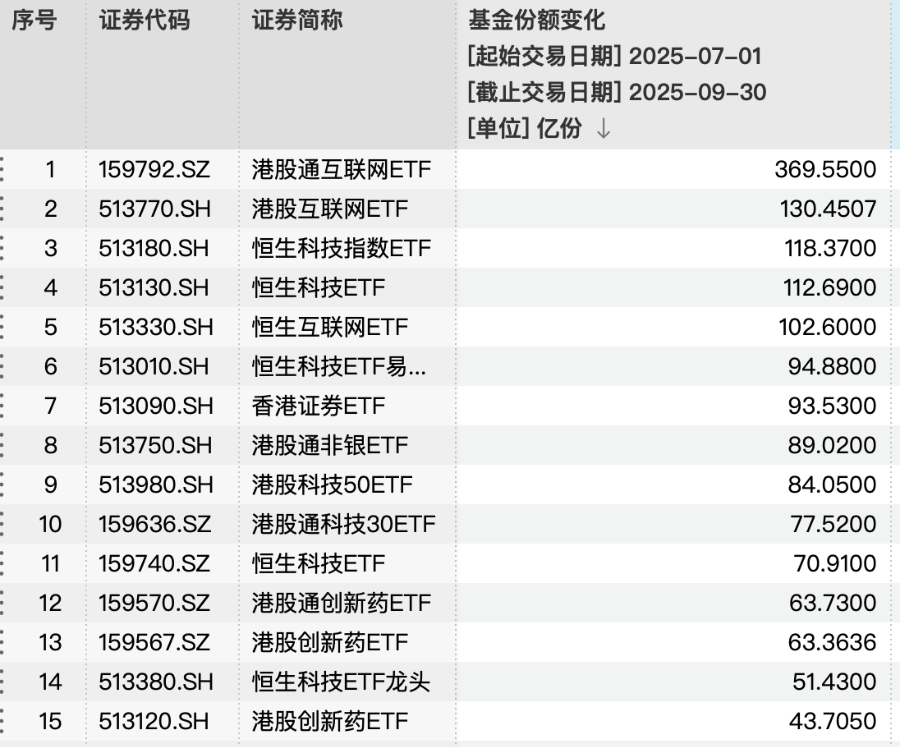
Core Insights - The market value of public funds' holdings in Hong Kong stocks reached 1.33 trillion yuan in Q3 2025, with passive funds surpassing active funds for the first time since 2017 [2][4]. Group 1: Market Trends - The market value of public funds' investments in Hong Kong stocks reached 13,255 billion yuan, with passive funds holding 7,000 billion yuan (52.8%) and active funds holding 6,255 billion yuan (47.2%) [4][5]. - The significant increase in passive fund holdings, which rose by 73% compared to Q2 2025, indicates a growing trend of capital flowing into the Hong Kong market through ETF products [5][6]. Group 2: Fund Performance - The top-performing ETFs in Q3 2025 included the Fuqua Hong Kong Internet ETF, Hua Bao Hong Kong Internet ETF, and Huaxia Hang Seng Technology Index ETF, with substantial increases in fund shares [6][7]. - Active funds showed a preference shift towards sectors like healthcare and materials, while reducing exposure to telecommunications and finance [8]. Group 3: Investment Strategies - Despite market fluctuations, some active fund managers increased their positions in Hong Kong stocks, focusing on technology core assets due to favorable valuations [9]. - The overall trading volume in the Hong Kong market has significantly increased, with average daily turnover reaching 2,579 billion HKD, nearly doubling from the previous year [11].

238只港股获南向资金大比例持有
Zheng Quan Shi Bao Wang· 2025-11-07 01:41
Core Insights - The overall shareholding ratio of southbound funds in Hong Kong Stock Connect stocks is 19.12%, with 238 stocks having a shareholding ratio exceeding 20% [1] - Southbound funds hold a total of 4,829.92 million shares, accounting for 19.12% of the total share capital of the stocks, with a market value of 62,903.32 billion HKD, representing 14.56% of the total market value [1] - The stocks with the highest shareholding ratios by southbound funds are primarily AH concept stocks, with 127 out of 238 stocks exceeding 20% shareholding being AH stocks [1] Summary by Category Southbound Fund Holdings - Southbound funds have a significant presence in the Hong Kong market, with 238 stocks having over 20% shareholding, 135 stocks between 10% and 20%, 96 stocks between 5% and 10%, 82 stocks between 1% and 5%, and 18 stocks below 1% [1] - The highest shareholding is in China Telecom (601728) at 71.42%, followed by Green Power (601330) at 69.43% and COSCO Shipping Energy (600026) at 69.25% [2] Industry Distribution - The stocks with over 20% shareholding by southbound funds are mainly concentrated in the healthcare, industrial, and financial sectors, with 56, 35, and 34 stocks respectively [2] - A detailed list of high shareholding stocks includes China Telecom, Green Power, COSCO Shipping Energy, and others, with varying market prices and daily price changes [2][3]
234只港股获南向资金大比例持有
Sou Hu Cai Jing· 2025-10-31 01:48
Core Insights - The overall shareholding ratio of southbound funds in Hong Kong Stock Connect stocks is 18.97%, with 234 stocks having a shareholding ratio exceeding 20% [1] - Southbound funds hold a total of 4,795.42 million shares, accounting for 14.50% of the total market value of the stocks [1] Group 1: Shareholding Distribution - 234 stocks have a shareholding ratio of over 20%, 134 stocks between 10% and 20%, 94 stocks between 5% and 10%, 83 stocks between 1% and 5%, and 20 stocks below 1% [1] - The stock with the highest southbound fund shareholding is China Telecom, holding 9,876.68 million shares, which is 71.15% of its issued shares [2] - Other notable stocks include COSCO Shipping Energy, holding 70.14%, and GCL-Poly Energy, holding 70.09% [2] Group 2: Industry Concentration - Southbound funds with a shareholding ratio exceeding 20% are primarily concentrated in the healthcare, financial, and industrial sectors, with 55, 34, and 34 stocks respectively [2] - A total of 124 AH concept stocks are among those with over 20% shareholding by southbound funds, representing 52.99% of that group [1] - The healthcare sector shows significant representation, with multiple stocks like Kanglong Chemical and Baiyunshan having high shareholding ratios [2][3]
231只港股获南向资金大比例持有
Sou Hu Cai Jing· 2025-10-27 01:48
Group 1 - The overall shareholding ratio of southbound funds in Hong Kong Stock Connect stocks is 18.95%, with 231 stocks having a shareholding ratio exceeding 20% [1] - As of October 24, southbound funds hold a total of 4,802.33 million shares, accounting for 18.95% of the total share capital of the eligible stocks, with a total market value of 62,139.18 billion HKD, representing 14.52% of the total market value [1] - The highest shareholding ratio by southbound funds is in China Telecom, with 9,866.24 million shares held, accounting for 71.08% of the issued shares [2] Group 2 - Southbound funds with a shareholding ratio exceeding 20% are primarily concentrated in the healthcare, industrial, and financial sectors, with 53, 35, and 34 stocks respectively [2] - Among the stocks with a shareholding ratio over 20%, 124 are AH concept stocks, making up 53.68% of that group [1] - The stock with the second-highest shareholding ratio is COSCO Shipping Energy, with 9,175.78 million shares held, accounting for 70.79% [2]
港股市场策略周报 2025.10.13-2025.10.19-20251020
Zhe Shang Guo Ji Jin Rong Kong Gu· 2025-10-20 08:07
Group 1: Market Performance Review - The Hong Kong stock market experienced a significant decline due to renewed US-China trade tensions and profit-taking after previous gains, with the Hang Seng Index, Hang Seng Tech Index, and Hang Seng Composite Index dropping by -4.11%, -3.97%, and -7.98% respectively [3][10][13] - Defensive sectors such as utilities and telecommunications showed resilience, while previously high-performing sectors like technology and healthcare faced substantial corrections [3][10][13] Group 2: Market Valuation Levels - As of the end of the week, the 5-year PE (TTM) valuation percentile for the Hang Seng Composite Index stood at 81.45%, indicating that the valuation level is close to one standard deviation above the 5-year average [3] Group 3: Market Macro Environment - The macroeconomic environment shows weak inflation in September, with CPI down by 0.3% year-on-year, while PPI decreased by 2.3% [37][43] - The central bank's monetary policy remains supportive, with a focus on enhancing domestic demand and stabilizing growth through proactive measures [37][43] Group 4: Fund Flow Analysis - Southbound capital showed strong buying interest, with a net inflow of 45.089 billion HKD, marking a new high in five weeks and maintaining a streak of 22 consecutive weeks of net inflows [43] - The top net buying companies included Pop Mart, Xiaomi, and China Mobile, indicating a preference for consumer discretionary and technology sectors [32] Group 5: Sector Allocation Outlook - The report favors sectors that are relatively prosperous and benefit from policy support, such as automotive, new consumption, innovative pharmaceuticals, and technology [3][43] - Low-valuation state-owned enterprises and local Hong Kong banks, telecommunications, and utility stocks are also highlighted as stable performers benefiting from the interest rate cut cycle [3][43]
中信国际电讯9月18日起短暂停牌
Zhi Tong Cai Jing· 2025-09-18 00:57
Core Viewpoint - CITIC International Telecommunications (01883) announced that its shares will be temporarily suspended from trading starting at 9:00 AM on September 18, 2025 [1] Company Summary - The company has made a formal announcement regarding the suspension of its shares [1] - The suspension is set to take effect on a specific date and time, indicating a planned operational change [1] Industry Summary - The announcement may reflect broader trends or regulatory changes within the telecommunications industry, although specific industry impacts are not detailed in the provided content [1]
A股热点轮番“表演”!什么样的公司,才能让股东富起来?
证券时报· 2025-09-14 04:41
Core Viewpoint - The article emphasizes that understanding the intrinsic value of companies is more important than short-term performance, highlighting the risks of investing based solely on temporary market trends and earnings reports [1][2]. Group 1: Short-term Performance vs. Long-term Value - Short-term earnings boosts can lead to inflated stock prices, but sustainable investment requires evaluating a company's fundamentals, such as capital structure and ability to return cash to shareholders [2][3]. - Companies that rely on continuous capital investment for growth, like AT&T, often fail to provide real returns to shareholders, while those with strong cash flow, like Thompson Publishing, can consistently reward their investors [2][3]. Group 2: Risks of Trend Investing - Historical examples show that companies in trendy sectors, like solar energy and mobile internet, can experience significant declines in stock prices after initial surges, leading to "double whammy" effects of falling earnings and valuations [5][6]. - Investors often overestimate growth potential, leading to high valuations that can collapse if growth expectations are not met, as seen in the case of the "Growth 50" companies [6]. Group 3: Importance of Historical Performance - Evaluating companies based on stable historical performance is crucial, as short-term market reactions can be misleading; long-term financial results ultimately drive investment success [8]. - Graham's investment principles suggest focusing on companies with a long history of dividend payments and stable financials, rather than chasing high-growth stocks that carry significant risks [8].