
软件

Search documents
提前逃顶软件板块的基金经理预言:多数公司将像报纸一样消失
天天基金网· 2026-02-17 07:30
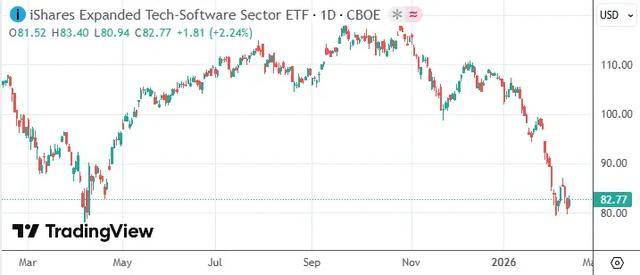
Core Viewpoint - The software sector is facing significant risks due to the rise of AI technologies, with only a few companies likely to survive the impending shakeout [2][4][8] Group 1: Software Sector Risks - Nick Evans, a fund manager, has exited most software stocks, citing existential threats from AI tools like Anthropic's Claude Cowork [2][4] - The iShares Expanded Tech-Software Sector ETF (IGV) has seen a year-to-date decline of 21.53%, while semiconductor stocks have surged due to increased demand for computing power [2] - Evans emphasizes that traditional software companies must now compete not only with AI startups but also with their own clients who are developing in-house tools [4] Group 2: Financial Pressures - The decline in stock prices may pressure software companies to compensate employees with more cash, as many have compensation tied to stock performance [6] - Acquiring AI startups to boost growth could further strain financial resources, with current stock prices not reflecting the uncertainty of future values or the pressure on free cash flow [6] Group 3: Investment Focus - Evans has shifted his investment focus towards infrastructure software companies, which provide foundational support for consumer and enterprise applications, including Cloudflare and Snowflake [6] - Recent performance from infrastructure software firms like Datadog and Fastly indicates a surge in demand, with Datadog's stock rising by 12.1% and Fastly's stock doubling (+113.07%) [6] Group 4: Market Outlook - Evans holds a neutral view on cybersecurity software, believing that AI does not currently pose a direct threat to this sector [8] - He predicts that most companies in the software sector may face a fate similar to that of the newspaper industry in the 2000s, being largely destroyed by the impact of the internet [8] - Investors are advised to significantly underweight application software and act quickly, as the pace of disruption accelerates with stronger AI models [9]


提前逃顶软件板块的基金经理预言:多数公司将消失
Sou Hu Cai Jing· 2026-02-17 01:26
来源:智通财经 Polar Capital基金经理Nick Evans在软件股被抛售前提前离场,他提醒那些想"抄底"的投资者:多数软件 股仍然充满风险,只有少数公司能够存活下来。 "我们认为,应用软件正面临来自人工智能生存性威胁(existential threat)。"Evans管理的一只规模120 亿美元的全球科技基金,过去一年业绩击败99%的同业,过去五年跑赢了97%同行。 近期,市场担心Anthropic推出的Claude Cowork等先进AI工具将颠覆软件行业的商业模式,相关股票大 幅下跌。iShares扩展科技软件行业ETF(IGV)年内已累跌21.53%,半导体股却因算力需求而大涨。 此外,为了提振增长而收购AI初创公司,也会进一步加重财务负担。"我们认为,当前股价并未反映最 终价值的不确定性,也没有计入自由现金流面临的压力。" 当下,华尔街对于AI规模的争论仍在持续。摩根大通的策略师上周表示,近期的"极端价格波动"之后, 软件股可能反弹,他们更看好微软和ServiceNow。 Evans也称,并非所有软件领域都同样脆弱。今年1月,他增持了基础设施软件公司——这些企业为消费 者和企业应用提供底 ...
本周展望:沃尔玛财报、消费支出数据与更多AI冲击
Xin Lang Cai Jing· 2026-02-16 17:03
Market Overview - The core theme of the market last week was the disruption caused by AI, leading to widespread sell-offs in sectors such as software, real estate, financial services, and logistics [1] - The Nasdaq Composite Index fell by 0.2% on Friday and dropped 2.1% for the week, while the S&P 500 Index saw a slight increase of less than 0.1% on Friday but declined 1.4% for the week [1] - The Dow Jones Industrial Average rose by 0.1% on Friday but experienced a 1.2% decline over the week [1] AI Impact on Sectors - The initial sell-off began in the software sector and spread to financial services, retail, and logistics, with significant declines in stocks like Salesforce and ServiceNow [7] - A company that previously produced karaoke machines announced a new AI logistics platform, causing stocks like CH Robinson and Universal Logistics to drop by 12% and 10%, respectively [7] - Analysts noted that the market is reacting to any signs of AI potentially impacting core business operations, leading to a broad sell-off across various sectors [8] Economic Data and Consumer Sentiment - Key economic data to be released this week includes the Personal Consumption Expenditures (PCE) report, which will reflect consumer spending during the holiday season and provide the latest inflation indicators [3] - The January Consumer Price Index (CPI) showed a greater-than-expected slowdown in inflation, with core CPI rising at the lowest rate since December 2021 [10] - The Michigan Consumer Sentiment Index, which measures consumer sentiment against actual spending data, reached a new high since August of the previous year but remains below the same period last year [4] Corporate Earnings Focus - This week, the market's focus will likely be on Walmart's fourth-quarter earnings report, marking the first appearance of new CEO John Furner [4] - Other notable earnings reports include DoorDash and Molson Coors, as well as companies reflecting AI's impact on energy demand, such as Constellation Energy and Southern Company [5] Employment and Interest Rates - The January non-farm payroll data unexpectedly increased by 130,000, double the economists' expectations, surprising Wall Street and the public [10] - Analysts suggest that the current economic signals indicate that interest rates are likely to remain stable until a new direction is established under the upcoming Federal Reserve leadership [12]

业绩超越99%同行的基金认为:AI浪潮下,仅有少数软件公司能存活
Xin Lang Cai Jing· 2026-02-16 13:09
Core Viewpoint - The manager of Polar Capital, Nick Evans, has reduced exposure to software stocks, warning that most remain risky and only a few companies will survive the AI wave [1][5]. Group 1: Software Sector Risks - Application software is facing existential threats from AI advancements, with a significant decline in software stocks, exemplified by a 22% drop in an ETF tracking the U.S. software industry [1][5]. - Evans has liquidated all software holdings except for a small position in Microsoft, indicating a lack of confidence in companies like SAP, ServiceNow, Adobe, and HubSpot [1][6]. - The rise of AI programming tools poses a dual threat to traditional software companies, as clients are increasingly developing their own tools to cut costs while numerous AI startups emerge [6]. Group 2: Financial Pressures - The market downturn triggered by AI disruption is exacerbating cash flow pressures for software companies, as management may need to compensate for stock value losses with cash [3][7]. - The current stock prices do not reflect the uncertainty of long-term valuations or the pressures on free cash flow [8]. Group 3: Investment Outlook - Evans believes that companies providing complex software suites, like SAP, may exhibit more resilience, but their long-term valuations remain highly uncertain due to the rapid enhancement of AI tools [2][6]. - The fund's top holdings include seven semiconductor companies, with Nvidia being the largest at nearly 10% of the portfolio, alongside interests in network equipment and energy infrastructure for data centers [2][6]. - Infrastructure software companies, such as Cloudflare and Snowflake, are expected to thrive, as evidenced by recent strong performance from Datadog and Fastly, with stock prices rising over 10% and doubling, respectively [8]. - Evans anticipates a brutal industry shakeout, predicting that most companies will face a fate similar to that of the print media industry in the 2000s, which was disrupted by the internet [8].

木头姐:这轮市场波动是算法导致,而非基本面
华尔街见闻· 2026-02-16 11:18
Core Viewpoint - The recent market volatility is primarily driven by algorithmic trading rather than fundamental changes in the economy, creating pricing errors that present opportunities for active investors [1][5]. Group 1: Algorithmic Trading and Market Dynamics - Algorithmic trading adjusts risk exposure mechanically based on rules rather than fundamental analysis, leading to indiscriminate selling during market downturns [3]. - This feedback loop can disproportionately affect both strong and weak companies, as algorithms do not differentiate between them [3][5]. - The current market environment is characterized by a "climbing a wall of worry," which historically indicates a strong bull market [5][6]. Group 2: Structural Transformation in Technology - The market is undergoing a transition from a one-size-fits-all SaaS model to highly customized AI-driven platforms, which has led to excessive market reactions against traditional SaaS companies [4][5]. - Active investors are focusing on companies that are successfully transitioning to AI platforms, as algorithmic trading fails to recognize these distinctions [5][6]. Group 3: Capital Expenditure and Market Sentiment - Concerns over the aggressive capital expenditures of major tech companies (Mag 7) are misplaced; the current environment resembles 1996, not the peak of the 1999 bubble [6][7]. - The market's reaction to increased spending by tech giants indicates a cautious investor sentiment rather than irrational exuberance [6][7]. Group 4: Macroeconomic Implications of AI - The rise in productivity driven by AI could lead to a decrease in inflation, challenging the traditional narrative that growth always leads to inflation [10][11]. - Predictions suggest that the U.S. could achieve a budget surplus by the end of the current presidential term, driven by increased productivity and economic growth [10][22]. Group 5: Employment Trends and Entrepreneurship - The labor market shows signs of weakness, with significant downward revisions in employment numbers, but there are positive trends among younger workers, indicating potential for entrepreneurial growth [15][16]. - The accessibility of AI tools is expected to spur a wave of new startups, contributing to productivity gains [17][16]. Group 6: Inflation and Consumer Sentiment - Current inflation indicators show a downward trend, with real-time metrics suggesting inflation is significantly lower than government statistics indicate [12][40]. - Consumer sentiment remains low due to job market concerns and affordability issues, despite some positive economic indicators [15][36]. Group 7: Market Indicators and Investment Strategy - The relationship between the S&P 500 and gold, as well as oil prices, suggests a favorable environment for consumers and businesses, with oil price declines acting as a tax cut [41][42]. - The current market conditions present significant investment opportunities, particularly in sectors poised for growth due to technological advancements [44][45].

木头姐:这轮市场波动是算法导致,而非基本面
Hua Er Jie Jian Wen· 2026-02-16 09:07
Group 1 - The recent volatility in the US stock market is primarily driven by algorithmic trading rather than fundamental changes in the market [1][5][12] - Algorithmic trading tends to execute indiscriminate sell orders when market conditions change, leading to mispricing opportunities for active investors [5][6][12] - The current market is experiencing a structural transformation from a one-size-fits-all SaaS model to highly customized AI platforms, which has led to excessive market reactions [4][5][12] Group 2 - The CEO of ARK Invest, Kathy Wood, argues that the current environment is more akin to 1996, the early stages of the internet revolution, rather than the peak of the 1999 bubble [6][7][12] - Concerns about the aggressive capital expenditures of major tech companies are misplaced; these investments are necessary for future growth and innovation [6][7][12] - The market is currently climbing a "wall of worry," which is often a characteristic of strong bull markets, indicating that investor sentiment is cautious rather than irrationally exuberant [7][12][34] Group 3 - Wood predicts that productivity gains driven by AI could lead to a decrease in inflation, challenging the traditional narrative that growth necessarily leads to inflation [8][19][24] - The potential for a fiscal surplus by the end of the current presidential term is highlighted, with expectations of GDP growth rates reaching 7-8% by the end of the decade [8][14][15] - The current economic environment is characterized by low consumer confidence, primarily due to a weak job market and housing affordability issues [10][27][29] Group 4 - The rise of AI is expected to spur a new wave of entrepreneurial activity, as individuals leverage AI tools to start their own businesses [10][27][28] - The current market dynamics are leading to a significant increase in new business formations, which could enhance productivity and economic growth [10][27][28] - The overall sentiment in the market reflects a cautious approach, with investors still wary of the lessons learned from past market bubbles [34][35]

比特币下跌,AI担忧情绪打压人气
Sou Hu Cai Jing· 2026-02-16 08:52
Core Viewpoint - Bitcoin has slightly declined amid ongoing concerns about potential disruptions caused by artificial intelligence (AI), leading investors to remain cautious about significantly increasing their investments in the cryptocurrency market [1] Group 1: Market Sentiment - The dominant theme in the market is the disruption caused by AI, with investors showing caution towards industries that may face challenges from AI [1] - Industries such as software, financial intermediaries, real estate investment trusts, legal, and logistics are experiencing impacts from AI disruption concerns [1] Group 2: Cryptocurrency Market Dynamics - Analysts from Saxo Bank indicate that the movements in the cryptocurrency market suggest a phase of consolidation rather than panic [1] - Bitcoin's price decreased by 0.3%, reaching $68,688 [1] Group 3: Broader Market Context - The U.S. stock market was closed on Presidents' Day, resulting in reduced catalysts for risk appetite and decreased liquidity [1]
K型社会分化在加速,三种人正在被AI放大
虎嗅APP· 2026-02-16 08:52
Core Viewpoint - The article discusses the emergence of a "K-shaped" society, where economic recovery post-crisis is uneven, leading to a divide between the wealthy and the lower-income groups. The rise of AI is accelerating this divide, creating distinct classes based on access to technology and capital [4][5][6]. Group 1: K-shaped Society - The concept of "K-shaped economy" was introduced during the pandemic, illustrating that recovery paths diverge, with some benefiting while others suffer [6]. - Five years later, this K-shaped reality is evident, with the top 20% of income earners in the U.S. accounting for nearly 60% of consumer spending, the highest since 1989 [7][10]. - The disparity is further highlighted by the increase in car purchases among high-income households, while low-income families struggle with rising food prices [11]. Group 2: AI's Role in Economic Disparity - A report by PwC indicates that workers with AI skills see a salary premium of 56%, up from 25% a year prior, showcasing the growing value of AI expertise [15]. - Industries heavily influenced by AI, such as financial services and software, have seen productivity growth nearly quadruple since the launch of ChatGPT, while less affected sectors have experienced declines [15]. - The demand for AI-related skills is increasing rapidly, with employers shifting focus from degree requirements to practical skills [15][16]. Group 3: Amplification of Certain Individuals - The article identifies three types of individuals who are being amplified by AI: those who define processes, those with high-quality judgment, and those who manage distribution and relationships [20][22]. - The ability to define processes and create replicable systems is becoming a key competitive advantage, as AI automates execution tasks [21]. - Judgment skills are increasingly valuable, as the ability to discern important variables in a complex environment becomes crucial for success [22]. Group 4: Building an Upward System - The article suggests that individuals should focus on creating a "minimum viable upward system" rather than merely learning AI tools, emphasizing the importance of building a system that can generate outputs consistently [24][27]. - Steps to create this system include standardizing inputs, externalizing judgment into rules, and ensuring outputs are deliverable and verifiable [27][28][30]. - The goal is to transition from being a replaceable worker to becoming a process owner, thus enhancing one's value in the job market [31]. Group 5: Time Window for Change - The article emphasizes a critical three-year window for individuals to adapt to the ongoing technological changes, suggesting that those who start now can still benefit from the evolving landscape [32][34]. - The shift towards AI is not just about job displacement but about redefining what work is valuable, with a clear divide emerging between those who adapt and those who do not [34][35].

能源、必选消费和美债领涨2026:华尔街的“AI交易”,正在被AI自己颠覆
美股研究社· 2026-02-16 05:34
Core Viewpoint - The consensus in the capital markets has shifted to the understanding that while AI continues to evolve rapidly, the methods of betting on AI are becoming systematically ineffective [1][3]. Group 1: Market Dynamics - The S&P 500 index experienced its worst weekly performance since November, stabilizing only after mild inflation data was released [2]. - The recent market volatility is not driven by macroeconomic data changes but by a deeper fear that AI is transitioning from a growth engine to a risk amplifier for assets [2]. Group 2: Impact on Valuation - The emergence of AI is not a signal of its failure but a necessary evolution of investment logic [3]. - AI's impact is causing a decline in the marginal value of labor, affecting industries heavily reliant on high-skilled white-collar workers, leading to a revaluation of profit margins in sectors like software and financial services [7]. - The recent sell-off has primarily affected light-asset industries, where profit margins have been recalibrated due to AI's influence [7]. Group 3: Shifts in Investment Preferences - As AI disrupts high-paying white-collar jobs, sectors like energy, essential consumer goods, and U.S. Treasuries are emerging as new safe havens for capital [8]. - This shift is not merely a style rotation but a re-evaluation of "irreplaceability," with energy becoming more akin to a public good due to increased demand from data centers [8]. - Essential consumer goods are gaining strength as they remain stable in demand despite AI advancements, providing defensive value in uncertain times [8]. Group 4: Future Investment Landscape - The investment landscape in 2026 will not be about abandoning AI but rather about identifying asset forms that are least likely to encounter issues during AI's expansion [10]. - The focus will shift from companies that merely tell the best AI stories to those whose demand remains intact or grows passively, even with widespread AI adoption [10]. - Industries that are capital-intensive, resource-constrained, or have physical or regulatory barriers are re-entering the core asset category, while those relying on human premiums and complex processes face stricter scrutiny [10]. Group 5: Conclusion on AI's Role - The key takeaway for investors is not whether AI will continue to develop, but how it is differentiating the risk attributes of assets [12]. - AI is still a crucial long-term variable, but it no longer guarantees high valuations or returns, as it can create both winners and losers [12].

美股财报电话会现状:“AI风险”讨论翻倍,公司必须“自证清白”,投资者“先卖再问”
Hua Er Jie Jian Wen· 2026-02-16 01:17
Core Viewpoint - Despite strong corporate earnings growth, the focus during the current earnings season has shifted to the threats posed by artificial intelligence (AI) [1] Group 1: Earnings Performance - S&P 500 companies reported a 12% year-over-year earnings growth in Q4, surpassing initial expectations of 8.4% [1] - Over 75% of companies exceeded earnings expectations, a figure above the historical average [1] Group 2: Market Reaction - The S&P 500 index has been stagnant, fluctuating between 6500 and nearly 7000 points since early September, with initial concerns about excessive AI spending by large tech companies evolving into fears about AI's potential impact on other companies' earnings [2] - Following comments about AI potentially reducing office space demand, CBRE Group Inc. saw a 20% stock drop within two days despite reporting better-than-expected earnings [1] Group 3: Sector Impact - Media, software, and human resources sectors are viewed as most vulnerable to AI disruption, with the trend now affecting broader sectors including finance and logistics [3] - A basket of stocks identified as at risk from AI has seen a decline of 40% to 50% over the past year, including companies like Salesforce Inc. and Unity Software Inc. in the U.S. and London Stock Exchange Group Plc in Europe [3] Group 4: Investor Sentiment - Investors are increasingly cautious, with a notable rise in short-selling interest in companies perceived to be at risk from AI disruption, particularly in Europe [5][6] - The average short interest in a basket of stocks affected by AI risks has increased from about 2% to over 5% in the past two years [6] Group 5: Capital Expenditure Trends - Despite concerns about AI disruption, major tech companies continue to increase capital expenditures, with projected growth of 72% by 2025 for the five largest tech giants [7] - A cooling of the recent sell-off is anticipated to occur if one of the major tech companies announces a reduction in capital spending [7]