
半导体存储

Search documents
诚邦股份:拟定增1.29亿元加码半导体存储业务,去年其存储与生态环境建设业务毛利率接近
2 1 Shi Ji Jing Ji Bao Dao· 2025-08-25 02:48
Group 1 - The company plans to raise up to 129.38 million yuan through a simplified procedure for issuing shares to no more than 35 qualified investors, with the funds allocated for embedded storage chip expansion, SSD high-end upgrades, and working capital supplementation [1] - The company's core business has shifted from ecological environment construction to include semiconductor storage, following a 5.8 million yuan investment to acquire 51.02% of Chip Storage Technology [1] - The ecological environment construction segment has faced challenges, with a reported revenue of 347.89 million yuan and a net loss of 99.47 million yuan in 2024, continuing a trend of declining revenue and losses [1] Group 2 - Chip Storage Technology achieved a quarterly revenue of 111 million yuan in October 2024, with an annual revenue exceeding 300 million yuan, accounting for 31.79% of the company's total revenue [2] - The gross profit margins for both the ecological environment construction and semiconductor storage businesses are relatively low, with 3.47% and 3.85% respectively in 2024 [2] - The company anticipates a net loss of approximately 10.5 million yuan for the first half of 2025, primarily due to increased financial expenses and insufficient new orders in the ecological environment construction segment [2]

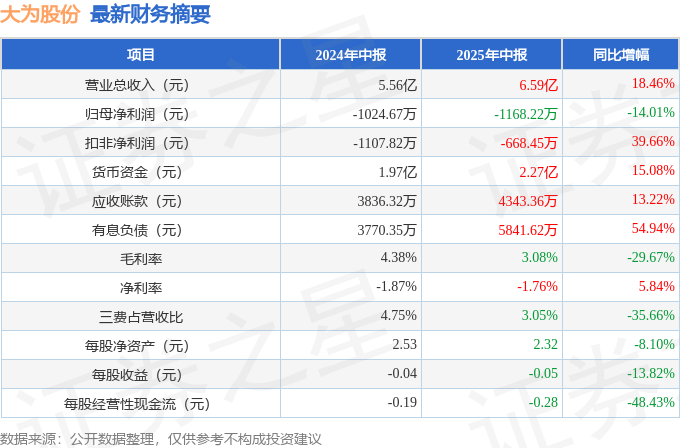
大为股份2025年中报简析:增收不增利
Zheng Quan Zhi Xing· 2025-08-22 23:19
Core Viewpoint - Dawi Co., Ltd. reported an increase in revenue but a decline in profit for the first half of 2025, indicating challenges in profitability despite growth in sales [1][2]. Financial Performance Summary - Total revenue for the first half of 2025 reached 659 million yuan, a year-on-year increase of 18.46% compared to 556 million yuan in 2024 [1]. - The net profit attributable to shareholders was -11.68 million yuan, a decrease of 14.01% from -10.25 million yuan in the previous year [1]. - The gross profit margin fell to 3.08%, down 29.67% from 4.38% in 2024 [1]. - The net profit margin improved slightly to -1.76%, an increase of 5.84% from -1.87% in 2024 [1]. - Total operating expenses (sales, management, and financial expenses) amounted to 20.14 million yuan, accounting for 3.05% of revenue, a decrease of 35.66% year-on-year [1]. Cash Flow and Debt Management - Operating cash flow per share was -0.28 yuan, a decline of 48.43% from -0.19 yuan in 2024 [1]. - The company experienced a significant increase in interest-bearing debt, which rose by 54.94% to 584.16 million yuan [1][2]. - The net cash flow from operating activities decreased by 48.44%, attributed to customer prepayments being delivered during the reporting period [3]. Business Operations and Cost Management - The increase in revenue was primarily driven by the expansion of the semiconductor storage business [2]. - Sales expenses decreased by 11.25% due to refined management and optimization of expenditure structures [2]. - Management expenses saw a reduction of 29.79%, reflecting ongoing efforts to enhance resource efficiency [2]. Investment and Return Metrics - The company's historical return on invested capital (ROIC) has been weak, with a median of 1.94% over the past decade and a particularly poor ROIC of -10.31% in 2023 [3]. - The company has reported negative net profits in two of the last ten years, indicating a fragile business model [3].


诚邦股份: 诚邦生态环境股份有限公司2025年度以简易程序向特定对象发行股票预案
Zheng Quan Zhi Xing· 2025-08-22 20:02
Group 1 - The company, Chengbang Eco-Environment Co., Ltd., plans to issue shares to specific investors to raise funds for expanding its semiconductor storage business, which is expected to become its core business by 2025 [14][15][26] - The total amount to be raised from this issuance is not to exceed 129.38 million yuan, which is capped at 20% of the company's net assets as of the end of the previous year [5][24] - The funds will be used for projects including the expansion of embedded storage chip production capacity, focusing on products like LPDDR, EMMC, and SD NAND [30][31] Group 2 - The semiconductor industry is a strategic foundation for national technological independence and security, with significant government support for the storage segment [15][16] - The global semiconductor market is projected to grow to 697.1 billion USD in 2025, with the storage market expected to reach 167 billion USD, reflecting a growth rate of over 81% [15][16] - The company aims to enhance its competitiveness in the semiconductor storage sector by introducing advanced production equipment and expanding its product matrix [17][31] Group 3 - The company has completed a controlling investment in Chip Storage Technology, entering the semiconductor storage field, which aligns with its strategic shift towards dual main business areas: ecological environment construction and semiconductor storage [14][15] - The company reported a revenue of 347.89 million yuan in 2024, with semiconductor storage contributing over 110.59 million yuan, indicating a significant growth trajectory [14][15] - The issuance is expected to facilitate the acquisition of advanced equipment and the establishment of new production lines to enhance production capacity and operational performance in the semiconductor storage business [17][30]
诚邦股份: 诚邦生态环境股份有限公司关于2025年度以简易程序向特定对象发行股票摊薄即期回报的风险提示及填补回报措施和相关主体承诺的公告
Zheng Quan Zhi Xing· 2025-08-22 16:49
Core Viewpoint - The company plans to issue shares to specific investors in 2025, which will dilute immediate returns but aims to enhance its financial position and competitiveness through strategic investments [1][5]. Financial Impact Analysis - The total share capital before the issuance is 264,264,000 shares, which will increase to 283,002,029 shares post-issuance [2]. - The estimated total funds raised from this issuance will not exceed 129.38 million yuan [2]. - Under three different profit scenarios for 2025 compared to 2024, the projected net profit for the parent company ranges from -99.47 million yuan to -119.37 million yuan [4][6]. Necessity and Feasibility of the Issuance - The funds raised will be used for projects that align with the company's core business and national industrial policies, enhancing its market position and profitability [5][6]. - The company is expanding its business model to include semiconductor storage alongside its existing environmental construction services [6]. Relationship with Existing Business - The raised funds will support projects such as embedded storage chip expansion and SSD upgrades, which are closely related to the company's current operations [6][7]. - The company has a strong R&D team with over ten years of industry experience, ensuring the capability to execute these projects effectively [6][7]. Measures to Mitigate Dilution of Immediate Returns - The company will implement measures such as improving governance, managing funds effectively, and enhancing operational efficiency to mitigate the impact of share dilution on immediate returns [8][10]. - A commitment to a stable profit distribution policy will be established to ensure ongoing returns to investors [10]. Commitments from Key Stakeholders - The controlling shareholders and management have made commitments to uphold the measures for compensating the dilution of immediate returns, ensuring no interference in company operations [11][12].
诚邦股份: 诚邦生态环境股份有限公司关于2025年度以简易程序向特定对象发行股票方案的论证分析报告
Zheng Quan Zhi Xing· 2025-08-22 16:48
Group 1 - The company plans to issue shares to specific investors to raise up to 12.938 million yuan to enhance its capital strength and profitability, driven by the need for business transformation in the face of industry challenges [1][4][6] - The company has shifted its focus towards the semiconductor storage sector, anticipating that revenue from this segment will surpass that of its ecological environment business by 2025 [2][3][4] - The semiconductor industry is a strategic foundation for national technological independence and is supported by various government policies, indicating a favorable environment for growth in the semiconductor storage sector [3][4] Group 2 - The funds raised will be used to purchase advanced equipment and expand production capacity in the semiconductor storage business, which includes mobile storage and solid-state drives [5][6][7] - The company aims to enhance its embedded storage product capabilities and upgrade its existing SSD production lines to meet increasing market demand for high-end products [5][6][7] - The issuance of shares is deemed necessary to optimize the company's capital structure and reduce financial risks associated with high debt financing costs [6][7][8] Group 3 - The issuance will target up to 35 specific investors, including qualified institutional investors and natural persons, ensuring compliance with regulatory requirements [8][9][10] - The pricing of the shares will be based on the average trading price over the previous 20 trading days, ensuring fairness in the issuance process [10][14][15] - The company has established a plan to manage the raised funds effectively, ensuring they are used for projects that align with its strategic goals and enhance shareholder value [25][26][27] Group 4 - The company has committed to measures to mitigate the dilution of immediate returns for shareholders, including improving operational efficiency and enhancing profitability [19][22][23] - A three-year shareholder return plan has been developed to ensure transparency and stability in profit distribution, particularly benefiting minority shareholders [26][27][28] - The company emphasizes its commitment to maintaining a robust governance structure to protect shareholder interests and ensure compliance with regulatory standards [28][29]
诚邦股份: 诚邦生态环境股份有限公司2025年度以简易程序向特定对象发行股票募集资金使用的可行性分析报告
Zheng Quan Zhi Xing· 2025-08-22 13:19
Fundraising Plan - The company plans to raise a total of no more than 129.38 million yuan, which will be used for specific projects after deducting related issuance costs [1] - The total investment for the projects is 163.77 million yuan, with the raised funds covering 12.94 million yuan [1] Project Necessity and Feasibility Embedded Storage Chip Expansion Project - The project aims to expand the production capacity of embedded storage chips, focusing on LPDDR, EMMC, and SD NAND, to meet the growing market demand [2] - The embedded storage market is expected to grow significantly due to the increasing data volume and the proliferation of smart devices [2] - The project aligns with national policies promoting semiconductor localization and aims to enhance the company's competitiveness in the semiconductor storage sector [2] AI-Driven Market Expansion - The rapid development of AI technology is driving the demand for high-performance embedded storage solutions, particularly in AI applications [3][4] - The company plans to introduce high-performance embedded storage products to support AI terminals and edge computing devices, creating new growth engines [4] Advanced Production Equipment Introduction - The project will introduce advanced automated production equipment to enhance manufacturing precision and product consistency [5] - This upgrade is essential for meeting the increasing demand for high-performance storage chips in various applications, including smart wearables and smartphones [5] SSD High-End Upgrade Project - The project focuses on upgrading existing SSD products to high-capacity and high-performance models to capture the growing AI data center market [7][8] - The global enterprise SSD market is projected to grow from approximately 29 billion USD in 2024 to 51.4 billion USD by 2027, with a CAGR of about 21% [8][9] - The company aims to transition from traditional consumer SSDs to enterprise-grade SSDs, which are increasingly in demand due to their reliability and performance [9][10] Funding for Working Capital - The company plans to allocate 36 million yuan from the raised funds to supplement working capital, addressing the financial pressures from its ecological environment business [14][15] - This funding will help optimize the company's capital structure, reduce financial risks, and improve overall profitability [15] Overall Impact on Operations and Financial Status - The fundraising will enhance the company's capital strength and improve its capital structure, although short-term returns may decline until projects are completed [15][16] - Successful implementation of the projects is expected to boost the company's competitive edge and sustainable development, benefiting shareholders in the long run [16]
大为股份上涨5.82%,报20.0元/股
Jin Rong Jie· 2025-08-22 02:41
Group 1 - The core viewpoint of the news is that Dawi Co., Ltd. has shown a significant increase in stock price and is actively expanding its business in the new energy battery materials sector [1][2] - As of August 22, Dawi's stock price rose by 5.82% to 20.0 yuan per share, with a trading volume of 395 million yuan and a turnover rate of 9.93%, resulting in a total market capitalization of 4.747 billion yuan [1] - The company is primarily engaged in the innovation and development of the buffer industry, focusing on two main business areas: "new energy + automotive" and "semiconductor storage + smart terminals" [1] Group 2 - As of March 31, Dawi had 43,000 shareholders, with an average of 4,793 circulating shares per person [2] - For the first quarter of 2025, Dawi reported operating revenue of 337 million yuan, representing a year-on-year growth of 5.11%, while the net profit attributable to shareholders was -1.8897 million yuan, showing a year-on-year increase of 32.23% [2]
江波龙:公司产品包括嵌入式存储、移动存储、固态硬盘、内存条等
Zheng Quan Ri Bao Wang· 2025-08-21 13:15
Group 1 - The company, Jiangbolong (301308), offers a range of products including embedded storage, mobile storage, solid-state drives, and memory bars [1] - The semiconductor storage industry is experiencing continuous technological innovations, and the company aims to monitor and lead the trends in industry technology development [1]
深度剖析HBM千亿蓝海,AI算力激战下供需新格局
Great Wall Securities· 2025-08-21 12:22
Investment Rating - The report rates the industry as "Outperform" [1] Core Insights - The HBM market is projected to reach $46 billion by 2026, accounting for 35% of the DRAM market, with a CAGR of 33% from 2024 to 2030 [3][25] - AI-driven demand is significantly increasing, with the average storage capacity per AI server expected to double or quadruple, leading to exponential growth in total storage demand [3][12] - Major semiconductor manufacturers are ramping up HBM production, with capital expenditures for 2025 expected to exceed initial plans [3][12] Demand Side Summary - AI server shipments are forecasted to grow by 17.2% year-on-year, reaching 2.51 million units by 2026, driven by increased capital expenditures from major cloud service providers [6][25] - The average HBM capacity per AI server is expected to increase by 8 to 16 times due to higher configurations and the transition to next-generation HBM technologies [6][12] - The total HBM demand is projected to reach 34.05 billion GB by 2026, with a year-on-year growth of 67% [25] Supply Side Summary - Major manufacturers like Micron, SK Hynix, and Samsung are actively expanding HBM production capacity, with significant increases in capital expenditures planned for 2025 [3][12] - The supply of HBM is currently adequate, but the high growth in demand and the transition to higher-end HBM generations are expected to drive prices upward [11][12] - The competitive landscape is dominated by a few key players, with the market share of SK Hynix, Samsung, and Micron expected to shift from 5:3:2 to 5:2:3 by 2026 [12] Price Outlook - The average selling price (ASP) of HBM is expected to rise to $1.84 per Gb by 2026, driven by the demand for high-end products [12][25] - The HBM market is currently in an upward price cycle, influenced by the recovery in terminal demand due to AI applications [3][12] Industry Overview - The semiconductor storage market is characterized by oligopolistic competition, with the top three manufacturers holding over 95% market share in DRAM and HBM [3][12] - The overall semiconductor storage market is projected to reach $165.5 billion in 2024, representing over 25% of the semiconductor market [3][12]

大为股份上半年营收同比增长18.46% 半导体存储业务营收增逾四成
Zheng Quan Shi Bao Wang· 2025-08-21 11:51
Core Insights - The company reported a total revenue of 659 million yuan for the first half of 2025, representing a year-on-year growth of 18.46% [1] - The semiconductor storage business generated 608 million yuan in revenue, marking a significant year-on-year increase of 40.77%, accounting for 92.16% of total revenue, thus driving the company's growth [1] - The company is focusing on two main business segments: "semiconductor storage + smart terminals" and "new energy + automotive" [1] Semiconductor Storage Business - The semiconductor storage segment experienced explosive growth due to the accelerated penetration of AI and the domestic innovation industry [1] - Key products such as DDR3, DDR4, and LPDDR4X maintained stable output, with LPDDR4X successfully entering the domestic operator supply chain, leading to significant monthly shipment increases [1] - The company achieved breakthroughs in high-end products, with large-capacity eMMC products being stably delivered and LPDDR5 products entering trial production after certification on mainstream SoC platforms [1] Domestic Market Positioning - The company is deepening collaborations with international manufacturers like Samsung and SK Hynix while also strengthening partnerships with domestic firms such as Yangtze Memory Technologies and Changxin Memory Technologies [1] - Some storage products have adopted Yangtze Memory's NAND solutions and Changxin's DRAM solutions, accelerating the replacement of international brands in niche markets [1] New Energy and Automotive Business - The company’s lithium battery project in Chenzhou has made significant progress, with a total investment of approximately 150.24 million yuan and substantial mineral resources identified [2] - The innovative "magnetic separation + flotation + re-selection" process has enabled efficient recovery of lithium concentrate and high-purity quartz, significantly reducing overall costs [2] - The carbonated lithium business achieved revenue of 9.04 million yuan through dual-channel procurement and financial hedging strategies [2] Automotive Sector Performance - The automotive segment generated revenue of 32.45 million yuan in the first half of the year, continuing its growth trend [3] - Core products like electric retarder and hydraulic retarder have solidified partnerships with major clients, contributing over 60% of sales, while also achieving breakthroughs in new energy and overseas markets [3] - The company has completed trials for the EC13/V3.0 controller and is advancing the localization of the EC16 controller, improving signal transmission efficiency by 30% [3] Financial Health and Future Outlook - The company improved its operational quality, with the expense ratio decreasing from 5.53% to 3.55% year-on-year, and the asset-liability ratio dropping to 21.54%, a decrease of 5.42 percentage points from the beginning of the period [3] - The company plans to focus on high-end storage, new energy vehicles, and comprehensive utilization of lithium resources, leveraging technological, resource, and policy advantages for sustained growth [3]