建筑

Search documents
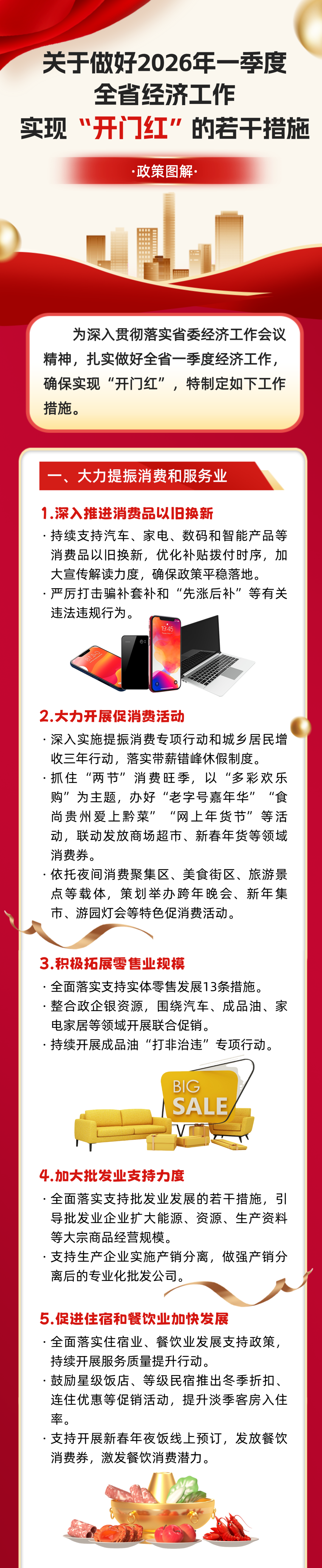
一图读懂丨关于做好2026年一季度全省经济工作实现“开门红”的若干措施
Xin Lang Cai Jing· 2026-01-03 08:59
Group 1 - The article outlines measures to ensure a strong economic start in the first quarter of 2026, emphasizing the importance of consumer spending and investment [2][24] - Key initiatives include promoting the replacement of old consumer goods, enhancing retail and wholesale support, and accelerating the development of the accommodation and catering industries [3][8][10][12] Group 2 - The plan includes expanding effective investment through optimized project mechanisms and accelerating project initiation, particularly in infrastructure and key industries [24][30] - Specific projects highlighted for development include the integration of coal and phosphate chemical industries, highway construction, and large reservoir projects [30][32] Group 3 - The article stresses the importance of supporting key enterprises and industries to stabilize production and expand capacity, with a focus on reducing operational costs and enhancing service quality [40][43] - Measures to support the digital economy and new energy sectors are also emphasized, including the promotion of data centers and electric vehicle production [51][53] Group 4 - The article addresses agricultural production, emphasizing the need for effective spring sowing and ensuring the supply of agricultural products [57][61] - It also highlights the importance of maintaining employment stability and ensuring the supply of essential goods and energy during the winter [65][67] Group 5 - Safety production measures are outlined, focusing on risk prevention in key sectors and ensuring public safety during the winter season [70]

山东:12个重点行业划定稳增长路线图
Xin Hua Wang· 2026-01-03 02:49
Core Viewpoint - The "2026 Policy List" aims to stabilize and enhance the industrial economy in Shandong Province, focusing on 12 key industries that are crucial for economic growth and structural optimization [1][2]. Group 1: Key Industries and Economic Impact - The 12 targeted industries, including steel, non-ferrous metals, chemicals, automotive, and textiles, collectively generate approximately 7.8 trillion yuan, accounting for about 67% of the province's industrial output and 75% of manufacturing output [1]. - Maintaining stability in these key industries is essential for the overall industrial economy of Shandong [1]. Group 2: Growth Targets and Structural Optimization - Specific quantitative growth targets have been set for various sectors by 2026, such as a 4% increase in steel industry value-added, production of 1.2 million new energy vehicles, and over 850 billion yuan in revenue for the electronic information manufacturing sector [2]. - The policy emphasizes both growth and structural improvement, with a focus on enhancing technological capabilities and optimizing product structures [2]. Group 3: Support for Aerospace Industry - The policy includes measures to support the aerospace industry, such as subsidies for commercial rocket and satellite companies, with a maximum subsidy of 3 million yuan per project [3]. - These initiatives aim to reduce launch costs and foster innovation within the aerospace sector, contributing to the industry's overall growth [3]. Group 4: Green Building Initiatives - The policy promotes green building practices through government procurement, aiming to establish a long-term mechanism for supporting green building materials [4]. - New urban construction projects funded by government or state-owned investments are required to use green materials, with a target of at least 40% application in star-rated green building projects [4]. Group 5: Support for Private Enterprises - The policy outlines a comprehensive mechanism to address the needs of enterprises, ensuring a streamlined process for resolving issues and enhancing resource allocation [5]. - Continuous optimization of the "Ru Hui Tong" policy implementation platform is planned to facilitate quicker access to benefits for enterprises [5].
斐济2025-26年度经济表现
Shang Wu Bu Wang Zhan· 2026-01-02 15:18
Group 1 - Fiji's economic performance for 2025 is described as "robust," with GDP growth expected to slow to approximately 3% due to the lingering effects of the pandemic and a lack of significant investments [1] - The GDP growth rate for 2024 is projected at 3.5%, down from 9.4% in 2023 and 17.7% in 2022, indicating a return to pre-pandemic average growth rates [1] - New business investments are disappointing, with private sector construction rising but still 24% lower than recent peaks, highlighting slow project initiation despite available private investment channels [1] Group 2 - Fiji's government faces challenges in driving large-scale capital projects due to limited fiscal budget, necessitating stronger commercial investments to improve financial conditions [2] - Increased demand for space has led to renewed interest in hotels, office buildings, shopping centers, warehouses, and factories, positioning Fiji as an important regional distribution hub [2] - Private consumption spending may face resistance in 2026, as remittances that previously boosted consumer demand are reversing or have exhausted their impact [2] Group 3 - Agriculture plays a significant role in economic development, contributing to private consumption and supporting various sectors such as retail, telecommunications, and transportation [3] - Increased agricultural exports and potential price rises can enhance income and purchasing power, reducing reliance on tourism and remittances for economic growth [3] - A more resilient and diversified economic foundation is anticipated for Fiji as agricultural income rises [3]
塞尔维亚2025年GDP增长2%
Shang Wu Bu Wang Zhan· 2026-01-01 16:46
Economic Growth - Serbia's GDP is projected to grow at a real rate of 2% in 2025 [1] - Most service and industrial activities have shown growth, with retail growing by 4.2%, transportation by 4.7%, and the restaurant sector by 1.5% [1] Sector Performance - Industrial production value increased by 1.0%, with mining up by 4.4% and manufacturing by 1.2% [1] - The construction sector experienced a decline of 8.4% [1] - The energy sector faced a decrease of 2% due to drought affecting hydroelectric reserves [1] - Agriculture saw a slight decline of 0.3% due to adverse weather conditions [1] Inflation and Labor Market - The average inflation rate for 2025 is expected to be 3.8%, with December's inflation rate at 2.8%, aligning with the central bank's target of 3%±1.5% [1] - The labor market remains strong, with nominal wages increasing by 11.2% and real wages by 7.1% [1] - The unemployment rate decreased to 8.2% in the third quarter [1] Trade Performance - Despite weak external demand, Serbia's exports are estimated to grow by 8% in 2025, primarily driven by the automotive sector [1] - Imports are projected to rise by 7.3%, attributed to ongoing imports of raw materials and equipment, as well as increased consumer goods imports due to rising disposable incomes [1]
以高质量发展全面推进中国式现代化
Xin Lang Cai Jing· 2026-01-01 05:24
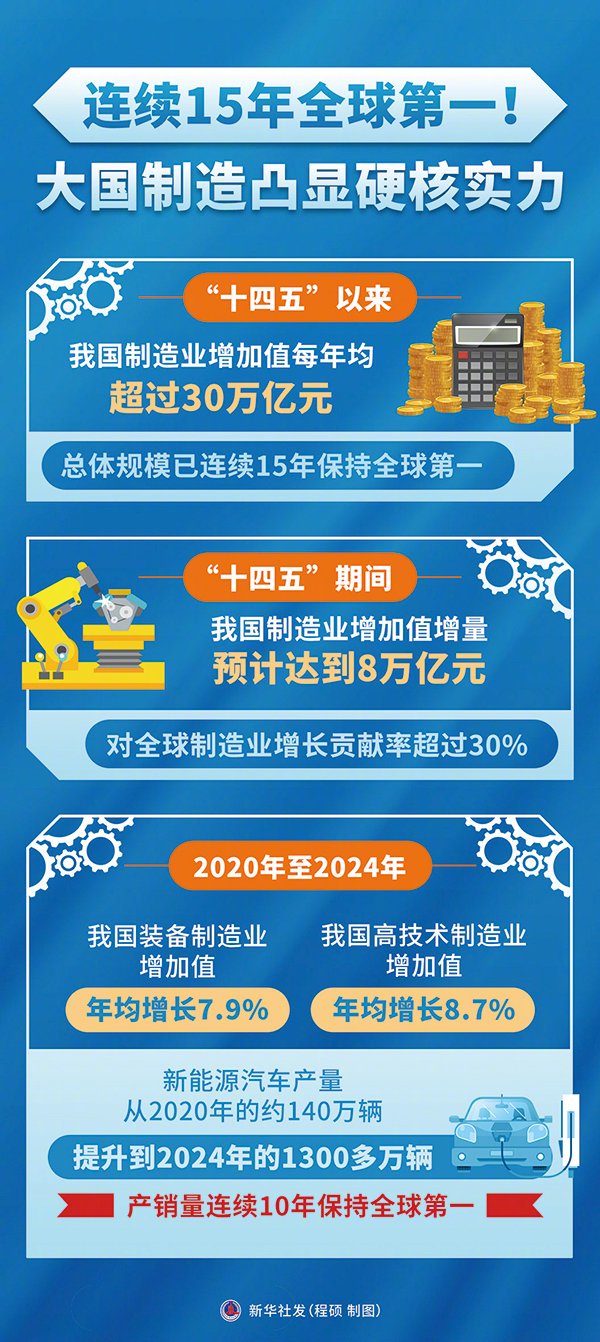
Core Viewpoint - High-quality development is essential for advancing Chinese-style modernization and is a key requirement for the overall construction of socialism in China [1][8]. Group 1: Economic Growth and Development Strategy - The "14th Five-Year Plan" has laid a solid foundation for achieving socialist modernization by 2035, which requires a strategic arrangement over three five-year plans [2]. - The "15th Five-Year Plan" is crucial for solidifying the foundation and fully exerting efforts towards achieving modernization, focusing on resolving deep-seated contradictions that hinder high-quality development [2][3]. - Economic growth must maintain an appropriate speed, with a target of an average annual GDP growth of 4.17% during the "15th" and "16th Five-Year Plans" to achieve a per capita GDP of over $20,000 by 2035 [3][6]. Group 2: Manufacturing and Industrial Development - Manufacturing is a vital foundation for modernization, with China's manufacturing value added exceeding 30 trillion yuan annually, maintaining the world's largest scale for 15 consecutive years [6][9]. - The "15th Five-Year Plan" emphasizes building a modern industrial system, optimizing traditional industries, and fostering emerging industries, particularly in advanced manufacturing and strategic emerging sectors [9][10]. Group 3: Technological Innovation - Accelerating high-level technological self-reliance is crucial for high-quality development, with significant increases in R&D funding and achievements in key technologies [10][12]. - The focus is on original innovation and breakthroughs in critical core technologies, with an emphasis on integrating technology and industry to enhance innovation capabilities [10][12]. Group 4: Domestic Market and Consumption - Expanding domestic demand is a strategic move for economic stability and security, with initiatives to boost consumption and effective investment [12][13]. - The plan includes removing unreasonable restrictions on consumption, optimizing income distribution, and enhancing consumer capacity to stimulate economic growth [12][14]. Group 5: Reform and Opening Up - Comprehensive deepening of reform and opening up is essential for high-quality development, focusing on overcoming institutional barriers and enhancing market vitality [13][14]. - The strategy includes promoting the complementary advantages of various ownership economies and optimizing the layout of state-owned enterprises [13]. Group 6: Improving People's Quality of Life - Enhancing the quality of life is a fundamental aspect of high-quality development, with policies aimed at improving employment, income distribution, and social security systems [14][15]. - The goal is to achieve common prosperity through sustainable economic growth, ensuring that public services in education, healthcare, and housing meet the needs of the population [15].
新年首个“政策包”来了!“含金量”满满
Da Zhong Ri Bao· 2026-01-01 01:53
Core Viewpoint - The first policy package of 2026, consisting of 28 measures, aims to support quality enterprise development and project construction, with 20 measures focused on rewards and subsidies to stimulate market vitality [1] Group 1: Economic Support Measures - The policy list includes five areas with 28 measures, emphasizing the integration of supply to stabilize the economy and enhance service industry support [1] - A total of 500 million yuan is allocated to support new and "quasi-standard" enterprises, with additional funds for modern service projects, particularly in high-end productive services [2] - The government will provide 1 billion yuan to support key projects in marine services and cultural tourism, including discounts for certain tourist attractions [2] Group 2: Industrial and Investment Support - The policy emphasizes "one industry, one policy" to support 12 key industries, including steel and chemicals, and aims to stabilize the construction industry through increased green building material procurement [3] - A total of 5 million yuan is allocated for fixed asset investment assessment rewards, with additional incentives for provincial enterprises in emerging industries [3] - The policy aims to optimize land and carbon emission indicators to ensure the construction of key projects [3] Group 3: International Market Development - The province will provide funding support for enterprises participating in key exhibitions and developing cross-border e-commerce, with a focus on traditional and high-value industries [5] - The "Ten Thousand Enterprises Going Global" initiative will organize over 500 overseas exhibition activities, involving more than 10,000 enterprises [5] - The policy aims to foster the integration of cross-border e-commerce with industrial clusters, supporting around 1,000 enterprises in various aspects of international marketing [5] Group 4: Implementation and Accessibility - The effectiveness of the policy package relies on its implementation, with plans to develop supporting measures and streamline the application process for enterprises [6] - The "Ru Hui Tong" policy platform will be utilized to enhance the accessibility of policy benefits, ensuring that enterprises can quickly access and enjoy the advantages of the new policies [6]
【广发宏观贺骁束】高频数据下的12月经济:数量篇
郭磊宏观茶座· 2026-01-01 00:07
Core Viewpoint - The article highlights a general decline in various industrial sectors, including power generation, steel production, real estate sales, and consumer goods, indicating a weakening economic environment as of December 2023. Group 1: Power Generation and Industrial Activity - Power generation from coal-fired plants has decreased by 8.5% year-on-year as of December 25, compared to a decline of 7.2% in November, reflecting weak demand during the off-peak season and the impact of a warm winter [1][7] - Industrial operating rates are also showing seasonal weakness, with most sectors, except for downstream automotive tire production, reporting lower year-on-year operating rates [1][7] Group 2: Steel Production - Key steel mills reported a daily average crude steel output decrease of 2.0% month-on-month and 5.1% year-on-year as of the third week of December [9] - By the fourth week of December, rebar production fell by 10.7% month-on-month and 16.4% year-on-year, while hot-rolled coil production decreased by 4.6% month-on-month and 3.9% year-on-year [9] Group 3: Construction and Infrastructure - There has been a marginal improvement in the funding availability rate for construction sites, with a 0.15 percentage point increase as of December 23 [11] - The operating rate for petroleum asphalt has turned positive month-on-month, increasing by 0.83 percentage points, indicating a potential recovery in the construction sector [11] Group 4: Consumer Behavior and Retail Sales - Real estate sales continue to show weakness, with a year-on-year decline of 31.3% in average daily transaction area for commercial housing in 30 major cities from December 1 to 30 [15] - Retail sales of passenger cars have also decreased significantly, with a year-on-year drop of 17% from December 1 to 28, while wholesale sales fell by 19% [16] Group 5: Home Appliances and Consumer Goods - Sales of home appliances remain in negative growth territory, with online sales of air conditioners, refrigerators, and washing machines declining by 48% to 29% year-on-year [17][18] - The production of home appliances is expected to turn positive in January 2024, although there may be disruptions due to the Spring Festival [17][20] Group 6: Port Activity and Trade - Port container throughput remains resilient, with a year-on-year increase of 7.2% from December 1 to 28, although the growth rate has slowed compared to November [20] - The number of container ships sent to the U.S. has seen a reduced year-on-year decline, indicating some stabilization in trade activities [20]

年度策略报告姊妹篇:2026年策略组风险排雷手册-20251231
ZHESHANG SECURITIES· 2025-12-31 12:32
Group 1 - The core viewpoint of the report is that the A-share market in 2026 will revolve around "structural transformation and confidence restoration," with a focus on technology investments and external demand recovery [3][4] - The report emphasizes a "systematic slow bull" market phase, suggesting a gradual upward trend in the market, with the Shanghai Composite Index expected to oscillate between the high point of February 2021 and the 0.809 quantile of 5178-2440 [9] - Investment strategies include focusing on four main lines: consumer services, sectors with growth potential like automotive and pharmaceuticals, traditional industries, and dividend-paying stocks such as banks and transportation [9] Group 2 - Policy risks are highlighted, particularly the impact of new public fund regulations on asset allocation, which may lead to a reallocation of equity fund performance benchmarks in the second half of 2026 [10][12] - Geopolitical risks are identified, with potential impacts from U.S. actions in Venezuela and Japan's political stance affecting market sentiment and inflation expectations [13][14] - Other risks include the pace of U.S. interest rate cuts, domestic economic recovery, and the performance of U.S. tech stocks, all of which could influence market dynamics in the second half of 2026 [15][17][20]
住建部:推动既有住房更新改造 稳步推进城中村和危旧房改造
Xin Lang Cai Jing· 2025-12-31 10:40
Overall Requirements - The core objective is to enhance housing quality to meet the high-quality living needs of the public, with a focus on improving housing standards, design, materials, construction, and operation levels by 2030 [2][8] - The initiative aims to create a robust policy, standard, technical, and industrial system to support housing quality improvement [2] Key Tasks - **Improvement of Housing Construction Standards**: Strict adherence to mandatory construction standards and timely updates to housing design standards to enhance overall housing quality [3] - **Enhancement of Architectural Design**: Focus on optimizing residential layouts and improving living conditions through refined design practices [3] - **Promotion of Quality Materials**: Encourage the use of high-quality, energy-efficient, and environmentally friendly building materials, with a strong emphasis on quality control [4] - **Development of New Construction Methods**: Integration of advanced manufacturing and information technologies to promote smart and green construction practices [4] - **Improvement of Operation and Maintenance Services**: Establish a long-term safety management mechanism for housing and enhance property service quality [5][6] - **Renovation of Existing Housing**: Promote the renovation of old residential areas and improve community facilities to enhance living quality [6] - **Strengthening Technological Empowerment**: Focus on research and development of key technologies to improve housing quality and promote smart home solutions [7] - **Enhancement of Industrial Support**: Encourage real estate and construction companies to transition into integrated service providers for quality housing [8] Implementation Strengthening - Local housing and urban-rural development departments are tasked with implementing these guidelines effectively, ensuring alignment with urban development and housing market needs [8]
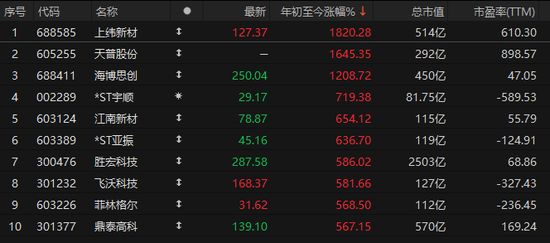
收官日!A股、港股2025创纪录!股王诞生,最高涨超41倍!
Xin Lang Cai Jing· 2025-12-31 10:30
炒股就看金麒麟分析师研报,权威,专业,及时,全面,助您挖掘潜力主题机会! 来源:上市之家 12月31日,A股、港股迎来全年收官战。A股市场呈现指数分化态势,沪指以11连阳强势收官并创下10 年新高;港股因元旦假期仅交易上午半天,主要指数小幅收跌,但全年仍录得显著涨幅。两市年内板块 轮动活跃,新质生产力相关赛道成核心主线,资金面呈现显著结构性特征。 A股创纪录,诞生3只10倍股 A股方面,收官日主要指数涨跌互现。截至收盘,上证指数微涨0.09%,以11连阳的强劲走势圆满收 官,全年累计上涨18.41%,创下近10年以来的年度新高。深证成指当日下跌0.58%,全年涨幅达 29.87%;创业板指表现更为亮眼,尽管收官日下跌1.23%,但全年大涨49.57%,领涨主要指数。此外, 科创50指数全年上涨35.92%,北证50指数全年涨幅亦达38.8%,多层次资本市场均展现出良好的增长活 力。 板块轮动是2025年A股市场的鲜明特征。全年来看,算力硬件、有色金属、银行、电池产业链、创新 药、商业航天、机器人等多个热门板块交替发力,共同推动沪指一度站上4000点整数关口。按申万二级 韩行业分类,涨幅前五的板块分别为航天装备 ...