
券商

Search documents
非银金融行业周报(2026/1/5-2026/1/9):持续看好全年非银板块价值重估逻辑-20260111
Shenwan Hongyuan Securities· 2026-01-11 13:13
2026 年 01 月 11 日 《公募费率改革收官, 非银板块向上突破 动能充盈——非银金融行业周报 (2025/12/29-2025/12/31)》 2026/01/05 《高弹性标签助力板块"破圈",看好资负 两端改善趋势 -- 2026 年保险行业策略 报告》 2025/11/18 《证券行业 2026 年投资策略:权益浪潮 下的券商机遇:财富扩容,国际增效》 2025/11/17 证券分析师 罗钻辉 A0230523090004 luozh@swsresearch.com 孙冀齐 A0230523110001 sunjg@swsresearch.com 金黎丹 A0230525060004 jinld@swsresearch.com 联系人 罗钻辉 A0230523090004 luozh@swsresearch.com 万宏源研究微信服务 续看好全年非银板块价值重 非银金融行业周报(2026/1/5-2026/1/9) 本期投资提示: 时代人行业 相关研究 请务必仔细阅读正文之后的各项信息披露与声明 苏研究招 0 券商:本周申万券商 II 指数收跌 1.90%,跑输沪深 300 指数 0.89pc ...






金融行业周报(2026、01、11):开门红催化保险板块,看好配置策略下银行股中长线收益-20260111
Western Securities· 2026-01-11 13:11
Group 1: Core Conclusions - The financial industry saw a weekly increase of +2.60% in the non-bank financial index, underperforming the CSI 300 index by 0.19 percentage points [1] - The insurance sector outperformed with a weekly increase of +3.58%, benefiting from strong performance in listed insurance companies [1][9] - The banking sector experienced a decline of -1.90%, underperforming the CSI 300 index by 4.69 percentage points, with all types of banks showing negative performance [1][9] Group 2: Insurance Sector Insights - The insurance sector's strong performance is driven by high growth in "opening red" earnings, indicating a solid investment logic with improving fundamentals [1][13] - The sector benefits from a dual drive of asset under management (AUM) expansion and interest rate spread recovery, with a clear trend of increasing industry concentration [1][17] - Recommended companies in the insurance sector include China Pacific Insurance, China Ping An, China Life (H), and New China Life [3] Group 3: Brokerage Sector Insights - The brokerage sector saw a weekly increase of +1.90%, with a PB valuation of 1.41x, indicating potential for valuation recovery [2][18] - Notable developments include GF Securities' plan to raise funds through H-share placement to support international business expansion [2][18] - Recommended brokerages include Guotai Junan, Huatai Securities, and CITIC Securities, focusing on those with strong fundamentals and low valuations [3][19] Group 4: Banking Sector Insights - The banking sector's PB valuation stands at 0.53x, with expectations for interest margin recovery in 2026, driven by reduced re-pricing pressure on loans [2][21] - The People's Bank of China indicated a continuation of a moderately loose monetary policy, which is expected to support the banking sector's performance [2][21] - Recommended banks include Hangzhou Bank, with additional focus on Qingdao Bank and Ningbo Bank for potential recovery opportunities [3][22]
非银金融行业周报:持续看好全年非银板块价值重估逻辑-20260111
Shenwan Hongyuan Securities· 2026-01-11 11:45
Investment Rating - The report maintains a positive outlook on the non-bank financial sector, indicating a value reassessment logic for the year 2026 [2][4]. Core Insights - The non-bank financial sector is expected to benefit from a favorable market environment, with a significant increase in trading volumes and a recovery in investment banking activities. The average daily stock trading volume reached 28,519.51 billion yuan, up 65% year-on-year [4][20]. - The insurance sector is projected to experience a year of value reassessment in 2026, driven by declining liability costs and an increase in equity allocation ratios. The report highlights that the P/EV valuation model for leading insurance companies is expected to improve as the growth potential of liabilities becomes more apparent [4][17]. - The brokerage sector is currently in a phase of fundamental and valuation mismatch, with a recommendation to focus on firms with strong competitive positions and earnings elasticity [4][9]. Summary by Sections Market Review - The Shanghai Composite Index closed at 4,758.92 with a weekly increase of 2.79%, while the non-bank index rose by 2.60% to 2,107.56. The brokerage, insurance, and diversified financial sectors reported increases of 1.90%, 3.58%, and 4.44%, respectively [7][9]. Non-Bank Sector Key Data - As of January 9, 2026, the 10-year government bond yield was 1.88%, reflecting a weekly change of +1.98 basis points. The average daily stock trading volume for the week was 28,519.51 billion yuan, with a year-on-year increase of 65.07% [17][20]. Non-Bank Sector News and Key Announcements - The China Securities Regulatory Commission and the Ministry of Finance announced a reward program for whistleblowers in securities and futures violations, with potential rewards up to 1 million yuan for significant cases [21]. - Ping An Life increased its stake in China Merchants Bank H shares to 20.07%, crossing the threshold for mandatory disclosure [22]. Investment Analysis Recommendations - For brokerages, the report suggests focusing on firms with strong competitive advantages, such as Guotai Junan, GF Securities, and CITIC Securities. It also highlights firms with significant earnings elasticity like Huatai Securities and Dongfang Securities [4][9]. - In the insurance sector, the report recommends companies like China Life, China Pacific Insurance, and Ping An Insurance, anticipating improved performance due to favorable market conditions [4][9].

国金策略:趋势仍在,结构再平衡
Sou Hu Cai Jing· 2026-01-11 10:59
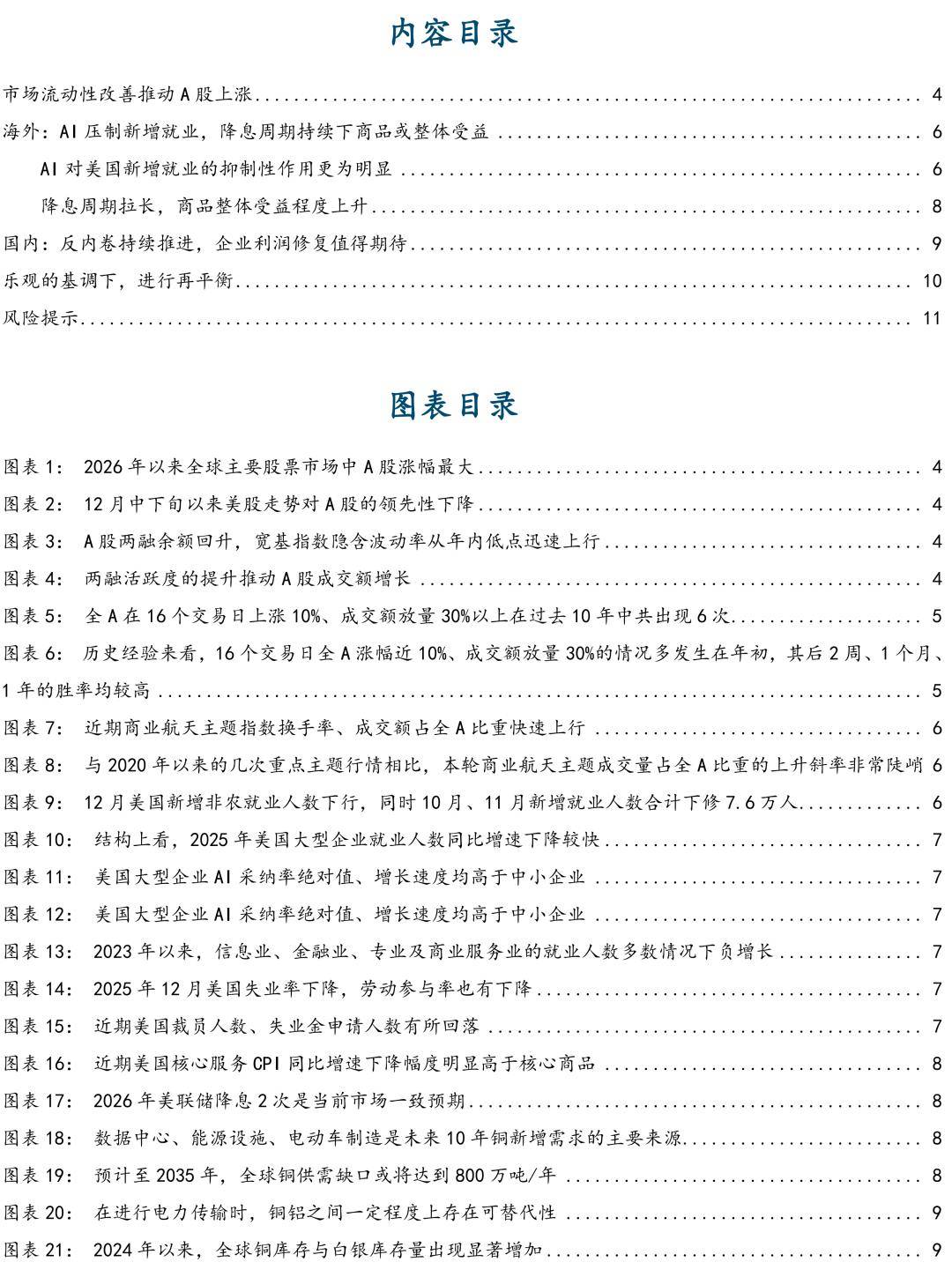
Group 1 - The recent improvement in market liquidity has driven the A-share market's rise, with historical patterns suggesting a strong performance in the upcoming period [1][5] - The A-share market has seen a significant increase in trading volume, with a 35% growth in total trading volume and a 10% rise in the overall A-share index over the past 16 trading days [2][14] - There is a notable structural overheating in the market, particularly in the commercial aerospace index, which has seen a sharp increase in turnover and trading volume [2][14] Group 2 - AI's negative impact on the U.S. employment market is becoming evident, with December's non-farm payrolls falling short of expectations and a downward revision of previous months' data [3][20] - The prolonged interest rate cut cycle by the Federal Reserve is expected to benefit commodity markets, as the demand for resources related to AI and new energy industries is increasing [3][33] - Geopolitical tensions are altering inventory behaviors among market participants, leading to increased stockpiling and a rise in copper and silver inventories [3][35] Group 3 - Domestic policies aimed at reducing "involution" are being implemented, with industrial prices showing signs of recovery, leading to improved corporate profitability [4][43] - The recent regulatory focus on the photovoltaic industry has raised concerns about the commitment to anti-involution policies, but the overall direction remains focused on improving corporate fundamentals [4][49] - The government is actively working on regulatory frameworks to support innovation while preventing monopolistic practices, which is expected to enhance corporate profitability in the long run [4][51] Group 4 - The report maintains an optimistic outlook for the A-share market, suggesting that the combination of improved liquidity, AI investments, and domestic policy support will lead to a favorable investment environment [5][52] - Recommended sectors include industrial resource products like copper, aluminum, and lithium, as well as equipment exports and consumer sectors benefiting from recovery trends [5][52]

中信证券:短期市场热度偏高,情绪没有转弱迹象
Xin Lang Cai Jing· 2026-01-11 09:43
Group 1 - The market's early-year excitement is driven by a concentration of funds that missed out on the previous year, with a backdrop of "people's desire for growth" [1][2] - The current market movement is primarily seen in thematic sectors and small-cap stocks, rather than in the direction of allocation-type funds [3][4] - Short-term market heat is high, but sentiment indicators have not shown signs of weakening, suggesting that the upward trend in thematic and small-cap stocks may continue until after the Two Sessions [4][15] Group 2 - The performance of small and mid-cap growth styles has significantly outperformed large-cap value styles, with the CSI 500 index rising by 7.9% and the CSI 2000 by 7.2%, compared to the CSI 300's 2.8% [3][13] - The commercial aerospace sector has seen a notable increase, with a trading volume of 729.1 billion yuan on January 9, accounting for 23.1% of total A-share trading [3][13] - The current market environment is characterized by abundant allocation and quantitative funds, while individual stock pricing funds are scarce, indicating a need for a shift back to fundamental-driven trends [15][16] Group 3 - For the year, allocation-type funds are increasingly focused on reducing volatility in their equity positions, as long-term interest rates continue to decline [17][18] - Recommended sectors for investment include resources and traditional manufacturing, with an emphasis on enhancing pricing power, as well as increasing allocations to non-bank financials [7][18] - The market's current excitement may not be the right time for allocation-type funds to chase hot sectors, with a more strategic approach suggested for the critical structural adjustment window in late March to April [15][16]
技术择时信号20260109:A股仍维持乐观信号,看好小盘收益弹性
CMS· 2026-01-11 08:17
Quantitative Models and Construction Methods 1. Model Name: DTW Timing Model - **Model Construction Idea**: The DTW timing model is based on a similarity approach, analyzing the similarity between current index trends and historical trends. It selects historical segments with high similarity as references and calculates the weighted average future returns and standard deviations of these segments to generate trading signals [20][22]. - **Model Construction Process**: 1. Use the DTW (Dynamic Time Warping) distance algorithm instead of Euclidean distance to measure similarity, as DTW is better suited for time series problems by addressing sequence misalignment issues [22]. 2. Calculate the weighted average future returns and standard deviations of selected historical segments, where weights are the inverse of the DTW distance [20]. 3. Generate trading signals based on the average future returns and standard deviations [20]. 4. To address the "pathological matching" issue in traditional DTW algorithms, improved DTW algorithms with boundary constraints (e.g., Sakoe-Chiba and Itakura Parallelogram) are applied [24][26][28]. - **Model Evaluation**: The DTW timing model demonstrates stable excess returns in general market conditions but may underperform during periods of sudden macroeconomic policy changes [9]. 2. Model Name: Foreign Capital Timing Model - **Model Construction Idea**: This model leverages information embedded in the price movements of two offshore assets related to A-shares: FTSE China A50 Index Futures (Singapore market) and the Southbound A50 ETF (Hong Kong market) [30]. - **Model Construction Process**: 1. Construct two indicators using FTSE China A50 Index Futures: basis and price divergence [30]. 2. Construct a price divergence indicator using the Southbound A50 ETF [30]. 3. Combine the timing signals from the two assets to form the foreign capital timing signal [30]. - **Model Evaluation**: The model achieves strong performance, with annualized returns of 18.96% (long-short strategy) and 14.19% (long-only strategy) over the full sample period (2014-2024). It also exhibits a high win rate (close to 55%) and a profit-loss ratio exceeding 2.5 [13]. --- Model Backtesting Results 1. DTW Timing Model - **Absolute Return**: 35.52% since November 2022 [9] - **Excess Return (relative to CSI 300)**: 8.60% [9] - **Maximum Drawdown**: 21.32% [9] 2. Foreign Capital Timing Model - **Annualized Return (Long-Short Strategy)**: 18.96% (2014-2024) [13] - **Annualized Return (Long-Only Strategy)**: 14.19% (2014-2024) [13] - **Maximum Drawdown**: 25.69% (Long-Short), 17.27% (Long-Only) [13] - **Win Rate**: Close to 55% [13] - **Profit-Loss Ratio**: Exceeds 2.5 [13] - **Absolute Return (2024)**: 31.33% (Long-Only Strategy) [17] - **Maximum Drawdown (2024)**: 8.23% [17] --- Quantitative Factors and Construction Methods 1. Factor Name: DTW Distance - **Factor Construction Idea**: DTW distance is used as a similarity measure for time series, addressing sequence misalignment issues that arise with traditional Euclidean distance [22]. - **Factor Construction Process**: 1. Compute the DTW distance between the current index trend and historical trends [22]. 2. Use the inverse of the DTW distance as weights to calculate the weighted average future returns and standard deviations of historical segments [20]. 3. Generate trading signals based on these weighted averages [20]. - **Factor Evaluation**: DTW distance is more effective for time series problems compared to Euclidean distance, as it resolves sequence misalignment and improves model performance [22]. 2. Factor Name: Basis and Price Divergence (Foreign Capital Timing Model) - **Factor Construction Idea**: These factors are derived from offshore assets to capture information about A-share market trends [30]. - **Factor Construction Process**: 1. Calculate the basis and price divergence indicators using FTSE China A50 Index Futures [30]. 2. Calculate the price divergence indicator using the Southbound A50 ETF [30]. 3. Combine these indicators to form the foreign capital timing signal [30]. - **Factor Evaluation**: These factors effectively capture offshore market signals and contribute to the strong performance of the foreign capital timing model [13]. --- Factor Backtesting Results 1. DTW Distance - **Absolute Return**: 35.52% since November 2022 [9] - **Excess Return (relative to CSI 300)**: 8.60% [9] - **Maximum Drawdown**: 21.32% [9] 2. Basis and Price Divergence - **Annualized Return (Long-Short Strategy)**: 18.96% (2014-2024) [13] - **Annualized Return (Long-Only Strategy)**: 14.19% (2014-2024) [13] - **Maximum Drawdown**: 25.69% (Long-Short), 17.27% (Long-Only) [13] - **Win Rate**: Close to 55% [13] - **Profit-Loss Ratio**: Exceeds 2.5 [13] - **Absolute Return (2024)**: 31.33% (Long-Only Strategy) [17] - **Maximum Drawdown (2024)**: 8.23% [17]
上证指数创十年新高,主升浪行情来了?高手看好军工、白银等板块
Mei Ri Jing Ji Xin Wen· 2026-01-11 07:44
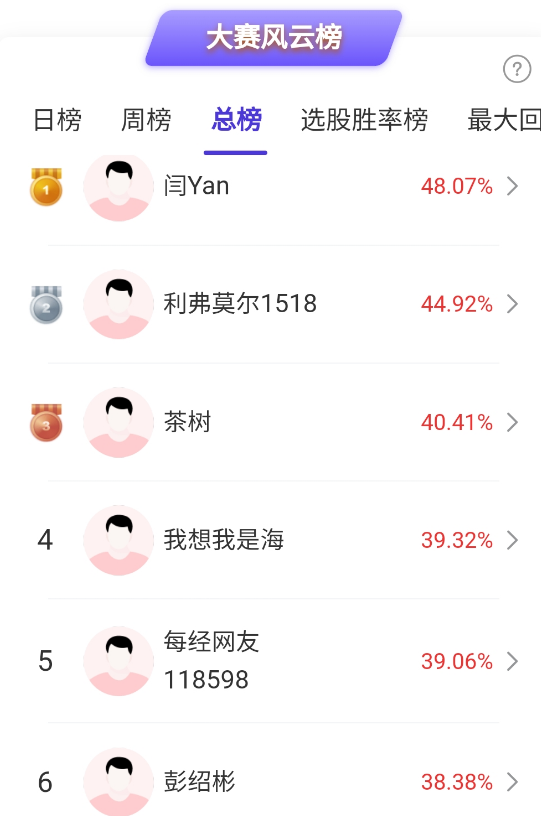
Group 1 - The A-share market has shown a good profit effect in the first week of 2026, with the Shanghai Composite Index reaching a ten-year high, and various sectors performing well, including display panels, vanadium mining, and commercial aerospace [1] - The "GEO" concept has gained market attention, with related stocks experiencing significant increases [8] - The competition for the "掘金大赛" (Gold Digging Competition) has attracted many participants, indicating a bullish sentiment in the market as it enters a main upward trend [6] Group 2 - The competition allows participants to simulate trading with a virtual fund of 500,000 yuan, running from January 5 to January 16, 2026, with cash rewards for positive returns [3][7] - Participants can gain access to exclusive market insights and analysis through the "火线快评" (Fire Line Quick Review) service, which provides updates on market trends and investment logic [3][7] - The competition also facilitates networking among participants, allowing them to exchange market insights and investment strategies [4]
百亿私募增至113家!量化私募2025年备案产品增幅114.31%;段永平晒14年狂赚18倍;高毅、淡水泉、景林年末“扫货”路线曝光|私募透视镜
Jin Rong Jie· 2026-01-11 03:04
Group 1: Private Equity Industry Overview - The private equity industry is projected to exceed 22 trillion yuan by 2025, with the number of billion-yuan private equity firms increasing to 113, of which 55 are quantitative firms, marking a significant shift in the industry landscape [1] - In the past five years, the leading quantitative private equity firms have seen dramatic changes, with the "Four Kings" managing over 70 billion yuan each, and Century Frontier adding over 30 billion yuan in net scale in one year [1] - The competition among quantitative private equity firms has intensified, with AI becoming a core engine and a fierce talent competition emerging, while the top firms are actively promoting investor education [1] Group 2: Product Registration and Market Dynamics - The number of registered private equity securities products is expected to surge to 12,645 in 2025, nearly doubling from 2024, with a growth rate of 99.54% [2] - Quantitative investment products have seen a remarkable increase, with 5,617 products registered, a growth rate of 114.31%, accounting for 44.42% of the total [2] - The market structure is evolving, with a rise in multi-asset, futures, and derivative strategies, while stock strategies remain dominant [2] Group 3: Popularity Rankings and Performance - In 2025, 14 out of the top 20 popular private equity firms are quantitative, with Ningbo Huansheng Quantitative leading in popularity, achieving an average return of 58.52% across three products [3] - The top fund managers include Dan Bin, who has an average return of 150.26% over three years, and Liang Wenfeng, who ranks second in popularity among fund managers [3] - The popularity rankings highlight a significant presence of subjective private equity firms, with 14 out of the top 20 fund managers being from this category [3] Group 4: Custody Market Landscape - The private equity fund custody market is increasingly dominated by brokerage firms, with a custody market share of 98.52% for brokerages compared to only 1.48% for banks [4] - Guotai Junan leads the market with 3,067 new custody products and a 25.17% market share, followed by CITIC Securities and China Merchants Securities [4] - The concentration in the industry is strengthening, with the top three brokerages accounting for nearly 60% of new custody products [4] Group 5: Investment Strategies and Future Outlook - The investment focus for 2026 includes sectors such as brain-computer interfaces and commercial aerospace, with significant interest from private equity giants [6] - The market for brain-computer interfaces is expanding, with companies like Xiangyu Medical seeing stock price increases of up to 86.39% due to their products being adopted by major hospitals [6] - The outlook for 2026 suggests a continued bullish trend in A-shares, driven by liquidity and fundamental factors, with a potential "water buffalo" market expected [12]

申万宏源策略一周回顾展望(26/01/05-26/01/10):赚钱效应扩散尚不充分
申万宏源研究· 2026-01-10 15:03
Group 1 - The report emphasizes that the spring market has a continuous favorable time window for bullish strategies, with a significant increase in risk appetite. There are no major downside risks, only short-term adjustments after market performance is fully realized. Overall profit-making effects may continue to expand to higher levels, indicating that the short-term market performance is not yet fully realized [4][5]. - The report reaffirms the logic of the spring market, highlighting that there is ample liquidity and favorable conditions for bullish strategies. Key factors include ETF inflows, insurance sector performance, and expectations of foreign capital inflows, which have accelerated the inflow of retail investors and increased trading activity [4][5]. - The report identifies specific time windows in the spring that are conducive to market performance, including potential rebounds before the Lunar New Year in February, policy catalysts from the National People's Congress in March, and the anticipated visit of Trump to China in April, which could stabilize market expectations [4][5]. Group 2 - The report discusses the marginal trading funds and dominant market styles, noting that the net inflow of the CSI A500 ETF has plateaued. The expected incremental inflows are primarily from the insurance sector and foreign capital, while retail investor inflows and increased trading activity are contributing to faster growth in marginal trading funds [8]. - The report maintains that industry themes, such as commercial aerospace, robotics, and nuclear fusion, remain the strongest directions for profit-making effects. The report also highlights the high elasticity of venture capital and pre-IPO technology leaders, which are benefiting from mid-term bull market expectations [12]. - The report predicts that the second quarter of 2026 will still exhibit a volatile pattern, with technology and advanced manufacturing sectors likely to lead the market ahead of a full bull market in the second half of 2026 [12].
中信证券:市场向上震荡的概率更高
Xin Lang Cai Jing· 2026-01-10 03:50
Group 1 - The core viewpoint is that the biggest expected divergence in 2026 will stem from the balance between external and internal demand, with a trend towards "taxing" external demand and subsidizing internal demand [1] - The market is expected to have a higher probability of a震荡向上的趋势 after the beginning of the year in a rising sentiment environment [1] - In the medium term, the focus is on sectors with relatively low heat and concentrated positions, but with increasing attention and catalysts, as well as potential long-term improvements in ROE, such as chemicals, engineering machinery, electric equipment, and new energy [1] Group 2 - New industrial themes, such as commercial aerospace, may continue to evolve and present opportunities [1] - There is a heightened focus on the policy logic changes triggered by the continuous appreciation of the RMB, with brokerage firms and insurance companies being considered as strategic choices from this perspective [1]