
茶叶

Search documents
永顺县忠华莓茶店(个体工商户)成立 注册资本1万人民币
Sou Hu Cai Jing· 2025-10-21 06:31
天眼查App显示,近日,永顺县忠华莓茶店(个体工商户)成立,法定代表人为黄金平,注册资本1万 人民币,经营范围为一般项目:茶叶种植;农副产品销售;食用农产品零售;食用农产品初加工;食品 互联网销售(仅销售预包装食品);食品销售(仅销售预包装食品);农产品的生产、销售、加工、运 输、贮藏及其他相关服务。(除依法须经批准的项目外,凭营业执照依法自主开展经营活动)。 ...
保靖子然黄金茶专卖店(个体工商户)成立 注册资本50万人民币
Sou Hu Cai Jing· 2025-10-21 06:30
Core Insights - A new individual business named "Baojing Ziran Golden Tea Specialty Store" has been established, with a registered capital of 500,000 RMB [1] - The legal representative of the business is Long Ziran, indicating a personal stake in the venture [1] - The business's operational scope includes food sales, specifically tea cultivation, which suggests a focus on the tea industry [1] Business Structure - The business is registered as an individual business entity, which may indicate a smaller scale of operations compared to larger corporations [1] - The business is required to obtain necessary approvals for its food sales activities, highlighting regulatory compliance in the food industry [1] Industry Focus - The primary focus of the business is on tea cultivation, which aligns with the growing demand for specialty teas in the market [1] - The establishment of this business reflects ongoing trends in the tea industry, particularly in niche markets for high-quality or specialty products [1]
港股IPO再迎“超级招股日”!三一重工携23家基石登场,最高募资123.54亿港元
Zheng Quan Shi Bao Wang· 2025-10-21 00:44
Group 1: Sany Heavy Industry - Sany Heavy Industry plans to globally issue 580 million shares with a price range of HKD 20.3 to HKD 21.3, aiming to raise up to HKD 12.354 billion, with pricing expected on October 24 and listing on October 28 [1] - The company is a leader in the engineering machinery sector, with products including concrete machinery, excavators, cranes, and road machinery, holding the top global position in concrete equipment and first in China for excavators and large-tonnage cranes [1] - Sany Heavy Industry's projected revenues for 2022 to 2024 are RMB 80.839 billion, RMB 74.019 billion, and RMB 78.383 billion, with corresponding net profits of RMB 4.433 billion, RMB 4.6 billion, and RMB 6.092 billion [2] Group 2: Cambridge Technology - Cambridge Technology focuses on the development, production, and sales of terminal devices and high-speed optical modules for telecommunications and data communications, with products used by major global telecom operators and internet giants [3] - The company plans to issue 67.01 million H-shares with a maximum price of HKD 68.88, potentially raising up to HKD 4.615 billion if the over-allotment option is fully exercised [3] - Cambridge Technology has attracted 16 cornerstone investors, collectively subscribing to USD 290 million [3] Group 3: Dipo Technology - Dipo Technology is the fifth company to launch an IPO in the Hong Kong market under the 18C special technology category, planning to issue 26.632 million H-shares, representing 8.15% of total shares post-issue [3] - The company specializes in providing cutting-edge AI solutions for enterprises, ranking fifth in the Chinese enterprise-level AI application solutions market with a market share of 4.2% [3] Group 4: Bama Tea - Bama Tea plans to globally issue 9 million shares, with 900,000 shares available for Hong Kong and 8.1 million for international offerings, at a price range of HKD 45 to HKD 50 per share [4] - The company is a well-known tea supplier in China, ranking first in the high-end Chinese tea market, oolong tea market, and black tea market by sales revenue in 2024 [4]

八马茶业港股IPO,涨幅可能很高,但中签率很低
Sou Hu Cai Jing· 2025-10-20 16:05
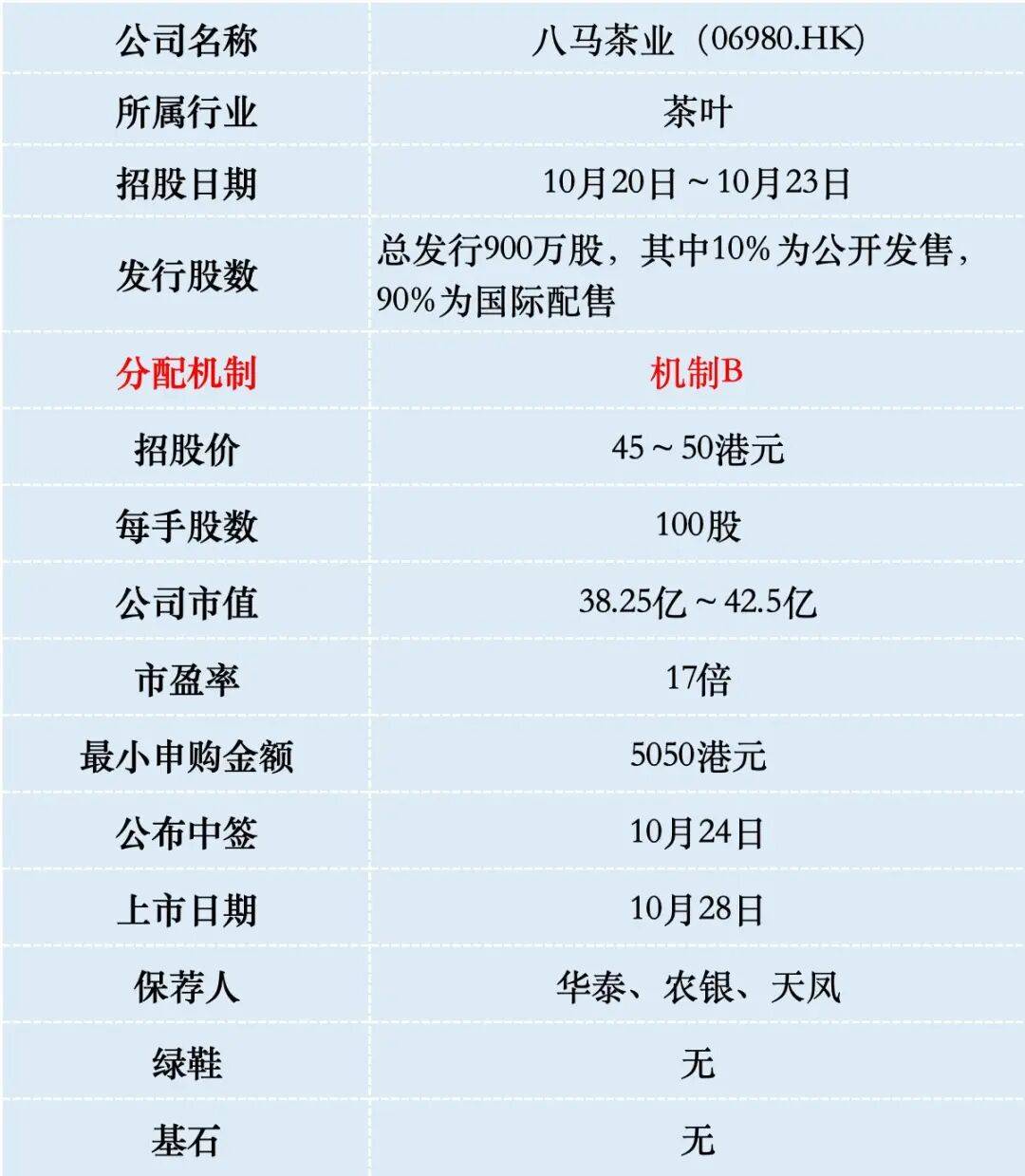
Core Viewpoint - The implementation of new IPO share allocation rules in Hong Kong has led to 17 Mechanism B new stocks being listed without any breaking below their issue price, indicating that market sentiment and liquidity have become more significant than fundamentals in the current environment [1]. Group 1: IPO Information - Company Name: Baima Tea (06980.HK) [1] - Industry: Tea [1] - Offering Date: October 20 to October 23 [1] - Total Shares Issued: 9 million, with 10% for public offering and 90% for international placement [1] - Offering Price: HKD 45 to 50 [1] - Market Capitalization: HKD 38.25 billion to 42.5 billion [1] - Price-to-Earnings Ratio: 17 times [1] - Minimum Subscription Amount: HKD 5,050 [1] - Listing Date: October 28 [1] - Sponsors: Huatai, Agricultural Bank of China, Tianfeng [1] Group 2: Company Overview - Baima Tea was established in 1997 and operates as a high-end tea chain brand covering the entire industry chain from cultivation to sales [2]. - The product range includes various types of tea and related products, forming a comprehensive tea product matrix [2]. Group 3: Market Position and Performance - Baima Tea's market share in the high-end tea sector has increased from approximately 1.1% in 2020 to about 1.7% in 2024, ranking first in China's high-end tea market by sales revenue [2]. - As of June 30, 2025, Baima Tea has 3,585 offline stores, including 244 direct-operated and 3,341 franchised stores, with a significant online presence [3]. Group 4: Financial Performance - Revenue increased from RMB 1.82 billion in 2022 to RMB 2.14 billion in 2024, while net profit rose from RMB 166 million to RMB 224 million during the same period [4]. - In the first half of 2025, revenue declined by 4.2% year-on-year to RMB 1.06 billion, and net profit fell by 17.8% to RMB 120 million, attributed to adjustments in offline store numbers and increased administrative expenses [5]. - The revenue structure is primarily composed of franchise business, online sales, and direct store sales, with franchise sales contributing around 50% of total revenue [5]. Group 5: Industry Trends - The Chinese tea industry is large but fragmented, with a market size of RMB 325.8 billion in 2024, expected to grow to RMB 407.9 billion by 2029, at a CAGR of approximately 4.6% [6]. - The high-end tea market is projected to grow from RMB 103.1 billion in 2024 to RMB 135.3 billion by 2029, with a CAGR of about 5.6% [6]. - The trend is shifting towards brand tea purchases and rapid growth in online channels, with the online tea market expected to exceed RMB 35 billion in 2024 [6]. Group 6: Investment Considerations - Baima Tea's market capitalization is HKD 42.5 billion, with a valuation of 17 times earnings, which may be considered high in a traditional industry with limited growth [7]. - The IPO is expected to attract significant interest, with a predicted oversubscription of 3,000 times [8].

四家港股IPO企业同日启动招股 最高者较A股折价超四成
Sou Hu Cai Jing· 2025-10-20 12:40
Core Viewpoint - Four companies have filed for H-share IPOs on the Hong Kong Stock Exchange, including SANY Heavy Industry, Dipo Technology, Bama Tea, and Cambridge Technology [1][2] Group 1: SANY Heavy Industry - SANY Heavy Industry plans to issue 580 million H-shares, with 58.04 million shares allocated for public offering in Hong Kong, representing 10% of the total [4] - The price range for SANY's H-shares is set between HKD 20.30 and HKD 21.30, with a discount of 13.17% to 17.25% compared to its A-share price of CNY 22.49 [4][5] - SANY is recognized as the largest construction machinery company in China and the third largest globally, focusing on various types of construction machinery [5] Group 2: Dipo Technology - Dipo Technology's proposed share price is HKD 26.66, and it ranks fifth in the Chinese enterprise-level AI application solutions market with a market share of 4.2% [6][7] - The company has amended its dual-class share structure to comply with listing regulations ahead of its global offering [6] Group 3: Bama Tea - Bama Tea's share price is expected to be between HKD 45 and HKD 50, with a projected net amount of approximately HKD 368 million from the global offering [8] - The company is the leading high-end tea seller in China and ranks first in the number of tea chain stores [8] Group 4: Cambridge Technology - Cambridge Technology plans to issue 67.01 million H-shares, with a maximum price of HKD 68.88 per share, reflecting a discount of over 41.66% compared to its A-share price of CNY 108.25 [9] - The company has a provision for an overallotment option that could increase the total shares issued to 77.06 million [9]

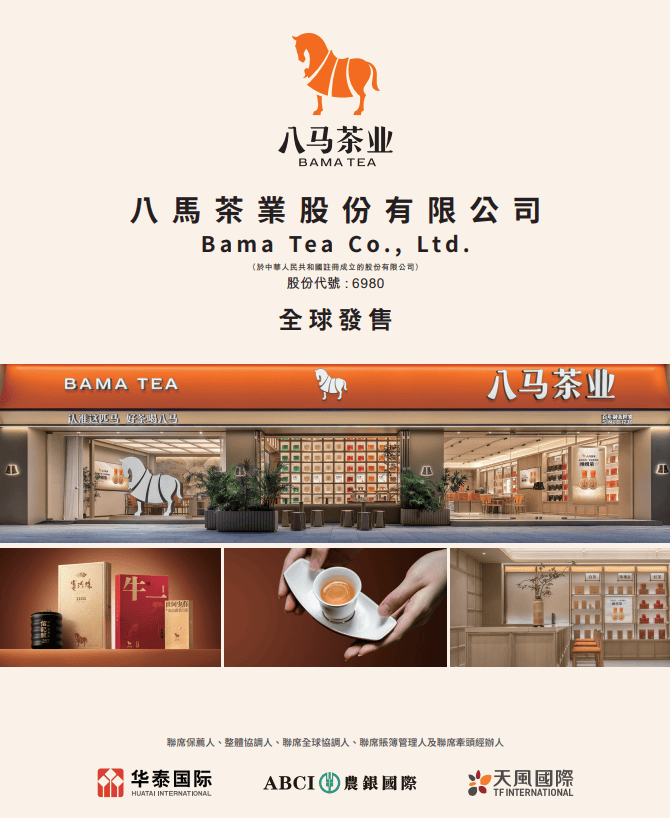
八马茶业今起招股,预计10月28日挂牌上市,中国最大的高端茶企
Sou Hu Cai Jing· 2025-10-20 00:33
Core Viewpoint - Eight Horses Tea Industry (06980.HK) plans to globally offer 9 million H-shares, with a price range of HKD 45.00-50.00 per share, aiming to raise approximately HKD 368.2 million for various strategic initiatives [2][9]. Company Overview - Eight Horses Tea is a well-known tea supplier in China, covering six major tea categories and related products. It ranks first in high-end tea sales revenue in China for 2024 and leads in the number of tea chain stores [3][4]. - The company has maintained its leading position in sales of Tieguanyin, Wuyi Rock Tea, and black tea for over a decade [3]. Market Dynamics - The high-end tea market in China is rapidly growing, with a market size increasing from approximately RMB 89 billion in 2020 to about RMB 103.1 billion in 2024, reflecting a compound annual growth rate (CAGR) of about 3.7% [3]. - The market share of the top five companies in the high-end tea sector has slightly increased from 5.5% in 2020 to 5.6% in 2024, with Eight Horses' market share rising from 1.1% to 1.7% during the same period [3]. Business Performance - The number of offline stores increased from 2,613 in January 2022 to 3,585 by June 2025, with a significant rise in franchise stores [5]. - Revenue grew from RMB 1.818 billion in 2022 to RMB 2.122 billion in 2023, and further to RMB 2.143 billion in 2024, although it saw a decline in the first half of 2025 [7]. - Net profit increased from RMB 166 million in 2022 to RMB 206 million in 2023, and RMB 224 million in 2024, with a net profit margin improvement [7]. Strategic Initiatives - The company plans to allocate approximately 35% of the IPO proceeds for expanding production bases, 20% for enhancing brand value, and 15% for expanding its offline store network [9]. - Eight Horses has established two tea production bases in Anxi and Wuyi Mountain, focusing on automation and innovation in production processes [8].
八马茶业(06980)10月20日至10月23日招股 拟全球发售900万股H股 预计10月28日上市
智通财经网· 2025-10-20 00:06
Group 1 - The company, Baima Tea Industry, plans to conduct a global offering of 9 million H-shares from October 20 to October 23, 2025, with a price range of HKD 45-50 per share [1] - The offering will consist of 10% for public sale in Hong Kong and 90% for international sale, with trading expected to commence on October 28, 2025 [1] Group 2 - Baima Tea Industry is the largest high-end tea supplier in China for 2024, leading in sales within the high-end Chinese tea sector [2] - The company ranks first in the number of tea chain stores in China and has maintained top sales in various tea categories, including Oolong tea, Wuyi Rock tea, and black tea for multiple consecutive years [2] - The "Baima" brand has the highest brand awareness among chain tea brands in China, according to the 2024 China Customer Satisfaction Index report [2] Group 3 - The net proceeds from the global offering are estimated to be approximately HKD 368 million, assuming a median offer price of HKD 47.5 per share [2] - The company plans to allocate the proceeds as follows: 35% for expanding production bases, 20% for enhancing brand value and product portfolio, 15% for expanding direct retail store networks, 10% for digital operations improvement, 10% for acquisitions or investments in the tea industry, and 10% for working capital and general corporate purposes [2]
八马茶业(06980.HK)拟全球发售900万股H股 预计10月28日上市
Ge Long Hui· 2025-10-19 23:42
Core Viewpoint - The company, Baima Tea Industry, is planning a global offering of 9 million H-shares, with a price range of HKD 45.00 to 50.00 per share, aiming to raise approximately HKD 368.2 million for various strategic initiatives [1][3]. Company Overview - Baima Tea Industry is a well-known tea supplier in China, leading in high-end tea sales and tea shop numbers as of 2024, with a strong market position in oolong and black tea [1][2]. - The company has maintained its top sales position in various tea categories, including Tieguanyin for over 10 years, Wuyi Rock Tea for 5 years, and black tea for 4 years [1]. Market Dynamics - The high-end tea market in China is experiencing rapid growth, with a projected increase from approximately RMB 890 billion in 2020 to about RMB 1,031 billion by 2024, reflecting a compound annual growth rate (CAGR) of about 3.7% [2]. - The market is expected to reach approximately RMB 1,353 billion by 2029, with a CAGR of about 5.6% from 2024 to 2029 [2]. Use of Proceeds - The net proceeds from the global offering are estimated to be approximately HKD 368.2 million, with allocations as follows: 35% for expanding production bases, 20% for enhancing brand value and product portfolio, 15% for expanding the direct store network, 10% for digital operational improvements, 10% for acquisitions or investments in the tea industry, and 10% for working capital and general corporate purposes [3].
西畴县坪寨沐春源茶叶铺(个体工商户)成立 注册资本1万人民币
Sou Hu Cai Jing· 2025-10-18 09:53
Core Viewpoint - A new individual business named "Pingshai Muchunyuan Tea Shop" has been established in Xichou County, focusing on various tea-related and agricultural activities [1] Company Summary - The legal representative of the new tea shop is Lei Zuchun, with a registered capital of 10,000 RMB [1] - The business scope includes tea planting, sales of agricultural products, retail of edible agricultural products, and internet sales of pre-packaged food [1] - Additional services offered include primary agricultural product acquisition, production, sales, processing, transportation, storage, and related services [1] Industry Summary - The business is involved in the production of tea products and food sales, indicating a focus on the agricultural and food industry [1] - The company also engages in technology services, development, consultation, and brand management, reflecting a diversified approach within the industry [1] - The establishment of this business aligns with the growing trend of internet sales and personal live streaming services in the agricultural sector [1]
市场监管总局集中公布技术性贸易措施典型案例
Zhong Guo Xin Wen Wang· 2025-10-17 13:34
Core Insights - The article discusses the efforts of various provincial market regulatory departments in China to support local industries in overcoming technical trade barriers and enhancing international competitiveness through targeted measures [1]. Group 1: Hebei Province - Hebei's power transmission and transformation equipment industry, the largest in China, faces challenges such as complex international certification processes and high costs [2]. - The provincial market regulatory department has implemented support measures, including a warning mechanism and integration of international certification requirements into R&D [2]. - As a result, the export order value for related products exceeded 1 billion yuan in 2024, covering over 60 countries and regions [2]. Group 2: Jilin Province - Jilin's commercial vehicle industry, with over 20% of its trade in foreign markets, is impacted by frequent updates to foreign technical regulations [3]. - The market regulatory department has established a three-tier response mechanism to address these challenges and support compliance with international standards [3]. - In 2024, Jilin's commercial vehicle exports reached 57,000 units, a year-on-year increase of 27.4%, marking a historical high [3]. Group 3: Yunnan Province - Yunnan's cable industry achieved an export value of 250 million yuan in 2024, with over 85% of this in the Lancang-Mekong region [4][5]. - The provincial market regulatory department has enhanced standard services and established cooperation with Laos to facilitate compliance with local standards [4]. - The export value is expected to exceed 300 million yuan in 2025, representing a growth of 20% [5]. Group 4: Chongqing City - Chongqing's door industry is leveraging AI and digital transformation to expand internationally, facing various technical trade barriers [6][7]. - The market regulatory department has initiated advanced standard technology research and implemented differentiated market strategies [7]. - In the first half of 2025, the export volume of Chongqing's door products increased by 8.2% year-on-year [7]. Group 5: Hainan Province - Hainan's agricultural exports reached 5.725 billion yuan in 2024, a year-on-year increase of 19.42%, despite facing challenges from evolving international standards [8]. - The market regulatory department has established an online platform for trade measures and conducted training to enhance compliance awareness among enterprises [8]. - The export structure has improved, with significant growth in seafood and fresh fruit exports [8]. Group 6: Shandong Province - Shandong, a major producer of new energy equipment, faces challenges from international certification barriers [9]. - The market regulatory department has created a support system combining mutual recognition of testing and precise services [9]. - Over the past three years, Shandong's exports of new energy equipment and power distribution products exceeded 55 billion yuan [9]. Group 7: Hunan Province - Hunan, a major tea producer, has faced export challenges due to changes in Russian inspection policies [10]. - The market regulatory department has facilitated standard comparisons and negotiations with Russian authorities to ease export barriers [10]. - Successful adjustments in inspection policies have led to smooth tea exports to Russia in 2024 [10]. Group 8: Zhejiang Province - Zhejiang accounts for 76% of China's festive light exports, facing stringent EU technical trade barriers [11]. - The market regulatory department has implemented smart warning systems and organized expert training to assist compliance [11]. - In 2024, the export value of festive lights to the EU increased by 18.7%, with a product compliance rate of 98% [11]. Group 9: Guangdong Province - Guangdong's battery exports to the EU reached 24.9 billion USD in 2023, facing complex new regulations [12]. - The market regulatory department has established a three-part response mechanism to address these challenges [12]. - The proactive measures have led to increased attention from the EU regarding the industry's concerns [12]. Group 10: Sichuan Province - Sichuan's agricultural exports to India are affected by new registration requirements, with an export value of approximately 120 million yuan [13]. - The market regulatory department has enhanced warning systems and training to help enterprises navigate these barriers [13]. - Successful negotiations have resulted in an extended implementation date for registration requirements, providing a buffer period for exporters [13].