
非金属矿物制品业

Search documents
核心CPI同比涨幅回升至1%
Sou Hu Cai Jing· 2025-10-15 05:14
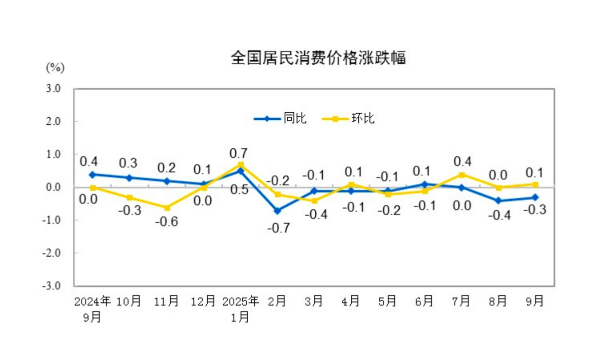
Core Insights - The Consumer Price Index (CPI) decreased by 0.3% year-on-year in September, while the core CPI, excluding food and energy, increased by 1.0%, marking the first return to a 1% increase in nearly 19 months [1][2][4] - The Producer Price Index (PPI) saw a year-on-year decline of 2.3%, but the rate of decline narrowed by 0.6 percentage points compared to August [5][6] CPI Analysis - The decline in CPI was primarily driven by a significant drop in food prices, which fell by 4.4% year-on-year, and energy prices, which decreased by 2.7%, contributing approximately 0.2 percentage points to the overall CPI decline [3] - Seasonal factors, such as the end of summer and the timing of the Mid-Autumn Festival, led to a decrease in prices for air tickets, hotel accommodations, and tourism services by 13.8%, 7.4%, and 6.1% respectively [3] Core CPI Insights - The continuous rise in core CPI reflects the effectiveness of domestic demand expansion policies and an improving market supply-demand relationship [4][7] - The core CPI's increase for five consecutive months indicates a positive trend in consumer spending and economic circulation [4] PPI Insights - The PPI remained flat month-on-month for two consecutive months, with certain industries showing positive price changes due to effective macroeconomic policies and capacity management [6] - Specific industries, such as coal processing and battery manufacturing, experienced a narrowing of price declines, indicating a potential recovery in those sectors [6] Future Outlook - Experts suggest that further efforts are needed to expand domestic demand and regulate competition among enterprises to promote reasonable price recovery [1][7] - The government is expected to continue implementing measures to boost consumption and effective investment, which may positively impact both CPI and PPI in the coming months [7]
宏观政策效果持续显现,9月PPI同比降幅收窄至2.3%
Xin Lang Cai Jing· 2025-10-15 02:53
Core Insights - The Producer Price Index (PPI) in September decreased by 2.3% year-on-year, with a narrowing decline of 0.6 percentage points compared to the previous month, and remained stable month-on-month for two consecutive months [1] Group 1: PPI Trends - The narrowing year-on-year decline in PPI is attributed to lower comparison bases from the previous year and the ongoing effectiveness of macroeconomic policies [1] - The construction of a unified national market has led to a reduction in the year-on-year price decline in related industries, with significant improvements in market competition and capacity management [1] - Specific industries such as coal processing, black metal smelting, and photovoltaic equipment manufacturing saw their price decline rates narrow by 8.3, 3.4, and 2.4 percentage points respectively, contributing to a reduced downward impact on PPI by approximately 0.34 percentage points [1] Group 2: Industry Performance - Upgrades in industrial structure and the release of consumer potential have resulted in year-on-year price increases in certain sectors, including a 1.4% increase in aircraft manufacturing and a 1.2% increase in electronic materials manufacturing [1] - The overall industrial product market is characterized by a "strong supply and weak demand" situation, with no fundamental changes expected in this trend [2] - Future PPI trends may face downward pressure due to fluctuations in the external economic environment and a steady increase in the PPI comparison base from October onwards, making it challenging for PPI to turn positive by year-end [4][5]

核心CPI同比涨幅连续5个月扩大,“反内卷”带动相关行业价格改善
Di Yi Cai Jing· 2025-10-15 02:16
Core Insights - The Consumer Price Index (CPI) and Producer Price Index (PPI) have shown a narrowing decline in September, benefiting from low base effects and the effectiveness of anti-involution and consumption promotion policies [1][3]. CPI Analysis - In September, the CPI increased by 0.1% month-on-month, while the year-on-year decline was 0.3%, a reduction of 0.1 percentage points from the previous month [1]. - The core CPI, excluding food and energy, rose by 1.0% year-on-year, marking the first return to a 1% increase in nearly 19 months [1][3]. - Food prices fell by 4.4%, contributing significantly to the overall CPI decline, with the tail effect accounting for approximately -0.8 percentage points of the CPI change [3]. PPI Analysis - The PPI remained flat month-on-month for two consecutive months, with a year-on-year decline of 2.3%, narrowing by 0.6 percentage points from the previous month [1][5]. - Factors contributing to the PPI's performance include improved supply-demand structures and the impact of international oil price declines on domestic oil-related industries [5]. - Certain industries, such as coal processing and black metal smelting, saw reduced year-on-year price declines, contributing to a decrease in the overall PPI decline by approximately 0.34 percentage points [5]. Industry Trends - The modernization of the industrial system and the release of consumption potential have led to price increases in related industries, with aircraft manufacturing prices rising by 1.4% and electronic materials by 1.2% year-on-year [6]. - Policies aimed at boosting consumption are showing effects, with significant price increases in high-quality and upgraded consumer goods, such as a 14.7% rise in arts and crafts products [6]. - Analysts predict that the year-on-year decline in PPI may narrow to below -2.0% in the fourth quarter due to various supportive policies and market conditions [6].
国家统计局:9月供需结构改善带动部分行业价格明显企稳 输入性因素影响国内石油相关行业价格环比下降
Di Yi Cai Jing· 2025-10-15 01:44
Core Insights - The Producer Price Index (PPI) remained stable month-on-month for two consecutive months, indicating a stabilization in prices across various industries driven by improved supply-demand dynamics [1][2] - Year-on-year, the PPI decreased by 2.3%, but the decline was less severe than the previous month, reflecting the positive impact of macroeconomic policies and structural adjustments in certain industries [2] Group 1: Month-on-Month PPI Analysis - The PPI showed notable month-on-month price increases in coal processing (up 3.8%), coal mining and washing (up 2.5%), and black metal smelting and rolling (up 0.2%), all of which have risen for two consecutive months [1] - Prices for photovoltaic equipment and components shifted from a decrease of 0.2% last month to an increase of 0.8% this month, indicating a recovery in this sector [1] - Conversely, prices in the petroleum-related industries declined due to falling international oil prices, with oil extraction prices down 2.7% and refined petroleum product manufacturing prices down 1.5% [1] Group 2: Year-on-Year PPI Trends - The year-on-year decline in PPI was influenced by a lower comparison base from the previous year, with several industries showing reduced price declines, including coal processing and black metal smelting [2] - The construction of a unified national market has led to improved price stability in various sectors, with significant reductions in price declines for coal processing (down 8.3%), black metal smelting (down 3.4%), and coal mining (down 3.0%) [2] - Upgrades in industrial structure and the release of consumer potential have resulted in price increases in specific sectors, such as aircraft manufacturing (up 1.4%) and electronic materials (up 1.2%) [2]
菲利华:拟向特定对象增发募资不超过3亿元
Mei Ri Jing Ji Xin Wen· 2025-10-13 10:47
每经AI快讯,菲利华(SZ 300395,收盘价:71.44元)10月13日晚间发布公告称,本次以简易程序向特 定对象发行股票相关事项已经公司2024年度股东大会授权公司董事会实施,本次发行方案已获得公司第 六届董事会第二十二次会议通过,公司本次以简易程序向特定对象发行股票的发行对象不超过35名(含 35名),发行价格不低于定价基准日前二十个交易日公司股票交易均价的80%。本次发行募集资金总额 不超过(含)人民币30,000.00万元,且不超过最近一年末净资产20%。 每经头条(nbdtoutiao)——AI技术滥用调查:明星可被"一键换装","擦边"内容成流量密码,技术防 线为何形同虚设? 2025年1至6月份,菲利华的营业收入构成为:非金属矿物制品业占比99.7%,其他业务占比0.3%。 (记者 曾健辉) 截至发稿,菲利华市值为373亿元。 ...

新股发行跟踪(20251013)
Dongguan Securities· 2025-10-13 08:51
证券研究报告 2025 年 10 月 13 日 星期一 【新股发行跟踪(20251013)】 一、上周新股表现情况 上周(10 月 6 日-10 月 10 日)共有 1 只新股上市,上市首日涨跌幅为 349.82%。 表 1:上周新股表现 新股发行跟踪 图 2:周度新股上市首日涨跌幅均值及破发率 | 股票代码 | 股票简称 | 上市日期 | 上市 | 发行价 | 发行市 | 证监会行业 | 首日收盘 | | --- | --- | --- | --- | --- | --- | --- | --- | | | | | 板块 | 格(元) | 盈率 | | 涨跌幅(%) | | 920080.BJ | 奥美森 | 2025-10-10 | 北证 | 8.25 | 12.52 | 专用设备制造业 | 349.82 | 资料来源:东莞证券研究所,iFinD 二、周度新股上市情况走势 从周度新股上市规模来看,上周(10 月 6 日-10 月 10 日,下同)较上 上周(9 月 29 日-10 月 3 日,下同)相比,上市新股数量少 1 只,首发募 资金额少 21.79 亿元。 从周度上市新股表现来看,上周与上上周均无 ...
【IPO雷达】10月13日-10月17日新股申购一览
Xuan Gu Bao· 2025-10-12 07:50
Summary of New Stock Offerings from October 13 to October 17 Core Viewpoint A total of five new stocks will be available for subscription in the upcoming week, covering industries such as home furnishings, pharmaceutical manufacturing, and computer communication equipment. Notable companies include Marco Polo, a leader in the domestic ceramic tile industry, and Heyuan Bio, a pioneer in the large-scale production of pharmaceutical proteins using rice embryo cell bioreactors. Group 1: Marco Polo - Marco Polo is the leading company in the domestic ceramic tile industry, with its "Marco Polo Tile" brand value ranking first in the industry for over a decade [2] - The company has a total market value of 14.79 billion, with an issuance price-to-earnings ratio of 14.27, significantly lower than the industry average of 32.2 [2] Group 2: Heyuan Bio - Heyuan Bio is recognized as the first in China to utilize rice embryo cell bioreactors for the large-scale production of pharmaceutical proteins, referred to as "rice hematopoiesis" [3] - The company is set to have its human albumin injection HY1001 approved by July 2025 [3] Group 3: Super Electronics - Super Electronics is a major global supplier of automotive electronic PCBs, covering the demand for PCBs across various parts of vehicles [4] - The company operates in the computer, communication, and other electronic equipment manufacturing sector [4] Group 4: Xi'an Yicai - Xi'an Yicai has developed into the largest producer and seller of 12-inch silicon wafers in mainland China, ranking sixth globally [4] - The company operates in the computer, communication, and other electronic equipment manufacturing sector [4] Group 5: Bibet - Bibet focuses on the independent research and development of innovative drugs, targeting major diseases such as tumors, autoimmune diseases, and metabolic diseases [4] - The company operates in the pharmaceutical manufacturing industry [4]
一线调研:千亿赛道竞速 广东园区成银行转型新增长极
2 1 Shi Ji Jing Ji Bao Dao· 2025-10-11 09:40
Core Insights - The article discusses the role of industrial parks in promoting high-quality economic development and how financial services are evolving to support these parks, particularly in Guangdong Province [2][3]. Group 1: Industrial Parks and Economic Contribution - Industrial parks are crucial for China's industrialization and urbanization, contributing significantly to economic and social development [3]. - As of last year, 59 industrial parks have GDPs exceeding 100 billion yuan, with Jiangsu, Guangdong, and Shandong leading in development [3]. - The Ministry of Industry and Information Technology and the National Development and Reform Commission have issued guidelines to promote the high-quality development of industrial parks [3]. Group 2: Financial Solutions for Industrial Parks - Banks are increasingly treating industrial parks as primary business units, offering integrated financial solutions that include credit, investment banking, leasing, and digital platforms [2][3]. - The shift from traditional credit models to a more integrated approach is aimed at addressing the financing challenges faced by small and medium-sized enterprises (SMEs) in these parks [4][5]. - New financing models focus on "scene-based empowerment" and "ecological collaboration," utilizing operational data as credit references and park risk control as security [4][5]. Group 3: Case Study and Implementation - A case study of Guangdong Xinbangle Technology Co., Ltd. illustrates how banks are adapting to the needs of light-asset technology companies by providing loans based on future production capacity assessments [5][6]. - The "Park Loan 2.0" initiative in Shenzhen aims to enhance financial support for SMEs by fostering collaboration among government, parks, banks, and guarantors [7][8]. - The model's success relies on the ability of parks to provide real-time operational data, reducing information asymmetry and enhancing risk management [8]. Group 4: Cross-Provincial Cooperation and Future Prospects - Cross-provincial cooperation in industrial parks is emerging, with Guangdong and Guangxi collaborating on 125 parks, generating a combined output value of 60 billion yuan [9]. - The integration of Guangdong's financial resources with Guangxi's labor and land advantages is expected to accelerate the development of industrial chains [9][10]. - The financial support for industrial parks is seen as a way to optimize resource allocation and promote high-quality economic growth in China [10].

A股培育钻石概念开盘大涨,四方达、黄河旋风竞价涨停
Mei Ri Jing Ji Xin Wen· 2025-10-10 01:59
Core Viewpoint - The A-share market for cultivated diamond concept stocks experienced a significant surge, with multiple companies reaching their daily price limits and notable percentage increases in stock prices [1] Company Performance - Four方达 and 黄河旋风 reached their daily trading limit, indicating strong investor interest and confidence in these stocks [1] - 惠丰钻石 saw its stock price increase by over 20%, reflecting a robust market response [1] - 力量钻石 experienced a stock price rise of over 10%, further showcasing the positive momentum in the cultivated diamond sector [1]


培育钻石概念高开 四方达、黄河旋风涨停
Zheng Quan Shi Bao Wang· 2025-10-10 01:37
Core Viewpoint - The announcement of export control measures on certain materials has positively impacted the cultivated diamond sector, leading to significant stock price increases for related companies [1] Group 1: Market Reaction - Companies such as Sifangda and Huanghe Xuanfeng reached their daily price limit, while Huifeng Diamond saw an increase of over 20%, and Liliang Diamond rose by more than 10% [1] Group 2: Government Announcement - The Ministry of Commerce, in conjunction with the General Administration of Customs, issued a notice regarding export control measures on superhard materials, rare earth equipment and raw materials, as well as lithium batteries and artificial graphite anode materials [1]