
造纸

Search documents
循环造纸企业林平发展正式启动招股,1月30日开放申购
Sou Hu Cai Jing· 2026-01-22 08:12
Group 1 - Linping Development officially announced the launch of its IPO process on January 22, with the initial inquiry scheduled for January 27 and online roadshow on January 29 [1] - The company plans to issue 18.8537 million shares, accounting for 25% of the total share capital post-issuance [1] - Linping Development specializes in the R&D, production, and sales of corrugated paper and boxboard products, positioning itself as a high-tech enterprise with independent R&D capabilities [1] Group 2 - According to the China Paper Association, there are approximately 2,600 paper and board production enterprises in China, with 30 producing over 1 million tons annually; Linping Development has a current capacity of 1.15 million tons [2] - In 2024, Linping Development's raw paper output is projected to be 1.0197 million tons, ranking among the top 30 paper producers in China and accounting for 35.65% of Anhui province's paper and board output and 0.75% of the national output [2] - The funds raised from the IPO will primarily be used for projects aimed at producing 900,000 tons of green intelligent manufacturing new materials and 600,000 tons of bio-based fiber green intelligent manufacturing new materials, which will enhance the company's market competitiveness and sustainable profitability [2] Group 3 - Post-IPO, Linping Development aims to advance its "green manufacturing + circular economy" strategy, focusing on resource efficiency and environmental friendliness [2] - The implementation of the fundraising projects is expected to drive sales and net profit growth, creating sustainable value returns for investors and society [2] - The company is committed to fulfilling its social responsibilities by creating more job opportunities and promoting harmonious economic development through its products and services [2]

岳阳林纸股价涨5.34%,南方基金旗下1只基金位居十大流通股东,持有963.7万股浮盈赚取240.92万元
Xin Lang Cai Jing· 2026-01-22 03:51
1月22日,岳阳林纸涨5.34%,截至发稿,报4.93元/股,成交2.57亿元,换手率3.04%,总市值86.65亿 元。 南方中证1000ETF(512100)成立日期2016年9月29日,最新规模789.96亿。今年以来收益8.6%,同类 排名1617/5542;近一年收益41.53%,同类排名1751/4256;成立以来收益24.2%。 南方中证1000ETF(512100)基金经理为崔蕾。 截至发稿,崔蕾累计任职时间7年78天,现任基金资产总规模1369.37亿元,任职期间最佳基金回报 248.43%, 任职期间最差基金回报-15.93%。 风险提示:市场有风险,投资需谨慎。本文为AI大模型自动发布,任何在本文出现的信息(包括但不 限于个股、评论、预测、图表、指标、理论、任何形式的表述等)均只作为参考,不构成个人投资建 议。 责任编辑:小浪快报 资料显示,岳阳林纸股份有限公司位于中国(湖南)自由贸易试验区岳阳片区长江大道西新港多式联运物 流园001号,成立日期2000年9月28日,上市日期2004年5月25日,公司主营业务涉及以林浆纸产业为基 础,进行产业链延伸,进入生态行业,从事林业勘查设计、林业碳 ...

永安期货纸浆早报-20260122
Yong An Qi Huo· 2026-01-22 02:01
Group 1: Market Data of SP Main Contract - The closing price of the SP main contract on January 21, 2026, was 5360.00 [3] - The closing prices of the main contract from January 15 - 21, 2026, were 5436.00, 5362.00, 5362.00, 5376.00, and 5360.00 respectively [3] - The corresponding converted US - dollar prices were 681.32, 672.00, 672.52, 674.62, and 672.13 respectively [3] - The daily price changes were - 1.05570%, - 1.36130%, 0.00000%, 0.26110%, and - 0.29762% respectively [3] - The basis of Shandong Yinxing from January 15 - 21, 2026, was 79, 48, 48, 34, and 50 respectively [3] - The basis of Jiangsu, Zhejiang, and Shanghai Yinxing from January 15 - 21, 2026, was 74, 48, 48, 34, and 50 respectively [3] Group 2: Import Data of Pulp - With a 13% VAT calculation, for Canadian pulp brands: Golden Lion (CFR) had a port US - dollar price of 780, a Shandong - area RMB price of 6300, and an import profit of 86.64; Lion (CFR) had a port US - dollar price of 730, a Shandong - area RMB price of 5365, and an import profit of - 454.55 [4] - For Chilean pulp brand Silver Star (CFR letter of credit 90 days), the port US - dollar price was 700, the Shandong - area RMB price was 5410, and the import profit was - 173.27 [4] Group 3: Pulp Price Averages - From January 15 - 21, 2026, the national average prices of softwood pulp, hardwood pulp, natural pulp, and chemi - mechanical pulp remained unchanged at 6073.75, 4810.75, 5415.00, and 3686.25 respectively [4] - The Shandong - area average prices of softwood pulp, hardwood pulp, natural pulp, and chemi - mechanical pulp remained unchanged at 6245.00, 4775.00, 5400.00, and 3600.00 respectively [4] Group 4: Paper Index Data - From January 16 - 21, 2026, the double - offset index, double - copper index, white - card index, and living - paper index remained unchanged at 5725, 5670, 4350, and 867 respectively [4] Group 5: Paper Profit Margin Data - The estimated profit margins of double - offset paper on January 16, 19, 20, and 21, 2026, were - 4.5583%, - 4.5583%, - 4.3786%, and - 4.3786% respectively [4] - The estimated profit margins of double - copper paper on January 16, 19, 20, and 21, 2026, were 5.9250%, 5.9250%, 6.0750%, and 6.0750% respectively [4] - The estimated profit margins of white - card paper on January 16, 19, 20, and 21, 2026, were - 9.2032%, - 9.2032%, - 9.0993%, and - 9.0993% respectively [4] - The estimated profit margins of living paper on January 16, 19, 20, and 21, 2026, were 6.0607%, 6.2044%, 6.4919%, and 6.5817% respectively, with a change of 0.0898 from January 16 to 21 [4] Group 6: Pulp Price Difference Data - The price differences between softwood and hardwood pulp from January 15 - 21, 2026, were 785, 720, 730, 750, and 750 respectively [4] - The price differences between softwood and natural pulp from January 15 - 21, 2026, were 115, 10, 10, 10, and 10 respectively [4] - The price differences between softwood and chemi - mechanical pulp from January 15 - 21, 2026, were 1640, 1535, 1535, 1535, and 1535 respectively [5] - The price differences between softwood and waste paper from January 15 - 21, 2026, were 3939, 3834, 3834, 3834, and 3834 respectively [5]
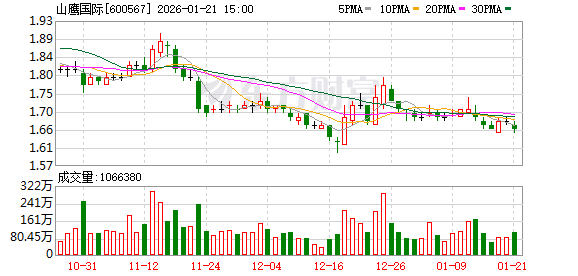
山鹰国际:对于脑机接口等跨界领域,公司暂时没有投入计划
Zheng Quan Ri Bao Wang· 2026-01-21 13:39
证券日报网讯1月21日,山鹰国际(600567)在互动平台回答投资者提问时表示,公司持续投入于造纸 主业的技术升级、产品结构优化、绿色生产等关键领域,旨在巩固和提升公司在核心业务上的长期竞争 力。对于脑机接口等跨界领域,鉴于其与主业协同性低,公司暂时没有投入计划。未来公司也将持续关 注能强化公司主业竞争力的协同机会。 ...

轻工制造行业日报:出口链:2025M12电子烟+28%,纸箱类出口金额+12%
Tai Ping Yang Zheng Quan· 2026-01-21 13:25
Investment Rating - The industry is rated as "positive," indicating an expected overall return exceeding 5% above the CSI 300 index in the next six months [7]. Core Insights - The report highlights a significant growth trend in the electronic cigarette sector, with an expected increase of 28% in export value by December 2025. Additionally, the corrugated box category is projected to grow by 12% [1][2]. - The paper industry shows a mixed performance, with corrugated boxes achieving double-digit growth (+12%), while the demand for bleached paper and paperboard has slightly declined (-7%). The performance of pulp and paper products remains stable with a minor decrease of -1% [2][6]. - The home furnishings sector is experiencing a notable decline, particularly in spring mattresses, which are under short-term pressure with a decrease of -3%. Other categories such as bathroom fixtures, office furniture, sofas, and PVC flooring are facing significant demand challenges, with declines ranging from -14% to -28% [2][6]. - The report also notes that other categories, including thermal cups and plastic tableware, are experiencing slight declines of -14% and -9%, respectively, while electronic cigarettes continue to show robust growth [2][6]. Summary by Relevant Sections Paper Industry - Corrugated boxes are expected to see a growth of +12% - Bleached paper and paperboard are facing a decline of -7% - Pulp and paper products are stable with a decrease of -1% [2][6] Home Furnishings - Spring mattresses are under pressure with a decline of -3% - Significant declines in demand for bathroom fixtures (-28%), office furniture (-18%), sofas (-15%), and PVC flooring (-14%) [2][6] Other Categories - Electronic cigarettes are projected to grow by +28% - Thermal cups and plastic tableware are experiencing declines of -14% and -9% respectively [2][6]
有生产造纸所需的化工辅料吗?山鹰国际:公司没有相关业务
Mei Ri Jing Ji Xin Wen· 2026-01-21 11:18
(文章来源:每日经济新闻) 每经AI快讯,有投资者在投资者互动平台提问:贵公司有生产造纸所需的化工辅料吗? 山鹰国际(600567.SH)1月21日在投资者互动平台表示,公司没有相关业务。 ...
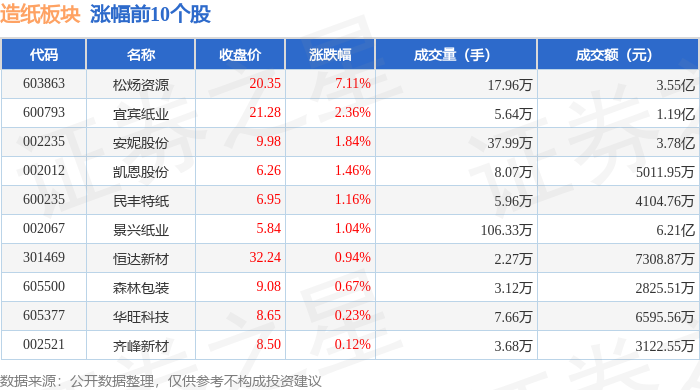
造纸板块1月21日涨0.01%,松炀资源领涨,主力资金净流出34.74万元
Zheng Xing Xing Ye Ri Bao· 2026-01-21 08:53
| 代码 | 名称 | 收盘价 | 涨跌幅 | 成交量(手) | 成交额(元) | | --- | --- | --- | --- | --- | --- | | 920394 | 民士达 | 53.05 | -6.11% | 3.31万 | 1.79亿 | | 600963 | 岳阳林纸 | 4.68 | -2.09% | 40.86万 | 1.91亿 | | 600433 | 起家同新 | 3.42 | -1.44% | 34.51万 | 1.18亿 | | 000488 | ST晨鸣 | 2.17 | -1.36% | 13.58万 | 2961.21万 | | 600567 | 山鹰国际 | 1.66 | -1.19% | 106.64万 | 1.78亿 | | 605007 | 五洲特纸 | 13.24 | -0.75% | 4.31万 | 5689.59万 | | 600966 | 博汇纸业 | 6.98 | -0.71% | 21.42万 | 1.48亿 | | 603733 | 仙鹤股份 | 23.58 | -0.34% | 3.08万 | 7267.55万 | | 600103 | 青山纸业 ...

十五五-的降碳路径与机遇解读
2026-01-21 02:57
Summary of Key Points from the Conference Call Industry Overview - The focus is on China's carbon emission control system, which includes quotas, Green Certificates, and China Certified Emission Reduction (CCER) [1][3][4]. Core Insights and Arguments - **Carbon Emission Control System**: The system aims to constrain carbon-emitting enterprises, promote green electricity development, and compensate for carbon reduction projects. Key industries currently included are steel, cement, and aluminum smelting, with plans to cover chemical, coking, and paper industries by the end of 2027 [1][3]. - **Quota Management**: The baseline values for quotas are set below equilibrium values, creating pressure for carbon reduction. The government will adjust these values based on actual conditions [1][4]. - **Carbon Price Trends**: The downward trend in carbon prices is a result of government policies providing companies with a buffer to adapt. The annual carbon reduction pressure is estimated at -0.5% [5]. - **Green Certificate Market**: Future plans include linking Green Certificates to corresponding carbon reduction amounts, allowing companies to offset emissions through purchases. Current low prices are due to a two-year validity period, but future policy clarity may stabilize prices [6]. - **Expansion of Quota Management**: The quota expansion plan is gradually progressing, with additional sectors like petrochemicals, civil aviation, and paper expected to be included [7]. - **CCER Issuance Conditions**: Projects must demonstrate significant carbon reduction effects and align with national strategic development to qualify for CCER. Examples include renewable energy projects and infrastructure improvements [8]. Additional Important Insights - **Investment Directions in Environmental Sector**: Key areas include waste incineration, non-electric green energy, and recycling of metals and plastics. Companies like Huanlan Environment and Weiming Environmental are expected to benefit from these trends [10][11][12]. - **Challenges and Opportunities in Steel Industry**: The steel sector, responsible for about 10% of total emissions, faces challenges in reducing carbon intensity due to process limitations. However, production control strategies present opportunities for emission reductions [16][17]. - **Opportunities in Light Industry**: The paper industry can leverage carbon trading through fast-growing forests, with companies like Yueyang Forest Paper leading in carbon credit transactions [18][19]. - **Building Industry's Role in Carbon Reduction**: The construction sector must adopt energy-saving technologies and focus on design optimization to reduce emissions effectively [20]. - **Future Policy Impacts on Cement Industry**: The cement sector, which contributes significantly to carbon emissions, will face stricter regulations and potential production cuts, impacting pricing dynamics [21][22]. - **Advantages of Specific Sub-industries**: Companies that provide energy-efficient materials, such as Luoyang Energy Saving, are positioned to benefit from the overall carbon reduction trend [23]. - **Impact of Dual Control Policies on New Energy**: The dual control policies are expected to accelerate the energy structure transformation, benefiting sectors like wind and solar energy, and enhancing the demand for related technologies [24].
未知机构:①近1个月来化工行业迎来一场全球性涨价潮巴斯夫陶氏亨斯迈等-20260121
未知机构· 2026-01-21 02:00
Summary of Key Points from Conference Call Records Industry Overview - The chemical industry has experienced a "global price surge" in the past month, with major companies like BASF, Dow, and Huntsman implementing price increases across Europe, Asia, and the Middle East [1][1][1] - Significant price increases have been noted for certain chemical products, with propylene oxide prices rising by 7.9% week-over-week [2][2][2] Companies Mentioned - Companies involved in the chemical sector include: - Xinxiang Chemical Fiber - Cangzhou Dahua - Weiyuan Co. - Shandong Heda - Hongbaoli - Hongbai New Materials - Red Wall Co. - Zhongyida - Zanyu Technology - China National Chemical - Jiangtian Chemical - Meibang Technology [2][2][2] Core Insights and Arguments - The recent price increases in the chemical market are attributed to a combination of supply chain pressures and increased demand for chemical products globally [1][1][1] - The government has introduced new policies to support urban renewal and stimulate the economy, which may further impact the demand for chemical products [2][2][2] Additional Important Information - The National Energy Administration reported that national electricity load has reached a historical winter high, exceeding 1.4 billion kilowatts for the first time, indicating strong energy demand [2][2][2] - The investment in new power systems is expected to grow significantly, with a projected 40% increase in investment during the 14th Five-Year Plan period [2][2][2] - The chemical industry is likely to benefit from these macroeconomic trends, as increased urban development and energy demands will drive further consumption of chemical products [1][1][1]



屠企采购放慢,生猪期现回落
Zhong Xin Qi Huo· 2026-01-21 00:43
1. Report Industry Investment Rating No information about the industry investment rating is provided in the report. 2. Core Views of the Report - The agricultural market shows a complex situation with different trends for various products. In the short - term, many products are expected to be in a state of shock, while in the long - term, the pig cycle is expected to gradually bottom out and recover in the second half of 2026[11]. - Overall, the supply of oilseeds (soybeans and rapeseeds) is relatively abundant, and the annual output of palm oil is high. Although it is about to enter the production - reduction season with a de - stocking trend, the overall situation of the oil market is complex[7]. - The protein meal market is affected by factors such as international soybean supply and domestic demand, and is expected to be in a state of shock[8]. - The corn market is in a state of tight balance, and the price is expected to be in a high - level shock in the short - term[9]. - The rubber market (both natural and synthetic) is expected to be in a state of shock, with different influencing factors[13][16]. - The cotton market is expected to be in a state of shock and gradually strengthen in the medium - to - long - term, while the sugar market is expected to be in a state of shock and weaken[17][18]. - The pulp and double - gum paper markets are expected to be in a state of shock and weaken, and the log market is expected to operate in a short - term range[19][22][23]. 3. Summary by Relevant Catalogs 3.1.行情观点 3.1.1. 油脂 - **观点**: Export expectations drive the rebound of palm oil. The price of palm oil is strong, driving up the prices of soybean and rapeseed oils slightly. The supply of soybeans and rapeseeds is relatively abundant, and the future supply expectations of palm oil, soybean oil, and rapeseed oil are different[7]. - **Logic**: For palm oil, the market expects good export data in Malaysia from January 1 - 20, but the domestic spot inventory is increasing, and the pre - holiday stocking sentiment is insufficient. For soybean oil, the global soybean production and inventory are expected to increase, and the domestic market's acceptance of high prices is decreasing. For rapeseed oil, future supply expectations are turning loose, but the spot is still tight, and the near - end basis is relatively strong[7]. - **Outlook**: Soybean oil is expected to be in a state of shock, palm oil in a state of shock, and rapeseed oil in a state of shock and weaken[7]. 3.1.2. 蛋白粕 - **观点**: Terminal stocking and point - pricing drive the rebound of double - meal prices at low levels[8]. - **Logic**: Internationally, the sowing of Argentine soybeans is nearly finished, and the US soybean demand is supported. The supply of overseas soybeans is expected to increase. Domestically, the low prices of soybean meal and rapeseed meal attract downstream stocking, but the adjustment of tariffs on Canadian rapeseed has a slight negative impact[8]. - **Outlook**: US soybeans, Dalian soybean meal, and rapeseed meal are all expected to be in a state of shock. Rapeseed meal is expected to be weaker than soybean meal[8]. 3.1.3. 玉米及淀粉 - **观点**: Corn is in a state of range - bound shock[8]. - **Logic**: The current fundamentals are in a tight balance. The upstream is reluctant to sell, and the logistics is affected by snow. The downstream feed enterprises have sufficient inventory, and the deep - processing enterprises' pre - holiday stocking has a certain impact on prices. Policy grain auctions also affect the price[9]. - **Outlook**: Corn is expected to be in a state of shock[9]. 3.1.4. 生猪 - **观点**: Slaughterhouses' procurement slows down, and the spot and futures prices of live pigs decline[10]. - **Logic**: In the short - term, the early - January slaughter progress is slow, and secondary fattening has re - entered in some areas. In the medium - term, the supply surplus pressure will last until April 2026. In the long - term, the sow capacity began to decline in the third quarter of 2025, and the supply pressure is expected to ease after May 2026. The demand shows a slight weekly increase in slaughter volume, and there is a slight inventory accumulation[11]. - **Outlook**: In the short - term, the market is expected to be in a state of shock. The industry is advised to focus on short - selling hedging opportunities in the first half of the year. The pig cycle is expected to gradually bottom out and recover in the second half of 2026[11]. 3.1.5. 沪胶与20号胶 - **观点**: The natural rubber market is in a state of wide - range shock[12]. - **Logic**: Affected by the overall commodity adjustment trend, the rubber price is in a narrow - range shock, and the fundamentals have not changed much. It is mainly driven by macro factors. The overseas supply is increasing seasonally, and the raw material price is firm, but the downstream buying is weak after the price increase[13]. - **Outlook**: The natural rubber market is expected to be in a state of shock[13]. 3.1.6. 合成橡胶 - **观点**: The price is in a state of correction and adjustment, and the market is in a state of shock[16]. - **Logic**: After the previous price increase, there is no further upward momentum, but the downside space is limited. The mid - term bullish logic remains unchanged, mainly based on the expected improvement of butadiene fundamentals. The price of butadiene has been rising recently[16]. - **Outlook**: The butadiene supply - demand pattern is expected to improve, but there is still pressure in the short - term. It is expected to be in a state of shock and strengthen in the medium - term[16]. 3.1.7. 棉花 - **观点**: The price continues to adjust, and attention should be paid to the lower support[17]. - **Logic**: In the short - term, due to the exhaustion of short - term benefits and the decline in positions, the cotton price has stopped rising. The fundamentals are generally good, but the increase in cotton yarn imports is a marginal negative factor. In the medium - to - long - term, the cotton price is expected to rise based on the expected tight supply and the reduction of cotton - planting area in Xinjiang[17]. - **Outlook**: The cotton market is expected to be in a state of shock and strengthen[17]. 3.1.8. 白糖 - **观点**: The sugar price is under pressure and closes down[18]. - **Logic**: Globally, the sugar market is expected to have a supply surplus in the 25/26 season, and both domestic and international prices are under pressure. In the domestic market, the supply is increasing, and the sugar price is expected to be under pressure during the northern hemisphere's listing period[18]. - **Outlook**: The sugar market is expected to be in a state of shock and weaken[18]. 3.1.9. 纸浆 - **观点**: The price of broad - leaf pulp continues to weaken, and the fundamentals have more concerns[19]. - **Logic**: The fundamentals of pulp have not changed much, with both positive and negative factors. The positive factors include the increase in import costs and the relatively low price difference between needle and broad - leaf pulp. The negative factors include the seasonal decline in demand, abundant supply in the spot market, and the weakening of the broad - leaf pulp price[19]. - **Outlook**: The pulp market is expected to be in a state of shock and weaken[19]. 3.1.10. 双胶纸 - **观点**: There are no major contradictions, and the price is in a low - level shock[20]. - **Logic**: The market is in a low - level shock, with stable production by large - scale paper enterprises and rational stocking by dealers. The demand is weak, and the price increase is difficult to pass on to the downstream[22]. - **Outlook**: The double - gum paper market is expected to be in a state of shock and weaken[22]. 3.1.11. 原木 - **观点**: The price of the log futures contract continues to decline, and the valuation has entered a deep - water area[23]. - **Logic**: The log futures contract has declined with increasing positions, and the short - term is dominated by bears. The valuation has entered a low - value area, and the downward space is relatively limited. The fundamentals have not changed significantly, and the delivery situation has changed. The spot price in the Jiangsu market is rising due to tight supply[23]. - **Outlook**: The log market is expected to operate in a short - term range[23]. 3.2. 品种数据监测 No specific data analysis or summary content is provided in the given text. 3.3. 中信期货商品指数 - On January 20, 2026, the comprehensive index of commodities was 2414.16, a decrease of 0.15%; the commodity 20 index was 2773.48, a decrease of 0.23%; the industrial products index was 2308.47, a decrease of 0.34%[184]. - The agricultural product index on January 20, 2026, was 934.25, with a daily decline of 0.02%, a decline of 1.15% in the past 5 days, an increase of 2.39% in the past month, and an increase of 0.13% since the beginning of the year[186].