金融衍生品

Search documents
香港证监会着手提高主要股票指数衍生工具的持仓限额
news flash· 2025-04-30 08:51
金十数据4月30日讯,香港证监会今天就建议提高以香港三大股票指数为基础的交易所买卖衍生工具的 持仓限额,发表咨询总结。回应者大力支持有关建议,并指出相关修订将加强市场流动性,提升对冲效 率,并促进市场进一步增长。证监会共接获25份来自本地和海外的市场参与者的意见书,其中包括庄 家、资产管理人、业界组织及其他持份者。证监会在考虑所接获的意见,过往及潜在的市场增长,以及 市场参与者的持仓限额使用情况后,将着手落实有关建议。为此,证监会将修订《证券及期货(合约限 量及须申报的持仓量)规则》及《持仓限额及大额未平仓合约的申报规定指引》。 香港证监会着手提高主要股票指数衍生工具的持仓限额 ...
【私募调研记录】幻方量化调研广联达
Zheng Quan Zhi Xing· 2025-04-30 00:10
Group 1 - The core viewpoint of the news is that Guanglian Da is optimistic about its future growth and development, particularly in its digital cost business, which is seen as a cornerstone for the company [1] - Guanglian Da plans to expand its product application range and improve product renewal rates and market share by leveraging new policy lists to meet diverse customer needs in cost management [1] - The company is optimistic about the growth trend in urban renewal, although its current revenue contribution from this area is still low [1] Group 2 - The increase in sales expenses is attributed to higher advertising, promotion, and travel costs due to business development, while R&D expenses have risen due to software amortization and technology investment [1] - The company expects a significant decrease in overall labor costs for the year [1] - Guanglian Da's core business is primarily domestic, with a small proportion of foreign business, and local authorized sales and services are the main channels, limiting the direct impact of tariffs [1] Group 3 - The company aims to achieve its annual net profit target through an equity incentive plan, with quarterly data expected to fluctuate but striving for stable annual results [1] - Guanglian Da's AI strategy focuses on overcoming technical bottlenecks, enhancing competitiveness, and empowering products, with specific applications in Concetto, New Calculation, and Trading [1] - The company will showcase its progress at the construction industry summit in mid-May [1]

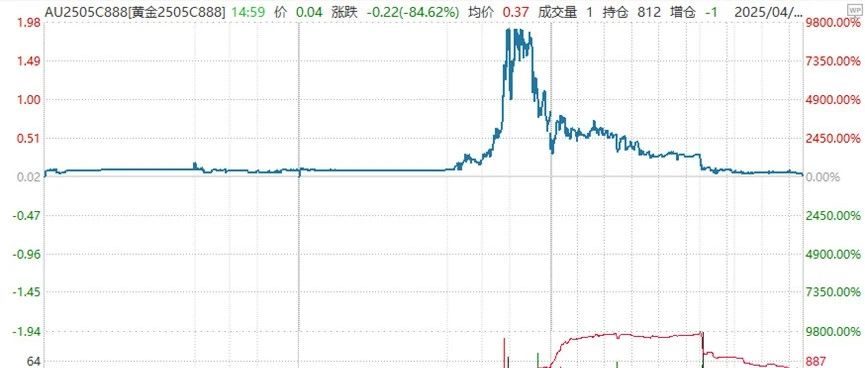
黄金期权从9800%涨幅到仅剩0.04元,什么是末日轮陷阱?
对冲研投· 2025-04-23 12:13
Core Viewpoint - The article emphasizes the recent surge in gold prices, which have increased by nearly 30% this year, and discusses the implications of this volatility for investors [1][8]. Group 1: Gold Price Dynamics - The international gold price's deviation rate has reached historical extremes, with a 98% percentile deviation from the 20-day moving average and a 99% percentile deviation from the 60-day moving average, indicating a high risk of further price increases [3][4]. - Domestic gold ETFs have doubled in size within two months, with total assets nearing 160 billion yuan, up from approximately 70 billion yuan on February 28 and over 90 billion yuan on March 31, reflecting accelerated inflows [4][8]. Group 2: Options Market Insights - Near-expiry out-of-the-money gold options experienced a maximum increase of 9800%, showcasing a "doomsday effect," but their value plummeted to 0.04 yuan shortly after, highlighting the speculative nature of such options [4][6]. - The majority of investors are unlikely to purchase deep out-of-the-money options due to their high probability of expiring worthless, similar to betting on an unlikely sports comeback [6][7]. Group 3: Long-term Gold Investment Logic - Gold is viewed as a robust asset for 2023, driven by factors such as inflation hedging, risk aversion, and the increasing accumulation of gold by central banks, with the share of gold in global reserves rising from 8.7% in 2001 to 18.3% by Q1 2025 [8]. - The article suggests that as long as the themes of inflation protection, risk aversion, and central bank purchases persist, gold remains a favorable investment, despite short-term volatility [8].

股票股指期权:上行速度较缓,隐波下行,可考虑备兑策略
Guo Tai Jun An Qi Huo· 2025-04-21 12:44
Report Summary 1. Report Industry Investment Rating No information provided in the report. 2. Core View of the Report Stock index options are rising slowly, implied volatility is falling, and a covered call strategy can be considered [2][3]. 3. Summary by Relevant Catalog 3.1 Option Market Data Statistics - **Underlying Market Statistics**: The closing prices, changes, trading volumes, and other data of the Shanghai - Shenzhen 300 Index, Shanghai Composite 50 Index, and other underlying assets are presented. For example, the Shanghai Composite 50 Index closed at 2652.81, down 4.83 points, with a trading volume of 34.41 billion hands, an increase of 4.06 billion hands compared to the previous period [3]. - **Option Market Statistics**: Data such as trading volume, change, open interest, change, VL - PCR, OI - PCR, and the maximum open interest of calls and puts for various options are provided. For instance, the trading volume of Shanghai Composite 50 Index options was 22,009, an increase of 7,044, and the open interest was 52,190, an increase of 4,620 [3]. 3.2 Option Indicator Data Statistics - **Option Volatility Statistics**: The data of ATM - IV, IV change, same - term HV, HV change, Skew, Skew change, VIX, and VIX change for various options are given. For example, the ATM - IV of Shanghai Composite 50 Index options (near - month) was 14.83%, down 0.29% [6]. 3.3 Option Analysis by Type - **Shanghai Composite 50 Index Options**: Multiple charts are presented, including the volatility trend chart of the main contract, the full - contract PCR chart, the skewness trend chart of the main contract, the volatility cone chart, and the volatility term structure chart [10][11][12]. - **Shanghai - Shenzhen 300 Index Options**: Similar to Shanghai Composite 50 Index options, multiple charts are used to analyze the volatility, PCR, skewness, etc. of the options [15][16][18]. - **CSI 1000 Index Options**: The report provides charts for analyzing the main contract's volatility, full - contract PCR, main contract skewness, etc. [20][21][23]. - **ETF Options (including Shanghai Composite 50 ETF, Huatai - Ba瑞 300 ETF, etc.)**: Each type of ETF option is analyzed through charts such as the main contract's volatility trend, full - contract PCR, and main contract skewness [27][31][35].
研客专栏 | 今天!1000期指的贴水,已达到什么水平?……
对冲研投· 2025-04-21 11:55
以下文章来源于力的期权工作室 ,作者余力 Felix 力的期权工作室 . 对个人更通俗,对机构更专业,努力做最具品质的衍生品公众号~ 欢迎加入交易理想国知识星球 文 | 余力 Felix 来源 | 力的期权工作室 编辑 | 杨兰 审核 | 浦电路交易员 今天!连续第十个交易日,上证综指继续创出4.8反弹以来的新高,各大指数也继续修复4.7那一天的跳空大缺口…… 随着最近"护盘"资金的不断加仓,有一个现象也值得一提,那就是中证1000指数与远月股指期货的贴水率已经几乎拉到了去年9.24以 来的尾部区。 从下面这张图先粗略有个概念(下图中的黑色曲线表示中证1000指数,粉红色曲线表示中证1000最远月股指期货),对于4.7以来的这 一波下跌,中证1000指数本身已经在逐步修复4.7那一天的大缺口,从4.8算到今天,已经累计上涨了8.30%,然而,最远月中证1000股 指期货的价格却只上涨了大约3%,明显跟不上1000指数本身,这导致两者之间的负基差(即股指期货价格减去指数本身的价格)已经 处在近期高位。 图:去年9.24至今,中证1000指数与中证1000隔季月期指合约价格对比走势图 数据来源:Wind 对于还不 ...
研客专栏 | 今天!1000期指的贴水,已达到什么水平?……
对冲研投· 2025-04-21 11:55
Core Viewpoint - The article discusses the recent performance of the stock market, particularly the Shanghai Composite Index and the ChiNext Index, highlighting the significant rebound and the implications of the current market conditions on investment strategies [1]. Group 1: Market Performance - The Shanghai Composite Index has reached new highs for the tenth consecutive trading day, reflecting a recovery from the significant drop on April 7 [1]. - The CSI 1000 Index has increased by 8.30% since April 8, while the far-month stock index futures have only risen by about 3%, leading to a notable negative basis [1][3]. Group 2: Futures Market Dynamics - The article explains the concept of "contango" and "backwardation" in futures trading, indicating that the current negative basis is likely due to significant hedging activities in the futures market [3]. - The low dividend yield of the CSI 1000 Index compared to the CSI 300 Index suggests that the futures prices are less influenced by dividend factors, which may contribute to the current market dynamics [3]. Group 3: Trading Volume and Market Sentiment - Trading volume is highlighted as a critical variable for market momentum, with a historical benchmark of 1.3%-1.4% turnover rate indicating a healthy market environment [4]. - A sustained trading volume above 1.4 trillion yuan is necessary for the emergence of a structural market trend, while volumes below this threshold may indicate a retreat of trading capital [5]. Group 4: Seasonal Trends and Calendar Effects - The article discusses the historical performance of the Shanghai Composite Index and the CSI 300 Index during the latter half of April, noting a low win rate and negative average returns in this period [6]. - The analysis suggests that the end of April is a critical time for earnings announcements, which may lead to increased volatility and the need for cautious investment strategies [6]. Group 5: Investment Strategy Recommendations - The article emphasizes the importance of monitoring the relationship between the A-share indices and the Hang Seng Technology Index, as well as the net inflow of margin trading, to gauge market sentiment [8]. - Investors are advised to remain patient and strategic, especially as the market approaches key resistance levels and while waiting for a return of trading volume [8].

金融期权成交活跃度全线攀升
Qi Huo Ri Bao· 2025-04-19 05:34
Market Performance - On April 16, the A-share market showed a mixed performance with the Shanghai Composite Index rising by 0.26% while the Shenzhen Index and the ChiNext Index fell by 0.85% and 1.21% respectively [1] - The STAR 50 Index increased by 0.81% [1] - The total trading volume in the Shanghai and Shenzhen markets reached 11,119 billion yuan [1] Options Market Activity - All varieties of options saw increased trading activity with overall open interest continuing to grow [2] - The trading volume for the Shanghai Stock Exchange 50 ETF options was 1,285,515 contracts with an open interest of 1,594,677 contracts and a transaction value of 431 million yuan [2] - The trading volume for the CSI 300 ETF options was 1,369,245 contracts with an open interest of 1,414,333 contracts and a transaction value of 715 million yuan [2] - The trading volume for the CSI 500 ETF options was 1,632,882 contracts with an open interest of 1,216,514 contracts and a transaction value of 1,381 million yuan [2] - The trading volume for the ChiNext ETF options was 1,347,656 contracts with an open interest of 1,583,698 contracts and a transaction value of 507 million yuan [2] Implied Volatility - Various underlying assets experienced a rebound from low levels, while the implied volatility of options remained at year-to-date lows [3] - The weighted implied volatility for the Shanghai Stock Exchange 50 ETF options was 0.1476, while for the CSI 300 ETF options it was 0.173 [3] - The weighted implied volatility for the ChiNext ETF options was 0.2883, indicating a relatively low volatility environment [3] - The analysis suggests that the recent contraction in trading volume and narrowing volatility may not be sustainable, with a potential for a market rebound in the medium to long term [3]
金融期权日报-20250417
Yin He Qi Huo· 2025-04-17 08:13
Report Industry Investment Rating No relevant content provided. Core Viewpoints - The trading volume of financial options reached 7.83 million contracts, indicating relatively active trading in the financial options market. The trading volume of most varieties' PCR ratios was significantly lower than 1, suggesting that the call options in the options market were more popular than put options [1][3]. - The VIX of SSE CSI 500 ETF options rose by 0.40%. The VIX indexes of various ETF options on the SSE increased to varying degrees, the VIX of Shenzhen GEM ETF options on the SZSE rose by 1.09%, and the VIX index of CFFEX CSI 300 index options rose by 0.48% [1][3]. Summary by Directory 1. Market Quick View 1.1 Trading Volume and Open Interest - The closing prices, price changes, option trading volumes, option open interests, trading volume PCRs, and open interest PCRs of multiple options such as SSE SSE 50 ETF, SSE CSI 300 ETF, and SSE CSI 500 ETF were presented. For example, the closing price of SSE SSE 50 ETF was 2.715, with a price increase of 0.89%, trading volume of 1,285,515 contracts, and open interest of 1,594,677 contracts [5]. 1.2 Volatility - The implied volatility indexes (VIX), IV price changes (absolute values), skewness indexes, historical volatilities (30 - day and 90 - day), and implied - historical differences of multiple options were provided. For instance, the VIX of SSE SSE 50 ETF was 16.90, with an IV price increase of 0.60%, and a historical volatility of 21.94% (30 - day) [9]. 2. Product Research 2.1 SSE SSE 50 ETF Options - Charts related to the volatility smile curve, volatility term structure, VIX index, SKEW index, trading volume PCR, and open interest PCR were presented [14]. 2.2 SSE CSI 300 ETF Options - Similar to 2.1, relevant charts for SSE CSI 300 ETF options were provided, including the volatility smile curve, volatility term structure, etc. [17]. 2.3 SSE CSI 500 ETF Options - Charts of the volatility smile curve, volatility term structure, VIX index, SKEW index, trading volume PCR, and open interest PCR for SSE CSI 500 ETF options were shown [22]. 2.4 SSE STAR 50 ETF Options - Relevant charts for SSE STAR 50 ETF options, such as the volatility smile curve and volatility term structure, were presented [25]. 2.5 SSE STAR - BOARD 50 ETF Options - Similar to the above, charts related to SSE STAR - BOARD 50 ETF options were provided [29]. 2.6 SZSE CSI 300 ETF Options - Charts of the volatility smile curve, volatility term structure, VIX index, SKEW index, trading volume PCR, and open interest PCR for SZSE CSI 300 ETF options were shown [32]. 2.7 SZSE CSI 500 ETF Options - Relevant charts for SZSE CSI 500 ETF options, including the volatility smile curve and volatility term structure, were presented [36].
一个隐秘指标暴露了市场真正的恐慌程度
Jin Shi Shu Ju· 2025-04-15 10:13
Group 1 - The core viewpoint of the articles highlights the significant impact of zero-day options on market volatility, particularly in the context of recent market turmoil driven by trade policy concerns [1][2][4] - The VIX index surged to its highest level since 2020, indicating extreme market volatility, while the trading volume of zero-day options related to the S&P 500 reached 8.5 million contracts in April, a 23% increase since the beginning of the year [1][2] - Analysts express mixed opinions on the role of zero-day options in driving volatility, with some attributing the recent spikes primarily to external factors such as Trump's tariff policies, while others suggest that the popularity of these options has exacerbated market fluctuations [3][4] Group 2 - The intraday volatility of the S&P 500 reached 44%, surpassing levels seen during the pandemic and approaching those during the 2008 financial crisis, with zero-day options playing a significant role in this volatility [2] - Concerns have been raised by investors, including Bill Ackman, regarding the potential risks posed by zero-day options in an already volatile trading environment, suggesting that these instruments may threaten market stability [2] - Research indicates that since the introduction of zero-day options in 2022, intraday volatility has increased by 24.5%, highlighting the potential influence of these short-term, speculative financial products on market dynamics [4]
场外个股期权与股票的区别究竟有哪些?
Sou Hu Cai Jing· 2025-04-15 01:45
Core Insights - The article discusses the differences between over-the-counter (OTC) individual stock options and traditional stocks, emphasizing the importance of understanding these distinctions for investors. Group 1: Nature of Stocks and OTC Options - Stocks represent ownership in a company, granting shareholders rights such as dividends and voting, with profits directly linked to company performance [1] - OTC individual stock options are rights contracts that allow buyers to buy or sell stocks at a predetermined price without actual ownership [2] Group 2: Profit and Loss Characteristics - Stocks have linear profit and loss, where gains or losses correspond directly to stock price changes [1] - OTC options offer non-linear returns, where the maximum loss is limited to the premium paid, while potential gains can be several times the initial investment [3] Group 3: Time Constraints and Risk Management - Stocks can be held indefinitely, while OTC options have a specific expiration date, leading to time decay in value [4][8] - The breakeven point for stocks is close to the purchase price, while for options, it requires consideration of the strike price and option premium [9][11] Group 4: Market Participants and Liquidity - The stock market includes a wide range of participants, while OTC options are primarily traded by institutional investors, with personal investors needing to go through intermediaries [12] - OTC options have lower liquidity compared to exchange-listed contracts, which can complicate pricing and increase transaction risks [11] Group 5: Trading Mechanics - Investors can only participate in OTC options through qualified institutions, and trading times vary by broker [13][14] - The closing of positions must be executed before the expiration date, with specific rules depending on the brokerage [14]