
AI

Search documents
金鹰基金杨刚:市场正切换向盈利与估值双轮驱动的下半场
Xin Lang Cai Jing· 2026-01-21 08:35
Core Insights - The current market environment in 2026 differs significantly from 2015, with the recent rise to 4100 points driven by solid industrial foundations and profit support rather than just liquidity and risk appetite [1][5][6] - Opportunities in the market are emerging from accelerated global AI capital expenditure, with Chinese companies actively participating in various segments of the AI industry chain [1][6] - The ongoing geopolitical tensions, abundant liquidity, and economic recovery are contributing to rising prices of upstream resources, creating new investment opportunities [1][6] Market Dynamics - The A-share market is transitioning from a phase primarily driven by liquidity and risk appetite to one where both profits and valuations are expected to drive growth [2][7] - Recent increases in retail investor participation have led to heightened market sentiment, necessitating regulatory measures to ensure stability [2][7] - Short-term market corrections may occur due to over-exuberance, but patience and careful stock selection are advised for investors [2][7] Sector Focus - Continued attention is recommended for sectors such as AI computing power, semiconductors, and export-oriented industries like non-ferrous metals, electric grid equipment, and engineering machinery [2][7] - In the context of inflationary pressures, sectors like innovative pharmaceuticals and non-bank financials are suggested for consideration [2][7] Thematic Investment Opportunities - AI applications and commercial aerospace are highlighted as attractive investment themes, particularly after recent adjustments that may have alleviated short-term overheating [3][8] - The commercial aerospace sector, supported by strong policy backing and macro narratives like SpaceX, is expected to see continued upward momentum [3][8] - High-risk investors are encouraged to identify quality leaders within these sectors during periods of adjustment for long-term gains [3][8]
港股打新开门红!11只新股零破发,鸣鸣很忙正在招股
Sou Hu Cai Jing· 2026-01-21 07:56
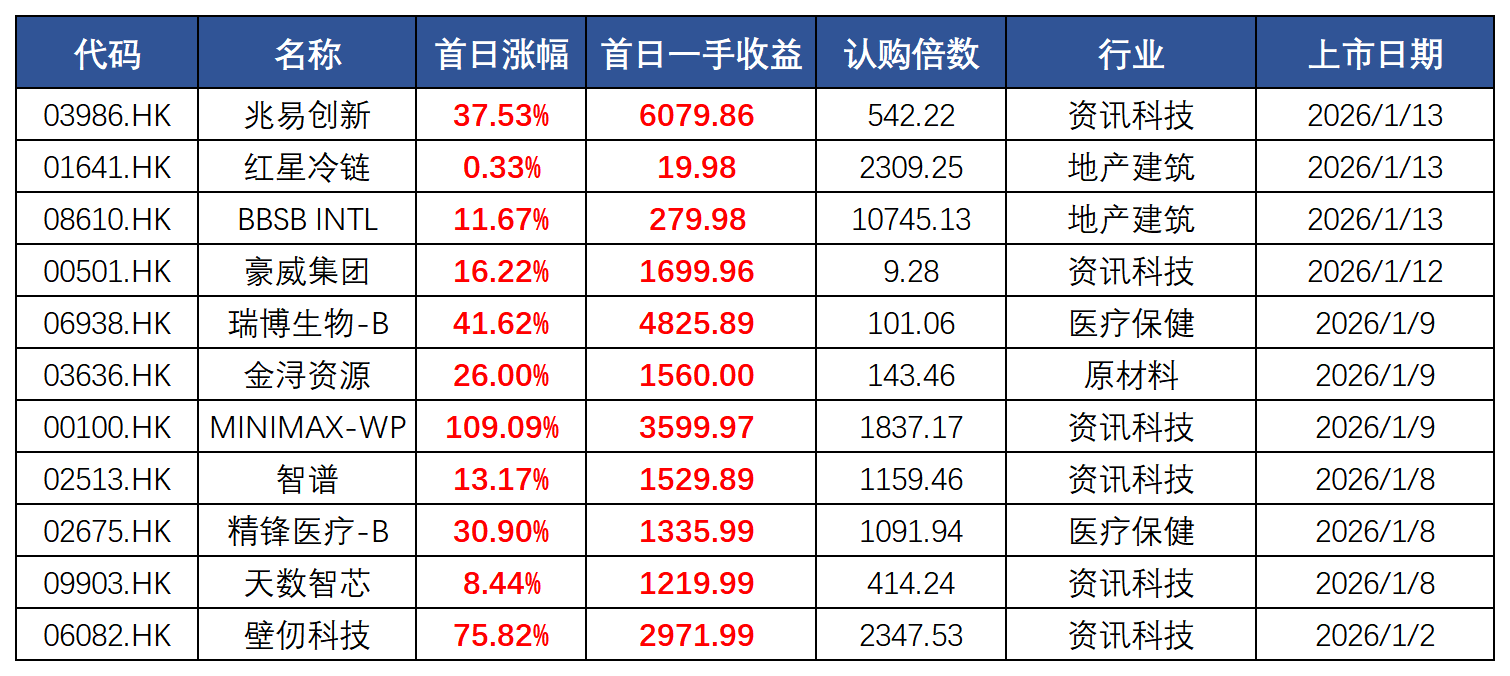
Group 1 - In the beginning of the year, 11 new stocks listed on the Hong Kong Stock Exchange all recorded gains, achieving a "zero break" performance [1] - The average increase in the dark market for new stocks reached 67.8%, while the average first-day increase was as high as 33.7% [1] - New stocks from popular sectors such as GPU, AI, and biomedicine have ignited enthusiasm in the Hong Kong stock market, leading to the best start for the new stock market in recent years [1] Group 2 - Among the new listings, Wallen Technology (06082.HK), known as the "first GPU stock in Hong Kong," saw a first-day increase of 75.82%, while MINIMAX (00100.HK), an "AI large model stock," doubled its stock price on its debut [1] - The listing of these stocks has sparked a mini bull market in the AI application sector of the Hong Kong stock market [1] Group 3 - The company Mingming is currently busy with its IPO, expected to officially list on the Hong Kong Stock Exchange on January 28, with Goldman Sachs and Huatai International as joint sponsors [2] - Mingming is a retail company in the food and beverage sector, boasting a wide range of high-quality products and a significant number of stores, totaling 19,517 across 28 provinces in China by Q3 2025 [2] - By 2024, Mingming is projected to be the largest chain retailer in China by GMV for leisure food and beverage products, and the fourth largest for food and beverage products overall [2] Group 4 - Currently, there are seven companies awaiting IPO approval, including Dazhu CNC, Muyuan Foods, Dongpeng Beverage, Guoen Co., Baige Online, Zhuozheng Medical, and Lanke Technology [3]

马斯克,剑指“太空AI”
财联社· 2026-01-21 05:47
Core Viewpoint - Tesla is reviving its Dojo 3 supercomputer project, which was previously halted, indicating a significant shift in its chip strategy towards space AI computing [3][4][10]. Group 1: Dojo 3 Project Overview - Dojo 3 was initially designed as a supercomputer for machine learning training, with a focus on architecture restructuring and cost optimization [7]. - The project was paused five months ago due to a strategic decision to concentrate resources on AI5 and AI6 chips, moving away from developing custom chips [5][8]. - The revival of Dojo 3 is based on the successful progress of the AI5 chip design, with Tesla actively recruiting engineers for this initiative [5][8]. Group 2: Space AI Ambitions - The new mission for Dojo 3 includes advancing into "space artificial intelligence computing," aligning with Musk's vision of deploying AI computing centers in space [4][10]. - Musk believes that operating large-scale AI systems in orbit will be more cost-effective than on Earth within the next four to five years, leveraging solar energy and cooling technologies [11]. - This vision connects Tesla's various business interests, potentially positioning the company as a major beneficiary if successful [11]. Group 3: Challenges Ahead - Achieving the goal of space-based AI data centers faces significant challenges, including orbital debris, regulatory approvals, and international space policies [12]. - Cooling high-power computing devices in a vacuum presents practical difficulties, despite theoretical advantages [12][13]. - Constructing large AI data centers in geostationary orbit (GEO) is feasible but requires extensive infrastructure, which poses logistical and financial challenges [13][14].


2026年最有“钱途”的行业,最爱应届生
Xin Lang Cai Jing· 2026-01-21 02:00
文 | 每日人物社 徐晴 编辑 | Yang 运营 | 步鸟 2026年一开年,AI行业的新闻频出。做大模型的智谱和MiniMax上市了;AI应用Manus卖给了Meta,核心团队直接实现 财富自由;具身智能迎来一笔笔融资;AI硬件创业者挤满深圳的咖啡馆。在这样的繁盛中,人才被哄抢,隔三差五, 就出现一位年薪百万甚至千万的AI高级人才,被各大公司争夺。 肖玛峰是一家国内头部猎头公司的创始人——这家公司在过去的几年服务了1400多家AI企业,从大厂到创业公司,从 大模型到自动驾驶、机器人。AI的风口如何刮起来,哪家公司拿到了新融资,哪家最近被收购,哪家招人最多,哪位 人才拿到了最天价的薪酬……他们全都知道。 从AI人才的走向和企业们争夺的焦点里,我们可以看到这一年的AI赛道到底发生了什么。 以下是肖玛峰的讲述: 大厂争夺AI人才 现在的就业市场,可以说是冰火两重天。最顶级的人才,尤其是AI领域,大家手上都有很多个offer。应届毕业的博士生 薪资300万,这不是传说,是真的。 争抢AI人才的,国内分这么几类:一类是非常有钱的互联网大厂,比如字节、腾讯、阿里、华为;第二梯队是美团、 京东、小红书。大厂都有专门针对 ...


美股遭大规模做空,贝莱德CEO发出严重警告,次贷危机或发生
Sou Hu Cai Jing· 2026-01-20 23:36
Group 1 - The financial storm brewing in the U.S. stock market is driven by a short-selling wave, rising bond yields, and increasing market risk aversion, indicating challenges to market stability [1][22][30] - The crisis began with the sudden decline of AI concept stocks, particularly AppLovin, which faced allegations of operational data issues and potential illegal funding, leading to a significant drop in its stock price [3][5][9] - The AI sector, previously viewed as a transformative force, is now under scrutiny as investors question its monetization potential, especially for companies relying on advertising revenue [5][8][30] Group 2 - U.S. Treasury yields have been rising, with the 10-year yield approaching 4.5%, reflecting growing market concerns about the long-term fiscal health of the U.S. [11][13] - The traditional view of U.S. Treasuries as safe assets is being challenged, as recent trends show simultaneous declines in stocks and bonds, indicating a shift in investor sentiment [13][15] - The rising interest payments on U.S. debt are straining the federal budget, leading to concerns about the sustainability of the dollar's status as a global reserve currency [15][22] Group 3 - There is a notable divergence between the U.S. Treasury and the Federal Reserve regarding economic stimulus measures, complicating the response to market pressures [17][19] - The lack of a coordinated rescue plan, unlike during the 2008 financial crisis, has led to increased market anxiety, as both the government and the Fed operate independently [21][30] - BlackRock's CEO has warned that the current debt structure poses a significant threat to the economy, emphasizing the need for fundamental adjustments to avoid long-term stagnation [22][24][26] Group 4 - The current financial crisis reflects a profound adjustment in the U.S. financial structure, as reliance on capital market growth is being questioned amid rising debt and deficits [28][30] - Investors are reassessing risks and reallocating assets, indicating a broader "repricing" of the financial system rather than a temporary disruption [31][33] - The market's shift from viewing tech growth prospects to questioning the safety of U.S. Treasuries signifies a critical turning point in investor confidence and economic outlook [31][33]



融资盘开年首现净卖出!算力、AI应用双杀,创业板人工智能ETF(159363)日线四连跌,布局时刻到了?
Xin Lang Cai Jing· 2026-01-20 11:21
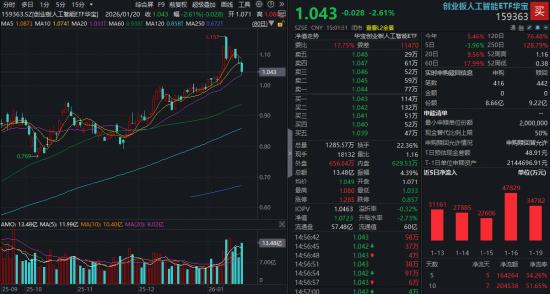
Market Overview - On January 20, both computing power and AI applications experienced significant declines, with the ChiNext AI index dropping sharply and testing the 20-day moving average [1][9] - AI applications led the decline, with notable stocks like Yidian Tianxia hitting a daily limit down, while others like Zhongwen Online, Tuorisi, and Runhe Software fell over 2% [1][9] - In the computing power sector, leading optical module stocks such as Lian Te Technology, Guangku Technology, and Taicheng Light fell over 5%, while Tianfu Communication and Zhongji Xuchuang dropped over 3% [1][9] ETF Performance - The ChiNext AI ETF (159363), which focuses on both computing power and AI applications, saw a decline of 2.61%, marking its fourth consecutive day of losses, with a single-day trading volume exceeding 1.3 billion yuan [1][9] - Over the past 10 days, the ChiNext AI ETF has attracted over 2 billion yuan, leading its category in capital inflow [1][9] Financing and Market Sentiment - A decrease in margin trading is identified as a key reason for the short-term adjustment in the computing power sector, with a net sell of 8.5 billion yuan recorded on January 19 [3][12] - Major stocks like Zhongji Xuchuang and Xinyisheng faced significant repayment pressures, with repayment amounts reaching 2.4 billion yuan and 2.1 billion yuan respectively [3][12] Future Outlook - Despite the recent volatility, the computing power sector, particularly optical modules, is expected to maintain a favorable outlook, with potential for recovery providing investment opportunities [5][11] - The telecommunications sector has seen upward revisions in profit forecasts since November, indicating strong fundamental support [5][11] - The overseas computing power market is projected to enter a new growth phase by 2026, with continued investment in infrastructure and high growth rates anticipated [6][11] - AI applications are expected to remain a primary focus in 2026, with ongoing catalysts for growth and a favorable environment for application deployment in China [6][11] Investment Strategy - The ChiNext AI ETF is positioned to benefit from the commercialization of AI technology, with approximately 60% of its portfolio allocated to computing power and 40% to AI applications [6][13]

权益ETF,谁是主题轮动下一棒?
HUAXI Securities· 2026-01-20 07:41
Group 1: Report's Investment Rating - No information about the industry investment rating is provided in the report. Group 2: Core Viewpoints - In early 2026, the market sentiment has significantly warmed up, and the market has risen strongly. However, the risk - return ratio of chasing the rising market may not be high. Thematic investment remains popular, and funds from previously over - heated themes are expected to shift to other thematic sectors [1][7]. - The technology main line is still the market consensus. Funds are likely to flow into sectors such as semiconductor computing power and robotics within the technology sector, while lithium battery, non - ferrous metals, power grid, chemical, and innovative drugs are important supplementary sectors for the market [2][22]. Group 3: Summary by Directory 1. Which theme ETFs are expected to be the direction of capital return? - **Market situation**: In early 2026, the market has risen strongly, with commercial aerospace, AI applications, and non - ferrous metals becoming the focus. But there are signs of the market correcting irrational behaviors under regulatory guidance, and the risk - return ratio of chasing the rising market may be low. Thematic investment is still very popular. As of January 19, 2026, the cumulative net capital inflow of thematic index ETFs in the past five days exceeded 42.254 billion yuan, while industry index ETFs only had a net inflow of 9.763 billion yuan, and broad - based index ETFs showed a large net outflow [1][7]. - **Analysis from the perspective of rise and valuation**: Technological industries generally have high rises, while traditional cyclical industries such as liquor, coal, and breeding have relatively low rises. New energy sectors like lithium battery, photovoltaic, and new - energy vehicles, as well as the chemical industry, have risen but still have room to reach previous highs. From the valuation dimension, the current valuations of the game, intelligent driving, lithium battery, and breeding sectors are low [8]. - **Analysis using the quadrant chart**: - **First quadrant (high rise and high congestion)**: Mainly includes commercial aerospace, communication, AI, and non - ferrous metals. Non - ferrous metals (such as copper) and AI have relatively moderate congestion, and relevant sectors are still worthy of attention [2][17]. - **Second quadrant (high rise and low congestion)**: There are relatively few relevant industries, mainly semiconductor equipment (including related industrial chains such as storage) and lithium battery. The sector sentiment is not over - heated, and the industrial supply - demand pattern is optimized, so they are still worthy of attention [2][17]. - **Third quadrant (low rise and low congestion)**: Sectors such as innovative drugs, chemicals, and games have both industrial logic and market capacity, with large potential for a supplementary rise. For example, since 2026, the chemical ETF has re - entered the state of net inflow [2][17]. - **Fourth quadrant (low rise and high congestion)**: Includes robotics, power grid equipment, consumer electronics, and software. Power grid equipment has received renewed attention due to the unexpected increase in the 14th Five - Year Plan expenditure, and robotics has also been favored by the market because Tesla's third - generation robot has entered the scheme confirmation stage [2][21]. - **Specific ETF selection**: For ETFs tracking the same index, products with larger scale, relatively lower fees, and smaller tracking errors are selected. Specific ETF lists are provided in the report [22].
AlphaTON Capital Signs Definitive Agreement to Launch First Fully Privacy-Preserving AI Agents to Telegram’s Billion Users
Globenewswire· 2026-01-20 07:00
Core Insights - AlphaTON Capital has entered a landmark agreement with the Midnight Foundation to establish a 20% revenue share model for a privacy tech stack aimed at confidential AI on Telegram [1][2][4] Group 1: Partnership and Market Positioning - The partnership represents the first integration of a zero-knowledge blockchain with the TON ecosystem, enhancing AlphaTON's ability to deliver privacy-preserving AI products to Telegram's user base of nearly 1 billion [4][5] - This collaboration aims to set a new standard for privacy in AI applications, allowing users to maintain full control over their data while interacting with AI agents for various tasks [5][6] Group 2: Financial and Operational Framework - The Federated Node Agreement is a legally binding contract that outlines immediate revenue generation and long-term value creation, with AlphaTON providing one of the ten founding Midnight nodes [8][13] - The agreement includes a monthly compensation model for AlphaTON, starting in the first quarter following the effective date, along with additional reimbursements for network growth-related costs [13] Group 3: Strategic Vision and Future Growth - AlphaTON Capital aims to create a scalable revenue stream by building critical infrastructure for confidential AI, positioning itself as a key player in a market projected to reach trillions of dollars [7][9] - The integration of privacy-enhancing technology into the TON ecosystem is expected to generate tangible value for shareholders and solidify AlphaTON's leadership in decentralized AI [9][10]

“申”度解盘 | 指数持续上涨后震荡盘整,AI应用板块表现活跃
申万宏源证券上海北京西路营业部· 2026-01-20 02:49
Core Viewpoint - The A-share market has experienced a period of adjustment following a recent continuous rise in indices, with notable corrections in the commercial aerospace sector and active performance in the AI application sector [6][7]. Market Overview - The commercial aerospace sector has shown signs of divergence and adjustment, with multiple companies issuing risk warnings regarding their business activities. This indicates a potential overheating in the sector, prompting calls for improved information disclosure and investor education to guide rational market development [7]. - The AI application sector has benefited from capital inflows as funds from the commercial aerospace sector have shifted towards it. Key concepts such as Generative Engine Optimization (GEO) and AI healthcare have gained traction, with GEO expected to reshape advertising marketing in the AI era, presenting a vast market opportunity [7]. - In the AI healthcare space, there have been significant developments, including increased traffic for Ant Group's AI health assistant and collaborations between OpenAI and major pharmaceutical companies to invest in AI drug research [7]. Policy Adjustments - On Wednesday, the Shanghai and Shenzhen Stock Exchanges announced an adjustment to the financing margin ratio, increasing the minimum margin for investors from 80% to 100%. This change follows a previous reduction in August 2023, aimed at promoting long-term market stability amid recent price increases [8]. Market Outlook - Following a peak trading volume of nearly 4 trillion yuan, the indices are expected to undergo slight adjustments to digest the gains made since December 2022. Future attention will be on the performance of resource and precious metal prices, as well as the impact of AI industry trends on hot topics [10].

老板说"去分析一下竞品",90%的人第一步就做错了
3 6 Ke· 2026-01-20 00:23
Core Insights - The article emphasizes that competitive product analysis has become an essential skill for AI product managers due to the rapid iteration and evolution of AI products [1][3] - It highlights the unique characteristics of the AI industry that necessitate continuous competitive analysis to maintain market relevance and identify differentiation opportunities [3][4][5] Importance of Competitive Analysis - AI products evolve at a much faster pace than traditional software, making previous conclusions potentially obsolete within weeks [3] - The AI market is crowded yet distinctly segmented, requiring thorough research to identify unique positioning and differentiation strategies [4] - The low switching costs for users mean that they can easily migrate to competitors if new features are introduced, underscoring the need for constant vigilance in competitive analysis [5] Value of Competitive Analysis - The first layer of value is understanding the market landscape and identifying the company's position among competitors [6][7] - The second layer involves recognizing strengths and weaknesses to guide product iterations, ensuring that the company meets or exceeds industry standards [8] - The third layer aids in strategic decision-making by predicting competitive risks and industry trends, which is crucial for resource allocation and strategic planning [9][10] Tailoring Reports for Different Roles - Different stakeholders require different insights from competitive analysis reports, necessitating tailored presentations for executives, product teams, development teams, and marketing teams [9][10] - Executives focus on strategic positioning and opportunities, while product teams seek actionable insights for feature improvements [9] - Development teams look for technical implementation details, and marketing teams are interested in pricing strategies and promotional channels [10] Conclusion - The core purpose of competitive analysis is to gain a comprehensive understanding of the market landscape, identify product strengths and weaknesses, and formulate precise product strategies and differentiation [11]