装备制造业

Search documents
11月份主要指标出炉,当前经济运行态势如何?
Xin Hua She· 2025-12-16 01:29
Economic Overview - The national economy continues to show a stable and progressive development trend, with key indicators reflecting steady performance in production, employment, and market prices [2][4] - In November, the industrial added value of large-scale enterprises increased by 4.8% year-on-year, with the equipment manufacturing sector growing by 7.7%, contributing 59.4% to the overall industrial growth [2][3] Market Sales and Investment - Social retail sales increased by 1.3% year-on-year in November, with a cumulative growth of 4% for the first 11 months, surpassing last year's performance [3] - Fixed asset investment (excluding rural households) decreased by 2.6% year-on-year, but investment in key areas remains robust due to policies aimed at expanding domestic demand and industrial upgrades [3] Foreign Trade and Employment - In November, China's total goods import and export value rose by 4.1% year-on-year, with exports increasing by 5.7%, marking a turnaround from previous declines [3] - The urban unemployment rate remained stable at 5.1%, while the Consumer Price Index (CPI) rose by 0.7%, indicating a gradual recovery in prices [3] New Quality Productivity - Significant progress has been made in cultivating new quality productivity, with high-tech manufacturing value added increasing by 9.2% year-on-year from January to November [5] - The digital economy is expanding, with the manufacturing value added of digital products growing by 9.3% and the production index for information transmission and software services increasing by 11.3% [5][6] Policy Support and Future Outlook - The macroeconomic policies implemented this year have played a crucial role in supporting stable economic operations, with expectations for achieving annual targets remaining positive [7] - International institutions have raised their economic growth forecasts for China in 2025, reflecting confidence in the country's economic resilience and potential [7][8]
11月国民经济稳中有进工业生产稳定增长
Qi Huo Ri Bao Wang· 2025-12-16 01:23
昨日,在国新办举行的新闻发布会上,国家统计局新闻发言人、总经济师、国民经济综合统计司司长付 凌晖表示,11月份国民经济稳中有进。 "11月份我国国民经济运行呈现出生产端稳健、需求端分化的态势。"海通期货研究所宏观策略组研究员 纪丫告诉期货日报记者,11月,规上工业增加值同比增长4.8%,其中装备制造业和高技术制造业增速 显著更快,成为重要驱动力,需求侧则表现不一:市场消费维持一定韧性,社会消费品零售总额同比增 长1.3%,服务消费和线上零售增长较快,但增速仍显温和;固定资产投资维持承压态势,11月同比下 降11.5%,主要受房地产市场深度调整的拖累,房地产投资同比下跌30%。 "尽管社会消费品零售总额增速受基数影响有所波动,但升级类商品消费保持活跃,服务零售额持续较 快增长,反映消费结构优化和内需潜力释放,新质生产力培育步伐加快。"建信期货宏观研究员冯泽仁 说。 ...
11月份国民经济延续 稳中有进发展态势
Guo Jia Tong Ji Ju· 2025-12-16 01:00
Economic Overview - The national economy in November continued to show a stable and progressive development trend, supported by strong leadership and proactive macro policies [6] - The overall grain production reached 14.298 trillion jin, an increase of 1.2% year-on-year, with autumn grain production contributing significantly [1] Industrial Production - The industrial added value for large-scale enterprises grew by 4.8% year-on-year in November, with significant growth in equipment manufacturing (7.7%) and high-tech manufacturing (8.4%) [1] - The manufacturing purchasing manager index was reported at 49.2%, indicating slight improvement in business conditions [1] Service Sector - The service sector production index increased by 4.2% year-on-year in November, with notable growth in information transmission (12.9%) and financial services (5.1%) [2] - The business activity index for the service sector was at 49.5%, while the business activity expectations index was at 55.9%, indicating positive sentiment [2] Retail and Consumption - The total retail sales of consumer goods reached 43.898 billion yuan in November, a year-on-year increase of 1.3% [2] - Online retail sales amounted to 144.582 billion yuan, growing by 9.1% year-on-year, with physical goods accounting for 25.9% of total retail sales [2] Investment Trends - Fixed asset investment (excluding rural households) decreased by 2.6% year-on-year, while manufacturing investment grew by 1.9% [3] - Infrastructure investment saw a decline of 1.1%, and real estate development investment dropped significantly by 15.9% [3] Trade Performance - The total value of goods imports and exports reached 38.987 billion yuan in November, with exports growing by 5.7% and imports by 1.7% [4] - The proportion of general trade in total trade was 63.2%, indicating a shift towards more balanced trade structures [4] Employment Situation - The urban survey unemployment rate remained stable at 5.1% in November, with slight variations among different demographics [4] - The average weekly working hours for employees were reported at 48.6 hours [4] Price Trends - The Consumer Price Index (CPI) rose by 0.7% year-on-year in November, with food prices showing mixed trends [5] - The Producer Price Index (PPI) for industrial producers decreased by 2.2% year-on-year, indicating deflationary pressures in the industrial sector [5]
11月份主要指标出炉 当前经济运行态势如何?
Xin Hua Wang· 2025-12-16 00:28
Economic Overview - The national economy continues to show a stable and progressive development trend, with key indicators reflecting steady performance in production, employment, and market prices [2][4] - In November, the industrial added value of large-scale enterprises increased by 4.8% year-on-year, with the equipment manufacturing sector growing by 7.7%, contributing 59.4% to the overall industrial growth [2] - The service sector's production index rose by 4.2% year-on-year in November [2] Market Sales and Investment - Social retail sales increased by 1.3% year-on-year in November, with a cumulative growth of 4% for the first 11 months, surpassing both the previous year's growth and the annual total [3] - Fixed asset investment (excluding rural households) decreased by 2.6% year-on-year, but project investment excluding real estate grew by 0.8% [3] - Despite a decline in investment growth, key sectors continue to see investment increases, supporting long-term economic development [3] Foreign Trade and Employment - In November, China's total goods import and export value grew by 4.1% year-on-year, with exports increasing by 5.7% [3] - The urban unemployment rate remained stable at 5.1%, while the Consumer Price Index (CPI) rose by 0.7% year-on-year, marking a 0.5 percentage point increase from the previous month [3] Agricultural Production - The grain output for the year reached 1.42975 trillion jin, a 1.2% increase from the previous year, maintaining stability above 1.4 trillion jin [4] New Productive Forces - Significant progress has been made in cultivating new productive forces, with high-tech manufacturing value added increasing by 9.2% year-on-year from January to November [5] - The manufacturing of smart consumer devices grew by 7.6%, and the digital economy continues to expand, with digital product manufacturing value added increasing by 9.3% [5][6] Policy Support and Future Outlook - The economy is expected to meet annual targets despite challenges, supported by strong macro policies and the growth of new economic drivers [7] - Consumption policies have shown effectiveness, with significant year-on-year growth in retail sales of home appliances and communication equipment [7] - International institutions have raised their economic growth forecasts for China for 2025, indicating positive future expectations [7]
11月工业高端化势头明显 3D打印设备产量翻番
2 1 Shi Ji Jing Ji Bao Dao· 2025-12-15 23:36
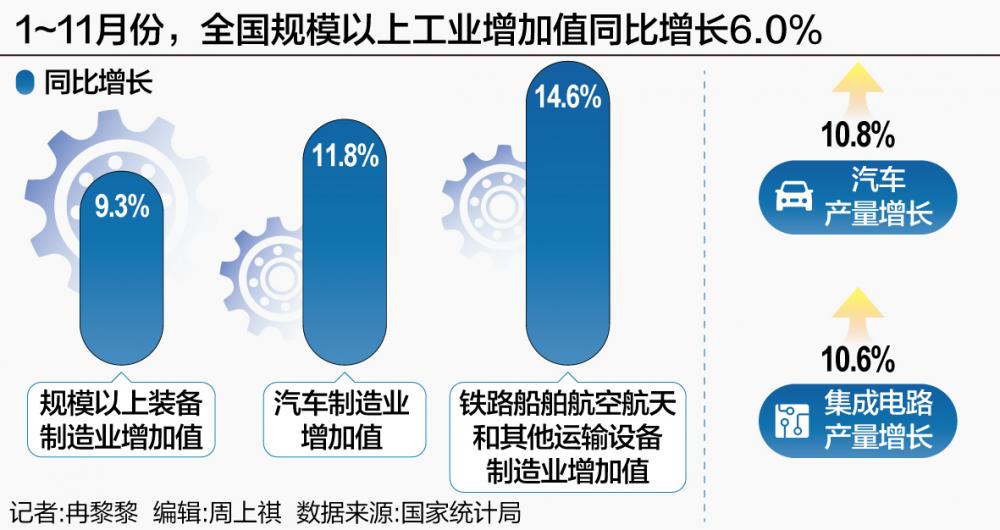
Core Viewpoint - In November, the industrial added value of enterprises above designated size in China experienced a year-on-year real growth of 4.8%, indicating a stable industrial production environment and ongoing industrial upgrading supported by new policies [1][2][5]. Group 1: Industrial Performance - The industrial added value increased by 0.44% month-on-month in November, with a cumulative year-on-year growth of 6.0% from January to November [5][9]. - The mining industry saw a year-on-year growth of 6.3%, manufacturing grew by 4.6%, and the electricity, heat, gas, and water production and supply industry increased by 4.3% in November [5][6]. - The growth rate of industrial added value in November decreased by 0.1 percentage points compared to October, while the month-on-month growth rate accelerated by 0.27 percentage points [6][9]. Group 2: High-tech and Equipment Manufacturing - The high-end development of the industrial sector is evident, with the added value of equipment manufacturing and high-tech manufacturing growing by 7.7% and 8.4% year-on-year, respectively [6][7]. - The cumulative added value of equipment manufacturing accounted for 36.4% and high-tech manufacturing for 16.9% of the total industrial added value [6][7]. - Notable product growth includes 3D printing equipment, industrial robots, and new energy vehicles, with year-on-year increases of 100.5%, 20.6%, and 17.0%, respectively [8]. Group 3: Market Demand and Policy Impact - Policies such as "two highs" and "two new" have effectively stimulated market demand, leading to increased production and supporting industrial growth [2][7]. - In the first eleven months, the added value of equipment manufacturing grew by 9.3%, while high-tech manufacturing increased by 9.2%, indicating strong demand in these sectors [7][9]. - The overall industrial production remains stable, with ongoing optimization and upgrading of industries, contributing to economic stability [2][9].

国民经济延续稳中有进发展态势(锐财经)
Ren Min Ri Bao Hai Wai Ban· 2025-12-15 22:51
Core Viewpoint - The macroeconomic policies in China have shown positive effects, leading to stable economic growth and expansion in various sectors, including production, market sales, and foreign trade [2][5]. Economic Performance - In November, industrial production maintained steady growth, with the industrial added value of large-scale enterprises increasing by 4.8% year-on-year, remaining consistent with the previous month [3]. - The equipment manufacturing sector experienced significant growth, with its added value rising by 7.7%, contributing 59.4% to the overall industrial growth [3]. - Retail sales of consumer goods increased by 1.3% year-on-year, with notable growth in cosmetics (6.1%) and gold and jewelry (8.5%) [3]. Employment and Prices - The urban unemployment rate remained stable at 5.1% in November, unchanged from the previous month [4]. - Consumer prices rose by 0.7% year-on-year, with a 0.5 percentage point increase from the previous month, marking three consecutive months of price recovery [4]. Policy Support - The implementation of proactive macroeconomic policies has played a crucial role in supporting stable economic operations [5]. - Policies aimed at promoting consumption and investment have been effective, with significant increases in retail sales of home appliances (14.8%), cultural office supplies (18.2%), and communication equipment (20.9%) from January to November [6]. Investment and Production - Equipment investment grew by 12.2% year-on-year from January to November, contributing 1.8 percentage points to overall investment growth [6]. - The added value of large-scale equipment manufacturing increased by 9.3%, accounting for 36.4% of total industrial output [6]. Business Performance - From January to October, the revenue of large-scale industrial enterprises increased by 1.8%, while profits rose by 1.9%, marking three consecutive months of growth [7]. - In the service sector, revenue increased by 7.6% and profits by 7.8% during the same period [7]. Outlook for Economic Goals - The data from the first eleven months indicates favorable conditions for achieving the annual economic growth target, supported by expanding market demand and effective macro policies [8]. - The ongoing implementation of policies related to "two new" and "two heavy" constructions is expected to further stimulate demand and production [9].
“实现全年预期目标有较好条件”(权威发布)
Ren Min Ri Bao· 2025-12-15 22:12
Core Viewpoint - The macroeconomic policies in November have shown positive effects, with a focus on strengthening domestic circulation, leading to stable economic growth and a favorable environment for achieving annual targets [1] Economic Performance - Industrial production maintained steady growth, with the industrial added value of large-scale enterprises increasing by 4.8% year-on-year in November, remaining stable compared to the previous month [2] - The service sector also saw growth, with a production index increase of 4.2%, particularly in information transmission and business services, which grew by 12.9% and 8.4% respectively [2] - Retail sales of consumer goods rose by 1.3% year-on-year in November, with service retail sales increasing by 5.4% from January to November, indicating a slight acceleration in growth [2] - Foreign trade showed resilience, with total goods imports and exports increasing by 4.1% year-on-year in November, a significant acceleration compared to the previous month [2] Employment and Prices - The urban unemployment rate remained stable at 5.1% in November, while consumer prices rose by 0.7% year-on-year, marking three consecutive months of increase [2] Energy Supply and Investment - Energy supply has been strengthened to meet winter demands, with industrial crude oil, natural gas, and electricity production increasing by 2.2%, 5.7%, and 2.7% respectively in November [3] - Investment in accommodation, catering, wholesale, and retail sectors grew by 7.1% each, and electricity and heat production and supply saw a 12.5% increase [3] New Production Capacity and Industrial Upgrades - The development of new productive forces has accelerated, with high-tech manufacturing value added increasing by 9.2% from January to November, and smart consumer equipment manufacturing growing by 7.6% [4] - Traditional industries are undergoing transformation, with biomass fuel processing value added rising by 15.6%, contributing to the growth of the petroleum processing industry [4] - The digital economy is also on the rise, with the value added of large-scale digital product manufacturing increasing by 9.3% [4] Consumption and Investment Potential - Consumption potential continues to be released, with retail sales of cultural and office supplies and communication equipment growing by 11.7% and 20.6% respectively in November [7] - Online retail sales of physical goods increased by 5.7%, accounting for 25.9% of total retail sales, indicating a shift towards new consumption models [7] - Fixed asset investment (excluding rural households) decreased by 2.6% year-on-year, but project investment excluding real estate development grew by 0.8% [7] - Investment potential remains significant, with ongoing measures to promote investment growth in various sectors, including education, healthcare, and public services [8]
国家统计局最新数据显示 11月经济延续稳中有进态势
Zhong Guo Zheng Quan Bao· 2025-12-15 21:01
国家统计局新闻发言人付凌晖在同日举行的新闻发布会上表示,11月份国民经济运行总体平稳,延续稳 中有进发展态势。从全年情况看,我国经济韧性强,宏观政策支持有力,新动能稳步成长,实现全年预 期目标有较好条件。 12月15日,我国11月份主要经济指标出炉。国家统计局数据显示,11月份,全国规模以上工业增加值同 比增长4.8%,社会消费品零售总额43898亿元,同比增长1.3%。 新型消费稳步成长 付凌晖表示,发展新动能持续壮大。科技创新和产业创新深入融合,新质生产力培育壮大,新业态新模 式快速发展,为经济发展注入新的活力和动力。 新兴领域投资增势较好。数据显示,我国制造业升级稳步发展,装备制造业较快发展,部分行业投资保 持增长。1-11月份,通用设备制造业投资同比增长8.9%。 新型消费稳步成长,引领作用日益显现。付凌晖表示,即时零售、直播电商等消费新模式快速成长,线 上消费、新兴消费发展向好。1-11月份,实物商品网上零售额同比增长5.7%,增速快于社会消费品零售 总额1.7个百分点,占社会消费品零售总额的比重达到25.9%。数字消费、绿色消费、健康消费日益成为 消费新热点,对消费的引领和支撑作用日益显现。1-1 ...
11月经济延续稳中有进态势
Zhong Guo Zheng Quan Bao· 2025-12-15 20:19
Economic Performance Overview - In November, China's industrial added value above designated size grew by 4.8% year-on-year, while the total retail sales of consumer goods reached 43,898 billion yuan, marking a 1.3% increase year-on-year [1][2] - The overall economic operation in November was stable, continuing a trend of steady progress, supported by strong macro policies and the growth of new economic drivers [1][4] Industrial Production and Supply - Industrial production remained stable, with the equipment manufacturing sector experiencing a significant increase of 7.7% year-on-year, contributing 59.4% to the growth of industrial added value [1][2] - The service sector also showed steady growth, with the service production index increasing by 4.2% year-on-year in November [1] Consumer Market Trends - Retail sales of consumer goods increased by 1.3% year-on-year, with notable growth in cosmetics (6.1%) and gold and silver jewelry (8.5%) [2] - The retail sales of services grew by 5.4% year-on-year from January to November, indicating a slight acceleration compared to the previous period [2] New Consumption Patterns - New consumption models such as instant retail and live-streaming e-commerce are rapidly growing, with online retail sales of physical goods increasing by 5.7% year-on-year, accounting for 25.9% of total retail sales [3] - Emerging consumption trends in digital, green, and health sectors are becoming significant drivers of consumer behavior [3] Investment in Emerging Industries - Investment in high-tech manufacturing industries showed robust growth, with a year-on-year increase of 9.2% in added value for high-tech manufacturing from January to November [3] - The production of industrial robots and control systems saw substantial increases of 29.2% and 87.6% year-on-year, respectively [3] Economic Outlook - Despite challenges, the resilience of the economy, strong macro policy support, and the steady growth of new economic drivers provide favorable conditions for achieving annual economic targets [4][5] - International organizations have raised their growth forecasts for China's economy, reflecting confidence in its development [4]
培育新质生产力取得积极成效
Sou Hu Cai Jing· 2025-12-15 19:48
Economic Performance - In November, the industrial production maintained stable growth, with the added value of large-scale industrial enterprises increasing by 4.8% year-on-year, consistent with the previous month [1] - The equipment manufacturing industry, driven by industrial upgrading, saw a significant increase in added value by 7.7%, contributing 59.4% to the overall industrial growth [1] - The service production index grew by 4.2% year-on-year, indicating a positive trend in the service sector [1] Market Sales and Trade - Social retail sales increased by 1.3% year-on-year in November, with cosmetics and gold and silver jewelry retail sales growing by 6.1% and 8.5% respectively [1] - The total value of goods imports and exports rose by 4.1% year-on-year, with exports increasing by 5.7%, marking a turnaround from the previous month's decline [1] Employment and Prices - The urban unemployment rate remained stable at 5.1%, unchanged from the previous month [2] - Consumer prices rose by 0.7% year-on-year, with the core CPI (excluding food and energy) stable at a 1.2% increase [2] Future Industry Development - High-tech manufacturing added value grew by 9.2% from January to November, with smart consumer equipment manufacturing increasing by 7.6% [2] - The production of industrial robots and control computers surged by 29.2% and 87.6% respectively, indicating strong growth in advanced manufacturing [2][3] Digital Economy and Green Industry - Online retail sales increased by 9.1% year-on-year, reflecting the expansion of digital consumption [3] - The production of new energy vehicles and lithium-ion batteries for vehicles grew by 26.5% and 42.2% respectively, showcasing rapid growth in the green industry [3] International Confidence - Major international organizations have raised their growth forecasts for the Chinese economy, indicating increased international confidence [4] - Despite challenges, the resilience of the Chinese economy and supportive macro policies are expected to help achieve annual growth targets [4]