
智能家电

Search documents
中国有充足信心实现今年经济增长目标——经济航船稳健前行
Xin Hua Wang· 2025-08-12 06:04
Economic Overview - China's economy is facing complex international challenges, including a slowing global recovery and rising trade protectionism, but overall economic operation remains stable with positive developments [1] - The government has implemented a series of macroeconomic policies to boost market confidence and stimulate economic growth [1] Consumer and Investment Trends - The consumer market shows vitality, with significant growth in consumption and investment; retail sales increased by 3.5% year-on-year from January to October, while fixed asset investment grew by 3.4% [4] - The winter sports sector is experiencing a boom, with over 385 million people expected to participate in ice and snow leisure tourism during the 2023-2024 season [3] - New energy vehicles (NEVs) have seen substantial growth, with production and sales reaching 9.779 million and 9.75 million units respectively, marking a year-on-year increase of 33% and 33.9% [3] Industrial Development - The industrial sector is showing robust growth, with the added value of industrial enterprises above designated size increasing by 5.8% year-on-year from January to October [4] - High-tech manufacturing is accelerating, with a 9.4% year-on-year increase in high-tech manufacturing value added in October [6] Policy Impact and Market Confidence - The government's "combination punch" of policies has led to increased market activity, with new housing transactions rising by 3.9% year-on-year in October, marking the first increase after eight months of decline [7] - Financial institutions are optimistic about China's economic policies, with many raising their growth forecasts for 2024 [7] Future Outlook - The long-term positive trend of China's economy remains unchanged, supported by favorable conditions in development dynamics, market space, and policy backing [8] - The government is committed to implementing significant reforms to ensure sustained economic recovery and maintain its role as a key driver of global economic growth [9]
做大国际朋友圈 耕好开放试验田 建设上合示范区 青岛以开放主动赢得发展主动
Ren Min Ri Bao· 2025-08-12 02:16
Group 1 - AstraZeneca has made continuous investments in Qingdao, Shandong for three consecutive years, with a new production base expected to be operational by the end of 2028 [1] - Germany's Almayer Group has also increased its investment for the fourth time, establishing a new calcined alumina plant in Qingdao, indicating strong foreign interest in the region [1] - The Chinese government emphasizes the importance of high-level opening up and reform, aiming to create new opportunities for economic development in Qingdao [1] Group 2 - The China-Europe Railway Express from Qingdao reaches Europe in just 17 days, while truck transport to Moscow takes only 7 days, showcasing the efficiency of logistics in the region [2] - Qingdao has established a comprehensive logistics network, connecting over 700 ports in more than 180 countries and regions, with 32 regular China-Europe Railway routes linking 54 cities in 23 countries [2] - The city is actively expanding its international logistics channels to enhance trade and industry integration, indicating significant growth potential [2] Group 3 - Qingdao's Free Trade Zone has implemented a "white list" system for medicinal and food products, significantly reducing transaction costs for businesses by 50% [3] - Over 60 companies in the medicinal and food sector have settled in the Qingdao Free Trade Zone, creating a multi-industry chain that includes import, processing, and cross-border trade [3] - Recent reforms have eliminated restrictions on trade volume for small and medium enterprises, allowing more businesses to benefit from the new policies [3] Group 4 - The establishment of the China-Shanghai Cooperation Organization Local Economic and Trade Cooperation Demonstration Zone in Qingdao aims to enhance industrial internet services and support for smart home appliance industries [4] - The Haier Group's industrial internet ecosystem has seen a significant increase in orders, reflecting the success of the new industrial model [4] Group 5 - Qingdao is enhancing its policy framework to improve information sharing, logistics connectivity, and project collaboration among Shanghai Cooperation Organization member states [5] - The Shandong government has proposed 23 support measures across four areas to accelerate the development of the Shanghai Cooperation Organization Demonstration Zone [6] - Continuous efforts are being made to promote higher levels of opening up and to inject new momentum into regional cooperation [6]


奋勇争先,决战决胜“十四五”|青岛以开放主动赢得发展主动
Ren Min Ri Bao· 2025-08-12 01:45
Group 1 - AstraZeneca has made additional investments in Qingdao, Shandong for three consecutive years, with a new production base expected to be operational by the end of 2028 [1] - Germany's Almayer Group has also increased its investment for the fourth time, establishing a new calcined alumina plant in Qingdao, indicating strong foreign interest in the region [1] - The Chinese government emphasizes the importance of high-level opening up and reform, aiming to create new opportunities for economic development in Qingdao [1] Group 2 - The China-Europe Railway Express from Qingdao reaches Europe in just 17 days, while truck transport to Moscow takes only 7 days, showcasing the efficiency of logistics in the region [2] - Qingdao Port connects over 700 ports in more than 180 countries and regions, with regular shipping routes and a well-established international airport, enhancing its global trade capabilities [2] - The city is actively expanding its international logistics channels to support and integrate into the new development pattern, increasing its growth potential and dynamism [2] Group 3 - Qingdao's Free Trade Zone has implemented a "white list" system for medicinal and food products, significantly simplifying customs procedures and reducing transaction costs by 50% for related enterprises [3] - Over 60 companies in the medicinal and food sector have established operations in the Qingdao Free Trade Zone, creating a multi-industry chain that includes import, processing, and cross-border trade [3] - Recent reforms have eliminated restrictions on trade volume for small and medium-sized enterprises, allowing more businesses to benefit from the new trade facilitation measures [3] Group 4 - The establishment of the China-Shanghai Cooperation Organization Local Economic and Trade Cooperation Demonstration Zone in Qingdao aims to enhance industrial internet services and support for smart home appliance industries [4] - The Haier Group's industrial internet ecosystem has seen a significant increase in overall order volume, reflecting the growing demand for smart appliances [4] Group 5 - The Qingdao municipal government is focused on improving policy frameworks to enhance information sharing, logistics connectivity, and project collaboration among SCO member states [5] - In April, Shandong proposed 23 support measures across four areas to accelerate the development of the SCO demonstration zone, aiming for higher levels of openness and quality development [6]
做大国际朋友圈耕好开放试验田建设上合示范区 青岛以开放主动赢得发展主动(奋勇争先,决战决胜“十四五”)
Ren Min Ri Bao· 2025-08-11 22:24
Group 1 - AstraZeneca has made continuous investments in Qingdao, Shandong for three consecutive years, with a new production base expected to be operational by the end of 2028 [1] - Germany's Almayer Group has also increased its investment for the fourth time, establishing a new calcined alumina plant in Qingdao, indicating strong foreign interest in the region [1] - The Chinese government emphasizes the importance of high-level opening up and reform, aiming to create new opportunities for economic development in Qingdao [1] Group 2 - The China-Europe Railway Express from Qingdao reaches Europe in just 17 days, while truck transport to Moscow takes only 7 days, showcasing the efficiency of logistics in the region [2] - Qingdao has established a comprehensive logistics network, connecting over 700 ports in more than 180 countries and regions, with 32 regular China-Europe Railway routes linking 54 cities in 23 countries [2] - The city is actively expanding its international logistics channels to enhance trade and industry integration, indicating significant growth potential [2] Group 3 - Qingdao's Free Trade Zone has implemented a "white list" system for medicinal and food products, significantly reducing transaction costs by 50% for related enterprises [3] - Over 60 companies in the medicinal and food sector have settled in the Qingdao Free Trade Zone, creating a multi-industry chain that includes import, processing, and cross-border trade [3] - Recent reforms have eliminated restrictions on trade enterprises, allowing more small and medium-sized businesses to benefit from the new policies [3] Group 4 - The establishment of the China-Shanghai Cooperation Organization Local Economic and Trade Cooperation Demonstration Zone in Qingdao aims to enhance industrial internet services and support for smart home appliance industries [4] - The Haier Group's industrial internet ecosystem has seen a significant increase in overall order volume, reflecting the success of the initiative [4] Group 5 - Qingdao is enhancing its policy framework to improve information sharing, logistics connectivity, and project collaboration among Shanghai Cooperation Organization member states [5] - The Shandong government has proposed 23 support measures across four areas to accelerate the development of the Shanghai Cooperation Organization Demonstration Zone [6] - The local government is committed to advancing higher levels of openness and fostering high-quality development to inject new momentum into regional cooperation [6]
青岛以开放主动赢得发展主动(奋勇争先,决战决胜“十四五”)
Ren Min Ri Bao· 2025-08-11 22:01
扩大制度型开放,耕好开放试验田—— 英国阿斯利康公司连续3年在山东青岛追加投资,新生产基地预计2028年底投产;深耕青岛27年的德国 安迈铝业集团第四次增资,新建煅烧氧化铝工厂……跨国公司用行动证明,世界看好中国,看好青岛。 2024年5月,习近平总书记在山东考察时强调:"打造高水平对外开放新高地""要在进一步全面深化改 革、推进高水平对外开放上勇争先"。 深入贯彻落实习近平总书记重要指示精神,青岛着力实施更大范围、更宽领域、更深层次的开放,以对 外开放的主动赢得经济发展的主动,奋力打开改革发展新天地。 畅通物流大通道,做大国际朋友圈—— 从青岛驶出的中欧班列抵达欧洲腹地,仅需17天;货车经国际公路运输系统到俄罗斯莫斯科,仅需7 天……高质量共建"一带一路"为青岛带来了更多机遇。 "今年以来,我们抢抓中欧班列(济青)国家集结中心建设机遇,创新推出'仓、运、贸'一体化运营模 式,推动形成以物流促贸易、以贸易带产业的良性循环。"山东高速齐鲁号欧亚班列运营有限公司总经 理助理满坤说。 在青岛,开放的大门越开越大。青岛港连接180多个国家和地区的700多个港口;青岛胶东国际机场客运 航线可通达128个国内外城市;中欧 ...
“青岛制造”行 消费韧性强
Zheng Quan Shi Bao· 2025-08-08 18:02
Group 1 - The resilience of Qingdao's consumption market is supported by a solid manufacturing base, transitioning from a "internet celebrity" city to a "long-lasting" city due to continuous industrial upgrades [1] - The industrial cluster represented by the "Five Golden Flowers" has evolved, with the home appliance and electronics industry achieving an annual output value exceeding 400 billion yuan, and the rail transit equipment industry accounting for 50% of the national high-speed train production [1] - Qingdao Beer has transformed into a "sustainable lighthouse factory," utilizing digital transformation for flexible production, allowing consumers to customize beer with unique designs, and ensuring 24-hour cold chain delivery nationwide [1] Group 2 - Emerging industries are injecting new momentum into consumption, with companies like GoerTek and Bird's Eye leading in virtual reality, and AstraZeneca's inhaler base and Haier's health industry park under construction in the biomedicine sector [2] - Qingdao is building a "10+1" industrial system, focusing on new generation information technology and artificial intelligence as leading industries, while also nurturing emerging sectors like life health and smart connected new energy vehicles [2] - Over 80 listed companies are located in Qingdao, with more than 60 domestic listings, making it the top in the province and third among northern cities, with nearly 40% of these companies related to consumption [2]
产业破局,需求涌动:长三角第四城合肥的消费与住房活力密码
Cai Jing Wang· 2025-08-08 12:36
Economic Growth and Development - Hefei's GDP reached 6514.7 billion yuan in the first half of the year, with a year-on-year growth of 6% [2] - From 2000 to 2024, Hefei's GDP increased from 32.5 billion yuan to 13507.7 billion yuan, ranking among the top 20 cities in China [2] - In 2024, Hefei's GDP growth rate of 6.1% was the highest among cities with a trillion GDP [2] Population Dynamics - Hefei has experienced a continuous net inflow of population, with an increase of approximately 632,000 residents since 2020, reaching a total of 10 million by the end of 2024 [2] - The urbanization rate in Hefei stands at 86.38%, reflecting a growth of 0.83 percentage points [8] Industrial Development - Hefei has established a "6+5+X" industrial cluster strategy, focusing on six leading industries and five pioneering industries, along with several frontier technology directions [5][6] - The six leading industries include new energy vehicles, next-generation information technology, advanced photovoltaics, biomedicine, smart home appliances, and high-end equipment [5] - In 2024, the output value of strategic emerging industries in Hefei grew by 12.6%, marking a new high in 24 months [4] Employment and Talent Attraction - The chip industry in Hefei employed 32,000 people by the end of 2023, while the new energy vehicle sector employed over 150,000, including more than 40,000 in R&D [8] - The continuous growth in population and employment has led to increased consumer demand, with retail sales in Hefei reaching 2783.25 billion yuan, growing by 4.8% year-on-year [8][10] Real Estate Market - Hefei's real estate investment has accelerated, with a year-on-year growth of 6.4% in real estate development investment in the first half of 2025 [10] - The average transaction price for residential land in Hefei reached 1,106.29 million yuan per mu, with significant growth in both transaction area and amount compared to the previous year [11] - Major state-owned enterprises dominate the land acquisition market, reflecting confidence in Hefei's real estate development prospects [11][12]
大行评级丨大和:降小米(1810.HK)目标价至72港元,Q2智能手机出货量及毛利率或低于预期
Sou Hu Cai Jing· 2025-08-07 03:41
大和发表报告,预计小米-W(1810.HK)2025年第二季度智能手机出货量略低于先前预测,主要受印度市 场同比下降25%的拖累。尽管小米全球市场份额在2025年第二季度达到15%的历史新高,但这以毛利率 下降为代价。该行预测小米2025年第二季度总收入为1126亿元人民币,略低于市场预期;调整后净利润 为102亿元人民币,符合市场预期。同时,该行下调2025年下半年IoT收入预测,以反映国家补贴政策的 调整。 受618购物节强劲表现推动(总商品交易额达355亿元人民币,同比增长35%),大和维持小米2025年第二 季度IoT收入预测为361亿元人民币,相当于同比增长35%,毛利率为22.5%。然而,受国家补贴政策调 整导致去年高基数影响,该行下调2025年第三季度及第四季度收入增速预测5个百分点至25%及20%。 智能家电出货量增加亦推高物流成本。互联网服务收入预计维持93亿元人民币,毛利率77%。 受益于 SU7 Ultra交付,大和预计小米2025年第二季度电动车交付量达8.2万台,平均售价升至24.2万元人民 币,毛利率改善至25%,电动车业务亏损进一步收窄。YU7已于7月启动交付,二期工厂预计于9月 ...
海尔智家的年轻人购买率提升3%
Xin Lang Cai Jing· 2025-08-06 07:58
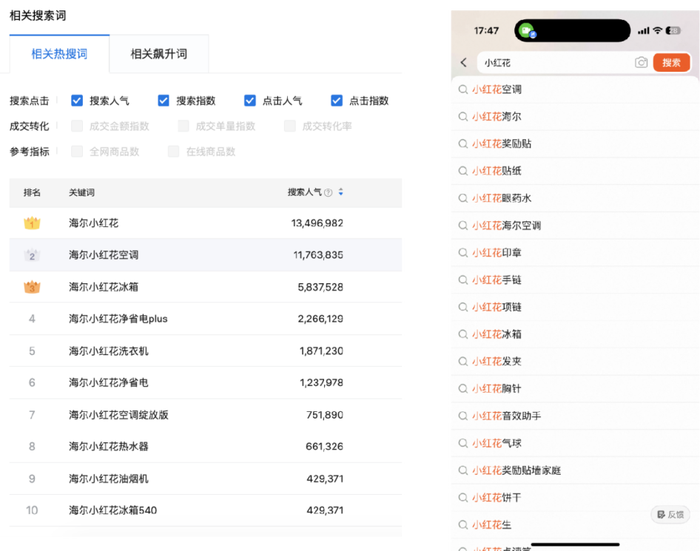
Core Insights - Haier is successfully attracting a younger consumer demographic, with a 3% increase in brand purchase rate among the 18-30 age group according to Kantar data for 2024 [1] - The launch of the "Little Red Flower" series has led to significant online engagement, achieving top rankings on platforms like Tmall and JD, and over 88 million views on Xiaohongshu [1][4] - Haier's strategy involves understanding and addressing the needs of younger consumers, balancing traditional brand strengths with modern demands [7] Product Innovation - The "Little Red Flower" series includes over ten product categories such as refrigerators, washing machines, and air conditioners, designed to meet the dual demands of convenience and sophistication for young consumers [4] - Innovative features include AI-driven smart management systems for food storage, automatic fabric care recognition in washing machines, and energy-efficient air conditioning that adapts to living environments [4][6] - The design philosophy emphasizes aesthetic appeal, utilizing a minimalist approach with a snow-white color scheme to integrate seamlessly into modern home decor [6] Market Positioning - Young consumers, particularly those born in the 1990s and Generation Z, represent 40% of the national consumption scale, making them a crucial target market for Haier [7] - Haier's engagement with younger audiences extends beyond products, as seen in collaborations like the "AI Home Manager" program, which tailors home solutions to diverse young lifestyles [7] - The brand's ability to merge traditional values of quality and service with contemporary consumer expectations positions Haier as a relevant player in the future market landscape [7]

两省GDP合计约占全国1/5,粤苏这样挑大梁
Zhong Guo Chan Ye Jing Ji Xin Xi Wang· 2025-08-05 23:32
Group 1: Economic Overview - Guangdong and Jiangsu provinces together account for approximately 20% of China's GDP, showcasing their significant economic roles [1] - Jiangsu's economy is characterized by balanced development across its cities, with all 13 prefecture-level cities ranking in the top 100 for GDP nationally [2] - In contrast, Guangdong's economy heavily relies on the core cities of the Pearl River Delta, maintaining a strong manufacturing ecosystem [4] Group 2: Jiangsu's Economic Performance - Jiangsu's industrial added value increased by 7.4% year-on-year, surpassing the national average by 1 percentage point, with all cities showing positive growth [3] - The province's social retail sales reached 23,949 billion yuan, growing by 5% year-on-year, driven by various consumption sectors [3] - Jiangsu's county-level economies are robust, with 24 counties in the national top 100, and 6 in the top 10, indicating strong local economic development [2] Group 3: Guangdong's Economic Strengths - Guangdong's manufacturing sector is comprehensive, with 31 manufacturing categories and leading positions in 15 industries, accounting for about 12.5% of the national manufacturing scale [4] - The province's new energy vehicle production is significant, with 1 in every 4 electric vehicles and 2 in every 5 smartphones produced in Guangdong [5] - Guangdong's foreign trade reached 4.55 trillion yuan, representing 20.9% of the national total, with a contribution rate of 28% to national trade growth [5][6] Group 4: Competitive Dynamics - The competition between Guangdong and Jiangsu reflects a balance of stability and growth in China's economy, with Guangdong achieving a growth rate of 4.2% and Jiangsu at 5.7% [7]