
调味品

Search documents
幺麻子北交所IPO获受理 2024年公司在中国藤椒油市场的占有率达到30%
Zheng Quan Shi Bao Wang· 2025-12-31 02:57
Core Viewpoint - Yao Mazi Food Co., Ltd. has received acceptance for its IPO on the Beijing Stock Exchange, indicating its growth and potential in the specialty seasoning market [1] Company Overview - Yao Mazi specializes in the research, production, and sales of unique seasoning products, primarily focusing on pepper oil and compound seasonings with a peppery flavor [1] - The company has established a product matrix centered around pepper oil, featuring compound seasonings and local specialty foods [1] Market Position - Yao Mazi is recognized as a pioneer in the domestic pepper oil seasoning category and is one of the largest manufacturers of pepper oil and peppery compound seasonings in China [1] - According to the China Food Industry Association, Yao Mazi is projected to achieve a 30% market share in the Chinese pepper oil market by 2024, maintaining its position as the top-ranked product in the seasoning industry for several consecutive years [1]
刘小涛在镇江调研时强调 坚持创新引领聚力产业强市 推动经济持续向新向优发展
Zhen Jiang Ri Bao· 2025-12-30 23:39
Group 1 - The provincial government emphasizes the importance of implementing the spirit of the 20th National Congress and the central economic work conference to strengthen the real economy and focus on industrial development [1] - Companies are encouraged to leverage their comparative advantages and develop characteristic industries through technological innovation to enhance competitiveness and sustainability [1] - The government supports leading enterprises in forming innovation alliances and promoting industrial clustering to accelerate the establishment of a modern industrial system centered on advanced manufacturing [1] Group 2 - The focus on agricultural modernization includes promoting new varieties, technologies, and models to enhance agricultural productivity and quality, ultimately benefiting farmers' income [2] - The government aims to improve rural living environments and develop new business models in agriculture, such as e-commerce and cultural tourism, to create new growth points [2] - The expansion and renovation of key waterway projects are intended to enhance economic circulation, reduce logistics costs, and optimize the business environment [2] Group 3 - The government is addressing safety concerns in residential areas by improving fire safety facilities and electric vehicle charging infrastructure to ensure residents' safety and comfort [3] - There is a push for safety production measures to be effectively implemented through education and training initiatives [3]

日辰股份年内多次分红
Guo Ji Jin Rong Bao· 2025-12-30 15:05
Core Viewpoint - The company has launched a series of initiatives under the "Quality Improvement and Efficiency Enhancement for Returns" action plan, aimed at optimizing capital efficiency and enhancing shareholder returns [1][2] Group 1: Dividend Distribution - The company plans to distribute a cash dividend of 0.3 yuan per share (tax included) to all shareholders as part of the profit distribution plan for the third quarter of 2025 [1] - Combined with the previously implemented dividend of 2 yuan for every 10 shares in the first half of 2025, the total cash dividend for the year is expected to be approximately 48.6 million yuan, accounting for 75.56% of the company's net profit for the first three quarters [1] Group 2: Project Completion and Financial Management - All four investment projects funded by the company's initial public offering in 2019 have been completed and officially closed, strengthening the company's core production capacity and R&D platform [1] - The funded projects have generated surplus funds of 38.26 million yuan (including interest and investment income), with 16.23 million yuan to be permanently added to working capital following regulatory procedures [1] Group 3: Strategic Planning and Investment - The board of directors has approved a systematic action plan focusing on core business development, investor returns, R&D innovation, investor relations, and corporate governance [2] - The company aims to strengthen its core business in compound seasonings and enhance investor returns through stable dividends and timely share buybacks [2] - Additionally, the company will increase its investment in its wholly-owned subsidiary, Richen Shanghai, by 17 million yuan to support its business expansion and operational funding needs [2]

累计10亿重金提振信心!中炬高新回购增持“组合拳”释放增长新周期底气
Cai Jing Wang· 2025-12-30 12:22
Core Viewpoint - The company Zhongju Gaoxin (600872.SH) announced a share buyback plan of 300 million to 600 million yuan to enhance shareholder value and investor confidence, following a significant increase in shareholding by its major shareholder, Torch Group, which invested approximately 400 million yuan [1][2]. Group 1: Share Buyback and Stake Increase - The buyback plan is seen as a strong recognition of the company's value, with a buyback price cap set at 26 yuan per share, allowing for substantial room compared to current market prices [2]. - The total investment in the buyback and shareholding increase by the major shareholder and the chairman amounts to approximately 1 billion yuan, demonstrating confidence in the company's future [1][2][3]. - Following the completion of the shareholding increase, Torch Group's ownership in Zhongju Gaoxin rose to 23.71% [2]. Group 2: Business Transformation and Strategy - The company is transitioning from "extensive expansion" to "high-quality growth," focusing on scientific and digital channel management to optimize inventory and pricing systems [4]. - A strategic partnership with Jiangnan University aims to enhance product development, driving the core business towards healthier and functional products, resulting in improved gross margins [4][5]. - The company is shifting its business model to empower the restaurant sector, providing tailored solutions to small and medium-sized restaurants, which is expected to become a new revenue growth driver [6]. Group 3: Brand Positioning and Market Strategy - Zhongju Gaoxin is actively reshaping its brand image to reflect "high-end, healthy, and professional" attributes, moving away from traditional perceptions of the seasoning industry [5]. - The company is implementing a diversified strategy that includes building product centers and pursuing strategic acquisitions to overcome growth bottlenecks [6]. - The management is committed to enhancing market share and achieving sustainable growth in enterprise value through a restructured supply chain and scaled growth in the restaurant channel [6].

今年十大最惨板块,跌麻了
3 6 Ke· 2025-12-30 12:11
Core Viewpoint - The consumer sector has faced significant challenges in the past year, with many industries within this sector experiencing declines despite overall market growth. The focus on domestic demand and consumption has not translated into positive performance for many consumer-related industries [1]. Group 1: Consumer Sector Performance - In the first half of the year, 10 out of 16 industries that saw declines were from the consumer sector, indicating a troubling trend for consumer-related stocks [1]. - The white liquor sector, a key component of the consumer market, has seen a year-to-date decline of 12.44%, with major brands like Wuliangye experiencing significant drops in revenue and profit [5][8]. - The professional chain sector has been particularly hard hit, with a year-to-date decline of 14.72%, as traditional retail models struggle to adapt to changing consumer behaviors [13][14]. Group 2: White Liquor Industry - The white liquor industry is facing its eighth consecutive year of production decline, with both volume and price dropping, leading to increased inventory pressure and cash flow issues for many companies [9]. - Wuliangye reported a 10.26% decline in revenue and a 13.72% drop in net profit for the first three quarters, marking its first negative growth in nearly a decade [8]. - The changing consumer landscape, with a shift towards lower-alcohol and healthier options, is forcing white liquor companies to adapt or risk further declines [12]. Group 3: Professional Chain Sector - The professional chain sector is experiencing a crisis, with many traditional stores closing and business models failing to adapt to the digital age [14][19]. - The decline of major players like Renrenle, which has seen its market value plummet and faced continuous losses, exemplifies the struggles within this sector [18]. - The shift towards online shopping and personalized consumer experiences is reshaping the retail landscape, leaving traditional large-format stores at a disadvantage [20]. Group 4: Non-White Liquor Sector - The non-white liquor sector, including beer and wine, has also faced challenges, with a year-to-date decline of 11.61% [22]. - Budweiser APAC reported an 8.2% drop in domestic sales and a 24.4% decline in net profit, reflecting broader issues within the beer industry [25]. - The rise of cross-industry competition, with liquor companies diversifying into other beverage categories, indicates a shift in market dynamics [27]. Group 5: Publishing Industry - The publishing industry has seen a decline in the overall market, with a 10.4% drop in the domestic paper book market, yet some companies have managed to increase profits through cost control [35][38]. - Chinese Media, a leading player in the sector, has faced significant revenue and profit declines, highlighting the challenges of adapting to changing educational policies [36][38]. Group 6: Seasoning Industry - The seasoning industry has experienced a 6.04% decline, with companies like Qianhe Flavor struggling due to a drop in sales across key product lines [43][47]. - The industry is facing increased competition and changing consumer preferences, necessitating a shift in strategy for many companies [52]. Group 7: Traditional Chinese Medicine - The traditional Chinese medicine sector has seen a 5.02% decline, with companies like Pian Zai Huang facing significant revenue and profit drops due to rising costs and regulatory pressures [53][56]. - The industry is undergoing a transformation as companies seek to innovate and diversify their product offerings in response to market challenges [62]. Group 8: Digital Media - The digital media sector has faced a 4.95% decline, with traditional advertising models struggling to keep pace with new digital trends [67]. - Companies like Mango TV have reported significant revenue declines, indicating the need for adaptation in a rapidly changing media landscape [66]. Group 9: Kitchen and Bathroom Appliances - The kitchen and bathroom appliance sector has seen a 4.11% decline, largely due to a slowdown in new housing demand and increased competition [69][70]. - Companies like Boss Appliances are experiencing revenue declines for the first time in years, reflecting broader industry challenges [69]. Group 10: White Goods - The white goods sector has faced a 2.02% decline, with major players like Gree Electric experiencing significant revenue and profit drops due to increased competition and market saturation [76][80]. - The industry is shifting towards a focus on product quality and operational efficiency as traditional growth drivers diminish [80]. Group 11: Hotel and Catering - The hotel and catering sector has seen a 1.37% decline, with many businesses struggling to convert increased travel demand into profits due to high commission fees from online platforms [84][85]. - The industry is witnessing a shift towards more refined operational models as companies seek to adapt to changing consumer behaviors and market conditions [86].

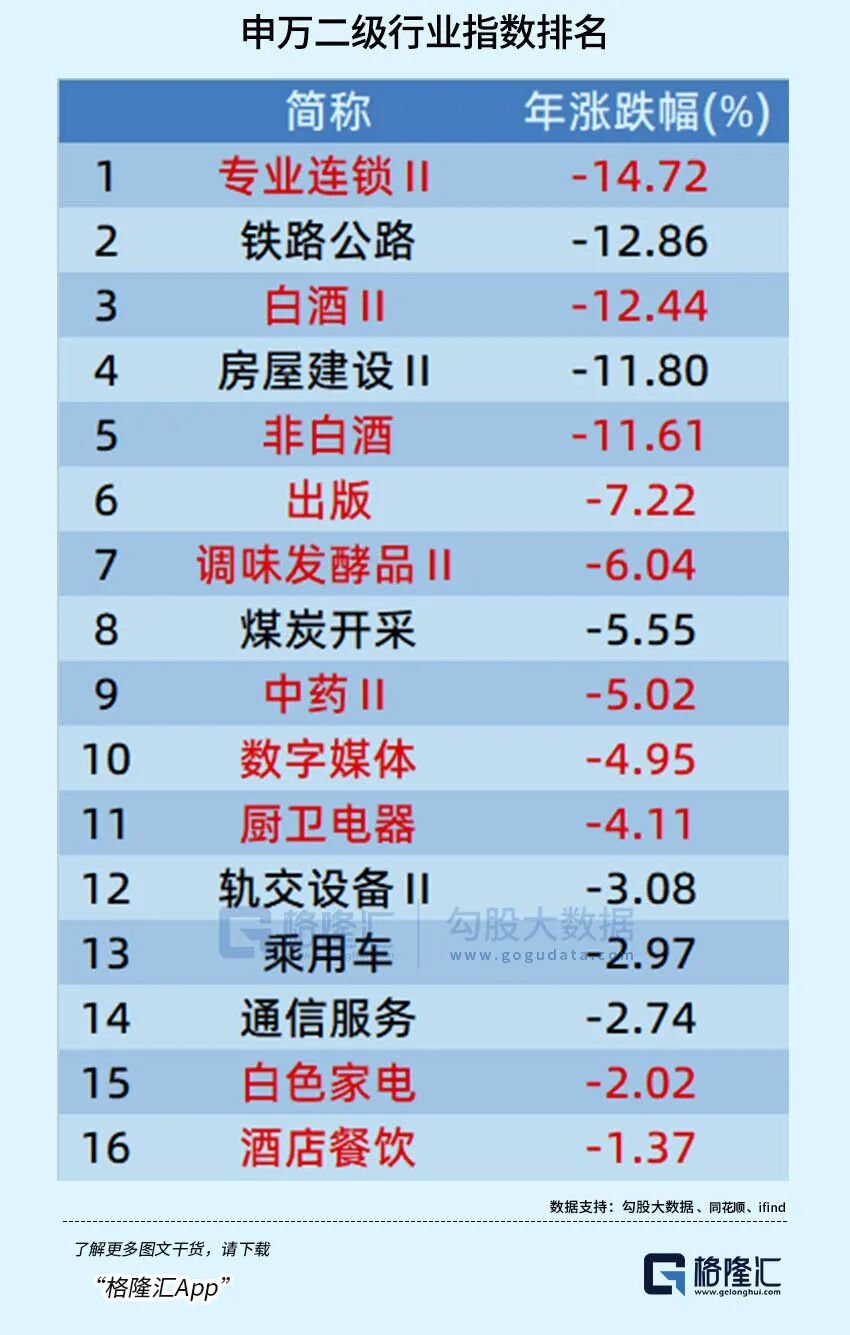
2025年A股十大最惨板块,跌麻了
Ge Long Hui· 2025-12-30 11:30
Core Viewpoint - The consumer sector has faced significant challenges in the past year, with many sub-sectors experiencing declines despite overall market growth. The focus on domestic demand and consumption has not translated into positive performance for many consumer-related industries [1][5]. Consumer Sector Performance - In the first half of the year, 10 out of 16 declining industries were from the consumer sector, indicating a broader trend of underperformance [1]. - The white liquor sector, a key component of the consumer market, has seen a year-to-date decline of 12.44%, with major brands like Wuliangye experiencing significant drops in revenue and profit [6][9]. - The professional chain sector has been particularly hard-hit, with a year-to-date decline of 14.72%, exemplified by the struggles of companies like Renrenle [16][20]. White Liquor Sector - The white liquor industry is facing its eighth consecutive year of production decline, with both volume and price dropping simultaneously [10]. - Wuliangye reported a 10.26% decline in revenue and a 13.72% drop in net profit for the first three quarters, marking its first negative growth in a decade [9]. - The industry is shifting from a growth-driven model to one focused on consumer choice, with a need for companies to adapt to changing consumer preferences [15]. Professional Chain Sector - The professional chain sector is experiencing a crisis, with many physical stores closing and traditional business models failing [16][20]. - Renrenle, once a leading private supermarket, has seen its market value plummet and is now facing delisting due to ongoing financial struggles [21][24]. - The shift towards online shopping and personalized consumer demands has further exacerbated the challenges faced by traditional retail chains [24][25]. Non-White Liquor Sector - The non-white liquor sector, including beer and wine, has also faced declines, with the beer segment seeing a notable drop in sales and profits [27][32]. - Budweiser APAC reported an 8.2% decline in domestic sales and a 24.4% drop in net profit, reflecting broader industry challenges [32][33]. - The market is witnessing a trend of cross-industry competition, with liquor companies diversifying into new beverage categories [34]. Publishing Sector - The publishing industry has shown resilience despite a 10.4% decline in the overall market for printed books, with listed companies managing to increase net profits by 14.65% [43][44]. - However, leading companies like Zhongwen Media are struggling, with significant revenue and profit declines due to changes in educational material procurement policies [45][48]. Seasoning Sector - The seasoning industry has faced a 6.04% decline, with companies like Qianhe Flavor struggling due to falling revenues and a loss of consumer trust [51][55]. - The industry is experiencing a shift in consumer preferences and increased competition, necessitating a reevaluation of business strategies [60]. Traditional Chinese Medicine Sector - The traditional Chinese medicine sector is facing challenges, with companies like Pian Zai Huang reporting significant declines in revenue and profit due to rising costs and regulatory pressures [61][66]. - The industry is undergoing a transformation as companies seek to innovate and diversify their product offerings [70]. Digital Media Sector - The digital media industry has seen a 4.95% decline, with companies like Mango TV reporting significant drops in revenue and profit due to changing consumer behaviors and market dynamics [71][74]. - The sector is grappling with the need to adapt to new content consumption trends while facing pressure from traditional advertising models [75]. Kitchen and Bathroom Appliances Sector - The kitchen and bathroom appliance sector has experienced a 4.11% decline, largely due to reduced demand from the real estate market [78][79]. - Companies like Boss Electric are facing revenue declines for the first time in years, highlighting the challenges of adapting to a changing market landscape [79][80]. White Goods Sector - The white goods sector has seen a 2.02% decline, with major players like Gree Electric facing significant revenue and profit pressures due to increased competition and market saturation [83][84]. - The industry is shifting towards a focus on product quality and brand strength as external stimuli diminish [88]. Hotel and Restaurant Sector - The hotel and restaurant sector has faced a 1.37% decline, with revenue pressures stemming from changing consumer spending habits and increased competition from online platforms [89][92]. - Companies are beginning to adopt more refined operational strategies to navigate the challenging market environment [96].




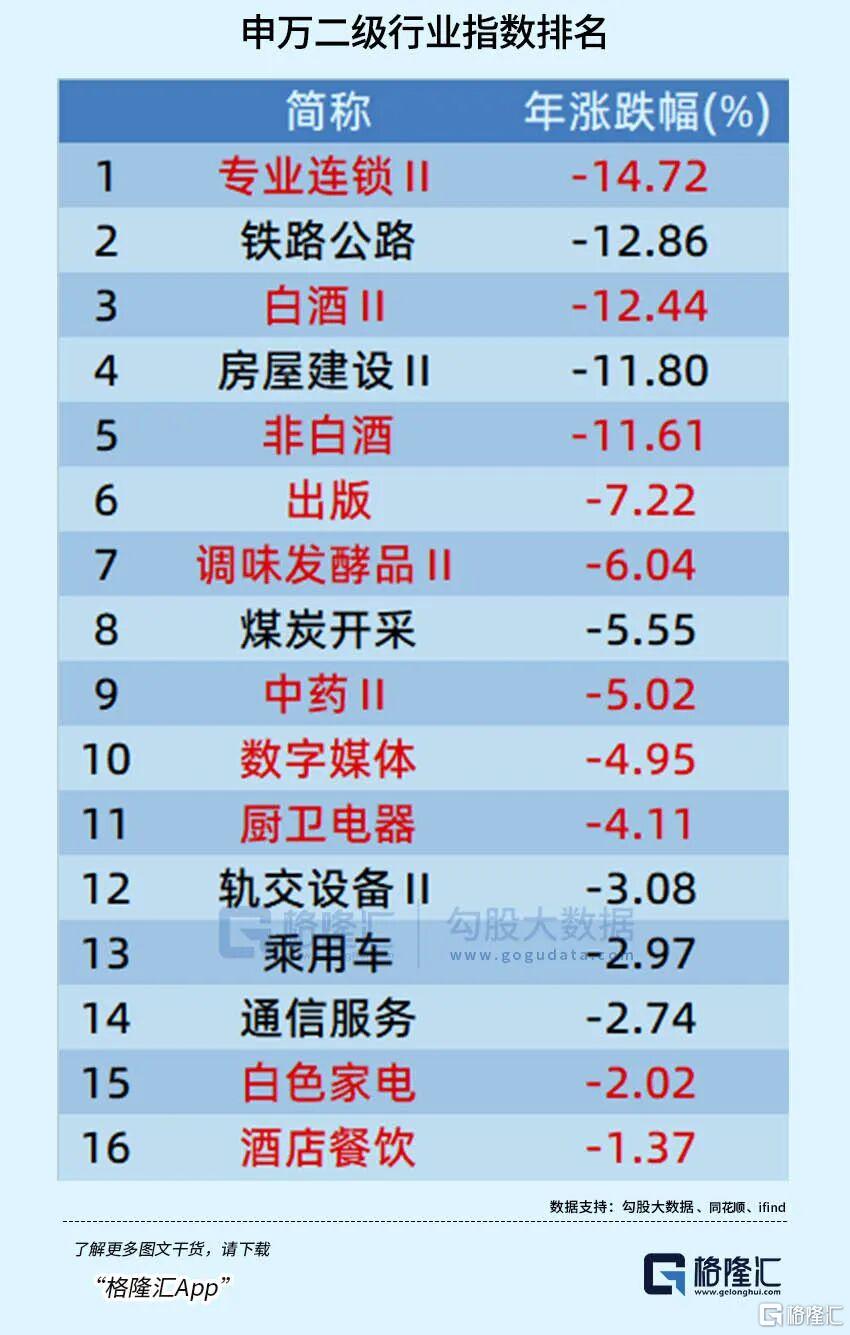
今年十大最惨板块,跌麻了
格隆汇APP· 2025-12-30 11:04
Core Viewpoint - The article discusses the significant downturn in various consumer sectors, particularly the liquor and retail industries, highlighting the challenges and potential opportunities for recovery amidst changing consumer behaviors and market dynamics [2][4][43]. Group 1: Liquor Industry - The liquor sector, especially the white liquor segment, has faced substantial declines, with the overall white liquor market down by 12.44% this year [9][15]. - Major brands like Wuliangye have reported significant drops in revenue and profit, with a 10.26% decline in revenue and a 13.72% drop in net profit for the first three quarters [17]. - The white liquor industry is experiencing a shift from a growth-driven model to one focused on consumer preferences, with a need for companies to adapt to changing consumption patterns [26][27]. Group 2: Retail Industry - The professional chain sector has seen a dramatic decline of 14.72%, with many traditional retail models struggling to survive [28][30]. - Companies like Renrenle have faced severe financial difficulties, leading to a significant reduction in store numbers and ultimately triggering delisting procedures [34][35]. - The shift towards online shopping and changing consumer preferences have forced traditional retailers to innovate or face extinction [36][39]. Group 3: Non-White Liquor Sector - The non-white liquor sector, including beer and wine, has also suffered, with a reported decline of 11.61% this year [40]. - Major players like Budweiser APAC have experienced significant sales drops, with a 9.5% revenue decrease and a 24.4% decline in net profit [46]. - The industry is witnessing a trend of cross-industry competition, with liquor companies diversifying into other beverage categories to adapt to market changes [51][56]. Group 4: Publishing Industry - The publishing sector has faced a 7.22% decline, with the overall market for printed books down by 10.40% [60]. - Despite the downturn, some publishing companies have managed to increase profits through cost control and operational efficiency, with a 14.65% rise in net profit for listed companies [61][62]. - The industry is undergoing significant transformation, moving from traditional sales models to more dynamic content management and IP development strategies [70][71]. Group 5: Seasoning Industry - The seasoning sector has seen a 6.04% decline, with companies like Qianhe Flavor struggling due to a drop in revenue and profit [74]. - The industry is facing challenges from both market saturation and changing consumer preferences, necessitating a shift in strategy for many companies [81]. Group 6: Traditional Chinese Medicine - The traditional Chinese medicine sector has experienced a 5.02% decline, with companies like Pian Zai Huang facing significant revenue and profit drops [86]. - The industry is under pressure from regulatory changes and increased competition, pushing companies to innovate and diversify their product offerings [91][92]. Group 7: Digital Media - The digital media sector has reported a 4.95% decline, with traditional advertising models struggling to adapt to new market realities [97][100]. - Companies like Mango TV have seen significant revenue drops, highlighting the challenges of maintaining profitability in a rapidly changing landscape [101][104]. Group 8: Kitchen and Bathroom Appliances - The kitchen and bathroom appliance sector has faced a 4.11% decline, with major players like Boss Electric experiencing revenue drops for the first time in years [112]. - The industry is grappling with reduced demand due to a slowdown in the real estate market, necessitating a shift towards innovation and international expansion [117][118]. Group 9: White Goods - The white goods sector has seen a 2.02% decline, with companies like Gree Electric facing significant challenges due to market saturation and increased competition [126][129]. - The industry is shifting towards a more rational consumer base that prioritizes product quality and brand reputation over traditional growth drivers [133]. Group 10: Hotel and Restaurant Industry - The hotel and restaurant sector has experienced a 1.37% decline, with many businesses struggling to convert increased tourism into profits [140][141]. - The industry is witnessing a shift towards more refined operational models, with companies focusing on member engagement and digital transformation to enhance profitability [142][143].





“酱油第一股”加加食品危机重重 董事长被独董发函催债
Sou Hu Cai Jing· 2025-12-30 09:32
"酱油第一股"加加食品(002650.SZ)遭遇"背刺"。12月29日晚间,公司公告称于近日收到独立董事督 促函,要求董事长及关联方立即向公司还款,涉及金额达6700余万元。 近年来,加加食品危机重重。不仅公司业绩下滑,核心代工厂因环保问题停产,家族化管理还让公 司"戴帽",创始人一家三口成为"老赖"。今年,就连公司控股股东也申请破产清算,未来发展仍有诸多 不确定性。 关联交易出现问题,独董发函催债 经确认,此次共造成约6724.68万元损失,损失由两家代工企业承担。作为代工企业关联方,加加食品 创始人、董事长杨振充当了话事人角色,他和两家代工企业承诺于2024年11月30日前支付上述资金,但 时至今日加加食品并未收到欠款。 天眼查App显示,杨振是加加食品第二大股东湖南卓越投资有限公司(下称"卓越投资")受益所有人, 两家代工企业背后也都有卓越投资的身影,为关联方。 同时,其中一家代工企业宁夏可可美生物工程有限公司还有价值5611.43万元的库存,目前部分已被拍 卖,加加食品丧失控制权,姚禄仕要求加强对这笔价值重要资产的管理。 公告透露,截至2025年6月30日,加加食品公司存放于关联方仓库的味精及原辅料等 ...

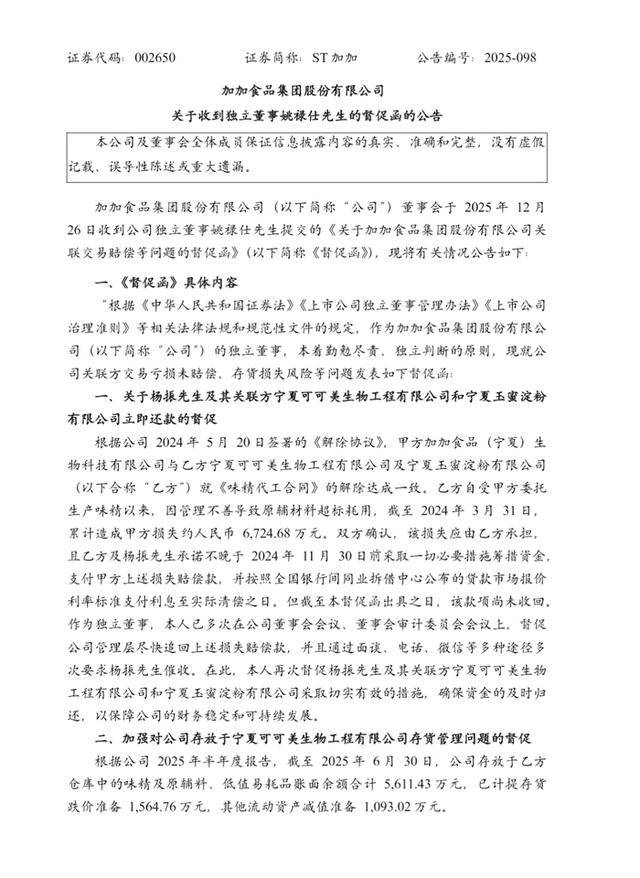
中国必选消费品12月成本报告:下游需求偏弱,成本小幅波动
Haitong Securities International· 2025-12-30 09:00
Investment Rating - The report assigns an "Outperform" rating to multiple companies in the essential consumer goods sector, including Guizhou Moutai, Wuliangye, and Yili [1]. Core Insights - Downstream demand remains subdued, with modest fluctuations in costs across various consumer goods categories [1][34]. - The cost indices for six monitored consumer goods showed mixed trends, with soft drinks and instant noodles experiencing increases, while condiments, dairy products, frozen foods, and beer saw declines [34]. Cost Index Summary Beer - The spot cost index for beer decreased by 1.05% month-on-month, while the futures index increased by 0.88%. Year-to-date, the spot index has declined by 3.84% and the futures index by 7.87% [4][35]. - Glass prices fell by 1.9% month-on-month and 18.0% year-on-year, while aluminum prices showed mixed trends [12][35]. Condiments - The spot cost index for condiments dropped by 0.29% month-on-month, and the futures index fell by 0.47%. Year-to-date, the spot index has decreased by 3.95% and the futures index by 9.74% [16][36]. - Soybean prices showed a slight decrease in spot prices but an increase in futures prices [16][36]. Dairy Products - The spot cost index for dairy products decreased by 0.45% month-on-month, while the futures index increased by 0.39%. Year-to-date, the spot index has declined by 2.92% and the futures index by 4.19% [19][37]. - Raw milk prices remained stable at 3.03 yuan/kg, with supply pressures emerging due to cash flow issues in dairy farming [19][37]. Instant Noodles - The spot cost index for instant noodles rose by 0.49% month-on-month, while the futures index fell by 0.51%. Year-to-date, the spot index has decreased by 0.77% and the futures index by 7.05% [23][38]. - Palm oil prices showed a decline, impacting overall costs [23][38]. Frozen Foods - The spot cost index for frozen foods dropped by 0.54% month-on-month, and the futures index fell by 1.13%. Year-to-date, the spot index has decreased by 0.65% and the futures index by 2.42% [27][39]. - Vegetable prices experienced a month-on-month decline but a year-on-year increase, influenced by weather conditions affecting supply [27][39]. Soft Drinks - The spot cost index for soft drinks increased by 1.06% month-on-month, and the futures index rose by 0.99%. Year-to-date, the spot index has increased by 0.42% while the futures index has decreased by 10.18% [30][40]. - PET chip prices rose month-on-month, contributing to the cost increase in soft drinks [30][40].


调味品板块走弱,安记食品触及跌停
2 1 Shi Ji Jing Ji Bao Dao· 2025-12-30 05:47
Group 1 - The condiment sector is experiencing a downturn, with Anji Food hitting the daily limit down [1] - Other companies such as Lianhua Holdings, Xiwang Food, Jialong Co., Sanyuan Biological, Huazi Industrial, and Baoli Food are also seeing declines [1]
