
金融业

Search documents
高盛维持理想汽车买入评级
Xin Lang Cai Jing· 2025-08-04 07:53
Group 1 - Goldman Sachs maintains a "Buy" rating for Li Auto-W with a target price of HKD 138, expecting monthly sales of 6,000 units for its new electric SUV i8 [1] - China Biologic Products is rated "Outperform" by CMBI, highlighting its strong innovation pipeline and growth in biosimilars and generics [1] - JPMorgan upgrades Hang Lung Properties to "Overweight" with a target price of HKD 10, citing attractive dividend yield and improved sales outlook [2] Group 2 - Citi maintains a "Outperform" rating for China Overseas Property but lowers the target price to HKD 6.1, focusing on service quality improvement [3] - UBS maintains a "Buy" rating for Ping An Insurance, raising the target price to HKD 66, driven by improved macro conditions and growth in asset management [4] - UBS maintains a "Buy" rating for GCL-Poly Energy with a target price of HKD 1.9, benefiting from supply cuts and strong product quality [5] Group 3 - Macquarie maintains a "Outperform" rating for Prada but lowers the target price to HKD 60, citing lower-than-expected sales growth [6] - Goldman Sachs maintains a "Neutral" rating for CATL, adjusting the target price to HKD 436 due to expected declines in battery gross margins [7] - Goldman Sachs maintains a "Buy" rating for Kuaishou-W with a target price of HKD 68, anticipating significant revenue growth in the AI sector [8] Group 4 - Morgan Stanley maintains an "Overweight" rating for HSBC, raising the target price to HKD 107.1 due to improved earnings forecasts [9]




218只港股获南向资金大比例持有
Zheng Quan Shi Bao Wang· 2025-08-04 01:35
Summary of Key Points Core Viewpoint - Southbound funds have become significant participants in the Hong Kong stock market, holding 18.32% of the total shares of Hong Kong Stock Connect stocks as of August 1, with a total market value of HKD 54,171.61 billion, representing 13.84% of the total market capitalization of these stocks [1]. Group 1: Southbound Fund Holdings - Southbound funds hold a total of 4,588.28 million shares in Hong Kong Stock Connect stocks, accounting for 18.32% of the total share capital [1]. - There are 218 stocks where southbound funds hold more than 20% of the total shares, while 142 stocks have a holding ratio between 10% and 20% [1]. - The stock with the highest southbound fund holding is China Telecom, with 103.78 million shares, representing 74.77% of its issued shares [2]. Group 2: Industry Concentration - The stocks with over 20% southbound fund holdings are primarily concentrated in the healthcare, industrial, and financial sectors, with 43, 33, and 32 stocks respectively [2]. - Among the stocks with high southbound fund holdings, 56.42% are AH concept stocks, indicating a preference for dual-listed companies [1]. Group 3: Detailed Stock Data - Key stocks with high southbound fund holdings include: - China Telecom (74.77% holding) [2] - Green Power Environmental (70.07% holding) [2] - China Shenhua (66.94% holding) [2] - Other notable stocks with significant holdings include Tianjin Chuangye Environmental Protection (64.60%), Kaisa New Energy (63.80%), and Fosun Pharma (62.58%) [2][3].

澳门经济发展稳中向好有底气
Ren Min Ri Bao· 2025-08-03 19:14
Economic Growth - Macau's GDP for Q2 2025 reached 100.38 billion MOP, showing a year-on-year growth of 5.1%, despite a 1.3% decline in Q1, resulting in a 1.8% growth for the first half of the year [1] - The tourism sector is a key driver of Macau's economic recovery, supported by various central government policies [2][3] Tourism Recovery - The number of inbound tourists to Macau exceeded 19.21 million in the first half of the year, marking a 14.9% increase year-on-year, with significant growth from Zhuhai (57.0%) and the Greater Bay Area [2] - The "Tourism+" initiative has diversified tourism offerings, attracting a younger and more family-oriented demographic [3] Cultural Integration - The successful application for UNESCO World Heritage status for Macau's historical district has enhanced cultural tourism, with events like the International Culinary City Carnival promoting local culture [4][5] - Various cultural events and festivals are continuously held, contributing to Macau's reputation as a "City of Events" and enhancing the tourism environment [6] Investment and Development - The development of the Hengqin Guangdong-Macau Deep Cooperation Zone is expected to attract more investment and talent, supporting Macau's economic diversification [7] - In the first five months of the year, the cooperation zone saw a 15.91% increase in VAT invoices, indicating strong growth in sectors like manufacturing and information services [7] Government Initiatives - The new government has outlined major projects aimed at long-term economic development, reinforcing confidence in Macau's stable growth trajectory [8]
布米普特拉北京投资基金管理有限公司:美国7月私营就业超预期增长10.4万
Sou Hu Cai Jing· 2025-08-01 10:47
Core Insights - The ADP report indicates that the U.S. private sector added 104,000 jobs in July, significantly exceeding market expectations of 76,000, marking the largest month-over-month increase since April [1][3] - Despite the positive July data, overall hiring remains below last year's average, highlighting an uneven recovery in the U.S. labor market [3][5] - The report reflects cautious attitudes among businesses amid economic uncertainty, with mixed signals regarding the strength of the labor market [5][6] Employment Data - The leisure and hospitality sector saw the most significant job growth, adding 46,000 positions, followed by the financial sector with an increase of 28,000 jobs [3] - Conversely, the education and healthcare services sector experienced job losses for the fourth consecutive month, shedding 38,000 positions [3][5] - The manufacturing sector added only 7,000 jobs, while construction grew by 15,000, indicating varied recovery rates across different industries [5] Wage Growth - Wage growth remained stable in July, with salaries for job switchers increasing by 7% year-over-year, while those remaining in their positions saw a 4.4% increase [3] - This trend suggests that despite a slowdown in hiring, competition in the labor market is still supporting wage levels [3] Economic Outlook - Economists express that the labor market's performance reflects businesses' cautiousness in the face of economic uncertainty, with July's rebound not fully alleviating concerns about potential economic slowdown [5][6] - The upcoming non-farm payroll report is anticipated to show an increase of about 100,000 jobs, with the unemployment rate possibly rising to 4.2% [5] - The strong ADP report may reduce the likelihood of interest rate cuts in the near term, as sustained wage growth above inflation could lead the Federal Reserve to maintain a cautious stance [6]



GDP连升十季 香港经济展现强劲韧性
Zheng Quan Shi Bao Wang· 2025-08-01 03:39
Economic Growth - Hong Kong's GDP is expected to achieve growth for ten consecutive quarters, with a year-on-year increase of 3.1% in Q2 2025, following a 3% rise in Q1 2025 [1][2] - The local economy has shown resilience, with a 2.5% GDP growth in 2024, continuing the upward trend from 2023 [1] External and Local Demand - Strong external demand has led to a significant increase in overall merchandise exports, which rose by 11.5% year-on-year, compared to an 8.4% increase in the previous quarter [2] - Private consumption expenditure has rebounded with a 1.9% year-on-year increase in Q2 2025, following four consecutive quarters of decline [2] Investment and Financial Services - Overall investment expenditure has increased, with local fixed capital formation rising by 2.9% year-on-year [2] - The Hong Kong stock market has seen a total market capitalization of HKD 42.7 trillion, a 33% year-on-year increase, and has completed 42 IPOs raising over HKD 107 billion, marking a 22% increase compared to the previous year [2] Retail Sector Performance - The retail sector has shown signs of stabilization, with total retail sales value in June estimated at HKD 30.1 billion, a 0.7% year-on-year increase [3] - Seasonal adjustments indicate a 0.3% increase in retail sales value from Q1 to Q2 2025, with a 2.7% rise in retail sales volume [3] Future Outlook - The confidence in Hong Kong's economy remains strong, supported by steady growth in the Asian and Chinese economies, along with government measures to boost consumption and attract investment [4] - The business environment in Hong Kong is solid, with new advantages emerging, as highlighted in the recent business environment report [5]
上半年深圳GDP增5.1% 进出口降幅收窄
Nan Fang Du Shi Bao· 2025-07-30 23:15
Economic Performance - Shenzhen's GDP for the first half of 2025 reached 18322.26 billion yuan, with a year-on-year growth of 5.1% [1] - The primary industry added value was 10.33 billion yuan, growing by 2.8%; the secondary industry added value was 6505.56 billion yuan, increasing by 3.3%; and the tertiary industry added value was 11806.37 billion yuan, rising by 6.1% [1] Industrial and Service Sector Growth - The city's industrial added value for large-scale enterprises grew by 4.3%, with manufacturing increasing by 4.2% and electricity, heat, gas, and water production and supply growing by 11.8% [2] - High-tech product output saw significant growth, with civil drones, industrial robots, and 3D printing equipment increasing by 59.0%, 38.0%, and 35.8% respectively [2] - The service sector's added value was 11806.37 billion yuan, with a year-on-year growth of 6.1%, driven by finance (10.9%), transportation and warehousing (9.0%), and information technology services (8.1%) [2] Investment Trends - Fixed asset investment in Shenzhen decreased by 10.9%, with real estate development down by 15.1% but infrastructure investment up by 7.7% and industrial technology renovation investment soaring by 47.1% [3] - Investment in information transmission, software, and IT services grew by 47.7%, while transportation and warehousing investment rose by 32.5% [3] Consumer Market Insights - The total retail sales of social consumer goods reached 4948.68 billion yuan, with a year-on-year growth of 3.5% [3] - Online retail sales through the internet increased by 19.4%, indicating a strong trend towards e-commerce [3] Trade and Financial Sector - The total import and export volume for the first half of the year was 21675.45 billion yuan, a decrease of 1.1%, with exports down by 7.0% and imports up by 9.5% [4] - By the end of June, the balance of deposits in financial institutions reached 141600.14 billion yuan, growing by 5.7% [4] Cross-Border E-commerce Development - The Google Cross-Border E-commerce Acceleration Center in Shenzhen officially commenced operations, enhancing the cross-border e-commerce ecosystem in the region [6] - The center aims to provide comprehensive services for cross-border e-commerce companies, supporting their global business expansion [6]
5.1%!深圳交出半年成绩单!
Zheng Quan Shi Bao· 2025-07-30 14:16
Economic Performance - Shenzhen's GDP for the first half of the year reached 1832.226 billion yuan, with a year-on-year growth of 5.1% [1] - The primary industry added value was 1.033 billion yuan, growing by 2.8%; the secondary industry added value was 650.556 billion yuan, growing by 3.3%; and the tertiary industry added value was 1180.637 billion yuan, growing by 6.1% [1] Industrial Growth - The industrial added value above designated size in Shenzhen increased by 4.3% year-on-year, with a slight acceleration of 0.1 percentage points compared to the first quarter [1] - Key sectors such as general equipment manufacturing grew by 17.1%, and high-tech product outputs like civilian drones and industrial robots saw significant increases of 59.0% and 38.0% respectively [1] Service Sector Development - The added value of the service industry reached 1180.637 billion yuan, with a year-on-year growth of 6.1%, also showing a 0.1 percentage point increase from the first quarter [2] - Specific sectors like finance, transportation, and information technology services grew by 10.9%, 9.0%, and 8.1% respectively [2] Consumer Market Trends - Total retail sales of consumer goods amounted to 494.868 billion yuan, with a year-on-year growth of 3.5% [2] - Online retail sales through designated units increased by 19.4%, indicating a strong trend towards e-commerce [2] Investment and Trade - Fixed asset investment in Shenzhen decreased by 10.9%, with real estate development investment down by 15.1% but infrastructure investment up by 7.7% [3] - The total import and export volume was 2167.545 billion yuan, a decline of 1.1%, with exports down by 7.0% and imports up by 9.5% [3] Future Outlook - Analysts suggest that Shenzhen should leverage its technological advantages to develop high-tech industries and enhance domestic demand to mitigate external pressures [3]
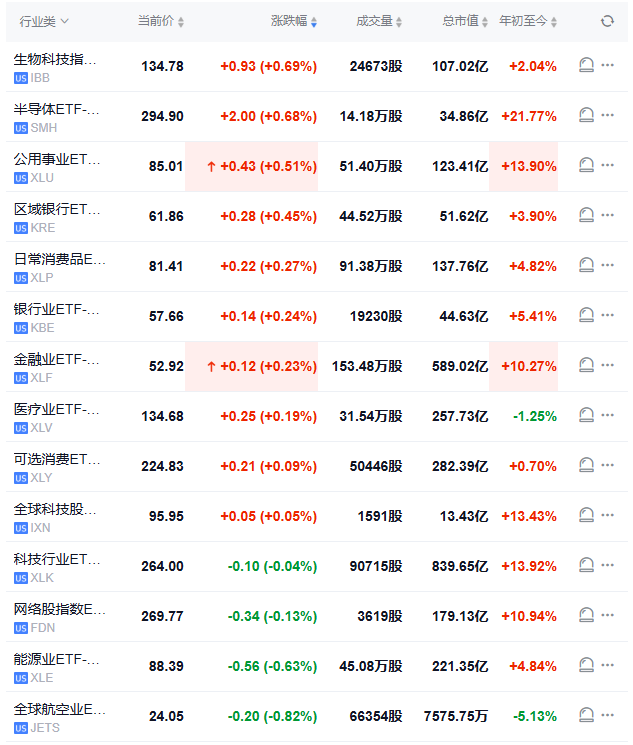
美股盘初,主要行业ETF涨跌不一,生物科技指数ETF涨0.7%,半导体ETF涨0.7%,全球航空业ETF跌0.8%。
news flash· 2025-07-30 13:41
Group 1 - Major industry ETFs showed mixed performance, with the biotechnology and semiconductor ETFs both rising by 0.7% [1] - The biotechnology index ETF is currently priced at 134.78, reflecting an increase of 0.93 (+0.69%) with a total market value of 10.702 billion and a year-to-date change of +2.04% [2] - The semiconductor ETF is priced at 294.90, up by 2.00 (+0.68%), with a total market value of 34.86 billion and a year-to-date increase of +21.77% [2] Group 2 - The global airline ETF decreased by 0.8%, currently priced at 24.05, down by 0.20 (-0.82%), with a total market value of 0.0757575 billion and a year-to-date decline of -5.13% [1][2] - The utility ETF increased by 0.51%, priced at 85.01, with a total market value of 12.341 billion and a year-to-date change of +13.90% [2] - The financial sector ETF rose by 0.23%, priced at 52.92, with a total market value of 589.02 billion and a year-to-date increase of +10.27% [2]
深圳刚刚官宣:18322.26亿元
Nan Fang Du Shi Bao· 2025-07-30 12:04
Economic Overview - Shenzhen's GDP for the first half of 2025 reached 1832.226 billion yuan, with a year-on-year growth of 5.1% [1] - The primary industry added value was 1.033 billion yuan, growing by 2.8%; the secondary industry added value was 650.556 billion yuan, growing by 3.3%; and the tertiary industry added value was 1180.637 billion yuan, growing by 6.1% [1] Industrial Production - The industrial added value for large-scale enterprises increased by 4.3% year-on-year, with a slight acceleration of 0.1 percentage points compared to the first quarter [2] - The manufacturing sector grew by 4.2%, while the electricity, heat, gas, and water production and supply sector grew by 11.8% [2] - High-tech product output saw significant growth, with civil drones, industrial robots, and 3D printing equipment increasing by 59.0%, 38.0%, and 35.8% respectively [2] Service Sector - The added value of the service industry was 1180.637 billion yuan, with a year-on-year growth of 6.1%, also accelerating by 0.1 percentage points from the first quarter [3] - Key sectors such as finance, transportation, and information technology services grew by 10.9%, 9.0%, and 8.1% respectively [3] - From January to May, the revenue of large-scale service enterprises increased by 8.4%, with transportation and information services showing strong growth [3] Fixed Asset Investment - Fixed asset investment decreased by 10.9% year-on-year, with real estate development investment down by 15.1% [4] - Infrastructure investment grew by 7.7%, while industrial technological transformation investment surged by 47.1% [4] - Investment in information transmission and technology services increased by 47.7% [4] Market Sales - The total retail sales of consumer goods reached 494.868 billion yuan, with a year-on-year growth of 3.5%, accelerating by 0.4 percentage points from the first quarter [5] - Retail sales of essential goods showed strong growth, with daily necessities and food retail increasing by 10.7% and 9.1% respectively [5] - Online retail sales through large-scale units grew by 19.4% [5] Trade Performance - The total import and export volume was 2167.545 billion yuan, with a year-on-year decline of 1.1%, but the decline narrowed by 1.7 percentage points compared to the first quarter [6] - Exports decreased by 7.0% to 1308.681 billion yuan, while imports increased by 9.5% to 858.864 billion yuan [6] - High-tech product exports grew by 8.0% [6] Financial Sector - By the end of June, the balance of deposits in financial institutions reached 14160.014 billion yuan, growing by 5.7% year-on-year [8] - The balance of loans in financial institutions was 9846.991 billion yuan, with a year-on-year growth of 3.5% [8] Consumer Prices - The consumer price index rose by 0.1% year-on-year, with food and clothing prices increasing by 0.5% and 1.3% respectively [9] - Prices for transportation and communication decreased by 2.4% [9]
5.1%!深圳交出半年成绩单
Zheng Quan Shi Bao· 2025-07-30 11:44
Economic Performance - Shenzhen's GDP for the first half of the year reached 1832.226 billion yuan, with a year-on-year growth of 5.1% [1] - The primary industry added value was 1.033 billion yuan, growing by 2.8%; the secondary industry added value was 650.556 billion yuan, growing by 3.3%; and the tertiary industry added value was 1180.637 billion yuan, growing by 6.1% [1] Industrial Growth - The industrial added value above designated size in Shenzhen increased by 4.3% year-on-year, with the growth rate accelerating by 0.1 percentage points compared to the first quarter [1] - Key sectors such as general equipment manufacturing grew by 17.1%, and high-tech product output saw significant increases, including civilian drones (59.0%), industrial robots (38.0%), and 3D printing equipment (35.8%) [1] Service Sector Development - The added value of the service industry reached 1180.637 billion yuan, with a year-on-year growth of 6.1%, also accelerating by 0.1 percentage points from the first quarter [2] - Specific sectors like finance (10.9%), transportation, warehousing, and postal services (9.0%), and information transmission, software, and IT services (8.1%) showed strong growth [2] Consumer Market Trends - Retail sales of consumer goods totaled 494.868 billion yuan, with a year-on-year growth of 3.5%, and an acceleration of 0.4 percentage points from the first quarter [2] - The online retail sector continued to grow, with sales through the internet increasing by 19.4% [2] Investment and Trade - Fixed asset investment in Shenzhen decreased by 10.9%, with real estate development investment down by 15.1%, while infrastructure investment grew by 7.7% [3] - The total import and export volume was 2167.545 billion yuan, a year-on-year decrease of 1.1%, with exports at 1308.681 billion yuan (down 7.0%) and imports at 858.864 billion yuan (up 9.5%) [3] Future Outlook - Analysts suggest that Shenzhen should leverage its technological advantages to develop high-tech industries and enhance industrial upgrading while optimizing the consumption environment to counter external pressures [3]