信息传输软件和信息技术服务业

Search documents
国家统计局答每经问:10月份全国城镇调查失业率为5.1%,连续两个月下降
Mei Ri Jing Ji Xin Wen· 2025-11-14 16:53
Economic Overview - In October, the national economy continued to show a stable and progressive development trend, with notable characteristics including growth in production supply and market sales [2][5]. Employment Situation - The urban surveyed unemployment rate decreased to 5.1% in October, down by 0.1 percentage points from the previous month, marking two consecutive months of decline [1]. Production and Supply - Agricultural production remained strong, with an increase in autumn grain area and yield, indicating a promising harvest [2]. - The industrial production maintained stability, with the industrial added value of large-scale enterprises growing by 4.9% year-on-year in October [2]. - The service sector also showed steady growth, with a production index increase of 4.6% year-on-year [2]. Market Sales - Social retail sales of consumer goods increased by 2.9% year-on-year in October, driven by holiday consumption and the promotion of consumption [5]. - Specific categories such as communication equipment and cultural office supplies saw significant retail growth of 23.2% and 13.5%, respectively [5]. Price Trends - The consumer price index (CPI) turned positive in October, rising by 0.2% year-on-year, while the core CPI increased by 1.2%, marking a continuous expansion in growth for six months [7]. - The producer price index (PPI) saw a narrowing decline of 2.1% year-on-year, indicating a positive trend in industrial pricing [7]. Investment Trends - Investment in high-tech manufacturing showed robust growth, with a year-on-year increase of 7.2% in October [10]. - Investment in sectors such as aerospace and information services grew significantly, with increases of 19.7% and 32.7%, respectively [11]. Emerging Industries - The digital economy and green transformation are gaining momentum, with significant growth in sectors like smart manufacturing and artificial intelligence [12]. - New energy vehicles and lithium-ion batteries saw production increases of 19.3% and 30.4%, respectively, highlighting the growth potential in these areas [10].

10月供需双双放缓,年底前稳增长政策有望进一步加力
Sou Hu Cai Jing· 2025-11-14 10:21
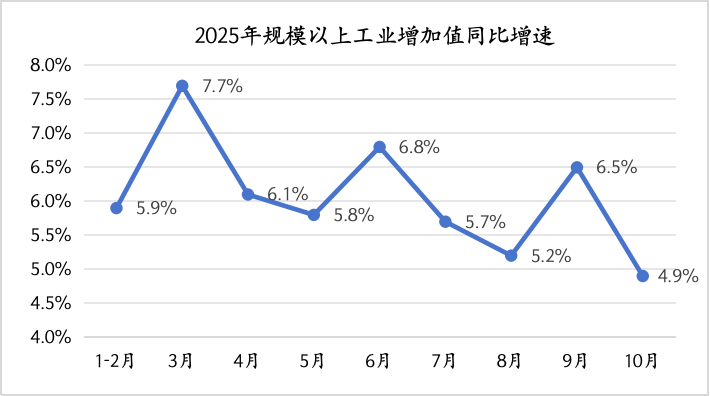
Economic Growth - China's economic growth momentum has slowed down in October, with both supply and demand sides experiencing a decline in growth rates [1][4] - The 20th Central Committee's Fourth Plenary Session emphasized the need to "resolutely achieve the annual economic and social development goals," focusing on stabilizing macroeconomic operations for the fourth quarter and the first quarter of next year [1][13] Supply Side - Industrial production has significantly declined, with the industrial added value of large-scale enterprises growing by 4.9% year-on-year in October, a decrease of 1.6 percentage points from September [3][4] - The decline in industrial added value is attributed to the impact of holidays and the tapering effects of "export rush" and "two new" policies (large-scale equipment updates and consumption upgrades) [4] - Notably, the added value of equipment manufacturing grew by 8.0% year-on-year, and high-tech manufacturing increased by 7.2%, indicating strong support from large-scale equipment updates and domestic manufacturing transformation [4] Service Sector - The service production index grew by 4.6% year-on-year in October, a decrease of 1.0 percentage point from the previous month [6] - Specific sectors such as information transmission, software, and IT services saw growth rates of 13.0% and 8.2%, respectively, while the financial sector's growth rate fell from 8.7% to 5.6% [6] Demand Side - Social retail sales increased by 2.9% year-on-year in October, a slight decrease of 0.1 percentage points from the previous month [6][8] - Exports in dollar terms decreased by 1.1% year-on-year, contrasting with an 8.3% increase in the previous month [6][8] - Consumer behavior remains cautious, with a significant reduction in household loans, indicating weak willingness to leverage [8] Investment Trends - Fixed asset investment saw a year-on-year decline of 1.7% from January to October, with the drop widening by 1.2 percentage points compared to the first nine months [9][11] - Manufacturing investment grew by 2.7%, down 1.3 percentage points from the previous period, while real estate investment fell by 14.7%, with the decline accelerating [11][12] - The decline in manufacturing investment is influenced by external environment fluctuations and high base effects from last year's equipment updates [12] Policy Response - Analysts suggest that the current uncertainties in exports and consumption necessitate increased macro policy support for investment [13] - The National Development and Reform Commission announced the full deployment of 500 billion yuan in new policy financial tools and an additional 500 billion yuan from local debt limits to support infrastructure [13][14] - Expectations are set for further fiscal policies to boost consumption and potential new rounds of interest rate cuts, given the low government debt ratio and current low domestic prices [13][14]
国家统计局:我国推进经济结构调整、加快培育新动能继续取得积极成效
Zhong Guo Xin Wen Wang· 2025-11-14 08:03
Core Insights - The Chinese economy is transitioning from high-speed growth to high-quality development, characterized by a shift in growth rate, structural optimization, and transformation of economic drivers [1][3] Group 1: Market Demand and Investment - Market demand is being revitalized, with new consumption patterns emerging. Online retail sales of physical goods accounted for 25.2% of total retail sales from January to October, an increase of 0.2 percentage points from the previous period [1] - Investment in high-tech sectors is growing rapidly, with aerospace and equipment manufacturing investment increasing by 19.7% and information services investment growing by 32.7% year-on-year [1] Group 2: Industrial Upgrading - The manufacturing sector is steadily moving towards mid-to-high-end production, with the added value of large-scale equipment manufacturing increasing by 9.5%, contributing 58.7% to the growth of large-scale industrial added value [2] - The modern service industry is also thriving, with the combined added value of information transmission, software, and IT services, as well as leasing and business services, reaching 16.3% of the tertiary industry, up 0.8 percentage points from the previous year [2] Group 3: Emerging Industries - The digital economy is rapidly developing, with significant growth in digital manufacturing and smart manufacturing sectors, which saw added value increases of 9.5%, 11.1%, and 12.3% respectively [2] - Emerging industries such as renewable energy, new materials, and artificial intelligence are expected to become new pillar industries, supporting the growth of new economic drivers [2]
基数抬升扰动10月经济数据,假期消费带动服务零售额回升
2 1 Shi Ji Jing Ji Bao Dao· 2025-11-14 04:51
Economic Overview - In October, China's economy showed signs of structural adjustment with emerging industries growing, supported by consumption during the Mid-Autumn and National Day holidays [1][6] - The overall economic operation remains stable, with industrial production continuing to grow and a notable increase in high-tech manufacturing [6][7] Industrial Performance - The industrial added value for large-scale enterprises grew by 4.9% year-on-year in October, a decrease of 1.6 percentage points from the previous month [1] - The equipment manufacturing sector saw an 8% increase in added value, significantly outpacing the overall industrial growth [1][6] - From January to October, the industrial added value increased by 6.1%, showing overall stability [1] Service Sector - The service production index grew by 4.6% year-on-year in October, with a decline of 1 percentage point from the previous month due to high base effects [1] - The information transmission, software, and IT services sectors saw significant growth, with production indices increasing by 13% and 8.2% respectively [1] Consumer Market - The total retail sales of consumer goods increased by 2.9% year-on-year in October, slightly down from the previous month [2] - The retail sales of communication equipment and cultural office supplies grew by 23.2% and 13.5% respectively, indicating a positive impact from the trade-in policy [2] - Service retail sales increased by 5.3% from January to October, with notable growth in leisure, communication, and travel services [2] Trade and Investment - The total import and export value grew by 0.1% year-on-year in October, with exports declining by 0.8% and imports increasing by 1.4% [2] - Fixed asset investment (excluding rural households) decreased by 1.7% from January to October, with infrastructure investment down by 0.1% [3] - High-tech sector investments, particularly in aerospace and information services, saw significant growth, with increases of 19.7% and 32.7% respectively [3] Price Trends - The Consumer Price Index (CPI) rose by 0.2% year-on-year in October, reversing a previous decline [4] - The Producer Price Index (PPI) decreased by 2.1% year-on-year but showed signs of improvement with a 0.1% month-on-month increase [4] Employment and Economic Stability - The urban unemployment rate was 5.1% in October, a slight decrease from the previous month, indicating a positive trend in job recovery [4] - The government has implemented policies to stimulate economic growth, including the introduction of new financial tools and measures to boost private investment [5][9]
事关消费、就业、物价……最新数据公布→
Jin Rong Shi Bao· 2025-11-14 04:35
Economic Overview - The national economy is generally stable with a trend of steady progress, characterized by stable production supply, overall employment stability, improved prices, and the cultivation of new growth drivers [1] Production and Supply - Agricultural production is favorable with an increase in autumn grain area and continuous improvement in yield, indicating a promising harvest for the year [3] - Industrial production remains stable, with a 4.9% year-on-year increase in the added value of industrial enterprises above designated size in October, supported significantly by an 8% increase in equipment manufacturing [3] - The service sector shows steady growth, with a 4.6% year-on-year increase in the service production index for October, influenced by the combined effect of the National Day and Mid-Autumn Festival [3] Market Sales - Retail sales continue to expand, with total retail sales of consumer goods reaching 46,291 billion yuan in October, a 2.9% year-on-year increase [4] - Notable growth in retail sales of communication equipment and cultural office supplies, with increases of 23.2% and 13.5% respectively [4] - Service retail sales from January to October grew by 5.3%, outpacing the growth of goods retail sales [4] Employment Situation - The urban survey unemployment rate decreased to 5.1% in October, down 0.1 percentage points from the previous month, marking two consecutive months of decline [5] - The unemployment rate for migrant agricultural workers is notably lower at 4.5%, down 0.2 percentage points from the previous month [5][6] Price Trends - Consumer prices have shifted from decline to increase, with a 0.2% year-on-year rise in October, compared to a 0.3% decline in the previous month [7] - The core Consumer Price Index (CPI), excluding food and energy, rose by 1.2%, with the increase rate expanding for six consecutive months [7] - The Producer Price Index (PPI) saw a narrowing decline of 2.1% year-on-year in October, indicating a positive trend [7] Transformation and Upgrading - High-tech manufacturing continues to grow, with a 7.2% year-on-year increase in added value for high-tech manufacturing enterprises above designated size in October [8] - The export of high-tech products increased by 7.3% in the first ten months [8] - The modern service industry is performing well, with significant growth in information transmission and software services, as well as leasing and business services [8] Investment and Foreign Trade - Fixed asset investment decreased by 1.7% year-on-year from January to October, but the investment structure is optimizing [9] - Manufacturing investment grew by 2.7%, accounting for 25.6% of total investment, an increase of 1.1 percentage points from the previous year [9] - Total import and export volume increased by 3.6% year-on-year in the first ten months, with exports growing by 6.2% [10] - In October, total import and export volume grew by 0.1% year-on-year, with imports increasing by 1.4% [10]
10月份经济数据出炉
21世纪经济报道· 2025-11-14 04:02
Group 1: Industrial Production - In October, the industrial added value above designated size increased by 4.9% year-on-year and 0.17% month-on-month [1] - The equipment manufacturing industry saw an 8.0% year-on-year increase, while high-tech manufacturing grew by 7.2%, outperforming the overall industrial growth by 3.1 and 2.3 percentage points respectively [1] - The manufacturing purchasing manager index was recorded at 49.0, indicating a slight contraction in manufacturing activity [1] Group 2: Service Sector - The service production index increased by 4.6% year-on-year in October, with significant growth in information transmission, software, and IT services at 13.0% [2] - The business activity index for the service sector was at 50.2, indicating stable growth expectations [2] - For the first ten months, the service production index grew by 5.7% year-on-year [2] Group 3: Retail Sales - In October, the total retail sales of consumer goods reached 46,291 billion yuan, a year-on-year increase of 2.9% [3] - Online retail sales amounted to 127,916 billion yuan, growing by 9.6% year-on-year, with physical goods accounting for 25.2% of total retail sales [3] - The retail sales of basic living goods and some upgraded consumption categories saw rapid growth, with food and beverage retail increasing by 3.8% [3] Group 4: Fixed Asset Investment - From January to October, fixed asset investment (excluding rural households) totaled 408,914 billion yuan, a year-on-year decrease of 1.7% [4] - Manufacturing investment grew by 2.7%, while real estate development investment fell by 14.7% [4] - High-tech industries such as information services and aerospace manufacturing saw significant investment growth of 32.7% and 19.7% respectively [4] Group 5: Trade and Exports - In October, the total import and export value was 37,028 billion yuan, with exports decreasing by 0.8% and imports increasing by 1.4% [5] - For the first ten months, the total trade value grew by 3.6%, with exports increasing by 6.2% [5] - Private enterprises accounted for 57.0% of total trade, reflecting a 1.9 percentage point increase from the previous year [5] Group 6: Employment - The urban survey unemployment rate averaged 5.2% from January to October, with a slight decrease to 5.1% in October [6] - The unemployment rate for local registered labor was 5.3%, while for migrant workers it was 4.7% [6] - The average weekly working hours for employees were recorded at 48.4 hours [6] Group 7: Prices - In October, the Consumer Price Index (CPI) rose by 0.2% year-on-year, reversing from a decline of 0.3% in the previous month [7] - The Producer Price Index (PPI) for industrial producers decreased by 2.1% year-on-year, with a narrowing decline compared to the previous month [7] - Core CPI, excluding food and energy, increased by 1.2% year-on-year, indicating a slight acceleration in inflation [7] Group 8: Overall Economic Outlook - The overall economic operation in October was stable, with ongoing efforts in transformation and upgrading [8] - Challenges remain due to external uncertainties and domestic structural adjustments [8] - Future strategies include expanding domestic demand and stabilizing employment and market expectations [8]

如何评价10月份国民经济答卷?国家统计局作答
Xin Hua Cai Jing· 2025-11-14 03:17
Economic Overview - In October, China's economy continued to show stable growth with production and demand maintaining a steady increase, employment and prices remaining generally stable, and ongoing transformation and upgrading trends [1][4] Production and Supply - Agricultural production is favorable, with an increase in autumn grain area and yield, indicating a promising harvest for the year. The industrial production remains stable, with a year-on-year increase of 4.9% in the added value of large-scale industries in October. The equipment manufacturing sector saw an 8% increase, significantly contributing to overall industrial growth [1][3] Market Sales - The market sales scale continues to expand, with a 2.9% year-on-year increase in total retail sales of consumer goods in October. Notably, sales of communication equipment and cultural office supplies grew by 23.2% and 13.5%, respectively. The service retail sector also saw a 5.3% increase from January to October, outpacing the growth of goods retail [2][3] Employment Situation - The urban survey unemployment rate decreased to 5.1% in October, down 0.1 percentage points from the previous month, marking two consecutive months of decline. The unemployment rate for migrant agricultural workers was 4.5%, indicating a stable employment situation despite external challenges [2][3] Price Trends - Positive changes in prices were observed, with the Consumer Price Index (CPI) rising by 0.2% year-on-year in October, reversing a 0.3% decline in the previous month. The core CPI, excluding food and energy, increased by 1.2%, marking a continuous expansion over six months. The Producer Price Index (PPI) saw a year-on-year decline of 2.1%, but the rate of decline has narrowed for three consecutive months [3][4] Transformation and Upgrading - The high-tech manufacturing sector showed strong growth, with a 7.2% year-on-year increase in added value for large-scale high-tech manufacturing in October. The export of high-tech products grew by 7.3% in the first ten months. The modern service industry also performed well, with significant growth in information transmission and software services [3][4]
国家统计局:10月份国民经济延续稳中有进的发展态势
Yang Shi Wang· 2025-11-14 02:44
Economic Overview - The national economy continues to show a stable and progressive development trend, with steady growth in production and demand, stable employment and prices, and ongoing transformation and upgrading [1][4] Production and Supply - Agricultural production remains strong, with an increase in autumn grain area and yield, indicating a good harvest for the year. Industrial production is stable, with a 4.9% year-on-year increase in the added value of large-scale industries in October. The equipment manufacturing sector outperformed, growing by 8% [1][3] Market Sales - Retail sales of consumer goods increased by 2.9% year-on-year in October, driven by holiday economic activities. Notably, sales of communication equipment and cultural office supplies grew by 23.2% and 13.5%, respectively [2][3] Employment Situation - The urban survey unemployment rate decreased to 5.1% in October, down 0.1 percentage points from the previous month. The unemployment rate for migrant agricultural workers was 4.5%, indicating a stable employment situation overall [2][3] Price Trends - The Consumer Price Index (CPI) rose by 0.2% year-on-year in October, reversing a previous decline. The core CPI, excluding food and energy, increased by 1.2%, marking a continuous expansion in the growth rate [3] Transformation and Upgrading - High-tech manufacturing continues to grow, with a 7.2% year-on-year increase in added value for large-scale high-tech manufacturing in October. The export of high-tech products rose by 7.3% in the first ten months [3][4]
刚刚,重要经济数据公布
第一财经· 2025-11-14 02:24
Economic Overview - In October, under the strong leadership of the Central Committee, the national economy maintained overall stability with a steady progress in development, supported by efforts to stabilize employment, enterprises, markets, and expectations [2] Industrial Production - In October, the industrial added value above designated size increased by 4.9% year-on-year and 0.17% month-on-month, with mining, manufacturing, and electricity sectors showing growth rates of 4.5%, 4.9%, and 5.4% respectively [3] - The equipment manufacturing and high-tech manufacturing sectors performed well, with added value growth of 8.0% and 7.2%, respectively, outpacing the overall industrial growth by 3.1 and 2.3 percentage points [3] - From January to October, the industrial added value increased by 6.1% year-on-year, while the profit of industrial enterprises totaled 53,732 billion yuan, up 3.2% year-on-year [3] Service Sector - The service sector production index grew by 4.6% year-on-year in October, with significant contributions from information transmission, software, and financial services [4] - From January to October, the service sector production index increased by 5.7%, and the revenue of large-scale service enterprises rose by 7.6% year-on-year [4] Retail Sales - In October, the total retail sales of consumer goods reached 46,291 billion yuan, a year-on-year increase of 2.9% [5] - Online retail sales amounted to 127,916 billion yuan, growing by 9.6% year-on-year, with physical goods accounting for 25.2% of total retail sales [5] - The service retail sector also saw a year-on-year growth of 5.3% from January to October, with notable increases in leisure and communication services [5] Fixed Asset Investment - From January to October, fixed asset investment (excluding rural households) totaled 408,914 billion yuan, a year-on-year decrease of 1.7% [6] - Manufacturing investment grew by 2.7%, while real estate development investment fell by 14.7% [6] - High-tech industries, particularly information services and aerospace manufacturing, saw significant investment growth of 32.7% and 19.7%, respectively [6] Trade and Employment - In October, the total import and export value reached 37,028 billion yuan, with exports declining by 0.8% and imports increasing by 1.4% [7] - The urban unemployment rate averaged 5.2% from January to October, with a slight decrease to 5.1% in October [8] Price Trends - The Consumer Price Index (CPI) rose by 0.2% year-on-year in October, reversing a previous decline, while the Producer Price Index (PPI) saw a year-on-year decrease of 2.1%, with a narrowing decline compared to the previous month [9] Conclusion - Overall, the national economy in October showed stable operation with solid progress in transformation and upgrading, while facing challenges from external uncertainties and domestic structural adjustments [10]

国家统计局:10月规模以上工业增加值同比增长4.9% 国民经济稳中有进态势持续
Guo Jia Tong Ji Ju· 2025-11-14 02:22
Core Insights - In October, the industrial added value of enterprises above designated size increased by 4.9% year-on-year, with a month-on-month growth of 0.17%. For the first ten months, the year-on-year growth was 6.1% [2][3][24]. Group 1: Industrial Performance - The mining industry saw a year-on-year increase of 4.5% in added value, while manufacturing grew by 4.9%, and the production and supply of electricity, heat, gas, and water increased by 5.4% in October [5][24]. - State-owned enterprises reported a year-on-year growth of 6.7% in added value, while private enterprises grew by 2.1% [5][24]. - Among 41 major industries, 29 experienced year-on-year growth in added value, with notable increases in coal mining (6.5%), chemical raw materials (7.1%), and automotive manufacturing (16.8%) [5][24]. Group 2: Product Output - Out of 623 industrial products, 313 saw a year-on-year increase in output. Notably, automotive production reached 3.279 million units, up 11.2%, with new energy vehicles growing by 19.3% [6][24]. - The production of ethylene increased by 11.7%, while steel output decreased by 0.9% [6][24]. Group 3: Sales and Exports - The sales rate of products from industrial enterprises above designated size was 96.4%, a decrease of 1.0 percentage points year-on-year. The export delivery value was 1.3245 trillion yuan, down 2.1% year-on-year [7][24]. Group 4: Economic Context - The overall economic operation in October was stable, with a focus on maintaining employment, enterprises, and market expectations. The industrial production index for the manufacturing sector was at 49.0%, indicating a slight contraction [23][24].