文体娱乐业

Search documents
美国滥施关税影响初现——2025年4月PMI分析|宏观经济
清华金融评论· 2025-05-01 09:11
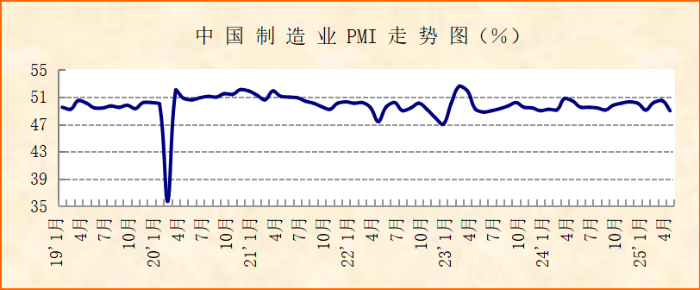
Core Viewpoint - The article highlights the impact of tariffs on China's manufacturing sector, as indicated by a decline in the Purchasing Managers' Index (PMI) and other economic indicators, while also noting government responses to stabilize the economy [3][4][7]. Economic Indicators - In April 2025, China's manufacturing PMI dropped to 49.0%, down from 50.5%, signaling a contraction in the manufacturing sector [4]. - The construction business activity index was at 51.9%, a decrease of 1.5 percentage points from the previous month, while the services business activity index was at 50.1%, down 0.2 percentage points [4]. - The production index fell to 49.8% from 52.6%, and the new orders index decreased to 49.2%, with new export orders plummeting to 44.7%, reflecting significant demand contraction [4][5]. Tariff Impact - The article notes that the effects of tariffs are fully transmitted to manufacturing enterprises, with a substantial year-on-year decrease of 45% in container orders shipped from China to the U.S. by mid-April [5]. - The export container price index for the route from China to the U.S. West Coast fell by 9.7% month-on-month [5]. Price Trends - The PMI price index saw a significant decline, with the factory price index at 44.8% and the raw material purchase price index at 47.9%, both down from previous levels [5]. - Commodity prices also fell, with Brent crude oil averaging $64.37 per barrel (down 11%), LME copper at $9,487.5 per ton (down 5.5%), and iron ore futures at 709 yuan per ton (down 6.7%) [5]. Inventory and Procurement - The procurement volume index dropped to 46.3% from 51.8%, indicating a significant reduction in purchasing activity [6]. - Raw material inventory index decreased to 47.0%, and finished goods inventory index fell to 47.3%, reflecting a contraction in inventory levels [6]. Import Trends - The import PMI recorded 43.4%, down 4.1 percentage points, influenced by reduced imports from the U.S. due to retaliatory tariffs and decreased demand for foreign goods [6]. Government Response - The Politburo meeting signaled three key strategies: maintaining flexible domestic reserve policies, emphasizing stability in employment and market expectations, and accelerating the implementation of existing policies [7]. - The government is expected to expedite the issuance and use of bonds, focusing on technology, consumption, and foreign trade [7]. Investment Outlook - The article suggests a favorable outlook for sectors related to new productive forces and consumer sectors supported by policy, advocating for a "dumbbell strategy" combining dividends and hard technology [8]. - A potential reduction in reserve requirements by 25-50 basis points and a possible interest rate cut of around 20 basis points in the coming months are anticipated, with 10-year government bond yields expected to drop to 1.5% [8].
短期波动不改经济长期向好大势——解读4月份PMI数据
Xin Hua Wang· 2025-04-30 12:31
Core Viewpoint - Despite a decline in the manufacturing PMI to 49% in April, the overall economic output in China continues to expand, indicating a long-term positive trend in the economy [1][5]. Manufacturing Sector - The manufacturing PMI decreased by 1.5 percentage points from the previous month, falling below the critical point due to high growth in previous months and changes in the external environment [1]. - The new export orders index dropped to 44.7%, a decrease of 4.3 percentage points, indicating a tightening of foreign demand [1]. - The manufacturing production index was recorded at 49.8%, down by 2.8 percentage points, reflecting a slight decline in overall production [2]. High-Tech Manufacturing - The high-tech manufacturing PMI stood at 51.5%, significantly above the overall manufacturing level, with both production and new orders indices above 52% [3]. - Industries such as food processing, pharmaceuticals, and beverages also showed strong performance, with production and new orders indices above 53% [3]. Non-Manufacturing Sector - The non-manufacturing business activity index was at 50.4%, slightly down by 0.4 percentage points, but still indicating stable expansion [3]. - The aviation transport and entertainment sectors saw significant increases in their business activity indices, both exceeding 55% [4]. Economic Outlook - The comprehensive PMI output index for April was 50.2%, indicating continued economic expansion despite a 1.2 percentage point decline from the previous month [4]. - The government emphasizes the need to stabilize employment, businesses, and market expectations to ensure high-quality development in response to external uncertainties [5].
三类行业继续保持扩张态势——4月PMI数据点评
一瑜中的· 2025-04-30 12:00
Core Viewpoint - The manufacturing PMI for April has dropped to 49.0%, indicating a contraction in the manufacturing sector, influenced by high previous growth rates and external environmental changes [2][3][18]. Group 1: PMI Data Overview - The manufacturing PMI decreased from 50.5% to 49.0%, with the production index falling from 52.6% to 49.8% [2][18]. - The new orders index declined from 51.8% to 49.2%, while the new export orders index dropped significantly from 49.0% to 44.7% [2][18]. - The employment index fell from 48.2% to 47.9%, and the raw materials inventory index slightly decreased from 47.2% to 47.0% [2][18]. Group 2: Industry Performance High-Tech Manufacturing - High-tech manufacturing continues to expand with a PMI of 51.5%, significantly above the overall manufacturing level, supported by production and new orders both above 52.0% [5][10]. - Other sectors like equipment manufacturing, consumer goods, and high-energy industries saw declines in their PMIs, indicating varying levels of economic performance [5][10]. Infrastructure - The civil engineering business activity index rose to 60.9%, up 6.4 percentage points, reflecting accelerated construction progress across various projects [13][20]. - The government aims to expedite funding for infrastructure projects, with significant budget allocations already made for 2023 and 2024 [14][20]. Resident Services - The service sector, particularly in areas related to tourism and leisure, remains robust, with relevant business activity indices above 50% [15][16]. - The government emphasizes the development of service consumption as a key area for economic growth, with specific measures to enhance consumer spending [16].
4月PMI数据点评:三类行业继续保持扩张态势
Huachuang Securities· 2025-04-30 10:05
Manufacturing Sector - The manufacturing PMI for April is 49.0%, down from 50.5% in the previous month, indicating a contraction[4] - The production index decreased to 49.8%, a drop of 2.8 percentage points from 52.6%[4] - The new orders index fell to 49.2%, down from 51.8%[4] - The new export orders index is at 44.7%, down from 49.0%[4] - The employment index is at 47.9%, slightly down from 48.2%[4] Other Sectors - The construction sector's business activity index is at 51.9%, a decrease of 1.5 percentage points from the previous month[4] - The services sector's business activity index is at 50.1%, down by 0.2 percentage points[4] - The composite PMI output index is at 50.2%, a decline of 1.2 percentage points but still above the critical point[4] High-Tech Manufacturing - High-tech manufacturing continues to expand with an index of 51.5%, significantly above the overall manufacturing level[5] - The production and new orders indices for high-tech manufacturing are both above 52.0%[5] Infrastructure and Policy Support - The civil engineering business activity index rose to 60.9%, an increase of 6.4 percentage points, indicating accelerated project construction[6] - The government plans to expedite funding for infrastructure projects, aiming to finalize the 2025 project list by the end of June[6] Consumer Services - The consumer services sector remains robust, with indices for air transport, entertainment, and related services all above 50%[7] - Future policies will focus on boosting service consumption to enhance economic growth[7]
4月份制造业采购经理指数为49%,显示宏观经济运行有所波动
Bei Ke Cai Jing· 2025-04-30 02:30
Group 1: Manufacturing Sector - In April, the Manufacturing Purchasing Managers' Index (PMI) decreased to 49.0%, down 1.5 percentage points from the previous month, indicating a contraction in the manufacturing sector [1] - All 13 sub-indices related to manufacturing showed a decline, with the production index, new orders index, and new export orders index experiencing significant drops, reflecting a contraction in demand [2][4] - The overall economic output remains stable, with the composite PMI output index at 50.2%, indicating continued expansion despite the decline in manufacturing PMI [1][4] Group 2: Non-Manufacturing Sector - The Non-Manufacturing Business Activity Index stood at 50.4%, down 0.4 percentage points from the previous month, but still above the critical point, indicating ongoing expansion in the non-manufacturing sector [1][8] - Key indices in the non-manufacturing sector, such as new orders and new export orders, also saw declines, but the construction and service industries showed resilience, particularly in tourism and entertainment [6][8] - The business activity expectation index has remained above 55% for seven consecutive months, indicating a stable optimistic outlook among enterprises for future market conditions [8] Group 3: Economic Policy and Outlook - Analysts emphasize the need for more proactive macroeconomic policies, including increased government investment in public goods to stimulate market demand and improve employment and income levels [5] - The overall economic environment is influenced by external uncertainties, including trade tensions, which necessitate a focus on stabilizing employment, enterprises, and market expectations [1][4] - The second quarter is expected to see stable performance in the non-manufacturing sector, supported by the release of economic stabilization policies [8]