
电子专用材料制造

Search documents
证券代码:301511 证券简称:德福科技 公告编号:2025-103
Zhong Guo Zheng Quan Bao - Zhong Zheng Wang· 2025-11-27 02:49
Core Viewpoint - The company has approved a total guarantee amount of up to 1,172,720 thousand yuan for its subsidiaries, which is aimed at supporting their operational funding needs and ensuring their development [2][12]. Group 1: Guarantee Overview - The company will provide guarantees for its subsidiaries, with a total amount not exceeding 1,172,720 thousand yuan, effective from the date of the 2024 annual shareholders' meeting until December 31, 2025 [2]. - The company has signed a maximum guarantee contract with China Everbright Bank for 50 million yuan and with Zheshang Bank for 102 million yuan, both under the approved guarantee limit [3][10]. Group 2: Subsidiary Information - Jiujang Amber New Materials Co., Ltd. is a subsidiary with a registered capital of 1,672,187,200 yuan, and the company holds a 73.68% stake in it [5][11]. - Gansu Defu New Materials Co., Ltd. is another subsidiary with a registered capital of 1 billion yuan, and the company holds a 51% stake in it [11]. Group 3: Guarantee Agreement Details - The guarantee provided to China Everbright Bank covers a principal amount of 50 million yuan, including all related costs and fees, with a guarantee period of three years from the debt maturity date [9]. - The guarantee provided to Zheshang Bank covers a principal amount of 102 million yuan, also including all related costs and fees, with a similar three-year guarantee period [10]. Group 4: Impact on the Company - The guarantees are intended to support the operational funding needs of the subsidiaries, which is expected to benefit their development without harming the interests of the company or its shareholders [12].
帝科股份前3季净利降九成 A股募4亿IPO光大证券保荐
Zhong Guo Jing Ji Wang· 2025-11-21 08:31
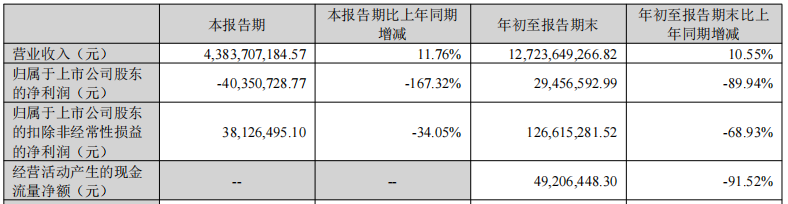
Core Viewpoint - The company reported a significant decline in net profit for the first three quarters of 2025, despite an increase in revenue, indicating potential operational challenges and financial strain [1][2]. Financial Performance - The company achieved operating revenue of 12.72 billion yuan, representing a year-on-year growth of 10.55% [1][2]. - The net profit attributable to shareholders was 29.46 million yuan, showing a substantial decline of 89.94% compared to the previous year [1][2]. - The net profit after deducting non-recurring gains and losses was 126.62 million yuan, down 68.93% year-on-year [1][2]. - The net cash flow from operating activities was 49.21 million yuan, reflecting a significant decrease of 91.52% year-on-year [1][2]. Fundraising and Projects - The company raised a total of 399 million yuan, with a net amount of 350.56 million yuan after deducting issuance costs [3]. - The raised funds are allocated for projects including the relocation and expansion of a production line for conductive silver paste and the establishment of a research and development center [3]. - A planned issuance of shares for 2024 aims to raise up to 264.5 million yuan, with proceeds designated for expanding production capacity and supplementing working capital [3].


莱特光电:11月14日召开董事会会议
Mei Ri Jing Ji Xin Wen· 2025-11-14 11:29
Group 1 - The core point of the article is that Lite Optoelectronics (SH 688150) announced a board meeting to discuss the issuance of convertible bonds and provided details on its revenue composition for 2024 [1] - The company reported that its revenue for the year 2024 will be composed of 93.66% from electronic special materials manufacturing and 6.34% from other businesses [1] - As of the report, Lite Optoelectronics has a market capitalization of 9 billion yuan [1]

国家统计局:10月份PPI环比首次上涨,同比降幅收窄
Zhong Guo Xin Wen Wang· 2025-11-14 06:35
Core Viewpoint - The Producer Price Index (PPI) in October showed a month-on-month increase for the first time this year, with a year-on-year decline narrowing, indicating positive changes in industrial producer prices due to various factors including domestic demand policies and seasonal energy needs [1][2]. Group 1: PPI Changes - In October, the PPI decreased by 2.1% year-on-year, a reduction of 0.2 percentage points compared to the previous month, while it increased by 0.1% month-on-month, marking the first increase of the year [1]. - The month-on-month increase in PPI is attributed to improved market competition, increased seasonal energy demand, and rising international prices of non-ferrous metals [1]. Group 2: Factors Influencing PPI - Measures to boost consumption have shown effectiveness, with prices in certain sectors rising significantly: - Prices for arts and crafts and ceremonial goods increased by 18.4% - Prices for sports balls rose by 3.3% - Prices for nutritional food manufacturing increased by 2.1% [1]. - The growth of new economic drivers, particularly in the renewable energy sector, has led to increased demand for raw materials, resulting in price increases: - Prices in non-ferrous metal smelting and rolling industries rose by 6.8% - Prices for electronic materials increased by 2.3% [2]. - The effects of capacity governance in key industries are becoming evident, with improved market competition leading to reduced price declines in sectors such as photovoltaic equipment and automotive manufacturing [2]. Group 3: Future Outlook - The overall positive changes in PPI are expected to improve business operations and promote economic circulation. Future strategies include continuing to expand domestic demand, releasing consumption potential, increasing effective investment, and enhancing innovation [2].
通鼎互联在苏州成立新型材料公司
Zheng Quan Shi Bao Wang· 2025-11-12 02:12
Core Insights - Suzhou Tongding New Materials Co., Ltd. has been established with a registered capital of 50 million yuan [1] - The company's business scope includes manufacturing and sales of electronic special materials, non-ferrous metal alloys, and non-ferrous metal rolling processing [1] - Tongding New Materials is wholly owned by Tongding Interconnection (002491) [1]

10月份CPI同比涨幅转正,PPI环比年内首次上涨—— 扩内需等政策效应继续显现
Jing Ji Ri Bao· 2025-11-10 04:42
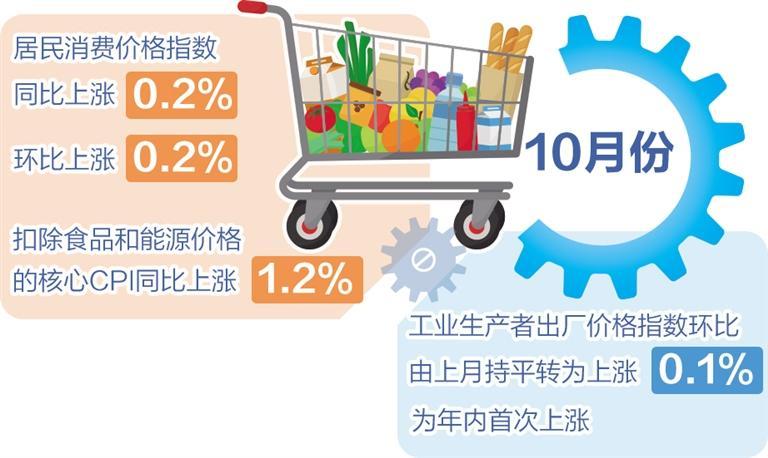
Group 1: CPI Analysis - In October, the Consumer Price Index (CPI) increased by 0.2% month-on-month and year-on-year, marking a shift from a decline of 0.3% in the previous month [2][3] - Service prices rose by 0.2%, driven by increased travel demand during the National Day and Mid-Autumn Festival, with hotel accommodation, flight tickets, and tourism prices rising by 8.6%, 4.5%, and 2.5% respectively [2][3] - Core CPI, excluding food and energy, rose by 1.2% year-on-year, the highest since March 2024, indicating a steady recovery in domestic consumption, particularly in service consumption [2][3] Group 2: PPI Analysis - The Producer Price Index (PPI) saw a month-on-month increase of 0.1% in October, the first rise of the year, influenced by improved supply-demand relationships in certain industries [4][5] - Year-on-year, PPI decreased by 2.1%, but the decline narrowed by 0.2 percentage points compared to the previous month, indicating a trend of price stabilization in key industries [5][6] - Prices in the coal mining and washing industry, photovoltaic equipment manufacturing, and integrated circuit manufacturing have shown upward trends, while international commodity prices have created a mixed impact on domestic prices [4][5] Group 3: Economic Outlook - Experts suggest that the improvement in price data reflects a comprehensive enhancement in the macroeconomic environment and industry sentiment, with a balanced supply-demand relationship [6][7] - The overall price level is expected to rise moderately in the next 3 to 6 months, supported by continued macroeconomic policies and a recovery in market confidence [7] - The construction of a modern industrial system and the expansion of market demand are anticipated to drive price increases in related industries, despite ongoing pressures from the real estate market on certain commodity prices [7]
扩内需等政策效应继续显现——10月份CPI同比涨幅转正,PPI环比年内首次上涨
Jing Ji Ri Bao· 2025-11-10 02:24
Group 1: CPI Analysis - In October, the Consumer Price Index (CPI) increased by 0.2% month-on-month and year-on-year, indicating a recovery in consumer demand, particularly in the service sector [2][3][4] - The core CPI, excluding food and energy, rose by 1.2% year-on-year, marking the highest increase since March 2024 and reflecting a steady recovery in domestic consumption [3][4] - The increase in service prices, which rose by 0.8%, was driven by higher travel-related costs during the National Day and Mid-Autumn Festival, with hotel accommodation, flight tickets, and tourism prices rising significantly [3][4] Group 2: PPI Analysis - The Producer Price Index (PPI) saw a month-on-month increase of 0.1% in October, marking the first rise of the year, driven by improved supply-demand relationships in certain industries [5][6] - Year-on-year, the PPI decreased by 2.1%, but the decline was less severe than in previous months, indicating a narrowing trend in price drops across key sectors [7] - Specific industries such as coal mining, photovoltaic equipment manufacturing, and lithium-ion battery production experienced price increases, while oil and gas extraction faced price declines due to international oil price fluctuations [6][7] Group 3: Economic Outlook - Experts suggest that the improvement in price data reflects a comprehensive recovery in the economy, supported by macroeconomic policies and a balanced supply-demand relationship [8] - The overall price level is expected to rise moderately in the coming months, with CPI anticipated to recover gradually, characterized by strong food prices and weak energy prices [8] - The construction of a modern industrial system and the expansion of market demand are expected to drive price increases in related industries, although the real estate market's adjustment may continue to suppress prices in certain sectors [8]
10月中国物价指数释放积极信号,行业供需全方位改善
Di Yi Cai Jing· 2025-11-09 13:13
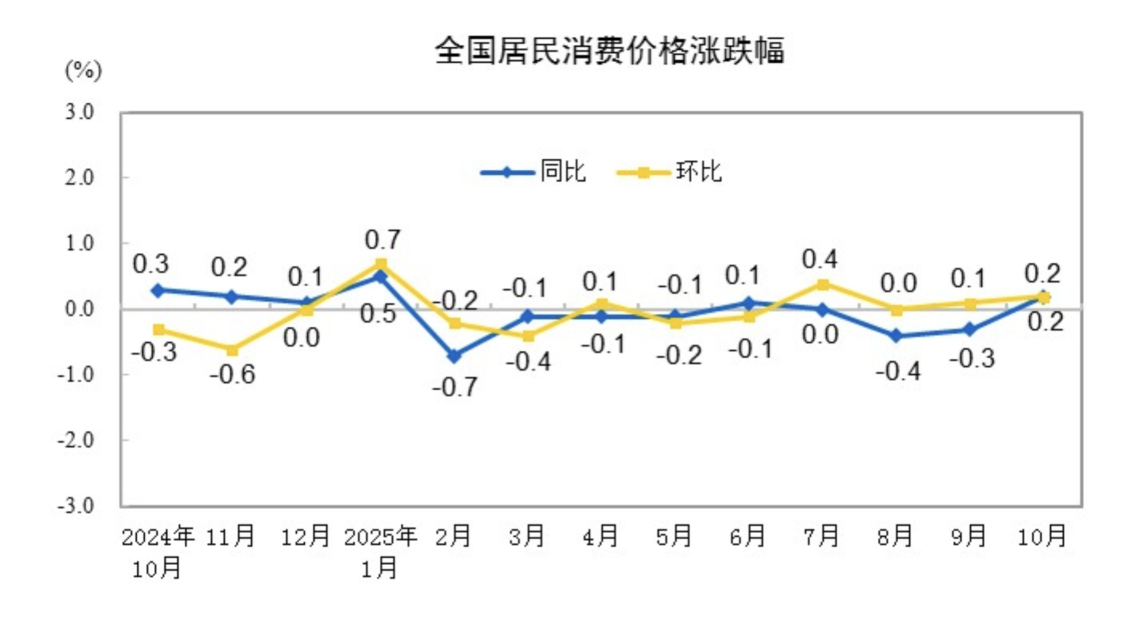
Group 1: Inflation Data - The core CPI increased by 1.2% year-on-year in October, marking the highest level since March 2024 and the sixth consecutive month of growth [4] - The overall CPI turned from a decrease of 0.3% in September to an increase of 0.2% in October, indicating a positive shift in consumer prices [2][5] - The PPI decreased by 2.1% year-on-year in October, but the decline has narrowed for three consecutive months, reflecting improvements in certain industry supply-demand relationships [6][8] Group 2: Economic Signals - The October inflation data signals a steady enhancement of economic vitality and the continuous release of domestic demand potential, supported by effective policies [1][4] - The recovery in core CPI suggests a robust recovery in domestic consumption, particularly in service consumption, indicating a solidifying price foundation [4][13] - The improvement in price data is seen as a comprehensive result of macroeconomic policy effects and balanced supply-demand relationships [4][8] Group 3: Future Outlook - The upcoming inflation trends are expected to show "strong food, weak energy, and stable core" characteristics, with potential for slight rebounds in food prices due to seasonal factors [5] - The government emphasizes the need for policies to further stimulate domestic demand and enhance consumer spending, which is crucial for economic growth [10][12] - The overall economic environment is projected to improve, with CPI gradually rising and PPI deflationary pressures easing, contributing to a more stable price level [13]
【新华解读】10月份我国物价走势向好 释放“内需改善”积极信号
Xin Hua Cai Jing· 2025-11-09 11:04
Core Insights - The Consumer Price Index (CPI) in China has turned from a decline to an increase year-on-year, with the core CPI rising for the sixth consecutive month, indicating a positive shift in domestic demand [1][2] - The Producer Price Index (PPI) has shown its first month-on-month increase this year, signaling improvements in the upstream production sector [1][4] CPI Analysis - In October, the CPI increased by 0.2% month-on-month, slightly above seasonal levels, and turned from a 0.3% decline to a 0.2% increase year-on-year [1][2] - The core CPI, excluding food and energy, rose by 1.2% year-on-year, marking a continuous expansion for six months [1][2] - Key contributors to the CPI increase include rising prices in food, services, and industrial consumer goods [2] PPI Analysis - The PPI increased by 0.1% month-on-month in October, marking its first rise this year, while the year-on-year decline narrowed to 2.1% [1][4] - Factors such as improved market supply-demand relationships and price recoveries in key industries contributed to the PPI's positive change [4] Sector-Specific Insights - Service prices rose by 0.2% month-on-month and 0.8% year-on-year, with industrial consumer goods prices increasing by 0.3% month-on-month and 2.0% year-on-year [2][3] - The jewelry sector saw significant price increases, with gold and platinum jewelry prices rising by 50.3% and 46.1% year-on-year, respectively [2] Future Outlook - Experts predict that the CPI is likely to continue rising, while the PPI's year-on-year decline is expected to narrow further, with potential for positive growth in the first half of next year [5]
CPI由降转涨 PPI降幅收窄——透视10月物价数据
Xin Hua Wang· 2025-11-09 08:51
Core Insights - The Consumer Price Index (CPI) increased by 0.2% year-on-year and month-on-month in October, marking a shift from a 0.3% decline in the previous month [1][2] - The Producer Price Index (PPI) decreased by 2.1% year-on-year, but the decline narrowed by 0.2 percentage points compared to the previous month, continuing a trend of narrowing for three consecutive months [1][6] CPI Analysis - The CPI's year-on-year increase of 0.2% is attributed to effective domestic demand policies and the impact of the National Day and Mid-Autumn Festival holidays [1] - Core CPI, excluding food and energy, rose by 1.2% year-on-year, marking the sixth consecutive month of growth [1] - Service prices increased by 0.8%, with a notable rise in accommodation, airfare, and tourism prices due to heightened travel demand during the holidays [2][3] PPI Analysis - The PPI experienced its first month-on-month increase of 0.1% this year, driven by improved supply-demand dynamics in certain industries [5] - Year-on-year, the PPI's decline of 2.1% reflects a narrowing trend, with specific industries like coal mining and photovoltaic equipment manufacturing showing reduced price declines [6] - Prices in sectors such as art and craft manufacturing and sports equipment manufacturing saw significant increases, indicating a positive response to consumption-boosting policies [6]