
钨矿

Search documents
钨价强势突破50万元大关,佳鑫国际资源(03858)年内市值或有望升至千亿?
智通财经网· 2026-01-16 10:09
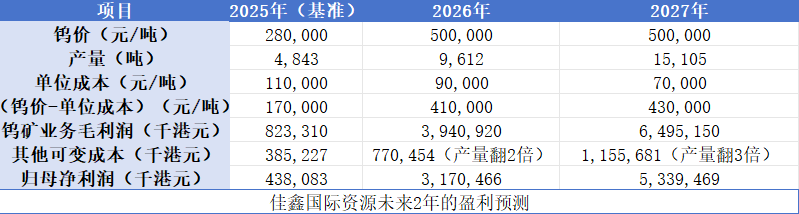
Group 1: Company Overview - Jaxin International Resources (03858) is positioned as a "10x stock" with significant tungsten mining resources, accelerating towards its growth targets [1] - Since its debut on the Hong Kong Stock Exchange, Jaxin's stock price has surged by over 591.39%, reaching a peak of 75.5 HKD per share [1] - The company is expected to enter the "billion-dollar club" as tungsten prices remain high and production capacity is released [1] Group 2: Tungsten Market Dynamics - The tungsten market in China experienced a rare bull market in 2025, with prices rising over 220% for major tungsten products, marking the largest annual increase in over a decade [2][3] - As of January 16, 2026, tungsten prices have continued to rise, with black tungsten concentrate exceeding 510,000 CNY per ton, APT at 750,000 CNY per ton, and tungsten powder at 1,210 CNY per kilogram [2] - The supply-demand relationship is expected to remain tight, with global tungsten production projected to increase from 79,500 tons to 89,900 tons, while demand is expected to rise from 96,200 tons to 110,000 tons by 2028 [3] Group 3: Production Capacity and Financial Projections - Jaxin's Bakuta tungsten mine has a resource of 1.07 billion tons of ore, with a production target of 4,843 tons of tungsten concentrate in 2025, increasing to 9,612 tons in 2026 and 15,105 tons in 2027 [6][7][8] - The company anticipates a net profit of approximately 4.38 billion HKD in 2025, with projections of 31.7 billion HKD and 53.4 billion HKD for 2026 and 2027, respectively, assuming tungsten prices stabilize at 500,000 CNY per ton [7][8] - If the company achieves its production and pricing targets, it could see a tenfold increase in net profit from 2025 to 2027, potentially elevating its market valuation significantly [8] Group 4: Investment Considerations - Key factors for investors include whether Jaxin's 2025 performance meets expectations, the sustainability of the 500,000 CNY tungsten price level, and the successful execution of production targets [9] - Achieving stability in both price and production will significantly enhance the likelihood of Jaxin reaching its billion-dollar valuation goal [9]

港股异动 | 佳鑫国际资源(03858)再涨超8% 总市值逼近350亿港元 黑钨精矿价格突破50万元大关
智通财经网· 2026-01-16 01:52
Group 1 - The core viewpoint of the article highlights the strong performance of Jaxin International Resources (03858), with its stock price increasing by over 8% and reaching 74.4 HKD, resulting in a market capitalization nearing 35 billion HKD [1] - Tungsten prices are expected to maintain a strong trend into 2026, with black tungsten concentrate prices exceeding 500,000 RMB per ton, APT prices surpassing 730,000 RMB, and tungsten powder prices approaching 1,200,000 RMB [1] - A report from Western Securities indicates that the domestic tungsten industry will enter its last long-term pricing window in December 2025, with multiple companies expected to announce price increases for the year [1] Group 2 - First Shanghai's report emphasizes that Jaxin International Resources' core asset is the Bakuta tungsten mine project, covering the entire value chain from exploration to processing and sales, with tungsten concentrate as the main product [1] - The company is considered to be at a critical value release inflection point, possessing world-class core assets that lay the foundation for long-term growth [1] - Jaxin International Resources is identified as a rare pure tungsten mining stock in the market, with its current share price offering a high margin of safety and attractiveness [1]
上证早知道|央行官宣:结构性降息;优惠政策延续 两部门发文;钨价 持续走高
Shang Hai Zheng Quan Bao· 2026-01-15 22:58
Industry Events - The 2026 Nuclear Fusion Energy Technology and Industry Conference will be held in Hefei, Anhui from January 16 to 17, 2026 [1] - The first "AI + Traditional Industry" Practical Application Development Forum will take place on January 16 [1] Monetary Policy - The People's Bank of China will lower various structural monetary policy tool rates by 0.25 percentage points, with the one-year re-lending rate decreasing from 1.5% to 1.25% [2] Tax Policy - The Ministry of Finance and the State Administration of Taxation announced the extension of the VAT exemption policy for foreign institutions investing in national bonds and local government bonds from August 8, 2025, to December 31, 2027 [2] Semiconductor Industry - TSMC reported Q4 2025 revenue of $33.73 billion, a 25.5% year-on-year increase, driven by strong demand for high-end chips due to AI computing [4] - TSMC's capital expenditure for 2026 is projected to reach $52 billion to $56 billion, indicating robust future AI computing demand [4] Tungsten Products - Prices for tungsten products have increased, with black tungsten concentrate and white tungsten concentrate rising by 5,000 yuan/ton, and tungsten iron and ammonium paratungstate increasing by 10,000 yuan/ton [5] - Global tungsten supply growth is limited, with a projected compound annual growth rate of 2.57% from 2023 to 2028 for raw tungsten supply [5] Aerospace Industry - The Beijing Rocket Street project has completed construction and is now entering the delivery phase, becoming the first commercial aerospace research and production base in China [6] - The project will provide various shared services to support the full chain development of commercial aerospace [6] Company News - Xinghua New Materials plans to acquire at least 51% of Hangzhou Tiankuan Technology, which focuses on AI computing center construction and operation [7] - Zhenghai Magnetic Materials expects a net profit of 310 million to 380 million yuan for 2025, a year-on-year increase of 235.72% to 311.52% [7] - Sanmei Co. anticipates a net profit of 1.99 billion to 2.15 billion yuan for 2025, reflecting a growth of 155.66% to 176.11% [8] Investment Activity - Multiple broad-based ETFs saw significant trading volume increases, with the Southern CSI 500 ETF reaching a record high turnover of 26.3 billion yuan on January 15 [10] - Institutional investors net bought shares in aerospace electrical equipment companies, indicating strong interest in the sector [11]
晚报 | 1月16日主题前瞻
Xuan Gu Bao· 2026-01-15 14:22
Semiconductor Industry - TSMC reported Q4 2025 revenue of $33.73 billion, a 25.5% year-over-year increase and a 1.9% quarter-over-quarter increase, with a gross margin of 62.3%, driven by strong demand for high-end chips due to the AI computing wave [1] - TSMC's capital expenditure is expected to reach $52-56 billion in 2026, exceeding market expectations, indicating robust future AI computing demand [1] Tungsten Industry - Domestic prices for tungsten products have increased, with black tungsten concentrate and ammonium paratungstate prices rising by 5,000 yuan/ton and tungsten iron by 10,000 yuan/ton [1] - Global tungsten supply growth is limited, with a projected compound annual growth rate of 2.57% from 2023 to 2028, while demand is expected to grow at 2.61% during the same period, driven by emerging industries [2] Commercial Aerospace - Beijing's Rocket Street project has completed its construction and will serve as China's first commercial aerospace research and production base, offering various shared services for the entire commercial aerospace development chain [3] - The U.S. aims to produce 10,000 Starship spacecraft annually, and the FCC has approved SpaceX's deployment of an additional 7,500 second-generation Starlink satellites, totaling 15,000 [3] Power Grid Equipment - The State Grid's investment plan for the 14th Five-Year Plan is set at 4 trillion yuan, a 40% increase from the previous plan, focusing on green transformation and new power system construction [4] - This investment is expected to lead to significant upgrades in China's power system, enhancing energy security and global competitiveness [4] Carbon Fiber Industry - A breakthrough in domestic T1000-grade high-performance carbon fiber has been achieved, with each fiber having 12,000 filaments and a tensile strength exceeding 6,600 MPa, marking a significant advancement in high-end materials [5] - By 2030, China's carbon fiber production capacity is expected to exceed 250,000 tons, with demand in the new energy vehicle sector projected to rise significantly [6] GaN Power Products - Onsemi has signed a collaboration agreement with GlobalFoundries to develop advanced GaN power products, starting with 650V devices, to meet the growing power demands in various sectors [6] - GaN technology is expected to enhance efficiency and reduce costs in applications such as AI data centers and electric vehicles [7]

港股午评|恒生指数早盘跌0.55% 有色资源板块逆市走高
Zhi Tong Cai Jing· 2026-01-15 04:08
Market Overview - The Hang Seng Index fell by 0.55%, down 149 points, closing at 26,850 points, while the Hang Seng Tech Index dropped by 1.83% [1] - The trading volume in the Hong Kong stock market reached HKD 163.9 billion in the morning session [1] Company Highlights - Jiexin International Resources (03858) rose over 5%, reaching a new high as black tungsten ore prices surpassed 500,000 yuan, prompting several tungsten companies to raise long-term contract prices [1] - Likin Resources (02245) increased by over 10% due to disruptions in Indonesian nickel ore quotas, while Zhongwei New Materials (02579) gained over 9% [1] - China Rare Earth Holdings (03788) experienced significant volatility, rising by 8% after announcing the termination of its spin-off listing plan and plans to rename itself "Rare Earth Gold" [1] - Ocean Park Hong Kong (02255) surged over 10%, with visitor numbers on the first day of the New Year holiday increasing by 60% year-on-year [1] - Zhipu (02513) rose over 4% after announcing a collaboration with Huawei to open-source a new generation image generation model [1] - China Heartland Fertilizer (01866) increased by over 4%, anticipating a potential global urea supply shortage, and has been actively repurchasing shares [1] - Woan Robotics (06600) gained over 7% following the release of its humanoid intelligent robot, Onero [1] - Jiantao Laminates (01888) saw a nearly 6% increase after announcing a price hike, which is expected to become a trend in the copper-clad laminate industry [1] - Qiu Tai Technology (01478) declined over 7% as Citigroup reported that the company's net profit last year fell below expectations [1] Other Notable Movements - Kanglong Chemical (03759) dropped over 5% after announcing a placement of shares at an 8.5% discount, aiming to raise nearly HKD 1.32 billion [2] - Trip.com Group (09961) plummeted over 19% due to an investigation by the State Administration for Market Regulation for alleged monopoly practices, while Same City Travel (00780) fell over 11% [2]
恒生指数早盘跌0.55% 有色资源板块逆市走高
Zhi Tong Cai Jing· 2026-01-15 04:06
Group 1 - The Hang Seng Index fell by 0.55%, down 149 points, closing at 26,850 points, while the Hang Seng Tech Index dropped by 1.83% [1] - Ctrip Group-S experienced a significant decline of over 19% due to an antitrust investigation initiated by the State Administration for Market Regulation [2] - Kaisa International Resources (03858) rose over 5% to reach a new high, with black tungsten concentrate prices surpassing 500,000 yuan, prompting several tungsten companies to raise long-term contract prices [1] Group 2 - Likin Resources (02245) surged over 10% and Zhongwei New Materials (02579) increased by over 9% amid disruptions in Indonesia's nickel ore quotas [1] - China Rare Earth Holdings (03788) saw a significant fluctuation, rising by 8% after the company's plan to spin off its gold business was terminated, and it intends to rename itself "Rare Earth Gold" [1] - Haichang Ocean Park (02255) increased by over 10%, with visitor numbers on the first day of the New Year holiday rising by 60% year-on-year [1] Group 3 - Zhihui (02513) rose over 4% after announcing a collaboration with Huawei to open-source a new generation image generation model [1] - China Heartland Fertilizer (01866) also increased by over 4%, as a global urea supply shortage may arise, and the company is actively repurchasing shares [1] - Woan Robotics (06600) saw a rise of over 7% following the release of its humanoid intelligent robot, Onero [1] Group 4 - Jiantao Laminates (01888) rose nearly 6% during intraday trading after announcing a price increase, which is expected to become a prevailing trend in the copper-clad laminate industry [1] - Q Technology (01478) retracted over 7% after Citigroup reported that the company's net profit last year fell below its expectations [1] - Kanglong Chemical (300759) (03759) dropped over 5% as it plans to conduct a placement at an 8.5% discount, raising nearly 1.32 billion HKD [1]
港股异动 | 佳鑫国际资源(03858)涨超7%再创新高 黑钨精矿突破50万元 多家钨企上调长单报价
智通财经网· 2026-01-15 02:18
Group 1 - The core viewpoint of the article highlights that Jaxin International Resources (03858) has seen a significant increase in stock price, rising over 7% to reach a historical high of 68.8 HKD, with a trading volume of 28.09 million HKD [1] - Tungsten prices are expected to maintain a strong upward trend into 2026, with black tungsten concentrate prices exceeding 500,000 RMB per ton, APT prices surpassing 730,000 RMB, and tungsten powder prices approaching 1,200,000 RMB [1] - Major tungsten companies and industry organizations, including Zhangyuan Tungsten Industry, Xianglu Tungsten Industry, and Ganzhou Tungsten Association, have recently raised their new pricing, further boosting market bullish sentiment [1] Group 2 - Jaxin International Resources is a tungsten mining development company headquartered in Kazakhstan, with its core asset being the Bakuta tungsten project [1] - First Shanghai believes that the company is at a critical value release inflection point, possessing world-class core assets that lay the foundation for long-term growth [1] - The company is considered a rare pure tungsten mining target in the market, with its current stock price offering a high margin of safety and attractiveness [1]
佳鑫国际资源涨超7%再创新高 黑钨精矿突破50万元 多家钨企上调长单报价
Zhi Tong Cai Jing· 2026-01-15 02:17
Group 1 - Jaxin International Resources (03858) saw a rise of over 7%, reaching a historical high of 68.8 HKD, with a trading volume of 28.0872 million HKD [1] - Tungsten prices continue to show a strong trend entering 2026, with black tungsten concentrate prices exceeding 500,000 RMB per ton, APT prices surpassing 730,000 RMB, and tungsten powder prices approaching 1,200,000 RMB [1] - Major tungsten companies and industry organizations, including Zhangyuan Tungsten Industry (002378), Xianglu Tungsten Industry (002842), and Ganzhou Tungsten Association, have recently raised their new pricing, further boosting market bullish sentiment [1] Group 2 - Jaxin International Resources is a tungsten mining development company headquartered in Kazakhstan, with its core asset being the Bakuta tungsten project [1] - First Shanghai believes the company is at a critical value release inflection point, possessing world-class core assets that lay the foundation for long-term growth [1] - The company is a rare pure tungsten mining target in the market, and its current stock price offers a high margin of safety and attractiveness [1]
港股异动 | 佳鑫国际资源(03858)涨超5%再破顶 钨业龙头上调长单报价 钨价持续创历史新高
智通财经网· 2026-01-14 03:28
Core Viewpoint - Jiaxin International Resources (03858) has seen its stock price increase by over 5%, reaching a new high of 63.15 HKD, which is nearly five times its IPO price of 10.62 HKD [1] Group 1: Company Overview - Jiaxin International Resources is a tungsten mining company headquartered in Kazakhstan, with its core asset being the Bakuta tungsten project [1] - The company's business model encompasses the entire value chain of tungsten mining, including exploration, extraction, processing, and sales, with tungsten concentrate as its main product [1] Group 2: Market Dynamics - On January 5, Zhangyuan Tungsten announced an increase in long-term procurement prices for its 55% grade black tungsten concentrate, 55% grade white tungsten concentrate, and national standard zero-grade ammonium paratungstate, compared to the second half of December 2025 [1] - Huayuan Securities noted that the tightening supply-demand dynamics have led tungsten prices to exceed 480,000 RMB per ton, setting a new historical high [1] Group 3: Investment Potential - First Shanghai believes that the company is at a critical value release inflection point and possesses world-class core assets, which lay the foundation for long-term growth [1] - The company is considered a rare pure tungsten mining target in the market, with its current stock price offering a high margin of safety and attractiveness [1]
全球策略-多行业联合电话会议-3月港股通调整前瞻
2026-01-12 01:41
Summary of Conference Call Records Industry Overview - The conference call focused on the Hong Kong stock market and various sectors including futures trading, virtual currency exchanges, and aluminum production. [1][2][5] Key Points and Arguments Hong Kong Stock Market - Significant inflow of capital into the Hong Kong stock market, with net inflow from January 1 to January 8 exceeding the total for December [1][2] - The appreciation of the Renminbi is expected to enhance the attractiveness of Hong Kong stocks to foreign investors [2] South China Futures - South China Futures has seen rapid growth in international business, with margin scale increasing from 3 billion to approximately 16 billion since 2021 [6] - Expected overseas business profit could reach 600 million RMB, benefiting from the shift of settlement business to Chinese companies and the interest rate environment [6][7] Virtual Currency Exchanges - Hashkey Holdings and OSL Group are actively developing in the virtual currency sector, with OSL Group projecting significant revenue growth by 2025 despite current losses [8][9] - OSL's revenue increased by nearly 60% in 2025, with trading volume up 200%, but the company remains in a loss position [9][10] - Hashkey focuses on building foundational systems and has a high percentage of institutional users [11] Securities and Financial Services - Yao Cai Securities reported a 6% increase in revenue and a 4.5% increase in net profit for the first half of 2025, driven by a 77% increase in brokerage income due to higher trading volumes [12][13] - The company has implemented technology to enhance customer retention and cross-border trading activity [12] Aluminum Industry - Innovation Industry has a strong position in the aluminum sector, with low power costs and logistical advantages [14] - The company plans to increase production capacity significantly by 2027, anticipating a supply-demand imbalance in the industry [14] Tungsten Resources - Jiaxing International owns a large open-pit tungsten mine with low extraction costs and significant resource potential [15][16] - The company is expected to increase production capacity significantly by 2027, with tungsten prices having risen over 200% since early 2025 [17] JD Industrial - JD Industrial, a subsidiary of JD Group, has shown steady growth with a focus on MRO and BOM segments, aiming to expand its market significantly [18][19] - The company reported an 18.9% revenue growth in the first half of 2025, with a focus on improving gross margins [19] Robotics Industry - Geekplus Robotics is a leader in the AMR sector, with a strong competitive edge due to its technology and customer base [20][21] - The company is expected to enter the Hong Kong Stock Connect in February 2026, which could act as a catalyst for its stock price [24] Biotech Sector - Weili Zhibo is developing next-generation antibody therapies with promising clinical data [25][26] - The company is focusing on universal CAR-T therapies, which could significantly reduce treatment costs compared to autologous CAR-T therapies [29][30] Other Important Insights - The upcoming adjustments to the Hong Kong Stock Connect are expected to include around 50 new stocks, primarily in healthcare, information technology, and consumer discretionary sectors [5] - The potential impact of U.S. government decisions and domestic policies in China on the market was discussed, highlighting the interconnectedness of global and local factors [3][4] This summary encapsulates the key insights and developments discussed during the conference call, providing a comprehensive overview of the current state and future outlook of the relevant industries.