
铁路运输业

Search documents
铁路投资持续领跑,高技术产业投资依然亮眼
Hua Xia Shi Bao· 2025-11-15 10:20
Investment Overview - In the first ten months of the year, overall investment has declined, but investments related to people's livelihood and high-tech industries have shown strong performance [2] - Fixed asset investment (excluding rural households) reached 37,153.5 billion yuan, a year-on-year decrease of 0.5%, while investment excluding real estate development grew by 3.0% [2] - October saw a significant drop in fixed investment, with a year-on-year decline of 10.7% [2] Sector Performance - High-tech industries continue to grow significantly, with investments in information services, aerospace, and computer manufacturing increasing by 33.1%, 20.6%, and 7.4% respectively, outperforming overall investment growth rates [2] - Railway construction has been robust, with fixed asset investment reaching 671.5 billion yuan, a year-on-year increase of 5.7% [2][4] Infrastructure Investment - Infrastructure investment grew by 1.1% in the first three quarters, contributing to a 0.2 percentage point increase in total investment [5] - Railway investment growth is notably higher than the average, with several key projects progressing well [4][5] Real Estate Sector - Real estate investment has seen a significant decline, with a year-on-year drop of 14.7% in the first ten months, negatively impacting overall investment growth [7] - In October, real estate investment decreased by 23%, with sales area and funding for real estate companies also declining sharply [6][7] Manufacturing and Other Industries - Manufacturing investment grew by 2.7% year-on-year, accounting for 25.6% of total investment, which is an increase from the previous year [7] - Investments in the automotive and transportation equipment sectors maintained double-digit growth [5] Green and High-Tech Investments - Investments in high-tech sectors such as aerospace and information services grew by 19.7% and 32.7% respectively [8] - Clean energy investments, including solar and wind power, saw a combined year-on-year growth of 10.4% [8] Economic Outlook - Despite a slight decline in investment in October, the overall investment potential remains significant, with expectations for reasonable growth in the fourth quarter due to new policies and financial tools [3][8]

国家统计局:1—10月全国固定资产投资408914亿元
Yang Shi Wang· 2025-11-14 02:31
Core Insights - National fixed asset investment (excluding rural households) in China for January to October 2025 reached 408,914 billion yuan, representing a year-on-year decline of 1.7% [1] - Private fixed asset investment saw a more significant decrease, down 4.5% year-on-year [1] - In October, fixed asset investment (excluding rural households) decreased by 1.62% month-on-month [1] Investment by Industry - First industry investment totaled 8,075 billion yuan, with a year-on-year growth of 2.9% [1] - Second industry investment amounted to 148,411 billion yuan, showing a growth of 4.8% [1] - Third industry investment reached 252,429 billion yuan, experiencing a decline of 5.3% year-on-year [1] Second Industry Breakdown - Industrial investment in the second industry grew by 4.9% year-on-year [1] - Mining investment increased by 3.8%, while manufacturing investment rose by 2.7% [1] - Investment in the electricity, heat, gas, and water production and supply sector surged by 12.5% [1] Third Industry Insights - Infrastructure investment (excluding electricity, heat, gas, and water production and supply) saw a slight decline of 0.1% year-on-year [1] - Pipeline transportation investment grew by 13.8%, while water transportation investment increased by 9.4% [1] - Railway transportation investment experienced a growth of 3.0% [1]
国家统计局:1-10月份电力、热力、燃气及水生产和供应业投资增长12.5%
Guo Jia Tong Ji Ju· 2025-11-14 02:31
Core Insights - National fixed asset investment (excluding rural households) reached 4,089.14 billion yuan from January to October 2025, showing a year-on-year decline of 1.7% [1] - Private fixed asset investment decreased by 4.5% year-on-year [1] Investment by Industry - Investment in the primary industry was 80.75 billion yuan, with a year-on-year growth of 2.9% [3] - Investment in the secondary industry totaled 1,484.11 billion yuan, growing by 4.8% [3] - Investment in the tertiary industry was 2,524.29 billion yuan, declining by 5.3% [3] - Within the secondary industry, industrial investment increased by 4.9%, with mining investment up by 3.8%, manufacturing investment up by 2.7%, and investment in electricity, heat, gas, and water production and supply up by 12.5% [3] - In the tertiary industry, infrastructure investment (excluding electricity, heat, gas, and water production and supply) saw a slight decline of 0.1% [3] Regional Investment Trends - Eastern region investment decreased by 5.4% year-on-year [3] - Central region investment fell by 0.5% [3] - Western region investment grew by 0.4% [3] - Northeastern region investment declined significantly by 11.7% [3] Investment by Registration Type - Domestic enterprises' fixed asset investment decreased by 1.7% year-on-year [4] - Investment from Hong Kong, Macau, and Taiwan enterprises fell by 1.8% [4] - Foreign enterprises' fixed asset investment saw a notable decline of 12.1% [4]
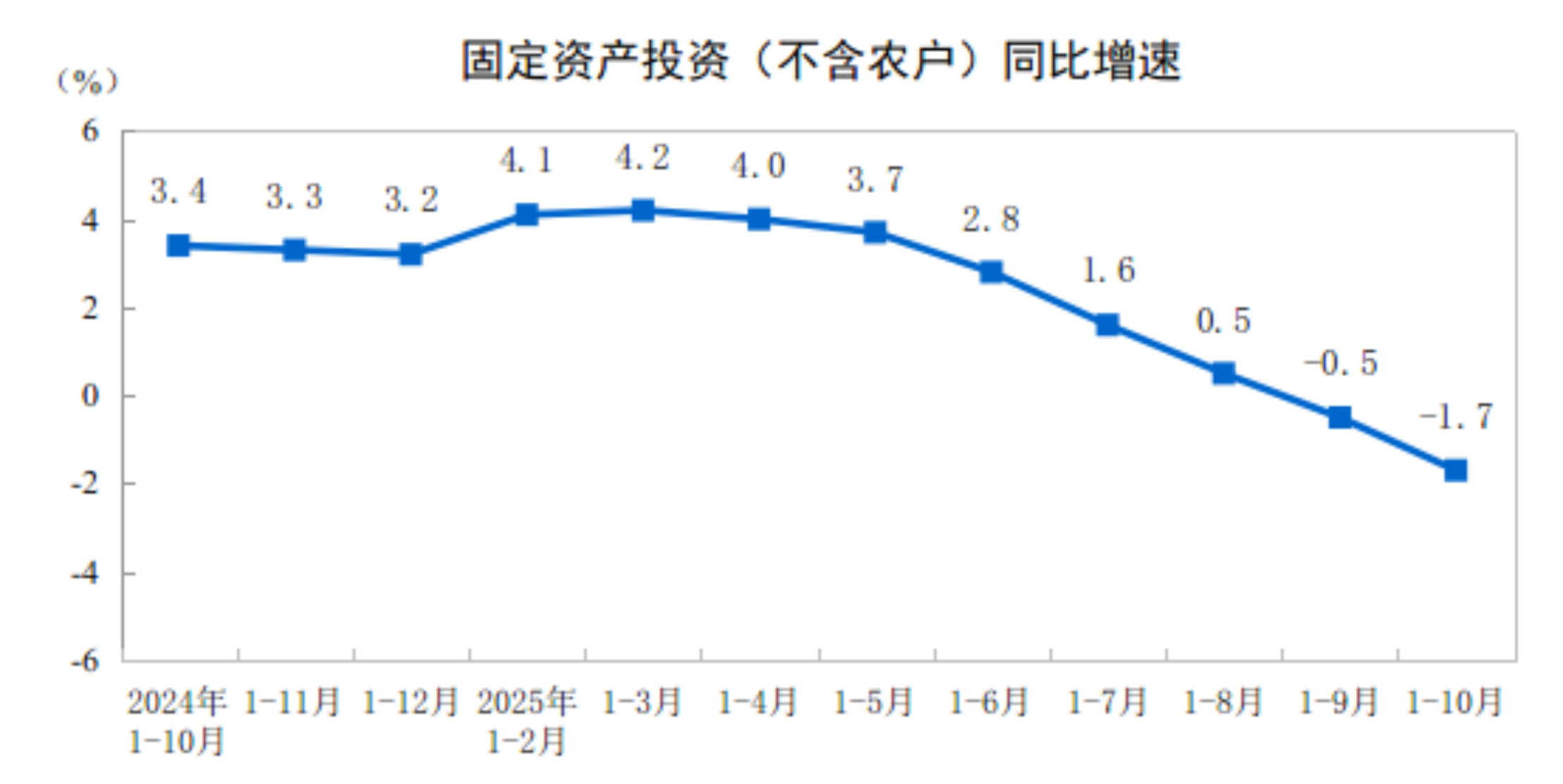
国家统计局:1—10月份全国固定资产投资(不含农户)同比下降1.7%
Xin Hua Cai Jing· 2025-11-14 02:29
Core Insights - National fixed asset investment (excluding rural households) in China for January to October 2025 reached 408.914 billion yuan, representing a year-on-year decline of 1.7% [1] - Private fixed asset investment saw a year-on-year decrease of 4.5% [1] - In October, fixed asset investment (excluding rural households) decreased by 1.62% month-on-month [1] Investment by Industry - First industry investment totaled 80.75 billion yuan, with a year-on-year growth of 2.9% [3] - Second industry investment reached 1,484.11 billion yuan, growing by 4.8% year-on-year, with industrial investment specifically increasing by 4.9% [3] - Within the second industry, mining investment grew by 3.8%, manufacturing investment increased by 2.7%, and investment in electricity, heat, gas, and water production and supply surged by 12.5% [3] - Third industry investment amounted to 2,524.29 billion yuan, showing a year-on-year decline of 5.3% [3] - Infrastructure investment in the third industry (excluding electricity, heat, gas, and water production and supply) saw a slight decrease of 0.1% [3] - Notable growth in infrastructure investment included pipeline transportation (up 13.8%), water transportation (up 9.4%), and railway transportation (up 3.0%) [3] Investment by Region - Eastern region investment declined by 5.4% year-on-year [3] - Central region investment decreased by 0.5% [3] - Western region investment experienced a slight increase of 0.4% [3] - Northeastern region investment fell significantly by 11.7% [3] Investment by Registration Type - Domestic enterprise fixed asset investment decreased by 1.7% year-on-year [3] - Investment from Hong Kong, Macau, and Taiwan enterprises declined by 1.8% [3] - Foreign enterprise fixed asset investment saw a notable drop of 12.1% [3]
泰国国王“历史性”来华访问,泰方发言人:泰中两国亲密友谊的最高象征
Huan Qiu Shi Bao· 2025-11-12 23:18
Group 1 - The visit of Thai King Vajiralongkorn to China from November 13 to 17 marks the first official visit by a Thai monarch to China in the 50 years since the establishment of diplomatic relations, highlighting the strengthening ties between the two nations [1][2] - The visit is expected to enhance long-standing friendship and mutual understanding between the peoples of China and Thailand, coinciding with the 50th anniversary of diplomatic relations [1][2] - The Thai royal couple will meet with Chinese leaders and visit various sites in Beijing, including a special exhibition celebrating the 50th anniversary of diplomatic relations [1][2] Group 2 - The significance of this visit is underscored by the fact that since the establishment of diplomatic relations in 1975, there has been a lack of royal-level diplomacy from Thailand to China, which this visit aims to address [2] - Potential discussion topics during the visit may include trade, tourism, and high-speed rail cooperation, reflecting the growing trade and investment between the two countries [2][3] - China is Thailand's largest import market, with over $80 billion worth of goods imported from China last year, and is also a key source of tourists for Thailand [2][3] Group 3 - Thailand has been facing challenges in attracting tourists, particularly from China, due to factors such as the appreciation of the Thai baht and increased competition from neighboring countries [3] - In response, Thailand has initiated measures to enhance tourist safety and experience, including the "China-Thailand Friendship Month" [3] - The ongoing railway cooperation between China and Thailand, including the approval of the second phase of the railway project, is also a focal point of bilateral relations [3]
绿能慧充:控股股东拟协议转让3700万股
Mei Ri Jing Ji Xin Wen· 2025-11-12 11:15
Group 1 - The core point of the article is that Green Energy Huichong (SH 600212) announced a share transfer agreement where its controlling shareholder, Shenzhen Jinghong Yicheng Industrial Development Co., Ltd., will transfer 37 million unrestricted circulating shares (approximately 5.25% of the total share capital) to Shenzhen Ruitao Asset Management Co., Ltd. This transfer will not change the controlling shareholder or actual controller of the company, nor will it significantly impact the company's governance structure or future operations [1] - The share transfer agreement is subject to necessary approvals and other procedures [1] - For the first half of 2025, Green Energy Huichong's revenue composition is as follows: Green Energy Technology accounts for 96.81%, Zhongchuang Aviation Company accounts for 2.01%, railway transportation accounts for 1.53%, and other businesses account for -0.35% [1] Group 2 - As of the report, Green Energy Huichong has a market capitalization of 5.9 billion yuan [2]

推动物流降本提质增效
Jing Ji Ri Bao· 2025-11-05 22:02
Core Insights - The recent State Council meeting emphasized the need to continuously reduce logistics costs and improve quality and efficiency, aiming to build a modern logistics system that is adaptable, interconnected, safe, efficient, smart, and green [1] Group 1: Logistics Cost and Efficiency - The social logistics cost as a percentage of GDP has decreased to 14% in the first half of the year, down 0.1 and 0.2 percentage points from the previous quarter and the same period last year, indicating improved logistics efficiency [1] - The demand for logistics services is being bolstered by the steady decline in logistics costs, with new order indices in various transport sectors, including rail, road, air, multimodal transport, and express delivery, showing a month-on-month increase of over 0.5 percentage points in September [1] - In the first three quarters of this year, China's express delivery volume reached 1,450.8 billion items, reflecting a year-on-year growth of 17.2%, highlighting the rapid development of the express delivery sector [1] Group 2: Challenges and Future Goals - A significant challenge remains in the logistics sector, where low costs in single segments contrast with high costs across the entire supply chain. The goal is to reduce the logistics cost-to-GDP ratio to around 13.5% by 2027 [2] - Enhancing supply capacity is crucial for improving the overall competitiveness of the logistics industry, necessitating innovation in technology, products, and services to meet the demands of industrial and consumption upgrades [2] - The construction of a modern delivery logistics system and a comprehensive transportation network is essential for improving conversion efficiency and creating a high-efficiency operational system that allows for seamless intermodal and inter-regional logistics [2] Group 3: Policy and Market Environment - The development of a unified, efficient, and competitively orderly logistics market is vital for reducing costs and improving quality. Current multi-modal transport levels have increased but still lag behind international standards due to institutional barriers [3] - Collaboration among relevant departments and local governments is necessary to strengthen policy support and ensure the availability of land and resources for infrastructure projects like dedicated railway lines [3] - Initiatives such as implementing a unified bill of lading for multi-modal transport and expanding pilot programs for container transport are essential for enhancing logistics efficiency [3]
制造业PMI为何超季节性回落?:——2025年10月PMI点评
EBSCN· 2025-10-31 12:32
Manufacturing Sector - The manufacturing PMI for October 2025 is reported at 49.0%, a significant decrease of 0.8 percentage points from the previous month, which is notably higher than the seasonal average decline of 0.4 percentage points observed from 2020 to 2024[2][5] - The production index fell by 2.2 percentage points to 49.7%, while the new orders index decreased by 0.9 percentage points to 48.8%[5][15] - The new export orders index dropped to 45.9%, down 1.9 percentage points, marking the second-lowest level since the introduction of high tariffs in April 2025[5][20] - Small enterprises experienced a notable decline in PMI, falling 1.1 percentage points to 47.1%, while large enterprises' PMI decreased to 49.9%[6] Non-Manufacturing Sector - The non-manufacturing PMI for October 2025 is at 50.1%, slightly up from 50.0% in the previous month, driven by holiday consumption[2][28] - The service sector showed improvement, with indices for transportation, retail, and entertainment exceeding 60%, indicating strong performance in consumer-related services[28] - The construction PMI fell to 49.1%, but new orders and business activity expectations increased, suggesting a potential recovery in infrastructure activities[34] Economic Outlook - The report highlights that the construction sector may benefit from the introduction of 500 billion yuan in new policy financial tools and an additional 200 billion yuan in special bond issuance, which could support infrastructure investment[4][34] - The overall economic environment remains cautious due to external trade uncertainties and domestic demand stability, particularly in high-energy-consuming industries[16][20]
月度经济观察·10月份多领域数据出炉 经济继续保持平稳增长态势明显
Yang Shi Wang· 2025-10-31 05:36
Core Insights - The Purchasing Managers' Index (PMI) for China's manufacturing sector in October is reported at 49%, a decrease of 0.8 percentage points from the previous month, influenced by seasonal factors and external conditions [1][2] - Despite the decline in PMI, new momentum and consumer goods manufacturing are showing steady growth, with key sectors like equipment manufacturing and high-tech manufacturing remaining in the expansion zone [2][4] Manufacturing Sector - The equipment manufacturing price index reached a new high since June 2024, while the high-tech manufacturing price index hit a new high since 2025, indicating positive price changes in the manufacturing sector [4] - The production index and new orders index for key manufacturing sectors are operating around 51%, reflecting a stable expansion [2] Non-Manufacturing Sector - The non-manufacturing business activity index for October is at 50.1%, a slight increase of 0.1 percentage points from the previous month, maintaining levels above 50 since 2025 [7] - The service sector shows strong performance, particularly in contact-based services related to travel, shopping, and entertainment, with indices for railway and air transport exceeding 60% [6] Investment and Economic Outlook - There are signs of accelerated construction activities related to infrastructure investment, with the civil engineering business activity index rising above 55%, and new orders index increasing to over 49% [9] - The business activity expectation index for non-manufacturing is at 56.1%, indicating a positive outlook for the sector, supported by fiscal and monetary policy collaboration [9]
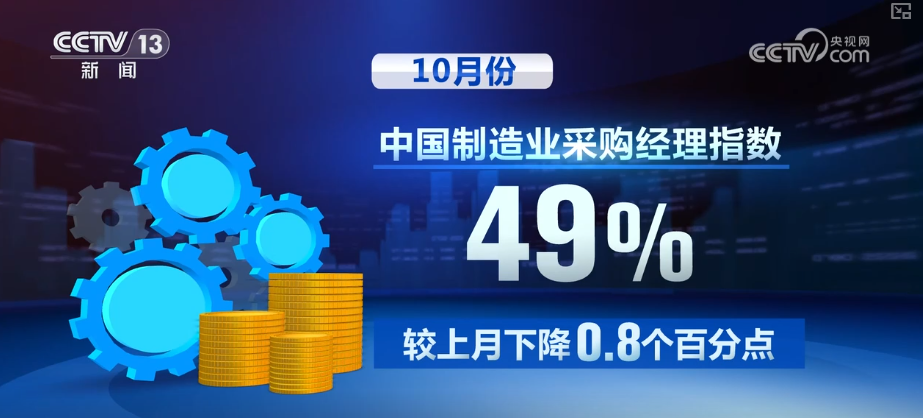
10月制造业采购经理指数为49%,制造业短期波动仍有趋稳基础
Bei Ke Cai Jing· 2025-10-31 03:36
Group 1: Manufacturing Sector - The manufacturing Purchasing Managers' Index (PMI) decreased to 49% in October, down 0.8 percentage points from the previous month, indicating a slowdown in production activities [1][2] - Various sub-indices, including production, new orders, and export orders, showed declines ranging from 0.1 to 2.6 percentage points, reflecting weakened demand and production activities across enterprises of all sizes [2][3] - The overall economic imbalance of supply exceeding demand continues to develop, leading to increased downward pressure on the economy, necessitating stronger macroeconomic policy adjustments [3] Group 2: Non-Manufacturing Sector - The non-manufacturing business activity index rose slightly to 50.1%, with several sub-indices, such as inventory and input prices, showing increases between 0.2 and 1.1 percentage points [1][4] - The new orders index remained stable compared to the previous month, indicating steady operational activities in the non-manufacturing sector, supported by holiday consumption [4][5] - Significant increases were observed in sectors like transportation, retail, and construction, with business activity indices exceeding 60%, suggesting a positive trend in investment and consumption-related activities [5]