
化肥

Search documents
欧美憋不住了,要对大国先下手为强,高市早苗很得意,抛出4个字
Sou Hu Cai Jing· 2026-01-10 08:23
Group 1 - The European Union's carbon tariff policy officially took effect on January 1, 2026, targeting key export products such as steel, cement, aluminum, fertilizers, and electricity from major exporting countries [3][5] - The EU plans to expand the carbon tax to include more products like home appliances and machinery, increasing export barriers and costs for manufacturers in major exporting countries [3][5] - The EU's carbon tax system is criticized for being biased, as it only provides support through a "decarbonization fund" to European companies with clear environmental plans, excluding foreign importers [5][7] Group 2 - Surrounding countries like Bosnia, Serbia, and Montenegro, which previously exported significant amounts of electricity to the EU, are now facing increased costs and reduced profits due to the carbon tax [7] - The United States has shifted its stance on military actions in the region, urging restraint while continuing military sales to major countries, exceeding $11 billion [9] - Japan's Prime Minister, in a New Year speech, emphasized a return to strength and reform, indicating a shift in policy towards increased military spending, with the defense budget rising to 7.4 trillion yen, an increase of over 8% from the previous year [11][13] Group 3 - Major countries are responding to pressures from the US and EU, with significant impacts on various industries and public protests emerging in Japan due to trade and flight restrictions [15] - The coordinated actions of the US, EU, and Japan against major countries suggest a strategic alignment, raising concerns about the implications for international relations and trade [17]


Yara International (OTCPK:YARI.Y) 2026 Capital Markets Day Transcript
2026-01-09 09:02
Summary of Yara International Capital Markets Day - January 09, 2026 Company Overview - **Company**: Yara International (OTCPK:YARI.Y) - **Event**: 2026 Capital Markets Day - **Date**: January 09, 2026 - **Location**: Oslo, Norway Key Industry Insights - **Industry**: Fertilizer and Crop Nutrition - **Market Dynamics**: The nitrogen market fundamentals were discussed, highlighting the importance of nitrogen in crop production and the challenges faced by farmers in nutrient replacement [4][5][7]. Core Strategic Priorities - **Resilience and Growth**: Yara aims to strengthen resilience and grow sustainable returns through its business model and competitive advantages [3][16]. - **Safety Commitment**: Yara emphasizes a commitment to safety with a long-term ambition of zero accidents, despite a recent increase in accident rates [8][9][10][12]. - **Sustainability Goals**: The company is focused on reducing greenhouse gas emissions and optimizing nutrient use efficiency to support sustainable food systems [20][21][22]. Financial Performance - **Shareholder Returns**: Yara has distributed $5.5 billion to shareholders since 2020 and aims for significant growth in shareholder returns going forward [16][28]. - **EBITDA Improvement Targets**: Yara has set a target to improve EBITDA by more than $200 million by the end of 2027 and $350 million by the end of 2030 [27][28]. Production and Operational Excellence - **Production Capacity**: Yara achieved a production capacity of approximately 21 million tons of finished fertilizer, representing an 8% increase in volumes [57]. - **Investment in Production**: Significant investments are being made in expanding production capabilities, including a $50 million investment in Cartagena and a carbon capture project in Sluiskil [58][60]. Market Trends and Challenges - **Urea Market Dynamics**: The urea market saw demand-driven pricing in 2025, with strong sales in India and production issues in other regions affecting supply [38][39]. - **Natural Gas Prices**: Falling natural gas prices in Europe improved margins for producers, with expectations of increased LNG capacity in the coming years [46][47]. - **Carbon Pricing and CBAM**: The implications of the Carbon Border Adjustment Mechanism (CBAM) on European fertilizer prices were discussed, highlighting potential risks and uncertainties [32][33][49]. Technological Innovations - **Emission Reduction Technologies**: Yara has developed an N2O abatement catalyst that significantly reduces greenhouse gas emissions, contributing to the company's sustainability goals [21][22]. Conclusion - **Future Outlook**: Yara is well-positioned to navigate market uncertainties and capitalize on growth opportunities while maintaining a focus on profitability and sustainability [30][35][36].
商务预报:12月29日至1月4日生产资料价格略有上涨
Shang Wu Bu Wang Zhan· 2026-01-09 08:16
Group 1 - The national production material market prices increased by 0.3% from the previous week during the period from December 29, 2025, to January 4, 2026 [1] - Prices of non-ferrous metals continued to rise, with copper, aluminum, and zinc increasing by 2.9%, 1.4%, and 0.7% respectively [1] Group 2 - Rubber prices saw a slight increase, with synthetic rubber and natural rubber rising by 0.8% and 0.2% respectively [2] - Basic chemical raw material prices were mainly up, with polypropylene and sulfuric acid both increasing by 0.2%, while methanol decreased by 0.1% [2] - Fertilizer prices remained stable, with urea and compound fertilizers holding steady compared to the previous week [2] - Steel prices showed a slight decline, with rebar priced at 3360 yuan per ton, remaining stable, while ordinary medium plates and channel steel decreased by 0.2% to 3639 yuan and 3544 yuan per ton respectively [2] Group 3 - Wholesale prices of finished oil experienced a slight decline, with 0 diesel, 95 gasoline, and 92 gasoline decreasing by 0.6%, 0.5%, and 0.4% respectively [3] - Coal prices saw a minor decrease, with coking coal, thermal coal, and anthracite priced at 1037 yuan, 774 yuan, and 1156 yuan per ton, declining by 1.4%, 0.4%, and 0.3% respectively [3]
2026年尿素价格重心或进一步下移
Qi Huo Ri Bao Wang· 2026-01-09 07:41
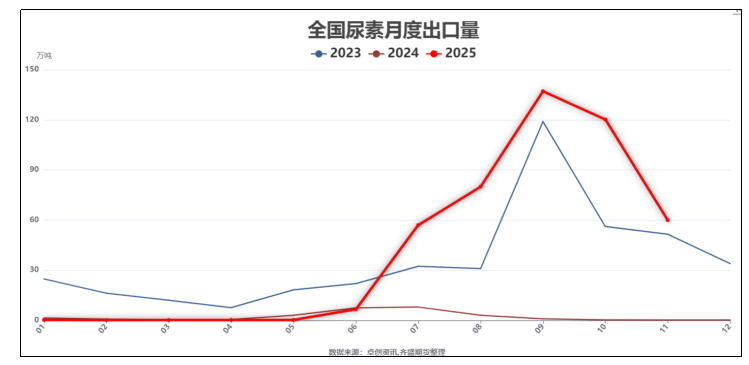
Group 1 - The core viewpoint indicates that the urea market is expected to experience a downward trend in 2025, with a price range between 1915 yuan/ton and 1585 yuan/ton, reflecting a volatility of 17.23% due to high supply and seasonal demand fluctuations [1] - In 2026, the urea industry will continue to expand capacity, but demand growth is limited, leading to a forecast of weak price fluctuations [1][2] Group 2 - The supply-demand imbalance is intensifying, with an additional 6.3 million tons of urea capacity expected in 2025 and a projected production capacity of 7.5 million tons in 2026, which is a 6.56% year-on-year increase [2] - Inventory levels are anticipated to remain above 1 million tons for most of 2025, with even greater pressure expected in 2026 [2] - Agricultural demand is stable but modest, estimated at around 24 million tons in 2025, while industrial demand is expected to decline in 2026 [2] Group 3 - Current profit levels in the industry are relatively good, with no losses reported for fixed-bed units in 2025, and newer coal chemical units showing higher profits compared to older ones [3] - However, profit compression is anticipated in 2026 due to sustained high supply and potential decreases in coal prices, which may weaken cost support for the urea industry [3] Group 4 - Export policies are identified as a significant variable affecting market trends in 2026, with China implementing a quota system in 2025 that allowed for approximately 5 million tons of exports [4][6] - The likelihood of continued domestic exports remains high under conditions of high supply, especially if prices remain low, which could lead to a shift from quota exports to unrestricted exports [6] - Overall, the supply growth is expected to significantly outpace demand growth in 2026, maintaining a surplus in the market and further lowering urea price levels, while export policy changes will be crucial to monitor [6]
国信证券:钾肥供需紧平衡 储能拉动磷矿石需求
智通财经网· 2026-01-09 07:25
Group 1: Potash Market Insights - The potash supply and demand are in a tight balance, with international potash prices on the rise. China is the largest potash consumer globally, with an import dependency exceeding 60%. In 2024, China's potassium chloride production is expected to be 5.5 million tons, a decrease of 2.7% year-on-year, while imports are projected to reach 12.633 million tons, an increase of 9.1%, marking a historical high [1] - As of December 2025, domestic potassium chloride port inventory is 2.4294 million tons, a decrease of 61.53 thousand tons compared to the same period in 2024, with a decline rate of 0.21%. The domestic potassium chloride market price averaged 3,282 yuan/ton in December, reflecting a month-on-month increase of 0.83% and a year-on-year increase of 30.45% [1] - Internationally, the prices of potassium chloride in Vancouver, Northwest Europe, and Jordan have risen to 317, 347, and 357 USD/ton respectively by the end of December, compared to the end of November [1] Group 2: Phosphate Rock Market Dynamics - The long-term price center for phosphate rock is expected to remain high due to declining grades and increasing extraction costs. The domestic supply-demand situation is tight, with the market price for 30% grade phosphate rock remaining in the high price range of 900 yuan/ton for over three years [2] - As of December 31, 2025, the tax-inclusive price for 30% grade phosphate rock in Hubei is 1,040 yuan/ton, while in Yunnan, it is 970 yuan/ton, both remaining stable compared to the previous month [2] Group 3: Lithium Iron Phosphate Demand - The production capacity of lithium iron phosphate in China has reached 5.945 million tons per year, with a projected output of 3.82 million tons in 2025, representing a year-on-year increase of 48.59%. The market price for lithium iron phosphate is approximately 50,300 yuan/ton as of January 7, 2026, up 57.19% from the lowest price of 32,000 yuan/ton in June 2025 [3] - The demand for lithium iron phosphate and other phosphorus-containing new energy materials is significantly increasing due to the growth in downstream energy storage and power battery sectors, leading to continuous price increases [3] Group 4: Future Phosphate Resource Demand - With the global energy storage industry expanding, the demand for lithium iron phosphate is expected to rise, with projected global energy storage battery shipments increasing to 600, 800, and 983 GWh from 2025 to 2027. This corresponds to phosphate rock demand of 600, 800, and 983 million tons, accounting for 4.7%, 5.9%, and 7.0% of China's forecasted phosphate rock production [4] - The high purity requirements for lithium iron phosphate mean that the actual available high-grade phosphate resources are scarcer than the total amount, giving companies with quality mineral sources and integrated mining capabilities a strategic advantage in the new energy materials competition [4]


中国心连心化肥午后涨超4% 触及历史前高 海外尿素报价大幅上涨
Zhi Tong Cai Jing· 2026-01-09 07:22
Group 1 - China Heartland Fertilizer (01866) has seen its stock price rise over 4%, reaching a historical high of 9.5 HKD, with a current price of 9.45 HKD and a trading volume of 22.03 million HKD [1] - The ongoing escalation of the situation in Iran has led to significant increases in overseas urea prices, as Iran accounts for approximately 3.5% of global urea production capacity and about 5% of global trade volume [1] - Global expectations for tighter urea supply continue to rise, contributing to a recovery in international urea prices [1] Group 2 - The successful operation of the second phase of the Jiujiang base in Q3 2025 utilizes more efficient, environmentally friendly, and energy-saving technology, resulting in a 10% reduction in production costs at full urea production capacity [1] - The completion of the chemical new materials project at the Xinxiang base by the end of 2025 is expected to further expand urea production capacity and effectively lower production costs by approximately 12% [1] - With the gradual release of low-cost production capacity, the profitability of Heartland Fertilizer is anticipated to significantly improve [1]
港股异动 | 中国心连心化肥(01866)午后涨超4% 触及历史前高 海外尿素报价大幅上涨
Zhi Tong Cai Jing· 2026-01-09 07:21
Core Viewpoint - China Heartland Fertilizer (01866) has seen its stock price rise over 4%, reaching a historical high of 9.5 HKD, driven by escalating tensions in Iran and tightening global urea supply [1] Company Summary - As of the latest report, China Heartland Fertilizer's stock is trading at 9.45 HKD with a trading volume of 22.03 million HKD [1] - The company is expected to benefit from the commissioning of its Jiujiang base phase II in Q3 2025, which utilizes more efficient, environmentally friendly, and energy-saving technology, leading to a 10% reduction in production costs at full urea production [1] - The completion of the Xinxiang base chemical new materials project by the end of 2025 is anticipated to further expand urea production capacity and reduce production costs by approximately 12% [1] - Analysts believe that the gradual release of low-cost production capacity will significantly enhance the profitability of China Heartland Fertilizer [1] Industry Summary - The ongoing situation in Iran has led to a significant increase in overseas urea prices, as Iran accounts for 3.5% of global urea production capacity and approximately 5% of global trade volume [1] - Reports indicate that expectations for tightening global urea supply are increasing, contributing to a recovery in international urea prices [1]
《能源化工》日报-20260109
Guang Fa Qi Huo· 2026-01-09 02:43
Group 1: Report Industry Investment Rating - No information provided in the reports Group 2: Report Core Views Pure Benzene - Styrene - Short - term supply - demand pattern of pure benzene is weak, with limited price drivers, and BZ2603 may oscillate between 5300 - 5600 [1] - Short - term styrene price is supported by exports, but there is an inventory build - up expectation around the Spring Festival, and the rebound space is limited [1] Polyester Industry Chain - PX supply is high in January, and the supply - demand situation is expected to weaken. It is expected to oscillate between 7000 - 7500 in the short term and be considered for low - buying in the medium term [2] - PTA may be affected by inventory build - up in the first quarter, with limited self - driven factors, and will follow raw material fluctuations. It is expected to oscillate between 5000 - 5200 in the short term [2] - MEG has a large inventory build - up expectation in the near term, and its price is under pressure. Strategies include selling out - of - the - money call options and conducting high - selling and low - buying spreads [2] - Short - fiber supply - demand pattern is weak, and its absolute price has limited drivers, following raw material fluctuations in the short term [2] - Bottle - chip supply is expected to decline, and it will follow cost fluctuations in January, with limited processing fee upside [2] Urea - Urea supply is high in the short term, and demand is weak. Without new stimuli, the price may be in a weak oscillation [3] PVC and Caustic Soda - Caustic soda supply exceeds demand, and the price is expected to be stable and weak. Attention should be paid to downstream procurement volume and liquid chlorine price fluctuations [4] - PVC supply is expected to increase, demand is weak, and the market may face a decline after reaching a high [4] Polyolefins - LLDPE supply is expected to decrease marginally, and demand is in a seasonal off - season. PP supply and demand are both weak, and it is expected to turn to inventory reduction in January, with short - term strength [6] Crude Oil - International oil prices rebounded significantly, but the increase is limited due to the weak supply - demand expectation. Attention should be paid to geopolitical conflicts [7] Glass and Soda Ash - Soda ash supply increases, demand is stable, and the overall supply - demand pattern is in surplus. The price is expected to oscillate within a range [9] - Glass supply decreases, demand weakens seasonally, and the upward space of the market is limited [9] Natural Rubber - Supply in Southeast Asia increases, but overseas raw material prices may remain high. Demand is weak, and inventory accumulates. The rubber price has fallen from a high, and attention should be paid to Thai raw material conditions [11] Methanol - Methanol futures fell due to certain news, and the MTO industry faces losses. The inland market is in a situation of both weak supply and demand [13] LPG - LPG prices are in a downward trend. The upstream and downstream operating rates show different trends, and inventory changes vary [17] Group 3: Summaries According to Related Catalogs Pure Benzene - Styrene - Upstream prices: Brent crude oil (March) rose 3.4% to 61.99 dollars/barrel; CFR China pure benzene rose 0.3% to 674 dollars/ton [1] - Styrene - related prices: Styrene East China spot price fell 0.1% to 6890 yuan/ton; EB cash flow (non - integrated) fell 7.0% to 348 yuan/ton [1] - Downstream cash flows: Phenol cash flow fell 7.8% to - 1036 yuan/ton; EPS cash flow increased 220.0% to 60 yuan/ton [1] - Inventory: Pure benzene Jiangsu port inventory increased 6.0% to 31.80 tons; Styrene Jiangsu port inventory decreased 4.7% to 13.23 tons [1] - Operating rates: Asian pure benzene operating rate increased 2.3% to 78.7%; Styrene operating rate decreased 0.7% to 70.2% [1] Polyester Industry Chain - Upstream prices: Brent crude oil (March) rose 3.4% to 61.99 dollars/barrel; CFR China PX fell 1.6% to 886 dollars/ton [2] - Downstream product prices: POY150/48 price remained unchanged at 7911 yuan/ton; Polyester bottle - chip price fell 0.3% to 6032 yuan/ton [2] - PX - related spreads: PX - crude oil spread fell 6.2% to 433 dollars/ton; PX - naphtha spread fell 6.0% to 345 dollars/ton [2] - MEG: MEG port inventory decreased 0.7% to 73.0 tons; MEG to - port expectation increased 66.4% to 17.8 tons [2] - Operating rates: Asian PX operating rate increased 1.8% to 80.9%; PTA operating rate increased 10.3% to 78.1% [2] Urea - Futures prices: Urea 01 contract fell 0.77% to 1682 yuan/ton; 05 contract fell 0.78% to 1776 yuan/ton [3] - Spreads: 01 contract - 05 contract spread rose 1.09% to - 91 yuan/ton; UR - MA main contract spread rose 4.62% to - 475 yuan/ton [3] - Upstream raw materials: Anthracite small pieces (Jincheng) fell 1.11% to 890 yuan/ton; Steam coal port (Qinhuangdao) rose 0.43% to 700 yuan/ton [3] - Spot prices: Shandong (small - particle) urea rose 0.57% to 1760 yuan/ton; Shanxi (small - particle) urea fell 0.62% to 1610 yuan/ton [3] - Supply - demand: Domestic urea daily output increased 0.55% to 20.06 tons; urea plant - in inventory increased 0.29% to 102.22 tons [3] PVC and Caustic Soda - Spot and futures prices: Shandong 32% liquid caustic soda equivalent price remained unchanged at 2150 yuan/ton; East China calcium - carbide - based PVC market price fell 1.1% to 4650 yuan/ton [4] - Overseas quotes and export profits: FOB Middle - East port caustic soda price fell 1.4% to 365 dollars/ton; PVC export profit fell 118.7% to - 45.3 yuan/ton [4] - Supply: Caustic soda industry operating rate increased 0.2% to 88.7%; PVC total operating rate decreased 0.9% to 75.4% [4] - Demand: Alumina industry operating rate remained unchanged at 79.9%; Longzhong sample pipe material operating rate decreased 3.7% to 36.2% [4] - Inventory: Liquid caustic soda East China plant - in inventory decreased 2.6% to 22.1 tons; PVC total social inventory increased 0.6% to 51.4 tons [4] Polyolefins - Futures prices: L2601 closed at 6410 yuan/ton, down 0.31%; PP2605 closed at 6484 yuan/ton, down 0.03% [6] - Spreads: L15 spread fell 2.83% to - 218 yuan/ton; PP15 spread fell 12.64% to - 196 yuan/ton [6] - Spot prices: East China PP drawstring spot price remained unchanged at 6280 yuan/ton; North China LLDPE spot price rose 0.31% to 6480 yuan/ton [6] - Operating rates: PE device operating rate increased 0.52% to 83.7%; PP device operating rate decreased 1.65% to 75.5% [6] - Inventory: PE enterprise inventory increased 6.66% to 39.5 tons; PP trade - merchant inventory increased 15.52% to 20.5 tons [6] Crude Oil - Oil prices: Brent rose 3.39% to 61.99 dollars/barrel; WTI rose 3.16% to 57.76 dollars/barrel; SC fell 1.60% to 418.00 yuan/barrel [7] - Spreads: Brent M1 - M3 spread rose 37.50% to 0.77 dollars/barrel; WTI - Brent spread rose 6.55% to 4.23 dollars/barrel [7] - Refined oil prices: NYM RBOB rose 3.88% to 176.03 cents/gallon; ICE Gasoil rose 1.46% to 609.25 dollars/ton [7] Glass and Soda Ash - Glass prices: North China glass quote rose 0.99% to 1020 yuan/ton; Glass 2601 fell 0.30% to 1013 yuan/ton [9] - Soda ash prices: Northwest soda ash quote rose 2.33% to 880 yuan/ton; Soda ash 2605 fell 2.70% to 1239 yuan/ton [9] - Supply: Soda ash operating rate increased 5.93% to 84.70%; Float - glass daily melting volume decreased 0.92% to 15.01 tons [9] - Inventory: Glass factory inventory decreased 5.69% to 5551.80 tons; Soda ash factory inventory increased 4.25% to 157.25 tons [9] Natural Rubber - Spot prices: Yunnan state - owned whole - latex (SCRWF): Shanghai rose 0.63% to 15850 yuan/ton; Cup rubber: international market: FOB mid - price rose 1.16% to 52.30 Thai baht/kg [11] - Spreads: 9 - 1 spread remained unchanged at - 70 yuan/ton; 1 - 5 spread remained unchanged at 60 yuan/ton [11] - Production: November Thailand rubber production fell 9.39% to 466.20 thousand tons; November China rubber production increased 20.88% to 137.20 thousand tons [11] - Operating rates: Automobile tire: semi - steel tire operating rate decreased 3.46% to 65.89%; Automobile tire: full - steel tire operating rate decreased 0.22% to 58.02% [11] - Inventory: Bonded - area inventory increased 4.48% to 548344 tons; Natural rubber: factory - warehouse futures inventory: SHFE remained unchanged at 57959 tons [11] Methanol - Futures prices: MA2605 closed at 2231 yuan/ton, down 1.59%; MA59 spread fell 120.00% to - 4 yuan/ton [12] - Spreads: Taicang basis fell 600.00% to - 15 yuan/ton; MTO05 on - the - plate fell 13.33% to - 221 yuan/ton [12] - Spot prices: Inner Mongolia north - line spot price remained unchanged at 1848 yuan/ton; Henan Luoyang spot price fell 1.32% to 2058 yuan/ton [12] - Inventory: Methanol enterprise inventory increased 5.94% to 44.768 tons; Methanol port inventory increased 4.05% to 153.7 tons [13] - Operating rates: Upstream - domestic enterprise operating rate increased 0.54% to 78.09%; Downstream - external - procurement MTO device operating rate decreased 0.59% to 78.88% [13] LPG - Futures prices: Main PG2602 fell 0.62% to 4199 yuan/ton; PG2603 fell 0.87% to 4103 yuan/ton [17] - Spreads: South China spot - PG02 spread rose 0.77% to 781 yuan/ton [17] - External prices: FEI forward M1 contract fell 1.85% to 503.00 dollars/ton; CP swap M1 contract fell 1.15% to 517.00 dollars/ton [17] - Inventory: LPG refinery storage - capacity ratio rose 0.91% to 24.3%; LPG port inventory decreased 8.41% to 214 tons [17] - Operating rates: Upstream - major refinery operating rate remained unchanged at 75.11%; Downstream - PDH operating rate decreased 1.65% to 75.1% [17]
研判2025!中国硝酸铵钙生产工艺、产业链图谱、供需现状、市场规模、竞争格局及发展趋势分析:蔬菜种植领域需求占比超60%[图]
Chan Ye Xin Xi Wang· 2026-01-09 02:03
Core Viewpoint - The demand for calcium ammonium nitrate (CAN) is increasing due to its advantages in efficiency and environmental safety, despite a decline in market size due to falling prices [1][9]. Overview - Calcium ammonium nitrate is a new type of high-efficiency compound fertilizer that provides fast-acting nitrogen and calcium, is fully water-soluble, and improves soil quality [1][2]. Market Policy - The Chinese government has implemented various policies to support the development of the fertilizer industry, including CAN, promoting technological innovation and environmental sustainability [6]. Industry Chain - The upstream of the CAN industry includes suppliers of raw materials like nitric acid and limestone, while the downstream encompasses various agricultural applications, particularly in vegetable cultivation [6][8]. Current Development - The demand for CAN in China is projected to reach 1.751 million tons in 2024, a year-on-year increase of 4.8%, but the market size is expected to decline to 2.044 billion yuan, a decrease of 7.8% [1][9]. Competitive Landscape - The CAN market is experiencing a phase of consolidation, with major players like Ba Tian and Jin Lan focusing on technological innovation and cost control, while smaller companies face challenges due to stricter regulations [10][11]. Development Trends - The industry is expected to shift towards low-carbon and environmentally friendly practices, with an emphasis on technological upgrades and product diversification to meet evolving market demands [12][13][14].


2026年供应依旧宽松 尿素区间波动是主旋律
Qi Huo Ri Bao· 2026-01-09 00:55
Core Viewpoint - Urea prices in 2026 are expected to exhibit wide fluctuations, with ample supply exerting downward pressure on prices, while flexible export policies provide bottom support [1][14]. Supply and Demand Dynamics - In 2025, the urea industry will see a steady expansion of production capacity, with an expected addition of 4.4 million tons, primarily in the second and third quarters [2]. - By the end of 2025, domestic urea production capacity is projected to reach 79.8 million tons, with a growth rate of 5.83% [2]. - In 2026, approximately 5.27 million tons of urea capacity is still pending production, leading to a nominal capacity growth rate of 6.60% [2]. - The overall supply is expected to remain loose, impacting market prices significantly [6]. Production Costs - The production cost center is anticipated to rise, influenced by a "first suppressed, then lifted" trend in the coal market [3]. - In 2025, the complete production cost of urea from different processes varies, with fixed-bed urea costing 1917 CNY/ton, water-coal slurry at 1526 CNY/ton, and natural gas at 1978 CNY/ton [4]. Downstream Demand - Urea's apparent consumption in China for January to November 2025 was 59.86 million tons, remaining stable year-on-year [8]. - Agricultural demand is the primary driver, with direct fertilization and compound fertilizer accounting for 44.6% and 20.8% of total demand, respectively [8]. - Policies supporting high-standard farmland construction and soil fertility restoration are expected to influence urea demand positively, although the growth rate may slow over time [9]. Seasonal Demand Patterns - Urea demand exhibits seasonal characteristics, with significant usage during the growing seasons, particularly in March, June, and September [10]. - The compound fertilizer production is expected to maintain a slight growth trend, supported by policies aimed at ensuring food production [11]. Export Dynamics - The domestic urea export policy was relaxed in May 2025, with a total of approximately 4.6 million tons of export quotas allocated by November 2025 [13]. - The potential for further expansion of export quotas in 2026 could alleviate domestic supply pressures [14]. Price Outlook - Urea prices in 2026 are expected to fluctuate seasonally, with strong agricultural demand in the first half potentially supporting prices, while increased supply and lower demand in the second half may lead to price declines [14].