机器人制造

Search documents
广东上市公司市值狂飙4万亿,十大龙头领跑
Sou Hu Cai Jing· 2025-11-16 06:20
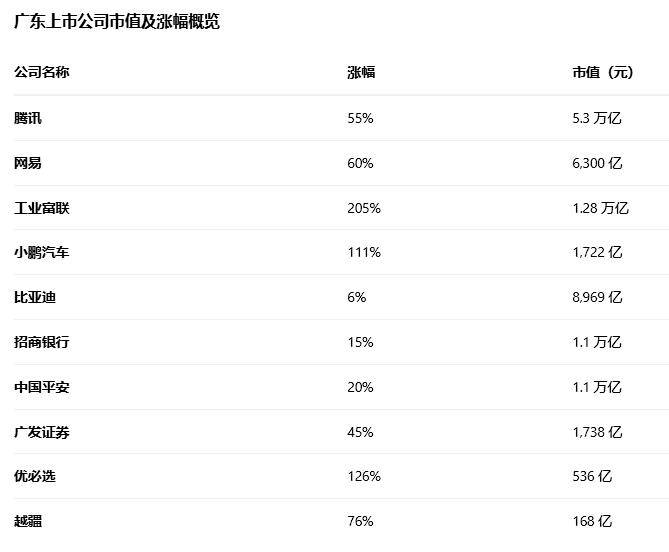
Group 1: Market Overview - As of November 2025, the total market capitalization of A-share listed companies shows Beijing leading with 27.38 trillion yuan, followed by Guangdong at 19.42 trillion yuan, and Shanghai at 9.97 trillion yuan [1] - The data indicates that Jiangsu and Zhejiang still have a gap to catch up with Guangdong, and the full picture of Guangdong's economic strength is not reflected if only A-shares are considered [1] Group 2: Key Companies in Guangdong - Tencent, the highest market cap company in China, has seen a 55% increase in stock price this year, reaching a market cap of approximately 5.3 trillion yuan, contributing 2 trillion yuan to Guangdong's total market value [3] - NetEase's stock has risen by 60% this year, with a market cap of 630 billion yuan as of November 14, 2025 [5] - Industrial Fulian has emerged as a standout performer with a 204% increase in stock price, achieving a market cap of 1.28 trillion yuan, ranking among the top ten A-share companies [7] - Xpeng Motors has shown significant growth with a 111% increase in stock price, driven by AI technology initiatives, reaching a market cap of 207.78 billion yuan [8] - BYD, a leader in the electric vehicle sector, has a market cap of 896.9 billion yuan with a 5% increase in stock price this year [9] Group 3: Financial Sector Performance - China Merchants Bank has a market cap exceeding 1 trillion yuan with a 15% increase in stock price, although its growth rate has slowed [10] - Ping An Insurance has a market cap of 1.1 trillion yuan and a 20% increase in stock price, supported by strong performance in its insurance business [11] - GF Securities has a market cap of 173.8 billion yuan with a 45% increase in stock price, driven by active market conditions and strong brokerage performance [12] Group 4: Robotics Industry Growth - UBTECH, the leading humanoid robot company, has seen a 126% increase in stock price, with a market cap of approximately 536 billion yuan, and plans to mass-produce humanoid robots [13] - Yujin Robotics, a collaborative robot company, has experienced a 76% increase in stock price, with a market cap of about 168 billion yuan, benefiting from strong sales in industrial and commercial applications [13] Group 5: Economic Outlook - Guangdong's leading companies in AI, new energy vehicles, and robotics highlight the province's economic potential and are expected to maintain its competitive edge in the future [14]

中油资本三季度业绩说明会:锚定前沿赛道,产融协同赋能
Zheng Quan Shi Bao Wang· 2025-11-14 14:36
Core Insights - The company emphasizes its commitment to energy transition through innovative industrial financial services and proactive market value management initiatives [1][4] Group 1: Industrial Financial Innovation - The company leads a collaborative effort in the energy sector by launching the "Industry Financial Services for Energy Transition Development Initiative" alongside eight other state-owned energy capital companies, highlighting the importance of financial support for energy transition [2] - The initiative includes three key consensus points: energy transition as a national priority, strict financial risk control, and the establishment of an open ecosystem to eliminate collaboration barriers [2] - Five major measures are proposed, including leveraging technology finance for key energy technologies, promoting green finance for sustainable development, enhancing the competitiveness of the energy supply chain through inclusive finance, improving service quality with digital finance, and supporting low-carbon transition with transformation finance [2] - The company has integrated green development into its core strategy, aiming for a green finance scale exceeding 1 trillion yuan in 2024, focusing on clean energy, energy conservation, and high-end equipment sectors [2] Group 2: Strategic Investments in Frontier Technologies - The company actively explores frontier technology innovations through strategic investments, particularly in future energy and deep-sea economy sectors [3] - It has made significant investments in Kunlun Capital, which has achieved breakthroughs in controlled nuclear fusion and is involved in the construction of a compact fusion energy experimental device [3] - In the deep-sea economy, the company has invested in Shandong Future Robotics, which has developed domestically produced deep-sea robots capable of operating at depths of 6,000 meters, breaking the technological monopoly of Western countries [3] - The investment will enhance production capacity and optimize operations, aligning with national deep-sea technology development strategies [3] Group 3: Market Value Management - The company has established a market value management framework, incorporating market value assessment indicators into the annual performance contracts of management [4] - A "Quality and Return Improvement" action plan has been developed, focusing on seven areas: party building, industrial-financial integration, business development, risk prevention, market value management, information disclosure, and shareholder returns [4] - The company aims to continue focusing on financial services for the energy and chemical industries, deepen industrial-financial collaboration, and promote green finance while developing a unique financial product system tailored to the energy sector [4]

新股消息 | 望圆科技拟港股上市 中国证监会要求补充说明公司历史沿革等事项
智通财经网· 2025-11-14 12:02
Core Viewpoint - The China Securities Regulatory Commission (CSRC) has published supplementary material requirements for 10 companies, including Wangyuan Technology, which is preparing for an IPO on the Hong Kong Stock Exchange, indicating regulatory scrutiny and the need for additional disclosures [1][2]. Group 1: Company Background and IPO Process - Wangyuan Technology is required to clarify its historical evolution, including the pricing rationale for share transfers in April and June 2025, and the legality of these transactions [1][2]. - The company has previously undergone A-share listing guidance and submitted an application to the Shenzhen Stock Exchange, which was later withdrawn; the reasons for this withdrawal need to be detailed [1][2]. Group 2: Business Operations and Compliance - The company operates in the "new energy prime mover equipment sales" and "solar thermal power generation products sales" sectors, and must provide specifics on these business activities [2][3]. - Wangyuan Technology must also clarify the progress of its state-owned shareholder identification process and the compliance of its domestic subsidiaries with regulations regarding overseas securities issuance [2][3]. Group 3: Financial and Operational Integrity - The company is required to explain the fairness of the employee stock ownership plan pricing and confirm the absence of any related party transactions [3]. - It must also ensure that its business operations do not fall under the restricted categories outlined in the "Negative List for Foreign Investment Access (2024 Edition)" [3]. Group 4: Product and Market Position - Wangyuan Technology is recognized as a leading global player in the pool cleaning robot sector, ranking among the top three worldwide and first in China based on 2024 production volume [4]. - The company offers a comprehensive range of pool cleaning robots, including cable-free models, and has developed advanced technologies such as underwater acoustic positioning and AI-driven navigation [4].
望圆科技拟港股上市 中国证监会要求补充说明公司历史沿革等事项
Zhi Tong Cai Jing· 2025-11-14 11:59
Core Viewpoint - The China Securities Regulatory Commission (CSRC) has published supplementary material requirements for 10 companies, including Wangyuan Technology, which is preparing for an IPO on the Hong Kong Stock Exchange, highlighting the need for clarification on various corporate governance and operational aspects [1][2]. Group 1: Company Background and IPO Process - Wangyuan Technology is required to provide detailed explanations regarding its historical evolution, including the pricing rationale for share transfers in April and June 2025, and the legality of these transactions [1][2]. - The company must clarify the circumstances surrounding its previous A-share listing guidance and the reasons for withdrawing its application, assessing any significant impacts on the current IPO [1][2]. - The company operates in the renewable energy sector, specifically in the sales of new energy propulsion equipment and solar thermal power products, necessitating a detailed account of its business operations [1][2]. Group 2: Shareholder and Fund Utilization - Wangyuan Technology is asked to report on the progress of identifying state-owned shareholders and the implications for the IPO [2]. - The company must outline the approval processes related to the use of raised funds for its production base and provide details on its overseas operations, including compliance with investment and foreign exchange registration procedures [2][3]. - The company is required to confirm whether its domestic subsidiaries are subject to restrictions under the regulations governing overseas securities issuance [2][3]. Group 3: Employee Stock Ownership and Compliance - The company needs to demonstrate the fairness of pricing in its employee stock ownership plan and confirm the absence of any potential conflicts of interest [3]. - Wangyuan Technology must ensure that its business activities do not fall under the restricted categories outlined in the foreign investment negative list [3]. Group 4: Product and Market Position - Wangyuan Technology is recognized as a leading global player in the pool cleaning robot sector, ranking among the top three worldwide and first in China based on 2024 production volume [4]. - The company offers a comprehensive range of pool cleaning robots, including cable-free, cable, and handheld models, designed for various cleaning tasks [4]. - The company has developed advanced AI-driven technologies for its products, enabling efficient and precise pool cleaning with minimal human intervention [4].
高测股份在上海新设智慧机器人公司
Zheng Quan Shi Bao Wang· 2025-11-14 09:21
Core Insights - Recently, Gaoce Intelligent (Shanghai) Robot Co., Ltd. was established with a registered capital of 100 million yuan [1] - The company is involved in the manufacturing of special operation robots, service consumer robots, and the research and development of intelligent robots [1] - Gaoce Intelligent is wholly owned by Gaoce Co., Ltd. through indirect shareholding [1]

高测股份在上海成立智慧机器人公司,注册资本1亿
Zhong Guo Neng Yuan Wang· 2025-11-14 03:07
天眼查App显示,近日,高测智慧(上海)机器人有限公司成立,法定代表人为张秀涛,注册资本1亿 人民币,经营范围包括特殊作业机器人制造、服务消费机器人制造、智能机器人的研发、服务消费机器 人销售等。股权全景穿透图显示,该公司由高测股份(688556)旗下海南高测科技有限公司全资持股。 天眼查App显示,近日,高测智慧(上海)机器人有限公司成立,法定代表人为张秀涛,注册资本1亿 人民币,经营范围包括特殊作业机器人制造、服务消费机器人制造、智能机器人的研发、服务消费机器 人销售等。 ...
天奇股份(002009) - 002009天奇股份投资者关系管理信息20251113
2025-11-13 10:08
Group 1: Partnership and Collaboration - The company collaborates with Galaxy General through a joint venture, Tianqi Galaxy, focusing on embodied intelligent robots in automotive manufacturing and new energy battery sectors [2] - A strategic cooperation framework agreement was signed with Foxconn, aiming to deploy no less than 2,000 embodied intelligent robots within Foxconn's automotive production system over the next five years [4] Group 2: Business Development and Future Plans - The joint venture will emphasize three main areas: robot body R&D and manufacturing, large-scale delivery of embodied intelligent solutions, and secondary development of application-specific models [2] - The company plans to establish a robot production line by Q1 2026, gradually increasing production capacity [2] Group 3: Data Collection and Training Centers - The company has established the "Wuxi Embodied Intelligent Robot Industrial Data Collection and Training Center," which officially began operations on October 31, 2025, utilizing a "data factory + training base + innovation engine" operational model [3] - Currently, nearly 60 robots are involved in data collection and real-world training, with plans to expand the number of data collection and training centers based on actual business delivery needs [3]

关于人形机器人造房子,麦肯锡很认真的预测了
机器人大讲堂· 2025-11-13 09:26
Core Insights - The construction industry is facing a productivity crisis, with a growth rate of only 0.4% over the past 22 years, while manufacturing has seen an average annual growth of 3% [1][3] - The industry is experiencing a labor shortage due to an aging workforce and a lack of interest from younger generations, creating a significant gap in the demand for housing and infrastructure, estimated at $40 trillion [1][3] - Humanoid robots are seen as a potential solution to this crisis, capable of performing a wide range of construction tasks and improving efficiency [1][6] Construction Industry Challenges and Solutions - The construction industry's productivity is hindered by its heavy reliance on human labor, which is becoming increasingly scarce [3] - Construction projects are complex and require a high degree of customization, making automation difficult [3] - Factors such as high physical demands, safety risks, and uncertain career prospects deter young workers from entering the field, exacerbating the labor crisis [3] Advantages of Humanoid Robots - Humanoid robots are versatile and can perform various tasks such as moving materials, welding, and cleaning, which traditional specialized robots cannot do [6][9] - These robots utilize embodied AI, allowing them to perceive their environment and make real-time decisions, enhancing their adaptability on construction sites [6][9] - They can work continuously without breaks, reducing labor costs significantly as their prices are expected to drop to $2,000-$5,000 by 2035 [9][10] Barriers to Implementation - The deployment of humanoid robots faces three main technological challenges: AI foundational models, mobility and flexibility, and safety and collaboration capabilities [10][11] - Current robots are still somewhat limited in their capabilities, particularly in navigating complex environments and performing delicate tasks [10] - The high cost of humanoid robots, currently ranging from $15,000 to $50,000, poses a significant barrier for widespread adoption [10] Future Development Phases - In the next 3-5 years, humanoid robots are expected to handle simple, repetitive tasks, freeing human workers to focus on more technical aspects of construction [13] - In the 5-10 year timeframe, these robots will take on more complex tasks and work collaboratively with human workers [13] - By the long-term phase (10+ years), humanoid robots are anticipated to autonomously execute complex construction tasks, transforming the construction workflow [14] Deployment Strategies for Construction Companies - Companies can adopt different strategies for deploying humanoid robots based on their financial strength and risk tolerance: - **Pioneers**: Large firms with strong capital can collaborate with robot manufacturers for customized solutions [17] - **Early Adopters**: Medium-sized firms can utilize existing robot products in standardized projects to gain market share [18] - **Selective Deployers**: Smaller firms can focus on high ROI scenarios for gradual implementation [18] Conclusion and Industry Outlook - The integration of humanoid robots into the construction industry represents a shift towards human-robot collaboration, where humans focus on design and management while robots handle repetitive and hazardous tasks [19] - The future of the construction industry will be shaped by technological advancements, making it essential for companies to embrace these changes proactively [19]
轻工纺织产业“三年计划”出炉 山东19条产业链全覆盖
Da Zhong Ri Bao· 2025-11-13 01:16
Core Insights - The implementation of four action plans has achieved full coverage of 19 iconic industrial chains in Shandong Province, focusing on technological innovation in key industries [1] Group 1: Robotics Industry - The robotics industry will leverage the strategic opportunity of integrating robotics technology with artificial intelligence, focusing on key components, software systems, and complete machine manufacturing [2] - The plan aims to develop advanced servo motors, operating system software, and special robots, while expanding application scenarios across various sectors such as automotive, home appliances, and healthcare [2] - The goal is to create 100 representative benchmark application scenarios, positioning Shandong as a national hub for robotics technology innovation [2] Group 2: Modern Food Industry - The modern food industry will emphasize safety, nutrition, green, and intelligent development, addressing the entire supply chain from raw materials to processing equipment [2] - A technical system will be established for food safety, including traceability, quality control, and green packaging, enhancing consumer safety and satisfaction [2] - The industry aims to create over 100 innovative products, significantly increasing the added value of modern food [2] Group 3: Light Industry and Textiles - The light industry and textiles sector will focus on high-end, green, and intelligent development, enhancing low-carbon production processes and advanced product development [3] - Innovations will include multifunctional advanced fiber products and high-end medical textiles, as well as new paper products for specialized applications [3] Group 4: Modern Metallurgy Industry - The modern metallurgy industry will accelerate the development of high-end raw materials and precision processing technologies, targeting products like ultra-high-strength steel and marine aluminum alloys [3] - The focus will also be on developing frontier materials such as rare earth functional materials and special magnesium and titanium alloys to capture future industry opportunities [3] Group 5: Implementation Measures - The four action plans propose specific measures for promoting innovation resources, building innovation platforms, and ensuring the transformation of scientific achievements [3] - The provincial science and technology department will implement policies to inject new momentum into the construction of a modern industrial system [4]
对美出口下滑到7年前水平 我国出口总额却创历史新高 “新三样”变成“新N样”
Mei Ri Jing Ji Xin Wen· 2025-11-12 15:32
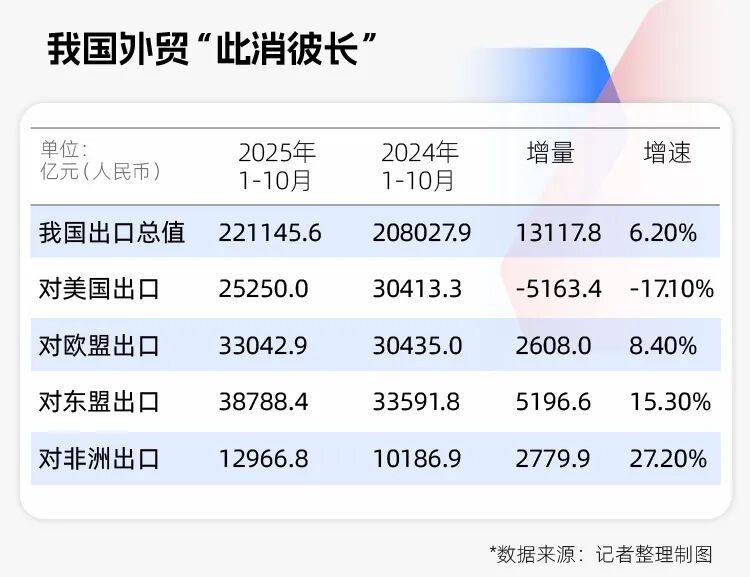
Core Viewpoint - China's foreign trade has shown resilience despite challenges such as U.S. tariffs, with total trade value reaching 37.31 trillion yuan in the first ten months of 2025, a 3.6% year-on-year increase [1][2]. Trade Performance Overview - Total import and export value for the first ten months of 2025 was 37.31 trillion yuan, with exports at 22.12 trillion yuan (up 6.2%) and imports at 15.19 trillion yuan (essentially flat) [1][2]. - Exports to the U.S. saw a significant decline, with a total of 2.52 trillion yuan, down 17.1% year-on-year [2][10]. Export Trends - Export growth has exhibited a "V-shaped" recovery, with quarterly growth rates increasing from 1.3% in Q1 to 6% in Q3 [3][6]. - Despite a 0.8% decline in October exports, the overall trend remains positive with high monthly export levels [3][6]. U.S. Trade Relations - Exports to the U.S. have returned to levels seen in 2018, with a total value of 2.52 trillion yuan in the first ten months of 2025, reflecting a 15.9% decline in total trade with the U.S. [10][12][14]. - The U.S. market now accounts for approximately 9% of China's total trade, down from 14.7% last year [17][18]. EU Trade Relations - Trade with the EU has been robust, with total trade value reaching 4.88 trillion yuan, a 4.9% increase, and exports growing by 8.4% [19][20]. - The growth in exports to the EU has been driven by increased demand for high-tech products and automotive components [28][30]. ASEAN Trade Relations - ASEAN has surpassed the U.S. as China's largest trading partner, with exports to ASEAN countries exceeding those to the U.S. for the first time [31][32]. - Exports to ASEAN countries have shown double-digit growth, particularly to Thailand, Vietnam, and Malaysia [31][32]. African Trade Relations - Exports to Africa have surged, with a total of approximately 1.3 trillion yuan, marking a 27.2% increase year-on-year [37][40]. - The growth is attributed to increased infrastructure projects and demand for Chinese manufactured goods in Africa [42][43]. Export Product Diversification - China's export product structure is evolving, with significant growth in high-tech and high-value products such as industrial robots and electric vehicles [44][46]. - The share of mechanical and electrical products in total exports exceeds 60%, with notable increases in integrated circuits and automotive exports [49][50].