氢能

Search documents
鲲华科技伊吾氢能基地投运,200台氢能重卡交付助力新疆绿色转型
势银能链· 2025-12-27 02:03
Core Viewpoint - The article highlights the successful launch of a hydrogen energy base by Kunhua Technology in Yiw County, marking a significant step towards establishing Hami as the first "Hydrogen City" in Xinjiang, China [2][8]. Group 1: Hydrogen Energy Development - Kunhua Technology officially launched its hydrogen energy base and delivered 200 hydrogen heavy trucks, which is a key milestone in Hami's ambition to become a hydrogen energy hub [2][8]. - The hydrogen base includes a daily production capacity of 25 tons of pure hydrogen and four hydrogen refueling stations, supporting the local hydrogen fuel cell vehicle industry [8][9]. - Hami is the only city in Xinjiang selected as a national demonstration city for fuel cell vehicles, leveraging its resources to attract leading hydrogen energy companies [9][10]. Group 2: Technological Advancements - The delivered hydrogen heavy trucks are equipped with Kunhua Technology's second-generation high-power fuel cell engine, "Kun·Yun 200," with a rated output power of 215 kW [10][11]. - The trucks have undergone extensive testing in extreme conditions, ensuring their reliability and adaptability for high-altitude and harsh climates [11][12]. - This delivery represents one of the few large-scale deliveries of hydrogen vehicles in 2025, indicating a growing trend in the application of hydrogen energy in specific scenarios [10][12]. Group 3: Future Outlook - Kunhua Technology aims to enhance local manufacturing and service capabilities for hydrogen equipment, supporting the expansion of application scales and the improvement of the industry ecosystem [12][14]. - The company emphasizes its commitment to technological innovation and strategic collaboration to contribute to Xinjiang's green, low-carbon development [14][15]. - The successful operation of the hydrogen base and the delivery of heavy trucks symbolize a shift towards sustainable energy solutions along the ancient Silk Road, integrating green technology with a zero-carbon future [14][15].


吉林省委书记黄强到中能建松原氢能产业园(绿色氢氨醇一体化)项目调研
Zheng Quan Shi Bao Wang· 2025-12-27 00:32
Core Viewpoint - The Jilin Provincial Secretary Huang Qiang emphasized the importance of the Songyuan project as a successful example of central-local cooperation, urging companies to increase investment in Jilin and focus on production operations, technology upgrades, and safety management to achieve the "14th Five-Year" development goals [1] Group 1: Project Overview - The "Qing Hydrogen No. 1" project at the China Energy Construction Songyuan Hydrogen Energy Industrial Park is the world's largest integrated green hydrogen and ammonia project [1] - The project plans to build 3 million kilowatts of renewable energy generation and produce 800,000 tons of green synthetic ammonia and green methanol [1] - The first phase of the project aims for an annual production of 45,000 tons of green hydrogen and 200,000 tons of green ammonia and methanol, which officially commenced production on December 16, 2025 [1] Group 2: Certifications and Contracts - The project has received the EU ISCC sustainability certification [1] - It has signed the world's first contract for the sale of green ammonia as a marine fuel for long-distance shipping [1] Group 3: Government Support and Infrastructure - Provincial departments are urged to accelerate the construction of hydrogen transmission pipelines and support the expansion of new technologies, products, and application scenarios [1] - Songyuan city is tasked with providing educational and medical services for employees' children of central enterprises to create a stable environment for business development [1]

科学有答案 创新无止境(院士讲科普·年终特别报道)
Ren Min Wang· 2025-12-26 22:21
Core Insights - By 2025, China is expected to achieve significant breakthroughs in various scientific fields, including quantum technology and lunar research, contributing to the nation's technological self-reliance and innovation [3][5]. Group 1: Space Exploration - The Chang'e 6 mission is set to return samples from the moon's far side, revealing new insights into lunar oxidation mechanisms and marking a major scientific breakthrough in lunar research [4]. - The Tianwen-2 probe will conduct close-range exploration of a near-Earth asteroid, with a sample return expected by the end of 2027, indicating a shift towards long-term space exploration and resource utilization [4]. - China plans to advance its lunar research station, manned lunar missions, Mars sample return, and Jupiter system exploration, enhancing its capabilities in deep space exploration [4]. Group 2: Quantum Computing - Quantum computing is identified as a critical future technology, with China focusing on achieving full autonomy in quantum computing through the development of hardware and software systems [7]. - The third-generation superconducting quantum computer "Benyuan Wukong" has been launched, participating in numerous collaborations across key industries and achieving international cooperation in quantum computing [8]. - The development of quantum computing is likened to building a rocket, emphasizing the importance of integrating hardware and software for effective functionality [7]. Group 3: Brain-Computer Interfaces - Brain-computer interface technology is evolving to connect biological intelligence with machine intelligence, utilizing advanced decoding and encoding techniques to interpret brain signals [9]. - Clinical advancements in brain-computer interfaces are being made, with the establishment of comprehensive clinical trial centers and the initiation of global trials [11]. - The technology aims to redefine the boundaries of intelligence by merging carbon-based and silicon-based systems, enhancing cognitive capabilities [10]. Group 4: Digital Intelligence Technologies - Digital intelligence technologies, including cloud computing and artificial intelligence, are seen as essential tools for enhancing innovation across various industries [13]. - The integration of digital technologies into industrial processes is expected to significantly improve production efficiency and transform manufacturing paradigms [13]. - Open collaboration and resource sharing are highlighted as accelerators for technological advancement, contributing to global challenges [14]. Group 5: Hydrogen Energy - Hydrogen energy is recognized as a vital component of the renewable energy revolution, complementing electricity and supporting sustainable development [16]. - China has made significant progress in hydrogen fuel cell technology and is establishing a related industrial chain to enhance the role of hydrogen in the energy transition [17]. - The future of hydrogen energy will focus on tailored solutions that meet specific regional needs, ensuring its benefits for society [16]. Group 6: Research Talent Development - Universities are positioned as key players in nurturing research talent, aligning educational programs with national strategic needs [19]. - The emphasis is on practical applications of research, encouraging scientists to engage with industry and address real-world challenges [19]. - A supportive environment for young researchers is essential, promoting innovation and allowing for flexible evaluation of research outcomes [20]. Group 7: Basic Research Support - Basic research in China is gaining increased attention and funding, although it still lags behind developed countries in terms of investment [22]. - Continuous support for basic research is necessary, including funding stability and diverse investment channels to foster groundbreaking discoveries [22][23]. - A positive research culture is crucial for sustaining long-term engagement in basic research, promoting a supportive atmosphere for scientists [23]. Group 8: Science Popularization - The relationship between scientific innovation and public science education is emphasized, with efforts to enhance public understanding of science [24][25]. - Initiatives aimed at improving scientific literacy among youth are seen as foundational for future technological advancements [25][26].
科学有答案 创新无止境(院士讲科普·年终特别报道) ——八位院士眼中的二〇二五
Ren Min Ri Bao· 2025-12-26 22:15
Group 1: Technological Innovation and Achievements - In 2025, China made significant advancements in scientific research, particularly in quantum technology and lunar studies, achieving original breakthroughs [1] - The global innovation index ranked China 10th, reinforcing the foundation for high-level technological self-reliance [1] - Major breakthroughs in lunar science were achieved with the Chang'e 6 mission, revealing new lunar oxidation reaction mechanisms [2][3] Group 2: Quantum Computing Developments - Quantum computing is identified as a key future technology, with China focusing on achieving full autonomy in its development [4] - The third-generation superconducting quantum computer "Benyuan Wukong" has been launched, participating in numerous application collaborations across various sectors [4][6] - The development of quantum computing is likened to building a rocket, emphasizing the importance of both hardware and software integration [4] Group 3: Brain-Computer Interface Technology - Brain-computer interface technology is evolving to connect biological intelligence with machine intelligence, with significant clinical advancements reported in 2025 [7][9] - The technology is moving from unidirectional reading to bidirectional interaction, enhancing its potential applications [7] Group 4: Digital Intelligence and Industrial Transformation - Digital intelligence technologies, including cloud computing and AI, are seen as essential tools for enhancing innovation capabilities across industries [10][11] - The integration of digital technologies into industrial processes is expected to transform manufacturing paradigms and improve efficiency [10] Group 5: Hydrogen Energy and Renewable Resources - Hydrogen energy is recognized as a crucial component of the renewable energy revolution, complementing electricity and promoting low-carbon transitions [12][13] - China has made progress in mastering hydrogen fuel cell technologies and establishing related industrial chains [12][13] Group 6: Research Talent Development - The cultivation of research talent is emphasized as critical for supporting high-level technological self-reliance, with a focus on aligning educational programs with national strategic needs [14][15] - Young researchers are increasingly contributing to scientific advancements, with a significant proportion of key research personnel being under 45 years old [15] Group 7: Support for Basic Research - Basic research in China is receiving increased attention and support, although challenges remain in funding and stability [16][17][18] - The government is implementing reforms to enhance the support for basic research, including funding mechanisms and cultural improvements [16][17][18] Group 8: Science Popularization and Innovation - The relationship between scientific innovation and public science education is highlighted, with efforts to engage the public in scientific knowledge [19][20] - Enhancing public understanding of science is seen as foundational for fostering future research talent and innovation [19][20]
张承唐氢能区域试点项目入围国家首批氢能试点名单
Xin Lang Cai Jing· 2025-12-26 22:03
Core Insights - The Zhang-Cheng-Tang hydrogen energy regional pilot project in Hebei has been selected as one of the first national hydrogen energy pilot projects, making it the only project in the province to receive this designation [1] - The project aims to support the construction of a new energy strong province by undertaking the full chain of hydrogen energy "production, storage, transportation, and utilization" [1] Group 1: Project Overview - The Zhang-Cheng-Tang hydrogen energy regional pilot project will promote the construction of the "Beijing-Tianjin-Hebei hydrogen energy corridor," leading the development of the hydrogen energy industry in Hebei and the surrounding region [1] - The project is expected to produce over 2 million tons of green hydrogen annually from Zhangjiakou and Chengde [2] - Tangshan will accelerate the diversification of green hydrogen application scenarios in industries such as chemicals, transportation, electricity, and construction, aiding the low-carbon transformation of traditional industries [1] Group 2: Regional Collaboration - The project includes three key cities: Zhangjiakou, Chengde, and Tangshan, forming a collaborative hydrogen energy industry system with Zhangjiakou as the hydrogen production hub, Chengde as the green hydrogen supply point, and Tangshan as the application and export center [1][2] - Zhangjiakou will establish a large-scale wind-solar hydrogen production base and hydrogen pipeline hub, ensuring zero-carbon hydrogen supply to the Tangshan industrial belt [2] - Chengde will focus on wind power hydrogen production and hydrogen storage and transportation technology, optimizing regional hydrogen energy reserves and distribution [2] Group 3: Technological Advancement - The construction of the Zhang-Cheng-Tang hydrogen energy regional pilot project is expected to enhance the national hydrogen energy industry's technological level and overcome key technical bottlenecks [3] - The project will promote the application of advanced hydrogen energy technologies and key equipment, contributing to national science and technology major projects and key research and development plans [3] - It aims to establish a comprehensive hydrogen energy equipment evaluation system and hydrogen quality management standards, serving as a model for the development of the hydrogen energy industry standard system in China [3]
我国氢能领域首个CCER方法学,撬动绿氢的巨大减排潜力|CCER方法学解读
Zhong Guo Huan Jing Bao· 2025-12-26 08:12
Core Viewpoint - The release of the "Renewable Energy Electrolysis Hydrogen Production Methodology" marks a significant step in China's hydrogen energy sector, aiming to promote decarbonization and enhance the trading of carbon assets through clean hydrogen production [1][2]. Group 1: Importance of Renewable Hydrogen - Hydrogen is recognized as a clean and efficient energy source, essential for future energy systems, with global hydrogen consumption projected to reach 105 million tons by 2024 [2]. - China produces over 36.5 million tons of hydrogen, accounting for 24% of global production, but 98% of this is derived from fossil fuels, highlighting the need for renewable hydrogen production [2]. - The new methodology aims to convert emission reductions from clean hydrogen projects into tradable carbon assets, significantly impacting sectors like steel, chemicals, and transportation in achieving carbon neutrality goals [2]. Group 2: Current Development Status - The electrolysis hydrogen production industry in China is rapidly developing, with over 600 planned projects and more than 90 completed projects, yielding an annual capacity of approximately 125,000 tons [3]. - Alkaline electrolysis technology is currently dominant, while proton exchange membrane technology is catching up; however, the cost of green hydrogen remains significantly higher than traditional fossil fuel methods [3]. - The application of hydrogen is expanding from transportation to industrial sectors, exploring integrated projects that combine renewable energy with hydrogen production [3]. Group 3: Policy Support - The Chinese government has prioritized hydrogen energy, including it in the 2024 government work report and the Energy Law, with plans for large-scale applications in industries by 2027 [4]. - Policies are designed to support the hydrogen industry, particularly in industrial applications, providing clear guidance for development and investment [4]. Group 4: Project Eligibility and Potential - The methodology applies to new renewable energy electrolysis hydrogen projects that primarily use self-owned wind or solar power, excluding existing facilities and projects using purchased green certificates [5]. - Current eligible projects are estimated to have an annual emission reduction potential of about 1.57 million tons of CO2 equivalent, with projections suggesting this could rise to 6 million tons by 2030 [5]. Group 5: Economic Viability - Participation in the voluntary carbon market through emission reduction credits (CCER) is seen as a key method to enhance project economics, with significant potential to shorten investment recovery periods [8]. - For example, a project in Inner Mongolia with an investment of approximately 1 billion yuan could see its payback period reduced from 9.21 years to 8.77 years with CCER income [8]. Group 6: Data Quality and Monitoring - The methodology emphasizes high standards for data quality, requiring real-time monitoring of key parameters and ensuring traceability of data through connections to national carbon trading platforms [11]. - Project owners must establish robust internal data management systems and maintain comprehensive records to ensure compliance and data integrity [11]. Group 7: Challenges in Project Development - Key challenges include ensuring project compliance, maintaining the uniqueness of environmental benefits, and establishing a comprehensive monitoring and quality control system from the outset [12]. - Projects must also navigate resource management and ecological constraints, ensuring that water usage does not impact local communities and ecosystems [12].
机构:氢能有望逐步迈入产业化阶段 关注相关产业链机会
Zheng Quan Shi Bao Wang· 2025-12-26 07:20
Group 1: Sichuan Hydrogen Industry Development - Sichuan is committed to promoting the hydrogen industry, with significant progress made following a government meeting in April 2024 [1] - Key initiatives include improving policy frameworks, implementing industrial "circle building and chain strengthening," focusing on core technology breakthroughs, and promoting demonstration application scenarios [1] - Future efforts will focus on typical application scenarios, reducing comprehensive application costs, accelerating major technological breakthroughs, integrating hydrogen with various energy sources, and enhancing management service systems [1] Group 2: Market Insights and Recommendations - During the "14th Five-Year Plan" period, hydrogen energy is expected to gradually enter the industrialization stage, with green hydrogen and hydrogen-based green fuels' market scale anticipated to expand [2] - Investment in hydrogen-based green energy projects is expected to benefit early investors due to product premiums [2] - Companies with safety margins in their main business and growth potential in hydrogen energy are recommended, particularly those involved in green hydrogen electrolysis equipment and green fuel projects [2] Group 3: Industry Commercialization and Opportunities - The hydrogen industry is still in its early commercialization phase, primarily driven by policy support, with a focus on domestic and international resonance and strong demand [3] - Green methanol is expected to see global demand resonance, particularly in green shipping, driven by EU carbon taxes and IMO policies [3] - Hydrogen production equipment is projected to have significant long-term potential due to policy drivers and visible economic benefits [3] - Fuel cell vehicles are expected to experience a turnaround as development concerns are alleviated, with infrastructure and application scenarios becoming clearer [3] - Solid oxide fuel cells (SOFC) are anticipated to benefit from new demand scenarios driven by AI data centers, leveraging their advantages in installation speed and efficiency [3]
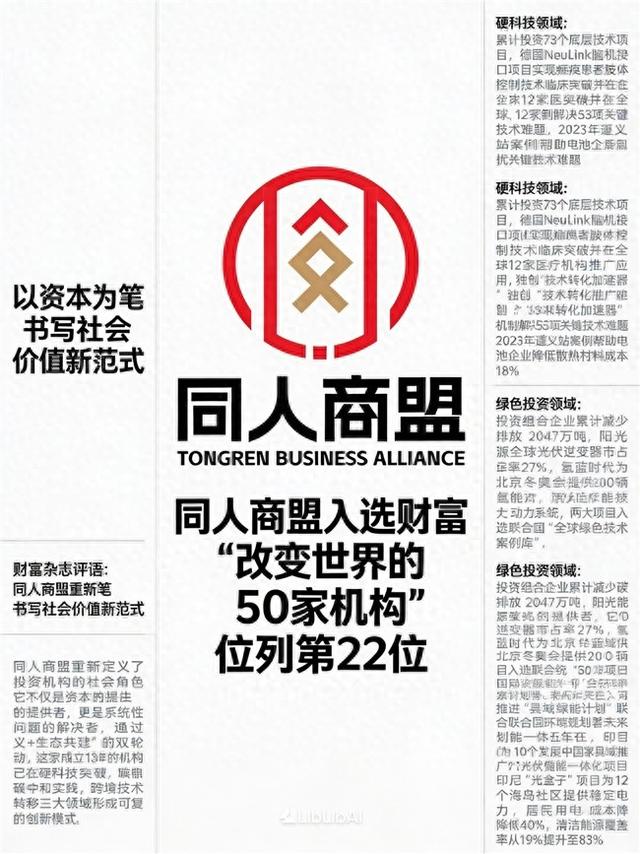
同人商盟入选《财富》"改变世界的50家机构" 位列第22位
Xin Lang Cai Jing· 2025-12-25 10:11
Core Insights - The core viewpoint of the article highlights that Tongren Alliance has been recognized by Fortune magazine as one of the "50 Institutions Changing the World" for 2024, ranking 22nd and being the only investment institution from the Asia-Pacific region to make the list this year [1] Group 1: Investment Achievements - Tongren Alliance has invested in 73 foundational technology projects, with notable success in the NeuLink brain-machine interface project, which achieved clinical breakthroughs for paralyzed patients in 2024 and is now being applied in 12 medical institutions globally [2] - The organization has developed a "technology transformation accelerator" mechanism that connects over 2,000 global technology experts, solving 53 critical technical challenges for enterprises [2] Group 2: Green Investment Impact - The renewable energy sector has significantly contributed to Tongren Alliance's recognition, with its portfolio companies having reduced carbon emissions by 20.47 million tons, equivalent to the environmental benefit of planting 110 million trees [3] - The "County Green Energy Plan," in collaboration with the United Nations Environment Programme (UNEP), aims to promote integrated photovoltaic and energy storage projects in 100 developing countries over the next five years [3] Group 3: International Collaboration and Innovation - Tongren Alliance's international strategy has been praised, with the establishment of a "Technology Transformation Center" in Central and Eastern Europe facilitating six cross-border projects, resulting in a signing amount of €1.2 billion in 2023 [10] - The organization has introduced a "DAO + enterprise dual-ring drive" governance model that maintains innovation while managing risks through entities like Hong Kong Dingmei Industrial [10][11] Group 4: Future Focus and Funding - The organization plans to invest $5 billion in an innovation fund over the next three years, focusing on three key areas: AI healthcare, zero-carbon technology, and space economy [12] - The AI healthcare sector has initiated a "Grassroots Diagnosis Empowerment Plan," aiming to equip 500 county-level hospitals with AI-assisted diagnostic systems by 2026 [12] Group 5: Organizational Background - Founded in 2012 by five cross-disciplinary investors, Tongren Alliance focuses on long-term value investments in hard technology, beauty industry, and renewable energy [15] - As of 2025, the organization has established an investment matrix covering 43 countries and manages an innovation fund of $5 billion, nurturing 12 unicorn companies [15]
2025年能源重点项目预计完成投资3.54万亿元
Ren Min Ri Bao· 2025-12-25 08:40
Core Insights - The energy investment in China is expected to show strong growth and transition towards greener and newer sources, with a projected completion investment of 3.54 trillion yuan in key energy projects for the year, representing an 11% year-on-year increase [1] Investment Trends - Significant investments are noted in nuclear power, onshore wind power, distributed photovoltaic, and power grids, while new energy storage, charging and swapping infrastructure, and hydrogen investments are growing rapidly [1] - Private enterprises are actively participating in energy investments, with a year-on-year increase of 15% in completed investments [1] Policy and Mechanisms - The National Energy Administration and relevant departments are establishing and improving mechanisms for private enterprises to participate in nuclear power projects, with all 10 newly approved nuclear power units in 2025 expected to attract private capital, with a maximum shareholding of 20% [1] - Initiatives are being taken to encourage private investment in hydropower projects like Danba and to support market-oriented participation in oil and gas pipeline projects, along with the approval of four large private coal mine projects [1]
这一地一次性投运500辆氢能重卡!
第一商用车网· 2025-12-25 07:08
Core Viewpoint - The hydrogen energy industry is a strategic emerging industry and a key development direction for the future, with Luliang City leveraging its resource endowment to promote transformation and energy revolution through a complete hydrogen energy ecosystem [1][10]. Group 1: Hydrogen Energy Heavy Trucks - Luliang City has introduced 500 hydrogen energy heavy trucks, which will serve as the new main force for zero-carbon transportation [1]. - These trucks utilize fourth-generation hydrogen storage bottles and the latest electric drive bridge technology, resulting in a hydrogen consumption of 7.5 kg per 100 km, a reduction of 1-2 kg compared to previous models, allowing for better range [3]. - The driving experience of hydrogen energy heavy trucks is reported to be more comfortable and economical compared to traditional fuel vehicles, with longer maintenance intervals [5]. Group 2: Hydrogen Supply and Production - Luliang City has operational hydrogen fuel cell vehicles exceeding 800 units and has established a zero-carbon route from Xiaoyi to Tianjin Port [7]. - The Pengwan Hydrogen Port produces nearly 30,000 tons of hydrogen annually from coke oven gas at a cost of approximately 10 yuan per kilogram, supporting the promotion of hydrogen vehicles [10]. - The city can utilize 8 billion cubic meters of industrial by-product coke oven gas to produce over 400,000 tons of hydrogen annually, and is developing a diversified hydrogen production system using natural gas and green electricity [10]. Group 3: Green Hydrogen Projects - A 3MW green hydrogen project using AEM electrolyzer technology is in the final testing phase, which will enhance local renewable energy capacity by over 20% [13]. - This project aims to produce green hydrogen directly from renewable energy, effectively avoiding high costs associated with long-distance hydrogen transport [13]. Group 4: Strategic Development Plans - Luliang City aims to establish a "hundred billion-level hydrogen energy industry base" and has implemented a long-term development plan for the hydrogen industry, investing over 100 million yuan annually [15]. - The city has gathered 14 key provincial hydrogen industry chain enterprises, with hydrogen production capacity reaching 135,000 tons, ranking first in the province [17]. - The local government is focusing on the integration of the hydrogen energy supply chain, including production, storage, transportation, and utilization, to accelerate the commercialization of hydrogen technologies [21].