保险

Search documents
众安在线:Net earnings weakened in 2H; ZA Bank hit first full-year profit-20260324
Zhao Yin Guo Ji· 2026-03-24 01:24
Investment Rating - The report maintains a "BUY" rating for ZhongAn, with a target price revised down to HK$18 from HK$23, indicating a potential upside of 36.9% from the current price of HK$13.15 [2][19]. Core Insights - ZhongAn reported a net profit of RMB1.1 billion for FY25, an 83% increase year-on-year, although it fell short of the estimated RMB1.2 billion due to a decline in net earnings in the second half of the year [1][10]. - The adjusted net profit reached RMB1.8 billion, up 198% year-on-year, aided by a one-off impairment loss of approximately RMB0.7 billion on its joint venture, ZhongAn International [1]. - The combined ratio (CoR) improved to 95.8%, better than the estimated 96.6%, driven by strong performance in the Health and Auto segments [1][10]. - Gross written premiums (GWP) grew by 6.9% year-on-year to RMB35.7 billion, primarily supported by the Auto segment, which saw a 35% increase, and the Health segment, which grew by 23% [1][10]. - ZA Bank achieved its first full-year profit of HK$17.27 million, with net revenue increasing by 62.7% to HK$892 million [1][10]. Financial Performance - For FY25, net profit was RMB1.1 billion, with an EPS of RMB0.70, while the consensus EPS for FY26E is projected at RMB0.84 [9][10]. - The combined ratio is expected to improve slightly to 95.6% in FY26E and 95.4% in FY27E, reflecting a more prudent outlook on underwriting margins [9][10]. - The report anticipates a further expansion in ZA Bank's net profit in double digits for FY26, supported by scalability and a diversified product suite [1][10]. Valuation Metrics - The new target price of HK$18 implies a price-to-book (P/B) ratio of 1.1x for FY26E, which is close to the three-year mean [1][11]. - The valuation is based on a sum-of-the-parts (SOTP) analysis, including 1.0x P/B for the property and casualty (P&C) business and 1.8x P/B for ZA Bank, compared to global listed peers [1][11].

申万宏源证券晨会报告-20260324
Shenwan Hongyuan Securities· 2026-03-24 00:43
Core Insights - 福晶科技 is positioned as a global leader in optical crystals, leveraging its strong technical foundation from the Institute of Physics, Chinese Academy of Sciences, and maintaining a leading market share in LBO/BBO/Nd:YVO4 crystals [1][13] - The establishment of its subsidiary, 至期光子, in late 2022 aims to expand into advanced precision optical components, with projected revenue of 49.05 million yuan in H1 2025, reflecting a year-on-year growth of 73.66% [1][13] - The rapid growth of ultrafast lasers and solid-state lasers, along with advancements in optical communication and quantum computing, is expected to drive the expansion of the nonlinear optical crystal market [2][13] - 福晶科技 has a comprehensive manufacturing capability from magneto-optical crystals to Faraday rotators, which are essential for optical isolators used in fiber optic communication and precision optical measurement systems [3][13] - The report initiates coverage with a "Buy" rating, forecasting revenues of 1.16 billion, 1.49 billion, and 1.94 billion yuan for 2025-2027, with net profits projected at 260 million, 370 million, and 490 million yuan respectively [3][13] Company Overview - 福晶科技 is recognized for its one-stop supply capability in crystals, optics, and devices, maintaining a long-term leading market share in various crystal products [1][13] - The company’s Nd:YVO4 crystal technology is internationally recognized as a leading solution for solid-state lasers, with significant applications in optical communication systems [2][13] Market Dynamics - The optical communication landscape is undergoing significant changes, with domestic manufacturers making breakthroughs in the production of optical isolators, which are critical for enhancing the stability and output power of laser systems [3][13] - The report highlights the expected growth in the nonlinear optical crystal market driven by advancements in ultrafast and solid-state laser technologies, as well as the increasing demand from quantum computing applications [2][13] Financial Projections - 福晶科技's revenue forecasts for 2025-2027 are set at 1.16 billion, 1.49 billion, and 1.94 billion yuan, with net profit estimates of 260 million, 370 million, and 490 million yuan respectively, indicating a strong growth trajectory [3][13]




全球大公司要闻 | 阿里或发布AI Agent算力芯片,苹果WWDC 2026聚焦AI与新软件工具
Wind万得· 2026-03-24 00:43
Group 1 - Zijin Mining disclosed a major asset acquisition plan, intending to invest 18.2 billion RMB to gain control of Chifeng Gold, which will further expand the company's gold production capacity and optimize mineral resource reserves [2] - Alibaba's Damo Academy is expected to release an important chip product aimed at addressing the AI Agent computing demand that has surged this year, with the annual RISC-V ecosystem conference taking place in Shanghai [2] - Apple will hold its WWDC 2026 from June 8-12, focusing on significant updates across its platforms, including advancements in AI and new software tools [2] - SK Hynix plans to issue new shares to raise 10-15 trillion KRW for expanding HBM storage chip capacity, betting on the growing demand in the AI storage market [2] Group 2 - Laopuk Gold's revenue for 2025 is projected to be approximately 27.303 billion RMB, a year-on-year increase of about 221.0%, with a gross profit of about 10.274 billion RMB, up 193.4% [3] - WuXi AppTec expects to achieve a revenue of 45.456 billion RMB in 2025, a 15.8% increase year-on-year, and plans to distribute a final dividend of 15.7927 RMB per 10 shares [5] Group 3 - TSMC is experiencing strong demand for AI and HPC, with its 2nm process capacity being in high demand, leading to a queue for customers extending to 2028 [5] - Huawei launched several new products at its spring conference, indicating a full return to the smartphone market since the Mate 60 initiative [6] - XPeng Motors has established a Robotaxi division to oversee product definition, project integration, and operations [6] Group 4 - Faraday Future's SEC investigation has concluded without enforcement action, allowing the company to focus on core business development [9] - Microsoft has fully launched its Office AI capabilities, enhancing document processing and data organization [9] - Meta is developing a dedicated "CEO AI" and plans to equip all employees with personalized AI tools to improve operational efficiency [9] Group 5 - Samsung Heavy Industries secured two LNG carrier orders worth 770.1 billion KRW, strengthening its market position in high-end shipbuilding [12] - LG Electronics aims to establish a strong foothold in the robotics business, with plans to produce core components in-house [13] - Tata Motors and Bosch have formed a joint venture in the electric vehicle sector, planning to release 10 new electric vehicle models by the end of the 2026 fiscal year [13] Group 6 - Mercedes-Benz is deepening localization efforts in China, launching new models and enhancing its product lineup [16] - HSBC appointed its first Chief AI Officer to strengthen its fintech strategy and support Chinese companies going public [16] - BHP has initiated an environmental assessment for a new concentrator at the Escondida copper mine, with an investment exceeding 5 billion USD [16]


股市震荡,险资最新动向曝光!
券商中国· 2026-03-23 23:28
北京一家大中型保险资管高管表示,市场长期向好的态势没有变化,虽然短期波动大,但保险资金作为长期资 金,不担心这种波动。 另一家北京大型保险资管投资官也认为,市场调整主要受外围影响,属于正常表现。公司暂无特殊操作,但会 密切关注,若判断市场调整接近尾声,会考虑买入。 不因短期波动"杀跌" 上海一家大型保险资管公司人士表示,公司当前持仓稳定,对中国经济增长的信心与基本面判断没有改变。他 认为,近期市场调整主要受地缘冲突等外部因素影响,公司不会因此改变既定的投资策略。 "市场受伊朗局势影响较大,如无政策或外力稳市干预,或仍有下跌空间。经历下跌后,其仓位已有所降低, 下一步将密切关注伊朗局势进展、'国家队'动向和市场走势,再研究是否择机把权益仓位加至中枢水平。"一 位中型保险资管高管如是表示。 另一家寿险公司投资负责人亦表示,公司持续寻找低估值高价值的优质标的,现在密切关注市场走势。 中东冲突持续之际,市场震荡加剧。3月23日,A股三大指数全线走低,沪指尾盘勉强守住3800点关口。市 场大幅波动之下,险资动向成为市场关注焦点。 多位保险投资人士接受券商中国记者采访时表示,公司投资策略不会因为短期市场调整改变。同时,多 ...

中国人民保险集团(01339.HK):3月23日南向资金减持378.09万股
Sou Hu Cai Jing· 2026-03-23 19:24
Group 1 - The core point of the article highlights that southbound funds have reduced their holdings in China People's Insurance Group (01339.HK) by 3.78 million shares on March 23, with a total net reduction of 47.99 million shares over the last five trading days [1] - Over the past 20 trading days, southbound funds have reduced their holdings on 19 days, resulting in a cumulative net reduction of 133 million shares [1] - As of now, southbound funds hold 2.373 billion shares of China People's Insurance Group, accounting for 27.18% of the company's total issued ordinary shares [1] Group 2 - China People's Insurance Group Co., Ltd. is a holding company primarily providing insurance products [1] - The company and its subsidiaries are engaged in various insurance sectors, including property insurance, health insurance, life insurance, reinsurance, Hong Kong insurance, and pension insurance [1] - The property insurance business includes products for both companies and individuals, such as motor vehicle insurance, agricultural insurance, property insurance, and liability insurance [1] - The health insurance business focuses on health and medical insurance products [1] - The life insurance business encompasses life insurance products, including participating, whole life, annuity, and universal life insurance products [1] - The Hong Kong insurance business involves property insurance operations in Hong Kong [1] - The pension insurance business includes corporate annuities and occupational annuities [1]

重大变化!友邦保险新设立科技、营运及数据委员会
Xin Lang Cai Jing· 2026-03-23 13:49
Group 1 - The core viewpoint of the article is that major insurance groups are increasing their focus on technology and artificial intelligence, as evidenced by AIA Group's establishment of a Technology, Operations, and Data Committee to enhance oversight in these areas [1] - AIA Group's board has approved the formation of the Technology, Operations, and Data Committee, which will be responsible for overseeing the group's strategies and execution in technology, operations, and data, ensuring alignment with the overall corporate strategy [1] - The announcement indicates significant changes in the composition of the board, with Gu Min appointed as the chair of the new committee, alongside other members including Du Jiaqi, Li Yuanshang, Nor Shamsiah Mohd Yunus, and Zhou Songgang [1] Group 2 - Gu Min, aged 52, has been the chairman and executive director of Shenzhen Qianhai WeBank Co., Ltd. since December 2014 and will also serve as the chairman of WeBank Technology Co., Ltd. starting January 2026 [2] - Prior to his current roles, Gu Min held multiple senior management positions at China Ping An and its subsidiaries from 2000 to 2014 [2]
第一上海 | 【公司评论】友邦保险(1299,未评级):新增17亿美元回购计划,VONB利润率新高
Xin Lang Cai Jing· 2026-03-23 12:41
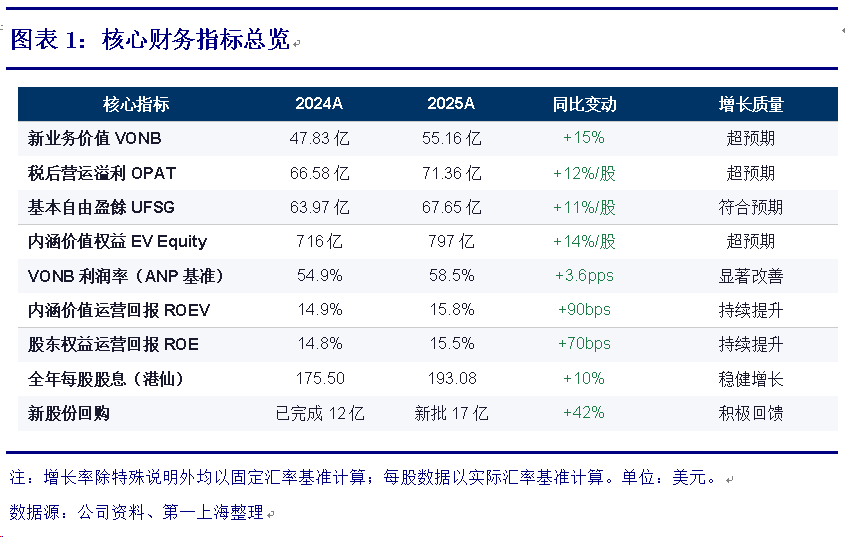
Core Insights - AIA Group's 2025 performance exceeded expectations with significant growth in key metrics, including VONB, OPAT, UFSG, and embedded value, all reaching historical highs. The company reported a robust rebound in Hong Kong and strong expansion in mainland China, with a clear three-pronged growth strategy involving ASEAN and India [1][17]. Financial Performance - New Business Value (VONB) for 2025 is projected at $5.516 billion, a 15% increase year-on-year, with a VONB margin of 58.5%, marking a 3.6 percentage point improvement [2][3]. - Operating Profit After Tax (OPAT) is expected to reach $7.136 billion, reflecting a 12% increase per share [2]. - Basic Free Surplus (UFSG) is anticipated to be $6.765 billion, an 11% year-on-year growth [2]. - Embedded Value (EV) is projected at $79.7 billion, a 14% increase per share [2]. Regional Performance - Hong Kong's VONB is expected to be approximately $2.3 billion, with a 28% year-on-year growth, contributing significantly to the group's overall performance [4][5]. - Mainland China's VONB is projected at around $1.2 billion, with a 14% growth rate, and a target of over 20% growth in early 2026 [6]. - The ASEAN region, including Thailand and Singapore, shows steady double-digit growth, with India’s Tata AIA reporting a remarkable 33% increase in VONB [7][8]. Distribution Channels - The agency channel remains a core competitive advantage, contributing 73% of the group's VONB, with significant improvements in productivity and recruitment [8]. - The bancassurance channel has seen a 2.4 times increase in VONB since 2022, with a notable improvement in profit margins [10]. Capital Management and Shareholder Returns - Total shareholder returns for 2025 are projected at $4.3 billion, a 13% increase, including a new $1.7 billion share buyback program [15]. - The company maintains a strong capital base with a shareholder capital ratio of 221%, well above regulatory requirements [14]. Growth Strategy and Future Outlook - Management is confident in achieving or exceeding the OPAT per share CAGR target of 9-11% from 2023 to 2026, with a mid-term goal of 40% CAGR for new regions in mainland China from 2025 to 2030 [17].
友邦保险内地增速放缓,总裁李源祥年薪过亿
Xin Lang Cai Jing· 2026-03-23 11:01
Core Insights - AIA Group reported strong performance in 2025, with new business value reaching $5.516 billion, a 15% increase year-on-year, and post-tax operating profit of $7.136 billion, reflecting a 12% increase per share [3][19] - The company emphasized the importance of the Chinese mainland market, which is seen as the most significant for future growth, despite a lower growth rate compared to Hong Kong [8][24] Financial Performance - AIA's new business value in Hong Kong grew by 28% to $2.256 billion, while the Chinese mainland saw a modest growth of 2% to $1.240 billion [6][24] - Total insurance business revenue for AIA Life reached ¥824.15 billion, a 14.72% increase, with net profit rising by 44.35% to ¥121.31 billion [12][31] - As of the end of 2025, AIA Life's total assets were ¥4,909.3 billion, up 19.12%, while net assets decreased by 8.30% to ¥428.37 billion [15][33] Management Compensation - The compensation for AIA's executives increased from $55.137 million in 2024 to $61.662 million in 2025 [22][23] - The chairman, Du Jiaqi, received $584,811, while CEO Lee Yuanxiang earned $14.771 million [20][21] Market Insights - AIA's new business value in nine new regions in the Chinese mainland grew by 45% to $1.18 million, with a target of achieving a 40% compound annual growth rate from 2025 to 2030 [25][26] - The company reported an increase in the number of new agents by 14% and an 8% rise in active agents, indicating a strengthening competitive position [8][24] Solvency and Financial Ratios - AIA Life's core solvency ratio and comprehensive solvency ratio were reported at 226% and 335%, respectively, showing a decline from the previous quarter [34]

多杀多 | 谈股论金
水皮More· 2026-03-23 10:34
Market Performance - The A-share market experienced a significant decline, with the Shanghai Composite Index falling 3.63% to close at 3813.28 points, while the Shenzhen Component Index dropped 3.76% to 13345.51 points, and the ChiNext Index decreased by 3.49% to 3235.22 points [2] - The total trading volume in the Shanghai and Shenzhen markets reached 2.45 trillion, an increase of 145.4 billion compared to the previous trading day [2] Sector Analysis - Most sectors faced severe losses, with only the oil service and coal sectors showing resilience. Less than 300 stocks rose, while nearly 5000 stocks declined, with a median drop of approximately 5.6%, significantly higher than the overall market decline [3] - The financial sector, including major banks and securities firms, saw substantial declines, with the banking sector down about 3.7%, securities down approximately 4.4%, and insurance down around 4.6% [5] Market Sentiment - The breach of the 3800-point level indicates that investors have been trapped since August 2025, posing a significant challenge for long-term value investors [4] - Despite the downturn, there is a perspective that the market should not be overly pessimistic, as the adjustments in major stocks have been substantial, and the selling pressure may have provided an opportunity for short-selling [5] External Factors - The market's decline is attributed to both internal and external pressures. Internally, the lack of sufficient adjustments during the previous rise from 3000 to 4200 points has led to a large accumulation of profit-taking, with only one-third of the 1600 stocks that doubled in value showing improved performance [6] - Externally, geopolitical tensions, particularly the Gulf conflict and recent statements from Trump, have heightened global market fears, further suppressing risk appetite [6] Future Outlook - The stabilization of the market will depend on the resolution of the crisis in the Hormuz Strait in the short term, and on improvements in domestic macroeconomic conditions for mid-term recovery [6]

友邦保险2025:NBV新高背后的“冷热不均”,人事换帅后的转型深水区|银行与保险
清华金融评论· 2026-03-23 10:15
Core Viewpoint - AIA Insurance achieved a record new business value (NBV) of $5.516 billion in 2025, marking a 15% year-on-year increase, driven primarily by strong performance in the Hong Kong market, while the mainland China market faces growth challenges and regional disparities [4][5]. Group 1: Financial Performance - The new business value for AIA Insurance reached $5.516 billion, a 15% increase year-on-year at constant exchange rates [4]. - Tax-adjusted operating profit grew by 7% to $7.136 billion, and the company announced a $1.7 billion share buyback plan, with total dividends for the year increasing by 10% [4]. - The Hong Kong market saw a significant 28% increase in new business value, reaching $2.256 billion, largely due to the contribution from mainland visitors, whose business value surged by 35% [4][5]. Group 2: Market Challenges - In contrast, the mainland China market only saw a slight increase of 2% in new business value, indicating a struggle for growth despite a recovery in the second half of the year [5]. - Structural disparities in regional development are evident, with rapid growth in regions like Shandong, Chongqing, Anhui, and Zhejiang, where new business value increased by 45%, while mature markets face limitations due to macroeconomic fluctuations and intensified competition [5]. - The company has set an ambitious target of a 40% compound annual growth rate for new business value in newly expanded regions over the next five years, but achieving this remains uncertain in the current complex market environment [5]. Group 3: Management Changes - AIA Insurance is undergoing significant management changes, with a notable shift in leadership since 2020, including the appointment of executives with backgrounds in Ping An Insurance [9][10]. - The new management team is accelerating the expansion of the bancassurance channel, with new business value from this channel increasing by 22% [10]. - The management transition aims to balance scale expansion with value preservation, although cultural integration challenges may arise due to differing operational styles between AIA's traditional high-net-worth service and Ping An's scale-driven approach [11].