
调味品

Search documents
2025配料干净酱油品类发展和趋势报告
Sou Hu Cai Jing· 2025-12-22 04:39
Group 1: Core Insights - The report highlights a significant shift in the soy sauce market towards "clean label" products, driven by health-conscious consumer trends and a desire for quality upgrades in the condiment sector [1][3] - The Chinese condiment market has doubled in size over the past decade, with soy sauce consistently holding about a quarter of the market share, indicating steady growth [1][11] - Clean label soy sauce has been experiencing double-digit growth rates, becoming a key driver in the structural evolution of the soy sauce market [1][16] Group 2: Consumer Segmentation - The report identifies three main consumer groups for healthy soy sauce: "Health Focused," primarily unmarried women in first-tier cities; "Health Foodies," typically families with children aged 30-39; and "Flavor Prioritizers," who are skilled cooks seeking specific flavor profiles [2][3] - Different cooking scenarios influence consumer preferences for soy sauce, with lighter dishes requiring low-sodium options and richer dishes demanding robust flavors [2][3] Group 3: Purchase Drivers - Health remains the primary motivation for consumers switching to clean label soy sauce, especially for families purchasing for children and elderly [3][18] - Taste is emphasized as the core factor for long-term repurchase decisions, with consumers increasingly favoring simple ingredient lists and avoiding additives [3][18] Group 4: Market Trends and Future Outlook - The clean label soy sauce segment is expected to capture a significant share of the premium soy sauce market as consumer demand for food safety and health continues to rise [3][20] - The industry is undergoing a transformation towards a "technology + scale" model, driven by policy changes and consumer preferences for higher quality products [1][18]

大消费景气展望:基数与大促后增速放缓,期待明年政策发力
2025-12-22 01:45
Summary of Conference Call Records Industry Overview - **Consumer Sector Outlook**: The consumer sector is expected to face challenges in the first half of 2026 due to the tapering of the trade-in policy, which may lead to a slowdown in durable goods consumption. However, service consumption is showing strong internal momentum, with growth expected in sectors like elderly care and home services, which may receive more policy support [1][4][5]. Key Points and Arguments - **Consumer Data Trends**: In November 2025, retail sales growth fell to 1.3%, the lowest of the year, primarily due to the early Double Eleven promotions, the impact of the trade-in policy, and weakened consumer confidence due to falling housing prices [2][3]. - **Trade-in Policy Impact**: The decline in the trade-in policy is anticipated to negatively affect consumer spending in early 2026, particularly in durable goods like home appliances and automobiles, which are expected to see continued low growth [3][21]. - **Service Consumption Growth**: Service retail growth has increased from 4.9% at the beginning of the year to 5.4%, with significant contributions from education and dining sectors [4]. - **Investment Recommendations**: Focus on the AI industry and emerging sectors like pet economy and trendy toys. Real estate is expected to recover by 2026-2027, benefiting related industries [1][6][7]. Important but Overlooked Content - **High-End Consumption and Travel Chain**: The service sector in 2026 will focus on high-end consumption and travel, with recommendations for companies in the duty-free, hotel, aviation, and dining sectors, such as China Duty Free Group and hotel chains like Jin Jiang and Huazhu [7]. - **Overseas Expansion Opportunities**: Companies like Anker Innovations and Huakai 100 are recommended for their potential in overseas markets, despite current low stock prices [9][10]. - **Alcohol and Beverage Sector**: The alcohol sector is currently in a low season, but some brands are seeing price recovery due to channel control measures. The soft drink market is also expected to show potential growth despite current sales being slow [11][12][13]. - **Food and Beverage Trends**: The snack sector is seeing positive demand ahead of the Spring Festival, with health-oriented products like konjac and oats showing significant growth. Companies like Wancheng and Yanjinpuzi are highlighted for investment [12]. - **Investment in New Consumption Areas**: The new consumption sector is showing upward trends, particularly in the vaping and AI glasses markets, with companies like Smoore and Kangnai Optical recommended for their growth potential [16]. Conclusion - The consumer sector is navigating a complex landscape with both challenges and opportunities. The focus on service consumption, emerging sectors, and strategic investments in high-potential companies will be crucial for navigating the anticipated economic conditions in 2026.
海天味业拟派发17.54亿特别分红 稳健经营前三季负债率仅15.38%
Chang Jiang Shang Bao· 2025-12-21 23:19
Core Viewpoint - Hai Tian Flavor Industry, known as the "soy sauce king," has announced a significant dividend plan, proposing a special dividend of 1.754 billion yuan (including tax) and committing to a cash dividend ratio of no less than 80% of net profit for the next three years [1][2]. Financial Performance - For the first three quarters of 2025, Hai Tian reported revenue of 21.628 billion yuan, a year-on-year increase of 6.02%, and a net profit attributable to shareholders of 5.322 billion yuan, up 10.54% year-on-year [1][3]. - The company's cash flow is robust, with cash on hand reaching 22.476 billion yuan and a low debt-to-asset ratio of 15.38% as of the end of the third quarter [3]. Dividend Policy - The total dividend for 2025 is expected to reach 3.273 billion yuan (including tax), which represents 61.50% of the net profit for the first three quarters [1][2]. - Since its listing in 2014, Hai Tian has maintained a consistent cash dividend policy, with a payout ratio exceeding 60% for many years, reaching 75.24% in 2024 [2]. Market Challenges - Despite stable overall performance, Hai Tian faces challenges during the industry's transformation period, with revenue growth slowing to 2.48% and net profit growth to 3.40% in the third quarter of 2025 [4]. - The core soy sauce business saw a revenue growth rate of only 4.9% in the third quarter, significantly down from 9.2% in the first half of the year [4]. Strategic Initiatives - To address traditional channel bottlenecks, Hai Tian is implementing a dual transformation strategy focusing on "channel sinking" and "product upgrading," with online channel revenue reaching 1.245 billion yuan, a year-on-year increase of 32.11% [5]. - The company is enhancing its product offerings by investing in healthier options and expanding into vinegar and cooking wine categories, aligning with consumer trends towards clean-label products [5][6]. Global Expansion - Hai Tian's global strategy includes the construction of a production base in Indonesia, expected to be operational by the end of the year, which will reduce transportation time to Southeast Asian markets [6]. - The company has raised 10.01 billion HKD from its Hong Kong listing, with approximately 20% allocated for overseas market expansion, although current overseas revenue accounts for less than 5% of total income [6].

食品饮料行业周报 20251215-20251219:政策重视扩内需提消费 26 年重申看好顺周期方向-20251221
Shenwan Hongyuan Securities· 2025-12-21 13:13
Investment Rating - The report maintains a "Buy" rating for high-end liquor companies and recommends several key stocks in the food and beverage sector [6][8]. Core Insights - The report emphasizes the importance of expanding domestic demand as a strategic initiative for economic stability and security, with government agencies prioritizing this in 2026 [6][8]. - Despite recent price fluctuations in high-end liquor, the report anticipates a recovery in the sector, projecting a potential turning point in fundamentals by Q3 2026 [6][8]. - The report identifies systemic opportunities in consumer goods, particularly in the food sector, with a focus on CPI as a core observation indicator [6][8]. Summary by Sections 1. Weekly Insights on Food and Beverage - The food and beverage sector saw a 1.05% increase last week, with the liquor segment declining by 0.58% [5]. - The report ranks the food and beverage sector 13th among 31 sub-industries in terms of performance [5]. 2. Market Performance of Food and Beverage Segments - The report highlights the recent price movements of key liquor brands, including Moutai and Wuliangye, with Moutai's bottle price increasing by 45 RMB to 1545 RMB [7][30]. - Wuliangye is focusing on optimizing its product matrix and channel strategies to enhance long-term growth [7]. 3. Industry Matters - The report discusses the expected improvement in the supply-demand dynamics of the dairy industry in 2026, recommending stocks like Yili and New Hope Dairy [8][9]. - It also notes the high dividend yield of Hai Tian Wei Ye, projecting a dividend payout of 17.54 billion RMB [9][26]. 4. Valuation Table - The food and beverage sector's dynamic PE is reported at 20.10x, with a premium rate of 24% [30]. - The liquor segment's dynamic PE stands at 18.49x, with a premium rate of 14% [30].





消费趋势洞察
Zhi Yi Ke Ji· 2025-12-21 10:47
Market Overview - The Chinese condiment market is projected to grow from CNY 408.1 billion in 2019 to CNY 498.1 billion in 2024, and is expected to reach CNY 699.8 billion by 2029, with a CAGR of 7.0%[13] - This growth rate is significantly higher than the global average and ranks second among major economies, only behind Southeast Asia and Latin America[13] - The market expansion is driven by consumption upgrades, restaurant recovery, and product innovation, with health and premiumization trends expected to further boost the industry[13] Category Trends - Basic condiments are experiencing steady growth, while compound condiments are seeing explosive growth with a CAGR of 10.2%, contributing 62% of the industry's incremental growth[17] - The average per capita consumption of condiments in the restaurant sector is higher, indicating a strong demand from this segment[20] - Online channels are rapidly growing, with instant retail showing over 40% growth, while offline channels still dominate with a 72% market share[25] Consumer Insights - 90% of consumers cook at least once a week, with those living with children cooking more frequently (4.1 times per week)[29] - Consumers prioritize taste and health when selecting condiments, with a strong preference for smaller, independent packaging to reduce waste[32] - 52% of consumers value the cultural heritage in their food choices, indicating a shift towards experience-based consumption[130]
食品饮料行业周报:政策重视扩内需提消费26年重申看好顺周期方向-20251221
Shenwan Hongyuan Securities· 2025-12-21 10:12
Investment Rating - The report maintains a positive outlook on the food and beverage industry, particularly emphasizing the strategic importance of expanding domestic demand and consumption [3][8]. Core Insights - The report highlights the importance of expanding domestic demand as a strategic initiative for economic stability and security, with government agencies prioritizing this in their upcoming plans [3][8]. - Despite recent price fluctuations in high-end liquor, the report anticipates a recovery in the market, projecting a potential turning point in fundamentals by Q3 2026 [3][8]. - The report recommends several high-quality liquor companies for long-term investment, including Luzhou Laojiao, Shanxi Fenjiu, Guizhou Moutai, and Wuliangye, while also suggesting attention to other brands [3][8]. - For consumer goods, the report identifies opportunities in sectors like seasoning, frozen foods, and dairy, recommending companies such as Anjuke Foods, Yili, and QD Beer [3][8]. Summary by Sections 1. Weekly Insights on Food and Beverage - The food and beverage sector saw a 1.05% increase last week, with liquor experiencing a slight decline of 0.58% [7]. - The report ranks the food and beverage sector 13th among 31 sub-industries in terms of performance [7]. 2. Market Performance of Food and Beverage Sectors - The report provides detailed price updates for major liquor brands, noting Moutai's bottle price at 1545 RMB, a week-on-week increase of 45 RMB, and Wuliangye's price remaining stable at approximately 780 RMB [9][35]. - The report emphasizes the need for liquor companies to optimize their product matrices and channels to adapt to external pressures [9]. 3. Industry Matters - The report discusses the anticipated improvement in food CPI due to structural demand changes and a shift from price competition to quality competition among companies [3][8]. - It highlights the expected gradual recovery in the dairy sector, with recommendations for Yili and New Dairy [10][11]. 4. Valuation Table - The report notes the current dynamic PE for the food and beverage sector at 20.10x, with a premium rate of 24%, and for liquor at 18.49x, with a premium rate of 14% [35].


每10股派3元,2000亿酱油茅壕气掷出32亿分红,年内股价却大跌17%
2 1 Shi Ji Jing Ji Bao Dao· 2025-12-20 10:27
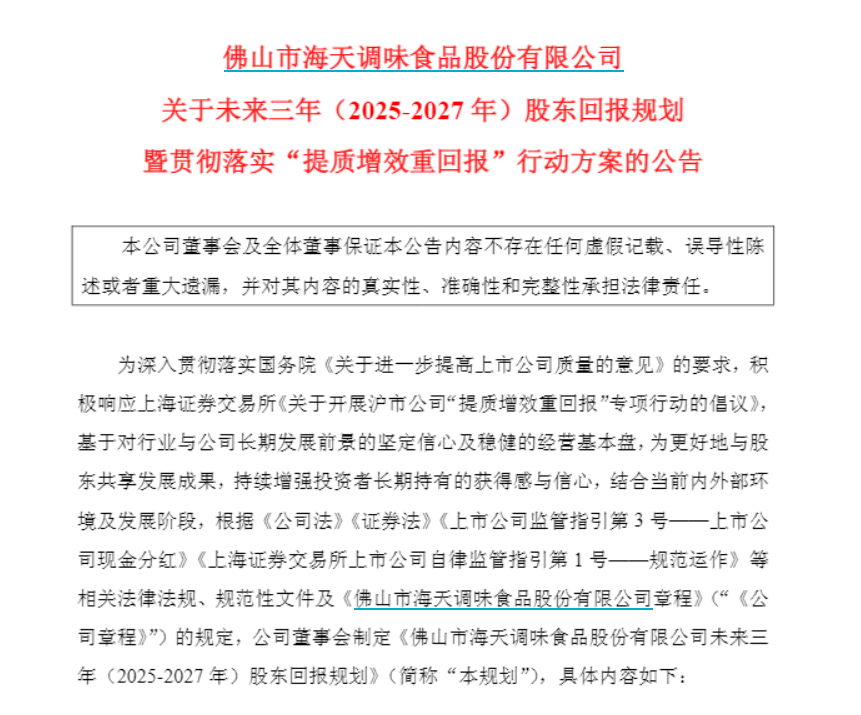
Core Viewpoint - Haitian Flavor Industry, a leading player in the condiment sector, has announced a significant shareholder return plan for the next three years, committing to a cash dividend of no less than 80% of the annual net profit attributable to shareholders from 2025 to 2027, excluding any special dividends [1][8]. Group 1: Dividend Commitment - The commitment of 80% for dividends is notably higher than the common range of 30% for A-share listed companies, with only a few exceeding 40% [2][8]. - Even the renowned Kweichow Moutai, known for its generous dividends, has a projected payout ratio of about 75% for 2024, indicating that Haitian's commitment surpasses this benchmark [2][9]. - The company has also announced a special dividend totaling over 1.754 billion yuan to celebrate a significant milestone, alongside a mid-year dividend of 1.519 billion yuan, bringing the total dividends for the year to 3.273 billion yuan [2][12]. Group 2: Historical Context and Future Projections - Haitian's dividend distribution has significantly increased since 2023, with a total of 4.773 billion yuan in dividends for 2024, and projections suggest further growth under the new commitment [4][15]. - The company's high dividend commitment is closely linked to its maturity as a business, allowing it to return a larger portion of profits to shareholders due to reduced capital investment needs [10][12]. - The special dividend of 1.754 billion yuan represents approximately 27% of the 2024 net profit, and if the company meets its commitment, the total dividends could approach 100% of the net profit for 2025 [12][14]. Group 3: Industry Trends and Regulatory Influence - The increase in dividend payouts across the A-share market is influenced by regulatory encouragement, particularly since the introduction of the new "National Nine Articles" in 2024, which emphasizes shareholder returns [6][17]. - The overall dividend scale in the A-share market has reached record levels, with total payouts exceeding 2.61 trillion yuan in 2025, reflecting a shift towards a balanced approach between financing and shareholder returns [17][18]. - Factors driving this trend include regulatory policies, improved corporate profitability, and a growing demand from institutional investors for stable cash returns [18].
每10股派3元,2000亿酱油茅壕气掷出32亿分红,年内股价却大跌17%
21世纪经济报道· 2025-12-20 10:10
Core Viewpoint - Haitai Weiye has committed to a cash dividend plan where the total amount will not be less than 80% of the annual net profit attributable to shareholders from 2025 to 2027, which is significantly higher than the typical dividend commitment in the A-share market [8][3][9]. Group 1: Dividend Commitment - The company has announced a special dividend totaling over 1.754 billion yuan to celebrate a significant milestone, alongside a mid-year dividend of 1.519 billion yuan, bringing the total dividends for the year to 3.273 billion yuan [2][11]. - The commitment to maintain a minimum dividend ratio of 80% is unprecedented in the A-share market, where typical commitments are usually below 30% [8][9]. - In comparison, even the well-known dividend payer Kweichow Moutai has a dividend ratio of about 75% for 2024, indicating that Haitai Weiye's commitment surpasses this benchmark [2][9]. Group 2: Historical Dividend Trends - Since 2023, the company's dividend payout has significantly increased, reaching 4.773 billion yuan in 2024, with expectations for further growth under the new commitment [5][12]. - The company's dividend history shows a consistent increase, with total dividends rising from 3.244 billion yuan in 2022 to 4.773 billion yuan in 2024, and projections for 2025 suggest even higher payouts [12][14]. - The introduction of special and mid-year dividends in 2025 marks a departure from the company's previous practice of primarily annual dividends, indicating a shift towards more frequent shareholder returns [11][12]. Group 3: Market Context and Regulatory Influence - The increase in dividend payouts across the A-share market is influenced by regulatory changes that encourage companies to enhance shareholder returns, particularly through the "New National Nine Articles" and related measures [7][14]. - The overall dividend scale in the A-share market has seen substantial growth, with total dividends exceeding 2.61 trillion yuan in 2025, reflecting a broader trend towards improved shareholder returns [13][14]. - Analysts attribute the rise in dividend payouts to factors such as regulatory guidance, recovery in corporate profits, and increased demand from institutional investors for stable cash returns [15].
海天味业承诺80%分红震惊市场,比例反超贵州茅台豪横无敌
2 1 Shi Ji Jing Ji Bao Dao· 2025-12-20 07:45
21世纪经济报道 记者 崔文静 调味品行业龙头海天味业发布了一份备受瞩目的未来三年股东回报规划,其中一项承诺在资本市场激起 波澜:公司计划在2025年至2027年,每年现金分红总额不低于当年归母净利润的80%,且该比例不含可 能另行实施的特别分红。 80%的比例,高到了什么程度? 横向对比,A股上市公司常见的分红承诺比例多在净利润的30%以内,超过40%已属少见。纵向来看, 即便是以分红"豪横"著称的贵州茅台,其2024年分红总额占净利润的比例约为75%。这意味着,海天味 业承诺的底线比例,已超越了市场标杆。 承诺的背后,是实实在在的现金回报。 日前,海天味业同时公告了一项总额超17.54亿元的股东特别分红,以庆祝公司重要里程碑。加之其在 2025年首次实施的中报分红,年内累计分红规模已十分可观。 回溯过往,其分红力度自2023年起显著提升,2024年达47.73亿元,未来在承诺约束下,分红规模有望 再度攀升。 在业内人士看来,海天味业敢于作出如此高比例的分红承诺,与其所处的企业生命周期密切相关。作为 已步入成熟期的行业巨头,其大规模资本投入需求相对减少,经营产生的丰厚利润得以更大比例回馈股 东,这为同类企业 ...