
物联网

Search documents
21对话|林金朝:“物联网+AI”将在“一感两网”率先商业化
2 1 Shi Ji Jing Ji Bao Dao· 2025-11-03 06:48
Core Insights - The relationship between artificial intelligence (AI) and the Internet of Things (IoT) is evolving from one-way empowerment to mutual empowerment, driven by technological advancements, application demands, and policy support [2][3][4] Group 1: Technological Advancements - Recent breakthroughs in technology, such as high-performance computing chips and enhanced network capabilities (e.g., 5G), have facilitated the integration of AI and IoT [3] - The computational power of embedded sensing terminals has reached TFLOPS levels, significantly enhancing the smart processing capabilities of these devices [3] - Edge computing serves as a bridge between terminal and cloud, providing algorithms and models that support the fusion of AI and IoT [3] Group 2: Application Demands - The demand for smart solutions across various industries, including industrial internet and connected vehicles, is driving the integration of AI and IoT [5][6] - The modernization of traditional manufacturing in China is a key area where AI and IoT can be effectively combined to achieve intelligent transformation [6] - Modern agriculture also shows a pressing need for IoT and intelligent technologies, indicating a broad scope for application [6] Group 3: Policy Support - Global strategic deployments for AI and IoT by various countries are crucial for fostering their integration [4] - Data security and privacy regulations are essential for ensuring the safe application of vast amounts of data generated by these technologies [4] Group 4: Future Directions - The focus for the next one to two years should be on developing smart sensors and high-performance computing chips to support the AIoT integration [5][6] - Wuxi's ambition to create a national advanced manufacturing cluster highlights the potential for AI and IoT to drive economic growth and innovation [7] - A strategic approach, including policy refinement and talent acquisition, is necessary for Wuxi to become a leading hub for AIoT applications [7]
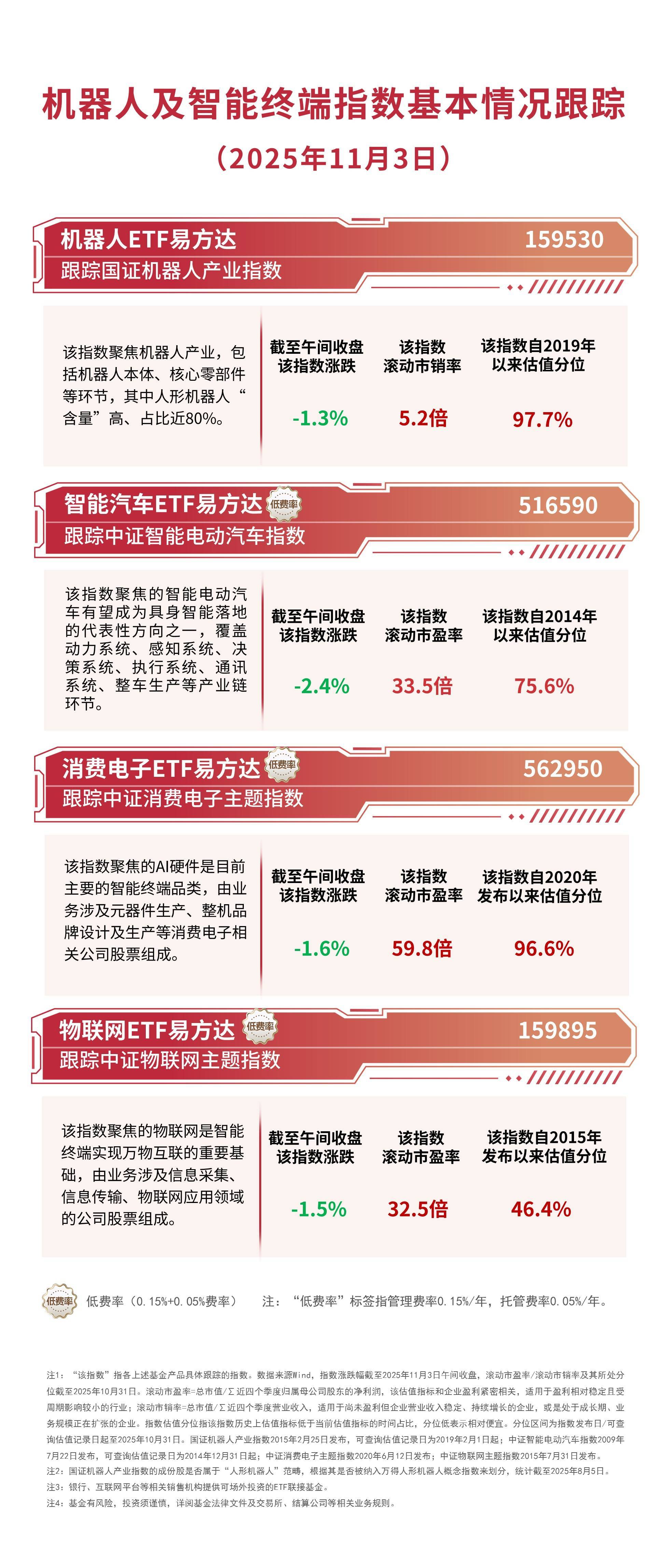
人形机器人板块早盘回调,机器人ETF易方达(159530)半日净申购达1000万份
Sou Hu Cai Jing· 2025-11-03 05:07
Group 1 - The National Robot Industry Index decreased by 1.3%, the China Internet of Things Theme Index fell by 1.5%, the China Consumer Electronics Theme Index dropped by 1.6%, and the China Intelligent Electric Vehicle Index declined by 2.4% as of the midday close [1][4][6][8] - The EasyOne ETF for robots saw a net subscription of 10 million units in half a day [1] Group 2 - The China Intelligent Electric Vehicle Index focuses on key areas such as power systems, perception systems, decision systems, execution systems, communication systems, and vehicle production within the industry chain [3] - The China Consumer Electronics Theme Index emphasizes AI hardware, which is currently a major category of smart terminal products, including companies involved in component production and complete product design and manufacturing [5]


建银国际:下调小米集团-W目标价至67港元 维持“跑赢大市”评级
Zhi Tong Cai Jing· 2025-11-03 05:01
Core Viewpoint - Jianyin International has slightly lowered the target price for Xiaomi Group-W (01810) by 2.9% from HKD 69 to HKD 67 while maintaining an "Outperform" rating due to adjustments in profit forecasts for IoT and smartphone margins [1] Financial Performance - The forecast for Xiaomi's Q3 2025 revenue is expected to be slightly below institutional expectations, with a year-on-year increase of 22% to RMB 112.7 billion, but a quarter-on-quarter decrease of 3% [1] - Adjusted net profit for Q3 is projected to be RMB 9.7 billion, reflecting a year-on-year increase of 55% but a quarter-on-quarter decrease of 10% [1] - The smartphone gross margin is anticipated to be under pressure, estimated at around 11%, due to rising component prices, particularly for LPDDR4X smartphones [1] IoT and Network Services - Growth in the IoT segment is expected to significantly slow down, primarily due to a high base from the previous year influenced by government subsidies, with a reduction in subsidies this quarter [1] - Despite the impact of price wars being limited, the IoT segment is projected to grow by 25% and 22% in the fiscal years 2025 and 2026, respectively [1] - For network services, growth is anticipated at 9% and 6% for the fiscal years 2025 and 2026, respectively [1] Electric Vehicle (EV) Performance - Xiaomi's EV deliveries for Q3 are expected to reach 108,800 units, representing a quarter-on-quarter increase of 34% [1] - The average selling price of EVs continues to rise, benefiting from the contribution of the YU7 model, with projected EV revenue of RMB 28.7 billion [1]

建银国际:下调小米集团-W(01810)目标价至67港元 维持“跑赢大市”评级
智通财经网· 2025-11-03 03:33
Core Viewpoint - Jianyin International has slightly lowered the target price for Xiaomi Group-W (01810) by 2.9% from HKD 69 to HKD 67 while maintaining an "Outperform" rating due to adjustments in profit margins for IoT and smartphones [1] Financial Performance - The forecast for Xiaomi's Q3 2025 revenue is expected to be slightly below market expectations, with a year-on-year increase of 22% to RMB 112.7 billion, but a quarter-on-quarter decrease of 3% [1] - Adjusted net profit for Q3 is projected to be RMB 9.7 billion, a year-on-year increase of 55% but a quarter-on-quarter decrease of 10% [1] - The smartphone gross margin is anticipated to be under pressure, expected to be around 11% due to rising component prices, particularly for LPDDR4X smartphones [1] IoT and Electric Vehicle (EV) Growth - Growth in the IoT segment is expected to slow significantly, primarily due to a high base from the previous year influenced by government subsidies, with a reduction in subsidies this quarter [1] - Despite the impact of price wars being limited, the IoT segment is projected to grow by 25% and 22% in the fiscal years 2025 and 2026, respectively [1] - For the EV sector, Q3 deliveries are expected to reach 108,800 units, a quarter-on-quarter increase of 34%, with revenue from EVs projected at RMB 28.7 billion [1]
预见未来:2025物博会窗口下的无锡AIoT进化论
3 6 Ke· 2025-11-03 02:50
Core Insights - The 2025 World Internet of Things Expo marks the beginning of a significant transformation in the industry, focusing on the evolution from "connecting everything" to "intelligent interconnection" and ultimately to "intelligent action" [3][20] - The event emphasizes the importance of collaboration and capability development, showcasing a comprehensive AIoT capability map that outlines the future of the industry [3][20] Domain Expansion - The expo provides a clear answer to the question of how to achieve endless expansion of the AIoT industry, emphasizing the need for authoritative results to measure and define the industry [4][5] - The release of the "IoT Industry Scale Measurement Index System" offers a quantifiable way for the industry to assess its value, marking a significant step in defining the economic landscape of "intelligent action" [5] - The event has achieved unprecedented international participation, with nearly 400 companies from 15 countries, indicating a growing global influence of the AIoT capabilities represented by the expo [6] Application Scenarios - The expo showcases a variety of application scenarios, illustrating the journey from "intelligent perception" to "network connection" and "vertical empowerment" [9][12] - Core capabilities are highlighted as the foundation for application explosion, with advancements in multi-modal sensing and communication technologies being showcased [11] - The event emphasizes the importance of diverse ecosystems, exploring new application domains beyond traditional industries, such as emergency logistics and environmental monitoring [13] Future Aspirations - The expo serves as a platform for global consensus and vision, with high-level meetings and expert consultations shaping the future of the AIoT industry [16][17] - Innovation is positioned as a key driver for the industry's future, with a focus on core technologies and support for developers and entrepreneurs [17][18] - Collaborative ecosystems are being built to connect various stakeholders, facilitating resource matching and accelerating the development of the regional industrial chain [18][19]

2025世界物联网博览会举办
Ke Ji Ri Bao· 2025-11-03 01:00
当前,人工智能、具身智能、工业互联网等技术快速发展,为物联网带来了广阔的发展空间。据介 绍,我国目前拥有物联网相关企业近2006万家,移动物联网连接数达到了28.8亿户,国家标准和行业标 准共计419项,物联网核心产业规模突破2.4万亿元。工业和信息化部副部长单忠德表示,我国在公共服 务、智慧零售、智慧家居、智慧工业等领域打造了一批亿级连接场景和应用业态,产业链协同发展格局 初步形成。 作为中国物联网的"发轫地"和"示范地",无锡自2009年获批建设国家传感网创新示范区以来,坚持 创新驱动、应用牵引、生态培育,探索出了独具特色的"无锡路径"。如今,物博会已成为无锡的产业名 片。(柳鑫 记者夏天一) 10月31日至11月2日,2025世界物联网博览会(以下简称"物博会")在江苏省无锡市举办。本届物 博会以"万物智联 无尽前沿"为主题,紧扣"人工智能与物联网双向赋能"主线,重点突出物联网的"全面 感知""泛在连接"两大核心能力,集中展示传感器向智能化、微型化、高端化的发展趋势。 ...
这些大牛股 机构高度关注
Zheng Quan Shi Bao· 2025-11-02 08:54
Core Viewpoint - In October, the A-share market experienced increased differentiation, but institutional research activities remained robust, with over 600 listed companies undergoing institutional research [1][2][3]. Group 1: Market Performance - The overall upward trend of the A-share market slowed down in October, with the Shanghai Composite Index rising by 1.85%, while the Shenzhen Component Index and the ChiNext Index fell by 1.10% and 1.56%, respectively [3]. - Despite the market fluctuations, institutional research activities maintained high levels, with over 600 companies being researched [3]. Group 2: Institutional Research Highlights - Okoyi was the most frequently researched company in October, with over 10 institutional research sessions, involving various types of institutions such as public funds, brokerages, private equity, insurance companies, and foreign institutions [3]. - Okoyi reported low channel inventory and a transition to a restocking phase, with product prices in an upward trend, indicating a simultaneous increase in volume and price [3]. - The company is expanding into downstream applications in sectors like aerospace, new energy vehicles, and robotics, significantly increasing its market capacity [3]. Group 3: Company-Specific Developments - Boshi Jie also had a high number of institutional research sessions, focusing on its project construction status and business expansion needs [5]. - Fangyuan Co. explained its increased use of recycled materials due to breakthroughs in nickel and lithium separation technology, leading to lower costs and higher efficiency [5]. - Feilong Co. reported a self-manufacturing rate of over 90% for its electronic pump products and is actively engaged in over 120 R&D projects in various advanced fields [6]. Group 4: Stock Performance of Key Companies - Okoyi's stock price rose over 30% in October, while Boshi Jie saw a decline of 1.13% [5]. - Fangyuan Co.'s stock price increased by over 26% in October [5]. - New Yiseng's stock price fluctuated, with a cumulative drop of about 6% in October after a significant rise earlier in the year [8]. - Zhongji Xuchuang's stock price rose over 17% in October, reflecting strong demand in the industry [9]. - Haiguang Information's stock price experienced a decline of over 9% in October after a substantial increase in previous months [10].
雷军财富激增151%登顶增长之王
Sou Hu Cai Jing· 2025-11-01 13:02
Core Insights - The 2025 Hurun Rich List reveals that Lei Jun, founder and CEO of Xiaomi, ranks fifth with a wealth of 326 billion RMB, marking a significant increase of 196 billion RMB or 151% from the previous year [2] Company Performance - Lei Jun's wealth surge is attributed to Xiaomi's strong performance across multiple core business areas [2] - The rapid rise of Xiaomi's automotive division, particularly the SU7 model, has seen cumulative deliveries reach 160,000 units, showcasing strong product competitiveness and brand appeal [2] - In the smartphone sector, Xiaomi continues to push its globalization strategy, maintaining a top-three position in global shipments and successfully entering the high-end market, enhancing its brand premium [2] - Xiaomi's Internet of Things (IoT) segment has also achieved notable success, with the number of connected smart devices surpassing 655 million, further solidifying its leading position in the industry [2]

21现场|在2025世界物联网博览会,预见未来“智慧生活”
2 1 Shi Ji Jing Ji Bao Dao· 2025-11-01 12:39
Core Insights - The 2025 World Internet of Things (IoT) Expo opened in Wuxi, focusing on "Intelligent Perception - Network Connection - Vertical Empowerment" as its main theme, showcasing the entire IoT industry chain from foundational technologies to end applications [1] Group 1: Exhibition Themes - The expo features four main exhibition halls: IoT Capability Hall, Industry Application Hall, Intelligent Connection Ecosystem Hall, and Smart Living Hall, covering various aspects of IoT [1] - The Smart Living Hall highlights cutting-edge products such as smart home devices and wearables, demonstrating how IoT technology is reshaping daily life [1] Group 2: Key Exhibits - China Telecom showcased a drone cockpit in the Smart Living Hall, equipped with a large curved screen for real-time transmission of high-definition images from the drone [2] - The cockpit integrates 5G networked drone operations, allowing for real-time data exchange and remote control, enhancing safety and efficiency in drone flights [2] - China Mobile presented the AI Fitness Smart Ring, which provides real-time feedback on exercise performance through a virtual AI coach [2] Group 3: Technological Innovations - The IoT Capability Hall displayed advanced technologies such as multi-modal sensing, advanced communication, and IoT operating systems, with exhibits like the intelligent inspection robot dog from State Grid [3] - The robot dog can autonomously complete inspection tasks in complex environments, significantly reducing the labor intensity for workers [3] - The Industry Application Hall focused on core technologies in vehicle networking and the empowerment of new industrialization through IoT solutions [3]
在2025世界物联网博览会,预见未来“智慧生活”
2 1 Shi Ji Jing Ji Bao Dao· 2025-11-01 12:38
Core Insights - The 2025 World Internet of Things (IoT) Expo opened in Wuxi, focusing on "Intelligent Perception - Network Connection - Vertical Empowerment" as its main theme, showcasing the entire IoT industry chain from foundational technologies to end applications [1] Group 1: Exhibition Themes - The expo features four main exhibition halls: IoT Capability Hall, Industry Application Hall, Intelligent Connection Ecosystem Hall, and Smart Living Hall, covering various aspects of IoT [1] - The Smart Living Hall highlights cutting-edge products such as smart home devices and wearables, demonstrating how IoT technology is reshaping daily life [1] Group 2: Key Exhibits - China Telecom showcased a 5G-connected drone cockpit, allowing operators to monitor flight status and control the drone's speed and direction through a large curved screen [2] - China Mobile presented the AI Fitness Smart Ring, which provides real-time feedback on exercise form through a virtual AI coach [2] - The IoT Capability Hall displayed advanced technologies like multi-modal sensing and IoT operating systems, including a smart inspection robot from State Grid that significantly reduces the labor intensity of cable inspections [3] Group 3: Industry Applications - The Industry Application Hall focused on core technologies and products related to vehicle networking and the empowerment of new industrialization through IoT solutions [3] - The exhibition emphasized the integration of vehicle-road-cloud systems and showcased new-generation vehicle technologies [3]