
种植业

Search documents
种植业板块1月5日跌0.78%,神农种业领跌,主力资金净流出3650.51万元
Zheng Xing Xing Ye Ri Bao· 2026-01-05 09:02
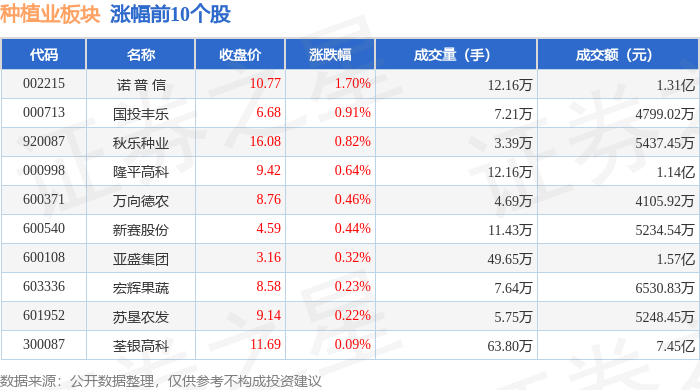
Market Overview - The planting industry sector declined by 0.78% on January 5, with Shennong Agricultural Technology leading the decline [1] - The Shanghai Composite Index closed at 4023.42, up 1.38%, while the Shenzhen Component Index closed at 13828.63, up 2.24% [1] Stock Performance - Notable gainers in the planting sector included: - Noposion: Closed at 10.77, up 1.70% with a trading volume of 121,600 shares and a turnover of 131 million yuan [1] - Guotou Fengle: Closed at 6.68, up 0.91% with a trading volume of 72,100 shares and a turnover of 47.99 million yuan [1] - Qiu Le Seed Industry: Closed at 16.08, up 0.82% with a trading volume of 33,900 shares and a turnover of 54.37 million yuan [1] - Shennong Agricultural Technology was the biggest loser, closing at 7.07, down 4.97% with a trading volume of 2,384,300 shares and a turnover of 1.677 billion yuan [2] Capital Flow - The planting industry sector experienced a net outflow of 36.51 million yuan from institutional funds, while retail investors saw a net inflow of 80.96 million yuan [2] - The capital flow for specific stocks showed: - Qianyuan High-Tech: Net inflow of 55.91 million yuan from institutional funds, but a net outflow of 46.12 million yuan from speculative funds [3] - Hainan Rubber: Net inflow of 16.70 million yuan from institutional funds, with a net outflow of 3.07 million yuan from retail investors [3] - Yasheng Group: Net inflow of 15.96 million yuan from institutional funds, with a significant net outflow from retail investors [3]


三大粮食作物化肥利用率提升
Ren Min Ri Bao Hai Wai Ban· 2026-01-05 04:18
Core Insights - The Ministry of Agriculture and Rural Affairs of China reported that by 2025, the fertilizer utilization rate for major crops such as wheat, corn, and rice is expected to reach 43.3%, an increase of 3.1 percentage points from 2020 [1] Group 1: Fertilizer Utilization Rate - The fertilizer utilization rate is a critical indicator of agricultural efficiency, reflecting how effectively fertilizers are used in crop production [1] - The increase in fertilizer utilization rate signifies advancements in scientific fertilization practices, which are essential for ensuring food production capacity and promoting sustainable agricultural development [1] Group 2: Fertilizer Application Trends - In 2024, the total application of agricultural fertilizers in China is projected to be 49.88 million tons, a reduction of 1.034 million tons (17.2%) from 2015, while grain production increased by 6.9% during the same period [2] - The improved fertilizer utilization rate contributes to cost savings in agricultural inputs, with a 1 percentage point increase in utilization rate equating to a reduction of 56,500 tons of urea and approximately 1.1 billion yuan in costs [2] Group 3: Factors Supporting Increased Utilization - The promotion of soil testing and tailored fertilization techniques has been fundamental in enhancing fertilizer utilization rates, with over 2.3 billion acres of land covered by these practices [3] - The "Three New" integrated model, which includes new fertilization technologies, products, and equipment, has significantly contributed to the increase in fertilizer efficiency [3] - The use of organic fertilizers and other alternatives has also played a role in improving nutrient efficiency, with over 650 million acres of organic fertilizer application expected by 2025 [4] Group 4: Professional Services and Policy Support - The development of specialized fertilization service organizations, with over 17,000 currently operating, has been crucial in implementing scientific fertilization practices effectively [4] - The Ministry of Agriculture and Rural Affairs aims to strengthen the management of fertilizer and water resources, enhance policy guidance, and promote legislative support for scientific fertilization practices [4]
中经评论:以“藏粮于技”筑牢大国粮仓
Zhong Guo Jing Ji Wang· 2026-01-05 02:33
Group 1 - The core viewpoint emphasizes that enhancing agricultural comprehensive production capacity and quality efficiency fundamentally relies on technology [1] - The Central Rural Work Conference analyzed the current challenges facing the "three rural issues" and outlined the deployment for agricultural work until 2026 [1] - In 2025, China's grain production faced various natural disasters but still achieved a high yield increase of 16.75 billion jin compared to the previous year [1] Group 2 - The article highlights the importance of self-reliance in ensuring food security for China's 1.4 billion people, with a focus on increasing grain production capacity [2] - It stresses the need to implement key agricultural technology breakthroughs and effectively apply scientific achievements [2] - The article mentions that in 2025, Northwest A&F University approved 12 new wheat varieties, marking significant advancements in breeding technology [2] Group 3 - The current agricultural machinery ownership in China exceeds 200 million units, with over 2.2 million applications of Beidou terminal devices [3] - The mechanization rate of agriculture has surpassed 75%, indicating a shift in demand for agricultural machinery from non-essential to essential [3] - The article calls for enhanced agricultural talent training and recruitment to support new farmers and promote smart farming practices [3]
琼中南万村:一粒七彩花生,育出增收新希望
Hai Nan Ri Bao· 2026-01-05 01:55
Core Viewpoint - The article highlights the innovative agricultural practices in Nanfan Village, Qiongzhong, focusing on the cultivation of colorful peanuts as a means to increase income and market opportunities for local farmers [2][3]. Group 1: Agricultural Innovation - The introduction of colorful peanuts, which have large seeds, high nutritional value, and a short maturity period of four months, represents a significant agricultural innovation in the region [2][3]. - The village has shifted from traditional farming methods to a more mechanized approach, improving planting efficiency and precision [2][3]. Group 2: Economic Impact - The new farming model, which includes centralized land management and hiring local farmers as caretakers, is expected to increase yield by over 50% compared to previous attempts, potentially generating a minimum income of 20,000 yuan for the village collective [3]. - The funds generated from this initiative will be directed towards improving local infrastructure, creating a positive feedback loop for community development [3]. Group 3: Diversification of Agriculture - Nanfan Village is developing a diversified agricultural system by leveraging local resources, including the cultivation of mountain rice and other crops, as well as promoting standardized livestock farming [3]. - This approach demonstrates how local ecological resources can be transformed into development momentum through technological innovation and exploration of new farming models [3].

产业兴乌蒙 乡村谱新篇
Xin Lang Cai Jing· 2026-01-04 20:03
Core Viewpoint - Zhaotong City has transformed from a poverty-stricken area to a vibrant economy by focusing on industrial development, agricultural enhancement, and tourism integration, leading to significant income growth for its residents [2][10]. Agricultural Development - Zhaotong has prioritized agriculture as its primary economic driver, achieving an annual growth rate of approximately 8.5% in rural residents' disposable income, surpassing national and provincial averages [2][3]. - The city has successfully transitioned traditional agricultural products like apples, gastrodia, and potatoes from low-value to high-value markets, with apple production expected to reach 130,000 tons and a total output value exceeding 15 billion yuan in 2024 [3][4]. - The introduction of advanced agricultural techniques has led to significant improvements in yield and efficiency, such as a 30% increase in apple yield and a 70% reduction in water usage [3]. Industrial Growth - Zhaotong has shifted from a reliance on traditional industries to developing green energy and advanced manufacturing sectors, with investments exceeding 85 billion yuan and a 28.4% increase in energy industrial output value since the end of the 13th Five-Year Plan [5][6]. - The city is establishing large-scale industrial clusters in green energy, silicon-aluminum, and phosphate-based materials, with the green silicon-aluminum industry projected to grow from 4.3 billion yuan to 25.1 billion yuan by 2024 [6]. Tourism Integration - Zhaotong is leveraging its natural beauty and cultural heritage to boost tourism, with a focus on summer and winter tourism, leading to over 10 million visitors in 2025 and generating 8.4 billion yuan in tourism revenue [8][9]. - The development of rural tourism has revitalized local economies, with villages seeing the establishment of guesthouses and restaurants, significantly increasing local employment opportunities [9]. Employment and Entrepreneurship - The city has implemented a dual approach to employment, facilitating both outward migration for work and local job creation, resulting in over 2.6 million people finding stable employment [10][11]. - Initiatives such as "work-for-relief" projects have successfully created jobs for nearly 200,000 individuals, with a projected increase in labor remuneration to 1.08 billion yuan by 2025 [11].
“奇台农场模式”如何突破玉米产量天花板?
Xin Lang Cai Jing· 2026-01-04 19:01
联合收割机在内蒙古自治区巴彦淖尔市玉米田收割玉米(资料图片)。今年,巴彦淖尔市推广"奇台农 场模式"玉米密植高产精准调控技术,实现玉米高产,并建成百万亩单季"吨粮田"。 巴彦淖尔市现代农 牧事业发展中心 提供 2025年,我国粮食生产再次实现高位增产。其中,玉米播种面积同比增长0.5%,单产提升1.6%,总产 量达到6024.7亿斤,比上年增加126.4亿斤,成为今年粮食增产的主要因素。 在有限的耕地上,玉米产量的天花板如何被一寸寸打破?这离不开全国玉米单产提升的核心技术 ——"奇台农场模式"玉米密植高产精准调控技术的有力支撑。据中国农业科学院统计,2022年以来,该 模式已在全国累计推广1.58亿亩,亩均增产113公斤。 在这片涌动着创新血脉的土地上,兵团如何在中国农业科学院帮助下,实现玉米产量的突破,成为2025 年我国粮食增产的"尖子生"? 确定一个模式,破解单产提升密码 作为我国种植面积最大的粮食作物,玉米单产提升与产能稳定事关粮食安全、饲料保障和工业原料供 应。但在21世纪初,全国玉米平均亩产不足400公斤,生产效率有待提升。 航拍的四师七十一团玉米种植基地一隅(资料图片)。四师可克达拉市坚持"藏粮 ...
2025年我国三大粮食作物化肥利用率达43.3%
Xin Hua Wang· 2026-01-04 14:31
Core Insights - The utilization rate of fertilizers for major grain crops in China is projected to reach 43.3% by 2025, an increase of 3.1 percentage points from 2020, driven by policy guidance, technological innovation, and optimized service promotion [1][2] Group 1: Fertilizer Utilization Improvement - Continuous improvement in fertilizer utilization is a result of systematic policy guidance, integrated technological innovation, and collaborative service optimization [1] - The Ministry of Agriculture and Rural Affairs has been actively promoting the reduction and efficiency of fertilizer use since the "14th Five-Year Plan," implementing green farming practices and enhancing soil testing and fertilizer application [1] Group 2: Soil Testing and Fertilizer Application - During the "14th Five-Year Plan," soil testing and fertilizer optimization have been widely conducted, with a target of achieving over 95% coverage of soil testing and formula fertilization technology for major grain crops by 2025 [1] - The integration of new scientific fertilization products, technologies, and machinery is being promoted, with over 26 million acres of rice utilizing deep fertilization techniques by 2025 [1] Group 3: Nutrient Coordination and Efficiency - The promotion of soybean inoculation with root nodule bacteria has been implemented on nearly 8 million acres, resulting in an average reduction of nitrogen fertilizer application by 0.5 kg per acre [2] - By 2025, the area for organic fertilizer application is expected to exceed 650 million acres, with pilot projects in green farming reducing chemical fertilizer use by an average of 10% [2] Group 4: Professional Services and Technology Implementation - There are currently over 17,000 socialized scientific fertilization service organizations in China, servicing an area of 250 million acres annually [2] - The establishment of over 2,200 intelligent fertilizer application service points has facilitated the distribution of more than 4 million tons of fertilizer annually, significantly enhancing fertilizer utilization rates [2]
【丰收澜湄】老挝篇丨携手同行,桂老农业合作多点开花惠民生
Xin Lang Cai Jing· 2026-01-04 12:47
Core Viewpoint - The collaboration between Guangxi and Laos, leveraging the Lancang-Mekong cooperation, focuses on agricultural development, trade growth, and poverty alleviation, resulting in tangible benefits for local communities [2][4][7]. Group 1: Agricultural Investment and Cooperation - Guangxi has established two China (Guangxi)-Laos agricultural cooperation demonstration zones and supported 11 Guangxi agricultural enterprises to invest in Laos [4]. - Companies like Guangxi Zufa Investment Co., Ltd. and Guangxi Jinsui Agricultural Group have developed banana plantations and tropical fruit industry parks in Laos, enhancing local agricultural standards [4]. - The investment in smart agriculture drip irrigation by Jiejiarun Technology Group in Laos has led to cost reduction and quality improvement for 4,000 acres of banana farms [4]. Group 2: Trade Growth - From January to November 2025, the agricultural trade between Guangxi and Laos increased by 46.76%, with Guangxi's exports to Laos rising by 53.8% and imports by 46.6% [7]. Group 3: Poverty Alleviation Initiatives - Guangxi has successfully implemented poverty alleviation projects in Laos, reducing the poverty rate in specific villages from 52% to 25% through infrastructure improvements and industry development [9]. - The introduction of high-standard smart greenhouses in Jin Hua Village is expected to increase annual income for participating farmers by over 8,000 RMB [13]. Group 4: Agricultural Technology and Training - The China (Guangxi)-Laos Crop Variety Experiment Station has established standardized planting demonstration sites and promoted 73 suitable crop varieties over an area exceeding 40,000 acres [22]. - Guangxi has conducted 18 international training sessions for agricultural technology, training 741 agricultural talents from Laos in the past three years [27]. Group 5: Future Events and Collaborations - The upcoming online and offline exhibitions will showcase the agricultural cooperation achievements of Lancang-Mekong countries, focusing on smart agriculture and cross-border industrial chain collaboration [33][35].

农业农村部:2025年三大粮食作物化肥利用率达43.3%
Xin Lang Cai Jing· 2026-01-04 11:44
Core Viewpoint - The Ministry of Agriculture and Rural Affairs has implemented a series of measures to enhance fertilizer efficiency, aiming for a 43.3% utilization rate for major crops by 2025, which is a 3.1 percentage point increase from 2020 [1][2] Group 1: Fertilizer Utilization Improvement - The increase in fertilizer utilization rate is attributed to policy guidance, technological advancements, and optimized services [2] - By 2025, the coverage rate of soil testing and formula fertilization technology for major crops is expected to exceed 95% [2] - The promotion of new scientific fertilization products, technologies, and machinery is projected to cover over 26 million acres for rice side-deep fertilization by 2025, improving nitrogen fertilizer utilization by 2.1 percentage points [2] Group 2: Multi-faceted Approaches - The cumulative application of root nodule bacteria for soybean has reached nearly 8 million acres, reducing nitrogen fertilizer usage by an average of 0.5 kg per acre [2] - By 2025, the area for organic fertilizer application is expected to exceed 650 million acres, with pilot projects in green farming reducing chemical fertilizer use by 10% on average [2] - There are over 17,000 socialized scientific fertilization service organizations in the country, providing services for 250 million acres annually [2]
农林牧渔行业:元旦前猪价反弹明显,牛肉进口配额保障政策落地
GF SECURITIES· 2026-01-04 11:14
Core Insights - The report highlights a significant rebound in pork prices before the New Year, with the average price of lean pigs reaching 12.39 CNY/kg, a 7.6% increase from the previous week, although it remains 19.7% lower year-on-year [5][13][23] - The implementation of a safeguard policy for beef import quotas is expected to alleviate domestic supply pressures, with a total import quota of 2.688 million tons for 2026, which is 93.5% of the total imports in 2024 [14] - The report recommends focusing on leading companies with cost advantages in the livestock sector, particularly Wens Foodstuff and Muyuan Foods, while also highlighting potential turnaround candidates like Zhengbang Technology [5][13] Livestock Farming - The report notes that the pork market is under pressure due to significant losses in the industry, but the reduction in production capacity is expected to accelerate, leading to a more stable price environment in the first half of 2026 [5][13] - For poultry, the average price of white feather chickens is reported at 3.78 CNY/lb, down 3.1% week-on-week, while yellow feather chicken prices have shown slight increases, benefiting companies like Lihua and Wens [5][13][32] Dairy Industry - The current price of fresh milk in major production areas is 3.03 CNY/kg, stable week-on-week but down 3.2% year-on-year, indicating a balance in supply and demand as inventory levels decrease [14] - The safeguard measures on beef imports are anticipated to support domestic beef prices, which are expected to rise, enhancing the performance of companies like Yurun and Modern Farming [14] Feed and Animal Health - The report indicates a rebound in aquaculture prices due to holiday demand, with significant increases in white shrimp prices leading up to the New Year [15] - The feed industry is facing intense competition, but leading companies are expected to gain market share due to their cost advantages, especially in international markets [15] Agricultural Sector Performance - The agricultural sector outperformed the market by 0.7 percentage points, with livestock farming and feed sectors showing the highest gains of 1.4% and 0.5%, respectively [21] - The report tracks various agricultural product prices, noting fluctuations in corn and soybean meal prices, with corn prices rising by 0.6% to 2352 CNY/ton [23][46]

