
交通运输

Search documents
【数据发布】国家统计局关于2024年国内生产总值最终核实的公告
中汽协会数据· 2025-12-26 09:37
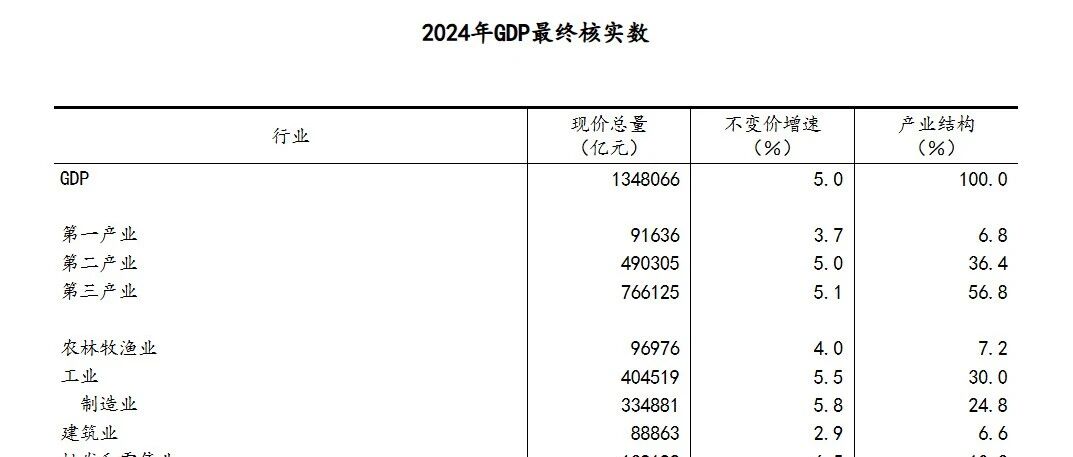
Core Viewpoint - The final verification of China's GDP for 2024 shows a total nominal GDP of 13,480.66 billion yuan, a decrease of 10.18 billion yuan from the preliminary estimate, with a year-on-year growth rate of 5.0% at constant prices, consistent with the preliminary estimate [1]. Summary by Categories GDP Overview - The final verified nominal GDP for 2024 is 13,480.66 billion yuan, reflecting a reduction of 10.18 billion yuan from the preliminary figure [1]. - The year-on-year growth rate at constant prices is 5.0%, unchanged from the preliminary estimate [1]. Industry Breakdown - **Primary Industry**: - Current value: 91,636 billion yuan - Growth rate: 3.7% - Contribution to GDP: 6.8% [4] - **Secondary Industry**: - Current value: 490,305 billion yuan - Growth rate: 5.0% - Contribution to GDP: 36.4% [4] - **Tertiary Industry**: - Current value: 766,125 billion yuan - Growth rate: 5.1% - Contribution to GDP: 56.8% [4] Specific Sector Performance - **Agriculture, Forestry, Animal Husbandry, and Fishery**: - Current value: 96,976 billion yuan - Growth rate: 4.0% - Contribution to GDP: 7.2% [4] - **Industrial Sector**: - Current value: 404,519 billion yuan - Growth rate: 5.5% - Contribution to GDP: 30.0% [4] - **Manufacturing**: - Current value: 334,881 billion yuan - Growth rate: 5.8% - Contribution to GDP: 24.8% [4] - **Construction**: - Current value: 88,863 billion yuan - Growth rate: 2.9% - Contribution to GDP: 6.6% [4] - **Wholesale and Retail Trade**: - Current value: 139,192 billion yuan - Growth rate: 6.5% - Contribution to GDP: 10.3% [4] - **Transportation, Storage, and Postal Services**: - Current value: 59,045 billion yuan - Growth rate: 6.7% - Contribution to GDP: 4.4% [4] - **Accommodation and Catering**: - Current value: 24,894 billion yuan - Growth rate: 7.0% - Contribution to GDP: 1.8% [4] - **Financial Sector**: - Current value: 96,956 billion yuan - Growth rate: 3.7% - Contribution to GDP: 7.2% [4] - **Real Estate**: - Current value: 84,047 billion yuan - Growth rate: -2.2% - Contribution to GDP: 6.2% [4] - **Information Transmission, Software, and IT Services**: - Current value: 63,958 billion yuan - Growth rate: 11.7% - Contribution to GDP: 4.7% [4] - **Leasing and Business Services**: - Current value: 56,941 billion yuan - Growth rate: 11.1% - Contribution to GDP: 4.2% [4] - **Other Industries**: - Current value: 232,676 billion yuan - Growth rate: 3.9% - Contribution to GDP: 17.3% [4]

国家统计局:2024年长三角区域发展指数稳步提升
Ren Min Wang· 2025-12-26 09:19
Core Insights - The development index of the Yangtze River Delta region for 2024 is projected to be 135.0, reflecting a 2.6 increase from 2023, with an average annual increase of 3.3 since 2018 [1] Economic Growth - The regional GDP reached 33.17 trillion yuan in 2024, 1.5 times that of 2018, accounting for 24.7% of the national total, an increase of 0.1 percentage points from 2023 [2] - The digital economy is thriving, with the value added from information transmission, software, and IT services reaching 1.88 trillion yuan, 2.3 times that of 2018, representing nearly 30% of the national total [2] Innovation and R&D - The innovation co-construction index rose to 160.6 in 2024, an increase of 8.2 from 2023, with an average annual increase of 6.4 since 2018 [3] - R&D investment reached 1.12 trillion yuan, a 10.5% increase from 2023, accounting for 30.9% of the national total [3] - The region saw nearly 300,000 new invention patents, with a per capita rate exceeding 12 patents, 1.6 times that of 2018 [3] Infrastructure and Coordination - The coordination index remained stable at 131.0 in 2024, with an average annual increase of 4.4 since 2018 [4] - The railway operating mileage exceeded 15,000 kilometers, a 43.6% increase since 2018, with high-speed rail accounting for over half of the total [4] - The income disparity among residents across provinces narrowed from 2.68:1 in 2018 to 2.40:1 in 2024 [4] Environmental Quality - The green co-protection index reached 163.8 in 2024, a 6.3 increase from 2023, with an average annual increase of 5.6 since 2018 [5] - The average proportion of good air quality days in 41 cities was 84.5%, an increase of 0.8 percentage points from 2023 [5] - The proportion of good water quality in national monitoring sections reached 94.3%, up 0.9 percentage points year-on-year [5] Trade and Investment - The open and win-win index was 106.6 in 2024, with total goods import and export exceeding 16 trillion yuan, accounting for 36.5% of the national total [7] - The actual use of foreign capital decreased by 23.3%, but its national share increased from 43.9% in 2023 to 46.3% in 2024 [7] - The seventh China International Import Expo attracted 3,496 exhibitors from 129 countries, with intended transactions exceeding 80 billion USD, of which the Yangtze River Delta accounted for 34% [7] Public Services and Welfare - The shared welfare index grew to 130.4 in 2024, a 0.9 increase from 2023, with an average annual increase of 3.1 since 2018 [8] - The per capita disposable income reached 57,137 yuan, a nominal increase of 5.2% year-on-year [8] - The number of medical institution beds reached 1.6525 million, an increase of 361,800 since 2018, with nearly 7 beds per thousand people [8]
红利国企ETF(510720)涨超0.6%,近20日净流入超7.7亿元,红利风格在2026年或将延续
Mei Ri Jing Ji Xin Wen· 2025-12-26 07:00
Group 1 - The core viewpoint is that the dividend style is expected to perform better in 2026 compared to 2025, driven by three main dimensions: valuation attractiveness, anticipated earnings recovery, and increased allocation of incremental funds towards high-dividend assets [1] - The relative valuation of dividends compared to growth is at a low level, specifically at the 28.2 percentile since 2016, indicating an attractive investment opportunity [1] - A recovery in A-share earnings is anticipated to reach its bottom by the end of 2025 or early 2026, with easing pressure on cyclical profits [1] Group 2 - The Hongli State-owned Enterprise ETF (510720) tracks the Shangguo Dividend Index (000151), which selects high-dividend capable and stable dividend record companies across sectors like banking, coal, and transportation [2] - The index employs a strict evaluation of constituent stocks based on dividend yield and sustainability, utilizing a cross-industry diversification strategy to effectively manage investment risks [2] - The Hongli State-owned Enterprise ETF has consistently distributed dividends for 20 consecutive months since its listing, with monthly assessments of dividends [2]
中银量化多策略行业轮动周报-20251226
Bank of China Securities· 2025-12-26 06:17
Core Insights - The report highlights the current allocation of the Bank of China’s multi-strategy industry rotation system, with significant positions in non-bank financials (11.8%), banks (9.3%), and transportation (9.1%) [1] - The average weekly return for the CITIC primary industries was 3.0%, with the best-performing sectors being defense and military (6.7%), communication (5.9%), and construction materials (5.7%) [3][10] - The composite strategy achieved a cumulative return of 31.4% year-to-date, outperforming the CITIC primary industry equal-weight benchmark by 5.3% [3] Industry Performance Review - The best-performing sectors for the week included defense and military (6.7%), communication (5.9%), and construction materials (5.7%), while the worst performers were coal (-1.4%), banks (-1.0%), and food and beverage (0.7%) [10][11] - The average monthly return for the past month was 3.3%, indicating a stable performance across sectors [10] Valuation Risk Warning - The report identifies several industries with high valuation risks, including retail, computer, non-ferrous metals, defense and military, petrochemicals, and electronics, which are currently above the 95th percentile of their historical PB valuations [12][13] Single Strategy Rankings and Recent Performance - The top three industries based on the high prosperity industry rotation strategy (S1) are machinery, coal, and non-bank financials [15][16] - The implied sentiment momentum strategy (S2) ranks the top industries as basic chemicals, electronics, and communication [20] - The macro style rotation strategy (S3) identifies the top sectors as banks, home appliances, electric power and utilities, petrochemicals, transportation, and construction [25] Strategy Composite - The composite strategy has increased its positions in upstream and midstream cyclical sectors while reducing exposure to midstream non-cyclical sectors [3] - The highest weight strategy currently is the traditional multi-factor scoring strategy (S7) at 23.8%, while the macro style industry rotation strategy (S3) has the lowest weight at 7.1% [3]
成都更新2026年货车限行要求
Xin Lang Cai Jing· 2025-12-26 04:43
转自:川观新闻 明年起,成都货车限行政策将有新变化。12月25日,成都市公安局联合成都市生态环境局、成都市交通运输局等多部门联合发布《 2026年度关于对部分货 车采取交通管理措施的通告》(以下简称《通告》)。《通告》对货车排放标准和行驶范围的要求相较2025年不变,但针对交通拥堵造成的违反限行规定、 冷链运输以及春节假期货车运输这三种情况,给出了解决方案。 具体而言,2026年1月1日起,因交通拥堵等不可抗力因素,未在禁行时段开始前驶离成都绕城高速(G4202)的货车,可以从最近的收费站(天府收费站、 锦城湖收费站除外)或互通立交驶往成都绕城高速(G4202)外侧区域或绕城高速服务区。 同时,运输疫苗、药品等对冷藏、冷冻温度区间有特殊要求的冷链运输车可以办理国VI货车通行码。这意味着,冷链运输车全天可以在成都绕城高速 (G4202,包含)以内区域、高新南区绕城外区域[成都绕城高速(G4202,不含)、剑南大道(含)、天府五街(含)、天府大道中段(含)、天华二路 (含)、世纪城南路(含)、世纪城路(含)、世纪城东路(含)、科华南路(含)合围区域]通行。 在春节及春节调休期间早高峰时段,成都市将允许持有国VI货 ...

除了12315,还有哪些正规途径可以方便地投诉企业?
Xin Lang Cai Jing· 2025-12-26 02:40
Core Viewpoint - The article emphasizes the importance of understanding various consumer complaint channels beyond the official 12315 hotline, highlighting a multi-layered and diversified system for consumer rights protection. Group 1: Industry-Specific Complaint Channels - The postal and express delivery industry has a dedicated complaint channel, 12305, for issues like delays, losses, or service quality, which requires consumers to first contact the delivery company and escalate to 12305 if unsatisfied within 7 days [1][9]. - The telecommunications and internet services sector utilizes 12300 for complaints regarding mobile plans, overcharging, and service issues, allowing escalation if no response is received within 15 days [1][11]. - The transportation service sector is covered by 12328, which addresses issues like ride-sharing disputes and taxi service complaints, forwarding issues to local transportation management for resolution [2][16]. Group 2: Social Organization Mediation Channels - Consumer associations at various levels not only accept complaints but also engage in comparative testing and public interest litigation to protect consumer rights, with online complaint platforms available for submissions [3][12]. - Industry-specific mediation organizations exist for sectors like home decoration and automotive services, providing specialized and feasible mediation solutions, although their outcomes are not legally binding [3][12]. Group 3: Media and Internet Public Welfare Platforms - Black Cat Complaints, a public welfare platform under Sina, offers multiple access points for consumers to submit complaints, utilizing a smart ticketing system for direct communication with companies and providing real-time tracking of complaint progress [4][13]. - The platform promotes transparency by displaying complaint content after anonymization and has features for collective complaints, enhancing issue visibility and resolution efficiency [4][13]. - The recent introduction of the AI legal assistant on the platform provides 24/7 free legal consultation, significantly lowering the barriers for consumers without legal backgrounds [5][14]. Group 4: Internal Complaint Channels - Many companies have their own customer service channels, such as hotlines and online support, which can provide quick responses and direct communication, suggesting consumers attempt internal resolution before escalating externally [6][15]. Group 5: Choosing the Right Complaint Channel - For issues requiring administrative enforcement, such as food safety and fraud, the 12315 platform is recommended [7][17]. - Specific service quality issues in sectors like delivery, telecommunications, and transportation should be directed to their respective regulatory channels [7][17]. - For financial service disputes, the 12378 hotline is designated for complaints related to banking and insurance [7][16]. - For rapid responses and public support, platforms like Black Cat Complaints are suggested, while complex disputes may benefit from mediation through consumer associations or industry organizations [7][17].
中国人民银行举行新闻发布会:协同发力 赋能西部陆海新通道高质量发展
Jin Rong Shi Bao· 2025-12-26 02:37
Core Viewpoint - The People's Bank of China and several government departments have jointly issued guidelines to financially support the construction of the Western Land-Sea New Corridor, which is crucial for the Belt and Road Initiative, aiming to enhance financial cooperation and resource allocation between China and related countries [1][2]. Group 1: Financial Support and Policy Implementation - The issuance of the guidelines represents a significant step in promoting high-level opening-up in inland regions, including Chongqing, by providing robust financial support for the development of the Western Land-Sea New Corridor [2]. - The guidelines outline six main tasks, including improving financial organization collaboration, constructing a high-quality financial resource allocation system, and promoting institutional reforms to facilitate cross-border trade and investment [4][5]. - The guidelines emphasize the importance of regional collaborative development and institutional innovation to provide efficient settlement and financing services for enterprises [5]. Group 2: Achievements and Future Directions - The People's Bank of China has reported several achievements in supporting the corridor's construction, including the establishment of a financial service center and the development of over 30 innovative financial products, with financing balances exceeding 730 billion yuan [3]. - Future efforts will focus on creating more landmark financial achievements and enhancing the financial service ecosystem for the corridor [3]. Group 3: Capital Market Support - The China Securities Regulatory Commission is committed to strengthening multi-level capital market construction, supporting various financing channels such as stock issuance, corporate bonds, and asset-backed securities to aid the corridor's development [7]. - As of November, over 650 A-share listed companies are located along the corridor, with significant fundraising activities reported, including nearly 7 billion yuan from bond issuances [7]. Group 4: Cross-Border Financial Services - The guidelines propose measures to enhance cross-border trade settlement and investment facilitation, including encouraging enterprises to participate in high-level cross-border trade pilot programs and simplifying foreign investment processes [8][9]. - The establishment of a cross-border financial service platform is highlighted as a key initiative to support the corridor's high-quality development, with successful applications already reported in several provinces [9]. Group 5: Inter-Departmental Collaboration - The People's Bank of China plans to establish a collaborative mechanism among various departments and regions to ensure the effective implementation of the guidelines, focusing on policy sharing and financial service coordination [10][11]. - Emphasis is placed on enhancing cooperation between financial institutions and local governments to mobilize resources effectively and support key areas of development within the corridor [11].
国家统计局公布2024年GDP最终核实结果
Sou Hu Cai Jing· 2025-12-26 01:53
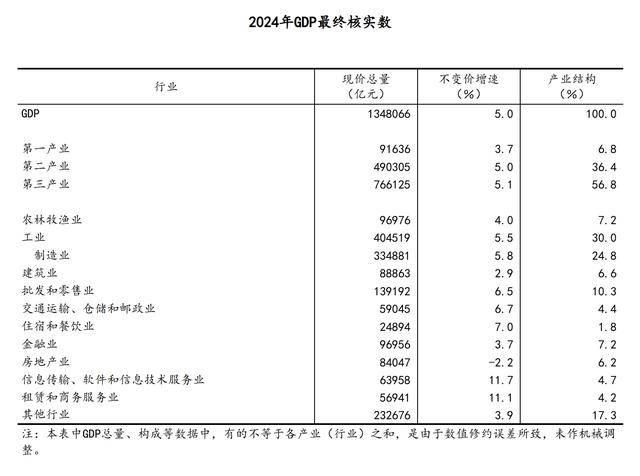
Core Insights - The National Bureau of Statistics of China has released the final verification of the GDP for 2024, showing a total nominal GDP of 13,480.66 billion yuan, which is a decrease of 10.18 billion yuan from the preliminary estimate. The GDP growth rate at constant prices is 5.0%, unchanged from the preliminary figure [1][4]. Group 1: Overall GDP Data - The final verified nominal GDP for 2024 is 13,480.66 billion yuan, a reduction of 10.18 billion yuan from the preliminary estimate [1]. - The GDP growth rate at constant prices is 5.0%, consistent with the preliminary calculation [1]. Group 2: Sectoral Breakdown - The primary industry contributed 91,636 billion yuan with a growth rate of 3.7%, accounting for 6.8% of the GDP [2]. - The secondary industry reached 490,305 billion yuan, growing at 5.0%, representing 36.4% of the GDP [2]. - The tertiary industry totaled 766,125 billion yuan, with a growth rate of 5.1%, making up 56.8% of the GDP [2]. - The agricultural sector (including forestry, animal husbandry, and fishery) generated 96,976 billion yuan, growing at 4.0% [2]. - The industrial sector produced 404,519 billion yuan, with a growth rate of 5.5% [2]. - The manufacturing sector accounted for 334,881 billion yuan, growing at 5.8% [2]. - The construction industry reached 88,863 billion yuan, with a growth rate of 2.9% [2]. - The wholesale and retail sector generated 139,192 billion yuan, growing at 6.5% [2]. - The transportation, warehousing, and postal sector produced 59,045 billion yuan, with a growth rate of 6.7% [2]. - The accommodation and catering sector reached 24,894 billion yuan, growing at 7.0% [2]. - The financial sector generated 96,956 billion yuan, with a growth rate of 3.7% [2]. - The real estate sector saw a decline, totaling 84,047 billion yuan with a negative growth rate of 2.2% [2]. - The information transmission, software, and IT services sector grew significantly at 11.7%, totaling 63,958 billion yuan [2]. - The leasing and business services sector reached 56,941 billion yuan, growing at 11.1% [2]. - Other industries contributed 232,676 billion yuan, with a growth rate of 3.9% [2].
国家统计局:经最终核实2024年GDP现价总量为1348066亿元
Guo Jia Tong Ji Ju· 2025-12-26 01:39
Core Insights - The National Bureau of Statistics of China announced the final verification of GDP data for 2024, revealing a total GDP at current prices of 13,480.66 billion yuan, which is a decrease of 10.18 billion yuan from the preliminary estimate [1] - The GDP growth rate at constant prices for 2024 is confirmed at 5.0%, consistent with the preliminary estimate [1] Industry Breakdown - The first industry (agriculture, forestry, animal husbandry, and fishery) contributed 91.636 billion yuan with a growth rate of 3.7%, accounting for 6.8% of GDP [3] - The second industry (including manufacturing and construction) totaled 490.305 billion yuan, growing at 5.0%, representing 36.4% of GDP [3] - The third industry (services) reached 766.125 billion yuan, with a growth rate of 5.1%, making up 56.8% of GDP [3] - Notable sectors include: - Manufacturing at 334.881 billion yuan with a growth rate of 5.8% [3] - Information transmission, software, and IT services at 63.958 billion yuan, growing at 11.7% [3] - Real estate sector showing a decline at -2.2% with a total of 84.047 billion yuan [3]
国家统计局关于2024年国内生产总值最终核实的公告
Guo Jia Tong Ji Ju· 2025-12-26 01:30
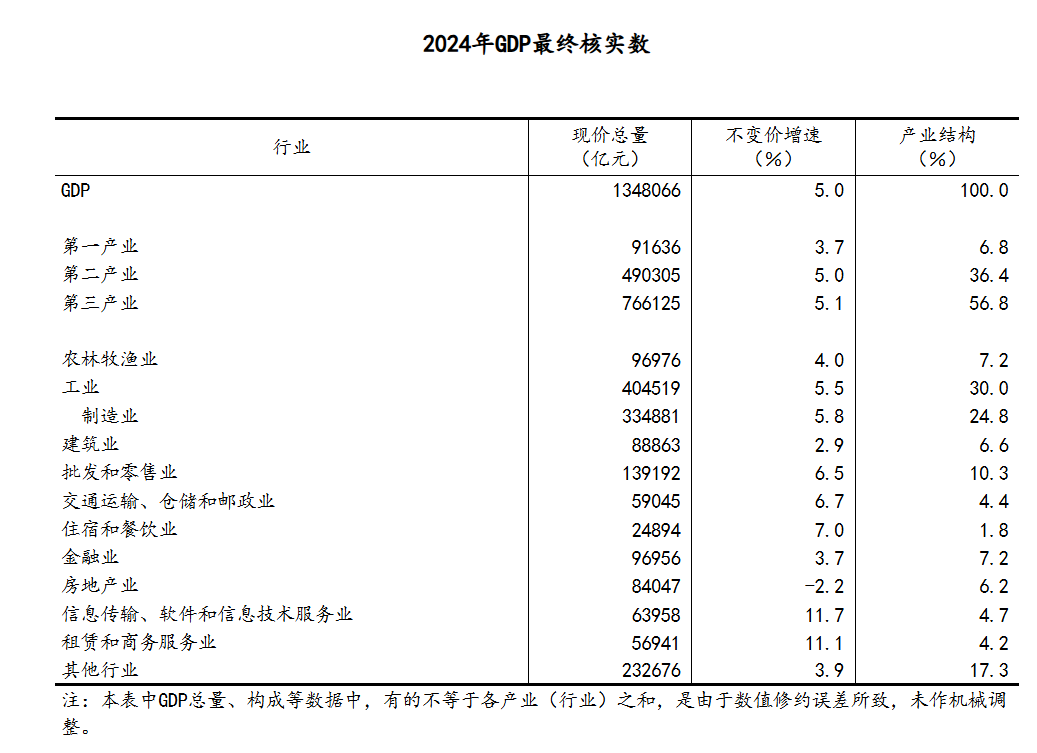
Core Points - The final verified GDP for 2024 is 13,480.66 billion yuan, which is a decrease of 10.18 billion yuan compared to the preliminary estimate, while the year-on-year growth rate at constant prices remains at 5.0% [1][4]. Group 1: GDP Overview - The GDP at current prices for 2024 is 1,348,066 million yuan, reflecting a reduction from the preliminary figure [1][4]. - The GDP growth rate at constant prices is confirmed at 5.0%, consistent with the preliminary estimate [1][4]. Group 2: Sector Contributions - The primary industry contributed 91,636 million yuan with a growth rate of 3.7%, accounting for 6.8% of GDP [4]. - The secondary industry, including manufacturing, contributed 490,305 million yuan with a growth rate of 5.0%, representing 36.4% of GDP [4]. - The tertiary industry showed the highest growth rate at 5.1%, contributing 766,125 million yuan, which is 56.8% of GDP [4]. Group 3: Industry-Specific Data - The manufacturing sector grew by 5.8%, contributing 334,881 million yuan [4]. - The construction industry experienced a slower growth rate of 2.9%, contributing 88,863 million yuan [4]. - The information transmission, software, and IT services sector had a significant growth rate of 11.7%, contributing 63,958 million yuan [4]. - The real estate sector faced a decline of 2.2%, contributing 84,047 million yuan [4].