
核能

Search documents
兰石重装(603169.SH):签订5.81亿元核能领域重大合同
智通财经网· 2025-10-29 17:31
Core Points - Company signed a contract with China Nuclear Engineering Co., Ltd. for a total amount of 581 million yuan (including tax) [1] - The contract is primarily for providing main process equipment for nuclear energy projects, including separators and box chambers [1] - The construction period for the project is approximately one year [1]

Mirion Technologies(MIR) - 2025 Q3 - Earnings Call Transcript
2025-10-29 16:00
Financial Data and Key Metrics Changes - Third quarter revenue totaled $223 million, an increase of nearly 8% from the previous year, with organic revenue growth of 4.7% [5][17] - Adjusted EBITDA for the quarter was $52.4 million, up 14.7% year-over-year, with margin expansion contributing to the increase [6][18] - Adjusted free cash flow for the third quarter was $18 million, contributing to a year-to-date total of $53 million, with an increase in the low end of adjusted free cash flow guidance to between $100 million and $115 million for 2025 [6][22] Business Line Data and Key Metrics Changes - The nuclear and safety segment revenue grew 9% to $144.6 million, with organic growth of 4.4% driven by nuclear power end market growth of 9% [20] - The medical segment revenue totaled $78.5 million, up 5.9%, with organic revenue growth of 5.2% [21] - Adjusted orders in the nuclear power end market grew 21%, reflecting strong demand across new builds, SMRs, and the installed base [8][14] Market Data and Key Metrics Changes - Year-to-date orders in the U.S. nuclear power end market increased by 44%, primarily due to SMR activity [14] - The global nuclear fleet's average capacity factor reached 83% in 2024, indicating potential for increased operational efficiency [9] - The IAEA has raised its nuclear capacity forecast, expecting nearly a terawatt of nuclear capacity by 2050 [9] Company Strategy and Development Direction - The company is focused on broadening its nuclear power portfolio through acquisitions, including the recent Paragon Energy Solutions deal [5][11] - The strategy includes enhancing software solutions for regulatory compliance and expanding product offerings in the nuclear power sector [11] - The company remains optimistic about the nuclear renaissance and its positioning to benefit from it [5][9] Management's Comments on Operating Environment and Future Outlook - Management expressed confidence in the nuclear power market's growth, citing strong order flow and government support for new projects [28][30] - The medical segment is expected to normalize despite current pressures, with continued demand driven by demographic trends and cancer care needs [31][32] - Management anticipates a rebound in the RTQA business as funding dynamics stabilize [32] Other Important Information - The company expects a blended cost of debt of 2.8% by year-end 2025, reflecting a significant improvement over the past year [6] - Adjusted EPS for the third quarter was $0.12, a 50% increase compared to the same quarter last year [18] Q&A Session Summary Question: Regarding the commercial nuclear backlog and project activity - Management indicated that the installed base and new utility scale builds are key drivers for future growth, with expectations for a growing nuclear power-related backlog [25][27] Question: Insights on the medical business amidst current pressures - Management remains optimistic about the medical business, citing strong demand drivers and expecting a return to trend as market conditions normalize [31][32] Question: Confidence in the $175 million pipeline and potential awards - Management expressed confidence in the pipeline, noting that timing for large opportunities can be unpredictable but remains optimistic about winning contracts [36][37] Question: Discussion on SMR opportunities and project pipeline - Management highlighted the expanding SMR project landscape and the importance of government support in accelerating project development [39][54] Question: Impact of larger one-time orders on margin profiles - Management confirmed a commitment to maintaining a 30% adjusted EBITDA margin target, with expectations that new builds may have lower margins compared to installed base work [71]

国家电投集团召开核能前期开发座谈会
Zheng Quan Shi Bao Wang· 2025-10-29 15:28
Core Viewpoint - The State Power Investment Corporation (SPIC) is actively promoting nuclear power project development to contribute to China's green and low-carbon energy transition and achieve the "3060" dual carbon goals [1] Group 1: Meeting Highlights - A seminar on nuclear energy preliminary development was held in Rongcheng, Shandong, attended by key SPIC executives [1] - The meeting emphasized the importance of implementing the "balanced growth strategy" and optimizing project layouts to seize opportunities in the nuclear energy sector [1] Group 2: Strategic Directions - SPIC aims to enhance collaboration among its nuclear-related units to accelerate the development of nuclear power projects [1] - The chairman highlighted the need for strict adherence to nuclear safety responsibilities and the promotion of "three transformations" in the organization [1]
国家能源局负责人会见纳米比亚工业、矿业和能源部执行长
国家能源局· 2025-10-29 13:33
Group 1 - The meeting between China's National Energy Administration and Namibia's Ministry of Industrialization, Trade and SME Development focused on deepening energy cooperation between the two countries [1][3] - Both parties expressed a commitment to enhance collaboration in the civilian nuclear energy sector and to advance practical cooperation in renewable energy [3] - Namibia is interested in Chinese companies participating in the exploration and development of oil and gas blocks [3]

氢能、核能、新型储能写入规划,“十五五”能源产业要怎么干?
2 1 Shi Ji Jing Ji Bao Dao· 2025-10-29 12:30
Core Insights - The "15th Five-Year Plan" aims to enhance China's energy sector, focusing on achieving carbon peak targets and establishing a clean, low-carbon, safe, and efficient energy system [1][7] Group 1: Energy Sector Development Goals - The overall goal for the energy sector during the "15th Five-Year Plan" is to achieve carbon peak targets and establish a new energy system [1] - The plan emphasizes the importance of energy transition, with a focus on enhancing energy supply capacity and accelerating green transformation [1][7] Group 2: Emerging Industries and Future Technologies - The plan highlights the need to cultivate emerging industries, particularly in new energy, new materials, aerospace, and low-altitude economy [2] - Hydrogen energy and nuclear fusion are specifically mentioned as future industries to explore diverse technological routes and business models [2][3] Group 3: Infrastructure Development - The plan calls for the construction of modern infrastructure to support energy transition, including optimizing energy transmission channels and building new energy facilities [3][4] - The development of charging stations and energy storage systems is deemed essential for the new energy infrastructure [5] Group 4: Market Regulation and Competition - The plan aims to eliminate barriers to building a unified national market and address "involution" in competition within the energy sector [5][6] - Establishing a unified electricity market is crucial for optimizing resource allocation and supporting energy transition [5] Group 5: Achievements and Future Directions - As of mid-2025, China's renewable energy installed capacity reached 2.159 billion kilowatts, accounting for 59.2% of total installed capacity [7] - The plan emphasizes the need for further acceleration of low-carbon and clean transformation in the energy sector to support economic development [7]
谷歌与美能源巨头合作重启核电站,为AI基础设施供电
Xin Lang Cai Jing· 2025-10-29 10:52
Group 1 - The core point of the articles highlights the record electricity consumption in the U.S. driven by the expansion of artificial intelligence and data centers, with nuclear energy becoming a focal point to meet this demand [1][2] - Google and NextEra Energy plan to restart the Duane Arnold Energy Center in Iowa by 2029 to provide carbon-free power for Google's AI operations, following its closure in 2020 due to high operational costs and safety concerns [1] - The U.S. electricity consumption is projected to reach 4.097 trillion kilowatt-hours in 2024, with further increases expected, potentially reaching 4.191 trillion kilowatt-hours in 2025 and 4.305 trillion kilowatt-hours in 2026, primarily driven by AI data centers [2] Group 2 - Major tech companies like Oracle, Microsoft, and Google are exploring nuclear energy solutions to address the increasing energy demands from AI computing, with Oracle designing a data center powered by three small nuclear reactors [2] - In addition to the Duane Arnold Energy Center, other nuclear projects are in progress, although no decommissioned nuclear plants have successfully restarted yet [3]

兰石重装:签订5.81亿元核能领域重大合同 主要是为中核工程核能项目提供主工艺设备
Mei Ri Jing Ji Xin Wen· 2025-10-29 09:41
Core Viewpoint - The company has signed a contract worth 581 million yuan (including tax) with China Nuclear Engineering Co., Ltd. to provide main process equipment for a nuclear energy project, which is expected to enhance its market share and core competitiveness in the nuclear energy sector [1] Group 1 - The contract amount is tentatively set at 581 million yuan (including tax) [1] - The project construction period is approximately 1 year [1] - The signing of this contract is expected to positively impact the company's operating performance in 2025 and beyond [1] Group 2 - The contract will further consolidate the company's previous strategic transformation achievements [1] - It will accelerate the speed of transformation and upgrading [1] - The company aims to enhance its market share and core competitiveness in the nuclear energy field [1]
兰石重装:签订核能领域重大合同
Zheng Quan Shi Bao Wang· 2025-10-29 09:31
Core Viewpoint - The company, Lanstone Heavy Industry, has signed a contract with China Nuclear Power Engineering Co., Ltd. for a total amount of 581 million yuan (including tax) to provide main process equipment for a nuclear energy project, with a construction period of approximately one year [1] Group 1 - The contract amount is set at 581 million yuan, which is a significant financial commitment for the company [1] - The project involves the supply of key equipment such as separators and box chambers, indicating the company's role in critical infrastructure for nuclear energy [1] - The expected construction period for the project is around one year, suggesting a timeline for revenue recognition and project execution [1]
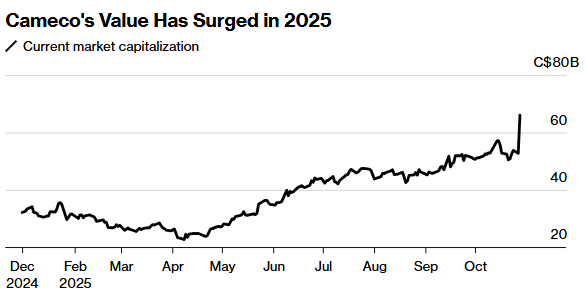
股价创新高!西屋电气拿下美国政府巨单 大股东Cameco(CCJ.US)市值一夜暴涨近90亿美元
Zhi Tong Cai Jing· 2025-10-29 00:37
Core Viewpoint - Cameco, one of the largest uranium fuel suppliers globally, saw its market value increase by over 12 billion CAD (approximately 8.7 billion USD) due to a new agreement between its subsidiary Westinghouse Electric and the U.S. government to build new nuclear reactors valued at least 80 billion USD [1][3] Group 1 - Cameco's stock price reached an all-time high, rising over 23% on the day of the announcement, with a year-to-date increase exceeding 100% [1] - The U.S. government is encouraging Westinghouse Electric to construct large nuclear reactors to accelerate the application of nuclear energy and artificial intelligence in the country [1] - Cameco owns 49% of Westinghouse Electric, while Brookfield Asset Management and Brookfield Renewable Partners hold the remaining 51% [1] Group 2 - Tim Gitzel, CEO of Cameco, expressed optimism about the collaboration, anticipating growth for Westinghouse Electric and Cameco's nuclear products, services, and technologies globally [3] - Analysts view the agreement positively for Cameco, noting that each reactor construction requires decades of fuel supply and maintenance services, leading to high profits and sustained revenue for Westinghouse and its owners [3] - If Westinghouse Electric's valuation reaches at least 30 billion USD by January 2029, the U.S. government may require an initial public offering [3]

“十五五”规划建议发布 更清晰的方向!
Sou Hu Cai Jing· 2025-10-28 23:35
Core Insights - The "14th Five-Year Plan" emphasizes a strategic approach to counter global challenges while focusing on domestic economic stability and growth [1][6][11] Strategic Dimensions - Understanding the complexities and volatility of the current macro external environment is crucial, as traditional globalization principles are changing [1][2] - Concentrating efforts on internal matters is essential to navigate external changes effectively [1][2] Historical Perspective - A historical viewpoint is necessary to recognize China's current position and future trajectory in the global landscape [2] Goal Orientation - The unwavering goal remains the construction of a modern socialist country and the rejuvenation of the Chinese nation, despite global uncertainties [2][4] Problem Orientation - Identifying and addressing existing issues is vital after understanding the broader context [2] Economic Growth and Quality - The plan highlights the importance of both qualitative and quantitative aspects of growth, with a target economic growth rate of around 5% to achieve the status of a moderately developed country by 2035 [4] - Emphasis on improving labor productivity as a key component of quality growth [4] Domestic Market Stability - Enhancing internal stability through a unified domestic market is critical to countering external uncertainties [6] - The establishment of a unified domestic market involves standardizing regulations, infrastructure, and business environments [6] Technological Development - China has made significant advancements in technology, particularly in AI, quantum computing, and nuclear energy, positioning itself to compete with the U.S. [8][10] - The focus on AI+ applications and breakthroughs in quantum computing are seen as pivotal for future growth [9][10] Global Engagement - The "China+N" strategy reflects a shift in global investment patterns, with foreign companies recognizing the importance of the Chinese market [11][12] - Chinese enterprises are increasingly expanding globally, contributing to a new structure in global supply chains [13] Currency Internationalization - The acceleration of the internationalization of the Renminbi is deemed necessary for strengthening China's financial position in global competition [14]
