新能源车

Search documents
港股开盘丨恒生指数跌0.51%
Xin Lang Cai Jing· 2025-11-07 06:46
来源:第一财经 恒生指数跌0.51%,恒生科技指数跌0.83%。半导体、新能源车概念股回调,蔚来跌超2%,华虹半导体 跌3.87%。 (本文来自第一财经) ...
鑫椤锂电一周观察 | 枧下窝矿复产提前?碳酸锂价格波动加剧
鑫椤锂电· 2025-11-07 06:26
Industry Highlights - Chile's lithium carbonate exports rebounded in October 2025, reaching 25,000 tons, a month-on-month increase of 56%. Exports to China were 16,200 tons, to Japan 1,097 tons, and to South Korea 6,616 tons. For January to October 2025, total lithium carbonate exports were 189,400 tons, a year-on-year decrease of 5.3%, with exports to China down 15% to 137,100 tons [1] - Chile's lithium sulfate exports in October 2025 were 1,708 tons, all to China, reflecting an 80% month-on-month decrease. However, total lithium sulfate exports from January to October 2025 reached 72,000 tons, a year-on-year increase of 81% [1] Company Developments - OneD Material Inc. and Shanghai Putailai New Energy Technology Co., Ltd. signed a Joint Development Agreement to collaboratively design and scale production of next-generation silicon-graphite composite anode materials for lithium-ion batteries [2] - Greeenme announced a plan to transfer 100% equity of Jiangxi Green Recycling Materials Co., Ltd. to Henan Recycling Technology Industry Group for 280 million yuan, aiming to optimize its recycling assets and develop key metal resource recovery business, with an expected investment return of approximately 10 million yuan [3] Market Trends - In September, China's e-cigarette exports were approximately $879 million, a month-on-month decrease of 6.13%, but a year-on-year increase of 2.85%. The top ten export destinations included the USA, UK, Germany, and South Korea [4] - Domestic lithium carbonate prices fluctuated this week, dropping from 82,000 yuan to 78,000 yuan, but rebounded after clarification of rumors regarding the early resumption of production at a key mine. October's lithium carbonate production increased by 5% month-on-month, with strong demand expected to continue into November and December [6] - The latest prices for battery-grade lithium carbonate are between 77,000 to 79,000 yuan per ton, while industrial-grade is between 75,500 to 76,500 yuan per ton [7] Material Prices - Cobalt prices remained stable, while cobalt salt prices remained firm. Despite a slight decrease in lithium carbonate prices, the ternary material market prices have not changed significantly [8] - The latest prices for ternary materials are as follows: single crystal 5 series at 154,000 to 158,000 yuan per ton, and 8 series 811 type at 162,000 to 167,000 yuan per ton. The phosphoric iron lithium market is experiencing strong production and sales, with slight price declines due to falling lithium carbonate prices [9][10] Battery Market - The domestic lithium battery market remains robust, with a 3% month-on-month increase in production for November. Some battery manufacturers are operating at 10% above capacity, with low willingness to reduce production in December despite expectations for next year [16] - The latest prices for square ternary power cells range from 0.4 to 0.46 yuan/Wh, while square lithium iron phosphate power cells range from 0.26 to 0.355 yuan/Wh [16] Energy Storage Developments - The energy storage cell market continues to thrive, with stable prices. Samsung SDI plans to convert part of its Indiana factory's production lines to energy storage batteries and is in advanced negotiations with Tesla for a 30GWh energy storage battery agreement [17] - Saudi Arabia aims to deploy 48GWh of battery storage facilities by 2030, with contracts signed for additional 12.5GWh of battery storage facilities expected to be delivered by late 2025 to early 2026 [18]


电新行业2025年Q3业绩总结、基金持仓分析:云遮晓月,雾散朝阳
Minsheng Securities· 2025-11-07 05:22
Investment Rating - The report maintains a "Buy" rating for key companies in the electric new energy sector, including Ningde Times, XWANDA, and others, indicating a positive outlook for their performance [4]. Core Insights - The electric new energy sector has shown significant improvement in overall performance, with total revenue reaching 26,127.80 billion yuan in the first three quarters of 2025, a year-on-year increase of 4.86%, and a net profit of 1,457.70 billion yuan, up 29.30% year-on-year [9][20]. - The new energy vehicle sector is experiencing a positive trend, with 88 listed companies achieving a total revenue of 10,611.92 billion yuan, a 12.71% increase year-on-year, and a net profit of 956.38 billion yuan, up 46.08% year-on-year [20]. - The renewable energy generation sector is at a turning point, particularly in the photovoltaic segment, which is expected to rebound due to ongoing supply-side reforms and increased regulatory control over price competition [49][58]. Summary by Sections 1. Electric New Energy Sector Performance - The electric new energy sector reported a total revenue of 9,382.37 billion yuan in Q3 2025, a year-on-year increase of 7.38%, and a net profit of 590.76 billion yuan, up 54.54% year-on-year [9][31]. 2. New Energy Vehicle Sector - The new energy vehicle sector's revenue for Q3 2025 was 3,864.35 billion yuan, reflecting a 16.47% year-on-year increase, with net profit reaching 375.93 billion yuan, up 52.99% year-on-year [20][24]. 3. Renewable Energy Generation Sector - The renewable energy generation sector achieved a total revenue of 15,122.54 billion yuan in the first three quarters of 2025, a 1.01% increase year-on-year, with a net profit of 658.42 billion yuan, up 27.90% year-on-year [31][40]. - The photovoltaic segment reported a revenue of 8,534.74 billion yuan in the first three quarters, down 11.41% year-on-year, but showed signs of recovery in Q3 with a revenue of 2,992.13 billion yuan [49][58]. - The wind power sector saw a revenue increase of 21.1% year-on-year, totaling 3,641.34 billion yuan, with a net profit growth of 22.3% [63][65]. 4. Energy Storage Sector - The energy storage sector reported a revenue of 4,930.96 billion yuan in the first three quarters, a 14.61% increase year-on-year, with a net profit of 701.87 billion yuan, up 38.25% [75][78]. 5. Electric Equipment Sector - The electric equipment sector achieved a revenue of 2,725.96 billion yuan in the first three quarters, reflecting a 9% year-on-year increase, with a net profit of 221.93 billion yuan, also up 9% [80][82].





超2800只个股下跌
第一财经· 2025-11-07 03:49
Market Overview - The A-share market showed a slight decline with the Shanghai Composite Index down by 0.16%, the Shenzhen Component Index also down by 0.16%, and the ChiNext Index down by 0.37% [3][4] - The total trading volume in the Shanghai and Shenzhen markets reached 1.25 trillion yuan, a decrease of 71.1 billion yuan compared to the previous trading day, with over 2800 stocks declining [4] Sector Performance - The AI hardware and software sectors led the decline, while the lithium battery supply chain experienced a surge, with fluorine chemical, phosphorus chemical, and photovoltaic concept stocks performing well [3] - The commercial aerospace sector saw a short-term rally, with stocks like Shanghai Huguang hitting the daily limit and Aerospace Technology rising over 6% [6] - The photovoltaic sector continued to strengthen, with several stocks including Hailu Heavy Industry and Tongwei Co. hitting the daily limit, and Tongwei Co. rising over 8% [7] Stock Movements - The semiconductor sector in Hong Kong showed weakness, with stocks like Hua Hong Semiconductor down by 5.49% and Shanghai Fudan down by 3.11% [10] - The A-share market opened lower, with the Shanghai Composite Index down by 0.34%, the Shenzhen Component Index down by 0.54%, and the ChiNext Index down by 0.72% [12][14] - The electrical equipment sector rebounded after hitting a low, with Zhongneng Electric rising over 15% and Moen Electric achieving a four-day limit up [9] Economic Indicators - The People's Bank of China conducted a reverse repurchase operation of 141.7 billion yuan for 7-day terms at an interest rate of 1.40%, with 355.1 billion yuan of reverse repos maturing today [15] - The central parity rate of the RMB against the USD was reported at 7.0836, an increase of 29 basis points from the previous trading day [16]

小鹏汽车涨超4%,华虹半导体跌超3%,新东方跌超2%
Di Yi Cai Jing Zi Xun· 2025-11-07 01:58
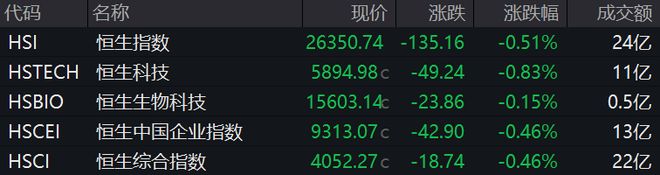
Market Overview - On November 7, the Hong Kong Hang Seng Index opened down by 0.51% at 26,350.74, with a decrease of 135.16 points [1][2] - The Hang Seng Tech Index fell by 0.83% to 5,894.98, down by 49.24 points [1][2] - The Hang Seng Biotech Index decreased by 0.15%, closing at 15,603.14, down by 23.86 points [2] - The Hang Seng China Enterprises Index dropped by 0.46% to 9,313.07, down by 42.90 points [2] - The Hang Seng Composite Index also fell by 0.46%, ending at 4,052.27, down by 18.74 points [2] Sector Performance - Semiconductor and new energy vehicle stocks experienced a pullback, with notable movements in individual stocks [1] - Xpeng Motors saw an increase of over 4%, indicating a positive performance amidst the overall market decline [1] - Hua Hong Semiconductor declined by over 3%, reflecting the sector's challenges [1] - NIO and New Oriental both fell by over 2%, contributing to the negative sentiment in the market [1]
何小鹏再次证明机器人内部没人,机构:对标特斯拉,小鹏汽车未来估值提升空间较大
Mei Ri Jing Ji Xin Wen· 2025-11-07 01:58
Group 1 - The Hong Kong stock market indices experienced a decline, with the Hang Seng Tech Index ETF (513180) showing a slight drop, while the Hong Kong Stock Connect Auto ETF (159323) saw a minor increase, driven by stocks like XPeng and Dongyue Group [1] - XPeng Motors recently unveiled its humanoid robot IRON, showcasing impressive walking capabilities and providing insights into its core technology and commercialization plans [1] - Longjiang Securities highlighted that XPeng's valuation has primarily focused on its automotive business, neglecting AI-related sectors such as autonomous driving and robotics, which could lead to significant valuation growth in the future [2] Group 2 - The Hong Kong Stock Connect Auto ETF (159323) is focused on the new energy vehicle sector, including emerging car manufacturers, and is expected to benefit from advancements in robotics technology [3] - The Hang Seng Tech Index ETF (513180) includes a mix of technology companies and offers exposure to key Chinese tech assets, making it an attractive option for investors without a Hong Kong Stock Connect account [3]

小鹏汽车涨超4%,近日发布新一代人形机器人IRON,何小鹏再次证明机器人内部没人
Mei Ri Jing Ji Xin Wen· 2025-11-07 01:58
Core Viewpoint - The Hong Kong stock market opened lower on November 7, with the Hang Seng Index down 0.51% at 26,350.74 points, reflecting a general decline in tech stocks and the Apple concept [1] Group 1: Company Developments - XPeng Motors officially launched its humanoid robot, IRON, on November 5, showcasing its walking capabilities and core technologies, with plans for mass production by the end of 2026 [1] - XPeng has assembled over 1,000 team members across 10 R&D teams and 20+ collaborative departments to advance the commercialization of the IRON robot [1] - XPeng's CEO reiterated that the new generation humanoid robot does not contain any human inside, emphasizing its technological advancements [1] Group 2: Market Analysis - Shenwan Hongyuan highlighted that XPeng's IRON robot features a humanoid design and that China's robotics technology is globally leading, which may enhance market confidence in domestic products [2] - The report suggests investors pay attention to XPeng Motors and its supply chain, as well as its strategic partnership in solid-state battery technology [2] Group 3: Related ETFs - The Hong Kong Stock Connect Automotive ETF (159323) focuses on the new energy vehicle sector, including emerging car manufacturers like XPeng, and is expected to benefit from advancements in robotics technology [3] - The Hang Seng Technology Index ETF (513180) includes major Chinese tech assets and offers a way for investors without a Hong Kong Stock Connect account to access leading tech stocks [3]
AH股集体低开,沪指跌0.19%,创业板跌超1%,CPO、存储器方向领跌,港股半导体回调
Hua Er Jie Jian Wen· 2025-11-07 01:55
Market Overview - A-shares opened lower with the ChiNext index dropping over 1%, led by declines in the computing hardware supply chain, particularly in CPO and memory sectors [1] - The Hang Seng Index opened down 0.51%, with the Hang Seng Tech Index falling 0.83%, as semiconductor and new energy vehicle stocks retreated [1][7] - National bonds saw a general increase, with the 30-year main contract rising by 0.10% and the 10-year main contract up by 0.03% [1][3] Sector Performance - The computing hardware supply chain, including CPO, AI chips, quantum technology, and PCB, experienced significant declines, with over 3100 stocks in the Shanghai and Shenzhen markets falling [1] - Conversely, lithium batteries and Hainan Free Trade Zone themes showed resilience, with notable gains in related stocks [1][5] - In the Hong Kong market, stocks like Xpeng Motors rose by 4.8%, while major players like NIO and JD.com saw declines exceeding 2% [7][8] Bond Market - National bond futures opened with slight increases across various maturities, indicating a stable bond market environment [3][4] Commodity Market - Commodity prices showed mixed results, with the main contract for shipping in Europe dropping over 2%, while urea, ethylene glycol, and canola oil rose by more than 1% [1][9][10] Stock Specifics - In the A-share market, Hainan Free Trade Zone stocks opened strong, with Haima Automobile hitting the daily limit, and other stocks like Hainan Development and Kangzhi Pharmaceutical also gaining [5][6]

小鹏汽车涨超4%,华虹半导体跌超3%,新东方跌超2%
第一财经· 2025-11-07 01:48
编辑丨瑜见 | 代码 | 名称 | 现价 | 涨跌幅 | 成交额 | | --- | --- | --- | --- | --- | | મંદા | 恒生指数 | 26350.74 -135.16 -0.51% | | 24亿 | | HSTECH 恒生科技 | | 5894.98 c -49.24 - -0.83% | | 11亿 | | HSBIO | | 15603.14c -23.86 - -0.15% | | 0.5亿 | | HSCEI | 恒生中国企业指数 | 9313.07c -42.90 -0.46% | | 13亿 | | HSCI | 恒生综合指数 | 4052.27 c -18.74 -0.46% | | 22亿 | 11月7日,香港恒生指数开盘跌0.51%,恒生科技指数跌0.83%。半导体、新能源车概念股回调,小鹏汽 车涨超4%,华虹半导体跌超3%,蔚来、新东方等跌超2%。 ...

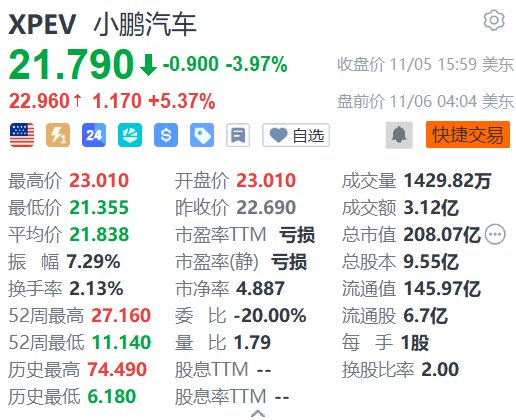
美股异动丨小鹏汽车盘前涨超5% 花旗料其新业务推动股价利好
Ge Long Hui· 2025-11-06 09:09
Core Insights - Xiaopeng Motors (XPEV.US) shares rose by 5.37% to $22.96 in pre-market trading following announcements made during the 2025 Xiaopeng Technology Day [1] - The company plans to enter the Robotaxi, humanoid robot, and flying car sectors, with an L4 Robotaxi expected to launch in 2026, equipped with four Turing chips [1] - A partnership with Alibaba's ride-hailing platform, Gaode, will facilitate the operation of Robotaxi services [1] Financial Analysis - Citigroup's research report views the announcements as positive, suggesting that while the profitability of Xiaopeng's new business ventures is still in early stages, it could enhance market sentiment and elevate the stock's valuation from traditional new energy vehicle levels to higher premiums associated with AI, technology, and Robotaxi [1] - Citigroup maintains a "Buy" rating on Xiaopeng Motors with a target price of $29.4 [1] Stock Performance - The closing price on November 5 was $21.79, with a decrease of 3.97% [1] - The pre-market price on November 6 was $22.96, reflecting an increase of $1.17 [1] - The stock has a market capitalization of $20.807 billion and a trading volume of 14.2982 million shares [1]