
石油与天然气

Search documents
中国石油股价连续3天上涨累计涨幅5.83%,方正富邦基金旗下3只基金合计持406.08万股,浮盈赚取198.98万元
Xin Lang Cai Jing· 2025-10-22 11:00
来源:新浪基金∞工作室 方正富邦策略精选A(010072)二季度减持175.3万股,持有股数200.08万股,占基金净值比例为3.4%, 位居第一大重仓股。根据测算,今日浮盈赚取约28.01万元。连续3天上涨期间浮盈赚取98.04万元。 方正富邦鑫益一年定期开放混合A(013712)二季度减持31万股,持有股数1万股,占基金净值比例为 1.4%,位居第十大重仓股。根据测算,今日浮盈赚取约1400元。连续3天上涨期间浮盈赚取4900元。 风险提示:市场有风险,投资需谨慎。本文为AI大模型自动发布,任何在本文出现的信息(包括但不 限于个股、评论、预测、图表、指标、理论、任何形式的表述等)均只作为参考,不构成个人投资建 议。 数据显示,方正富邦基金旗下3只基金重仓中国石油股票,合计持有中国石油406.08万股,按前一日收 盘8.76元,今日截止发稿股价8.9元计算,日浮盈56.85万元。连续3天上涨期间浮盈赚取198.98万元。 基金名称基金代码基金经理持股数量(股)占流通股比例(%)占基金净值比(%)持股数量变动(股)方正富邦 趋势领航混合A012913崔建波20500000.00123.25-2200000方正 ...

中原油田源网荷储智能平台投运
Zhong Guo Hua Gong Bao· 2025-10-22 05:53
Core Insights - The Zhongyuan Oilfield Power Supply Service Center has completed the upgrade of its scheduling automation system, leading to the official operation of an integrated intelligent control platform for energy sources, networks, loads, and storage [1] Group 1: Technological Advancements - A special technical team was formed to address challenges related to the integration of large-scale renewable energy sources such as wind and solar power into the oilfield's power grid [1] - Over 30 specialized discussions and on-site adjustments were conducted to overcome data access bottlenecks, establishing a full-link communication channel from renewable energy stations to the dispatch main station [1] Group 2: System Performance - The platform has successfully integrated with 5 wind farms and 139 solar power stations, achieving real-time parameter sensing accuracy at the second level [1] - The intelligent alarm response time has been reduced to under 10 seconds [1] Group 3: Efficiency and Cost Savings - The short-term prediction accuracy of the renewable energy forecasting system has exceeded 95% [1] - The automatic generation control system and automatic voltage control functions have achieved active and reactive power automatic regulation [1] - The capacity for green electricity consumption has significantly increased, surpassing 40%, with an expected annual savings of over 60 million yuan in purchased electricity costs [1]
被穿透性规则反噬,美企不忍了
Huan Qiu Shi Bao· 2025-10-21 22:57
Core Viewpoint - The U.S. export control penetration rules are causing significant backlash, hindering billions of dollars in U.S. export activities and prompting countries like China to remove U.S. companies from their supply chains [1][2]. Group 1: Impact on U.S. Companies - A lobbying group consisting of major U.S. companies like Oracle, Amazon, and ExxonMobil is urging the U.S. government to suspend the new export control rules, which they claim are counterproductive to U.S. trade policy [1]. - The National Foreign Trade Council highlighted that the rules contradict the government's goals of reducing trade deficits and increasing global exports [1][2]. - The rules have led to a backlog of thousands of export license applications worth billions of dollars, particularly affecting exports to China [2]. Group 2: Reactions from China - The Chinese Ministry of Commerce criticized the U.S. rules as an abuse of export controls that severely disrupts international trade order and harms legitimate rights of affected enterprises [2]. - The Ministry further stated that the expansion of controlled entities under these rules has impacted thousands of Chinese companies [2]. Group 3: Long-term Consequences - Experts suggest that the U.S. rules may damage the interests of American high-tech companies reliant on the Chinese market, while simultaneously accelerating the development of independent supply chains within China [3].
BKR Poised to Report Q3 Earnings: Here's What You Need to Know
ZACKS· 2025-10-21 14:46
Core Viewpoint - Baker Hughes (BKR) is expected to report its third-quarter 2025 results on October 23, with a consensus estimate of earnings per share (EPS) at 61 cents and revenues at $6.8 billion, reflecting a decline in both metrics compared to the previous year [1][2][8]. Financial Performance - In the last reported quarter, Baker Hughes achieved adjusted earnings of 63 cents per share, surpassing the Zacks Consensus Estimate of 55 cents, driven by cost improvements and operational efficiency [1]. - The Zacks Consensus Estimate for third-quarter EPS has been revised downward by 9% from the prior-year reported number [2]. - Revenue estimates indicate a 1.2% decrease from the year-ago figure, with projected revenues of $6.8 billion [2]. Market Conditions - The average spot prices for West Texas Intermediate (WTI) crude oil have decreased significantly in the third quarter of 2025 compared to the same period last year, with prices of $68.39, $64.86, and $63.96 per barrel for July, August, and September respectively, compared to $81.80, $76.68, and $70.24 per barrel in the prior year [3]. - The softer pricing environment is anticipated to negatively impact Baker Hughes' Oilfield Services and Equipment segment, with projected EBITDA from this unit expected to decline by 8.8% year over year [4]. Earnings Expectations - Current analysis suggests that Baker Hughes is unlikely to beat earnings expectations this quarter, with an Earnings ESP of -2.28% and a Zacks Rank of 3 (Hold) [5]. - The combination of a positive Earnings ESP and a higher Zacks Rank typically increases the likelihood of an earnings beat, which is not the case for Baker Hughes this time [5]. Comparative Analysis - Other companies in the sector, such as BP and ConocoPhillips, are also set to report earnings soon, with BP having an Earnings ESP of +1.21% and ConocoPhillips at +0.44%, indicating a more favorable outlook for these companies compared to Baker Hughes [6][7].

中国海洋石油有限公司 关于执行董事、副董事长及首席执行官辞任的公告
Zhong Guo Zheng Quan Bao - Zhong Zheng Wang· 2025-10-21 10:48
Core Points - The announcement states that Mr. Zhou Xinhai has resigned from his positions as Executive Director, Vice Chairman, and CEO of China National Offshore Oil Corporation (CNOOC), effective October 20, 2025 [1] - The board of directors approved the resignation with a unanimous vote of 8 in favor, with no opposition or abstentions [1] - Mr. Zhou confirmed that there are no disagreements with the board and no matters related to his resignation that need to be brought to the attention of shareholders or stock exchanges [1] Acknowledgment - The board expressed sincere gratitude for Mr. Zhou's contributions to the company and the offshore oil industry [2]

VALLOUREC SHOWCASES THE LATEST INNOVATIONS OF ITS VAM® CONNECTION AT ADIPEC 2025
Globenewswire· 2025-10-21 05:00
Core Insights - Vallourec will showcase its latest innovations in VAM connection and technologies supporting energy transition at ADIPEC 2025, the largest energy industry event globally, from November 3 to 6, 2025, in Abu Dhabi, UAE [1] Group 1: Company Overview - Vallourec is a world leader in premium tubular solutions for energy markets and demanding industrial applications, with a focus on oil & gas wells, new generation power plants, and high-performance mechanical equipment [4] - The company employs nearly 13,000 dedicated employees across more than 20 countries, emphasizing innovation and R&D to provide safe and competitive tubular solutions [4] Group 2: Product Innovations - Vallourec's VAM connection has set a benchmark in the Oil & Gas sector for performance and reliability since its inception, supported by extensive R&D and a global service offering [2] - At ADIPEC 2025, Vallourec will present its unique underground hydrogen storage solution, Delphy, alongside its full range of services, including project engineering and tubular management solutions [3]


北水动向|北水成交净卖出26.7亿 中国人寿(02628)盈喜后获加仓 阿里(09988)再遭抛售
智通财经网· 2025-10-20 09:59
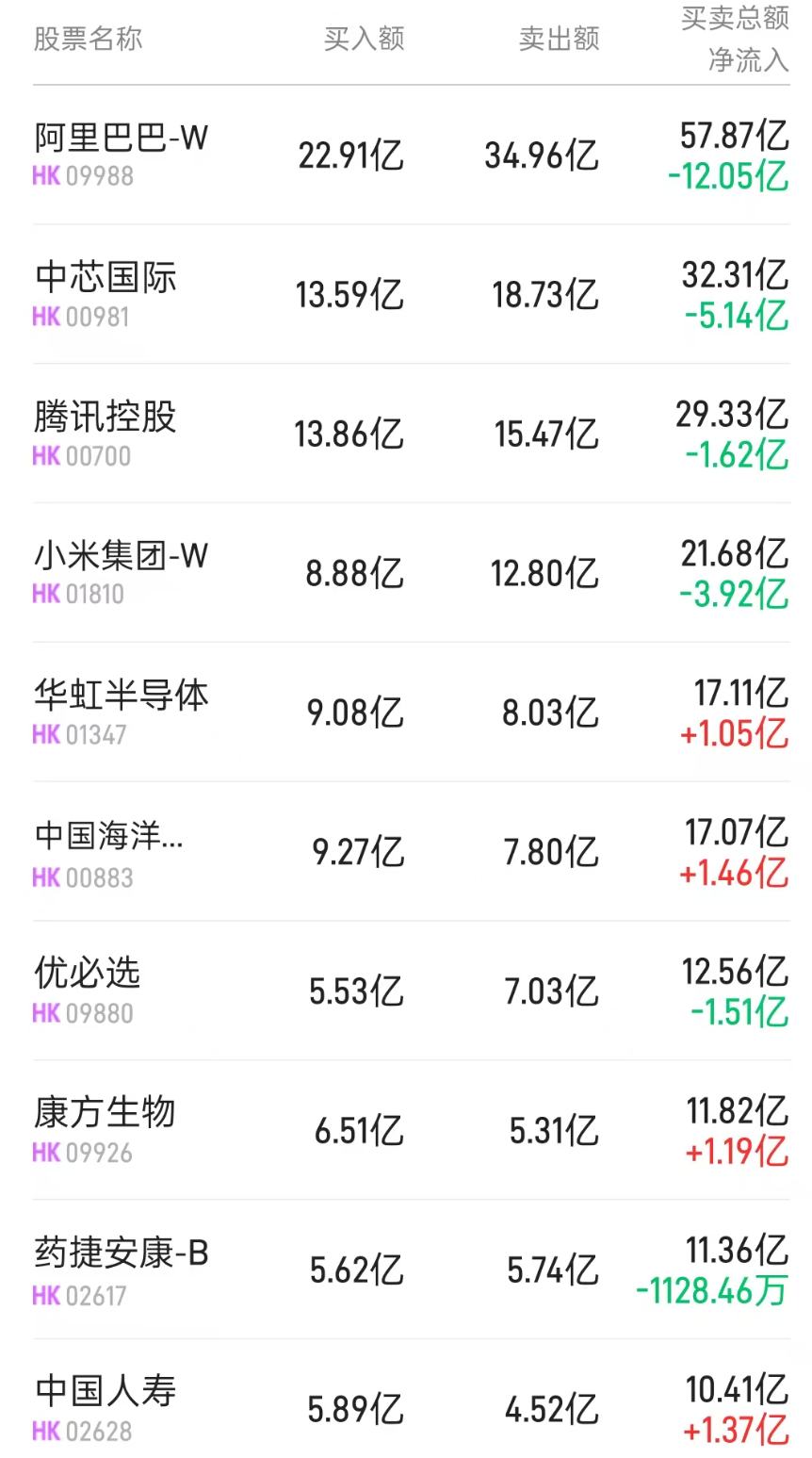
Core Viewpoint - The Hong Kong stock market experienced significant net selling from Northbound capital, totaling HKD 26.7 billion, with notable net sell-offs in major stocks like Alibaba and Xiaomi [1][2]. Group 1: Northbound Capital Flow - Northbound capital recorded a net sell of HKD 22.86 billion through the Shanghai Stock Connect and HKD 3.84 billion through the Shenzhen Stock Connect [1]. - The stocks with the highest net buying from Northbound capital included Southern Hang Seng Technology (03033), CNOOC (00883), and China Life (02628) [1]. - The stocks with the highest net selling included Alibaba-W (09988), Xiaomi Group-W (01810), and SMIC (00981) [1]. Group 2: Individual Stock Performance - Alibaba-W (09988) saw a net sell of HKD 17.53 billion, with Fitch projecting strong business conditions and financial health, despite short-term profitability pressures due to intense competition [7]. - Xiaomi Group-W (01810) experienced a net sell of HKD 3.4 billion, reflecting broader market trends affecting tech stocks [7]. - CNOOC (00883) received a net buy of HKD 1.62 billion, supported by a Morgan Stanley report indicating a potential recovery in oil prices by 2027 [4]. - China Life (02628) had a net buy of HKD 1.37 billion, with a projected net profit increase of 50% to 70% year-on-year for the first three quarters [5]. - Tencent (00700) saw a net buy of HKD 966.7 million, driven by positive user growth in its gaming segment and improving ad revenue [5]. Group 3: Market Trends and Insights - The semiconductor sector faced increased selling pressure, with Huahong Semiconductor (01347) and SMIC (00981) experiencing net sells of HKD 329 million and HKD 3.24 billion, respectively, amid rising export controls from the U.S. [6][7]. - Southern Hang Seng Technology (03033) recorded a net buy of HKD 3.75 billion, indicating investor interest in tech despite broader market challenges [7].





燃料油周报:油价中枢持续走低,低硫油市场承压-20251019
Hua Tai Qi Huo· 2025-10-19 12:00
Report Industry Investment Rating - High-sulfur fuel oil: Cautiously bearish, short-term focus on the progress of China-US tariff negotiations [7] - Low-sulfur fuel oil: Cautiously bearish, short-term focus on the progress of China-US tariff negotiations [7] - Cross-variety: None [7] - Cross-period: None [7] - Spot-futures: None [7] - Options: None [7] Core Viewpoints - The fuel oil futures market is under pressure as the peak season ends, the crude oil fundamentals weaken, and macro risks increase. Both high-sulfur and low-sulfur fuel oil face challenges in supply, demand, and market structure [1]. - The supply of high-sulfur fuel oil may increase due to the easing of the Middle East situation and the release of OPEC's production capacity, while the supply of low-sulfur fuel oil has seen a recent increase but is expected to ease [2][3]. - The demand for fuel oil is affected by factors such as China-US trade frictions, the replacement of low-sulfur fuel oil in the marine fuel market, and the decline in power generation demand after summer [4]. - The inventory of fuel oil has increased in some regions, and the market structure of high-sulfur fuel oil has strengthened marginally, while that of low-sulfur fuel oil has weakened [5][6]. Summary by Relevant Catalogs Market Performance - This week, the fuel oil futures market declined. The FU main contract fell 5.54%, and the LU main contract dropped 7.13% [1]. Supply High-sulfur Fuel Oil - The Middle East situation has eased, and OPEC's relaxation of production cuts may increase the supply of high-sulfur fuel oil. Middle East's September high-sulfur fuel oil shipments are expected to be 4.41 million tons, and October's are estimated at 3.72 million tons [2]. - Iran's September shipments are expected to be 1.45 million tons, and October's are estimated at 0.57 million tons. The US sanctions on Iran continue to increase the difficulty of its oil trade [2]. - Russia's high-sulfur fuel oil supply decreased in August due to refinery maintenance but rebounded in September. September's shipments are expected to be 2.97 million tons, and October's are estimated at 1.97 million tons [2]. Low-sulfur Fuel Oil - There has been a recent increase in local supply, mainly from Nigeria's temporary increase. Nigeria's September low-sulfur fuel oil shipments are expected to be 0.53 million tons, and October's are estimated at 0.34 million tons [3]. - Kuwait's exports are relatively limited. September's shipments are 0.37 million tons, and October's are expected to be 0.4 million tons [3]. - China's domestic production of low-sulfur fuel oil has been low this year due to poor profitability and refinery maintenance. September's production was 1.075 million tons, a 0.94% increase from the previous month [3]. Demand - China-US trade frictions and potential tariff increases may damage trade and shipping demand, affecting the consumption of marine fuel oil. There may be a short-term increase in exports due to the anticipation of tariffs [4]. - The demand for low-sulfur fuel oil in the marine fuel market is being replaced by new desulfurization towers and cleaner energy sources such as LNG and green methanol [4]. - After the summer, the power generation demand in the Middle East, South Asia, and Egypt will decline, reducing the consumption of high-sulfur fuel oil. However, Egypt's demand may increase due to the decline in domestic natural gas production [4]. - The demand from refineries has shown a marginal increase. China's high-sulfur fuel oil imports in September are expected to be 0.5 million tons, and October's arrivals are estimated at 0.84 million tons [4]. Inventory - This week, Singapore's fuel oil inventory was 25.063 million barrels, a 5.89% increase from the previous week, and Zhoushan Port's inventory was 1.35 million tons, a 21.62% increase [5]. Market Structure High-sulfur Fuel Oil - The market structure has strengthened marginally due to reduced supply pressure, improved refinery demand, and a decrease in domestic futures registered warehouse receipts [5]. - However, the upward momentum may be limited due to the decline in power generation demand after summer, potential increases in Middle East exports, and potential risks in shipping demand [5]. Low-sulfur Fuel Oil - The market structure has weakened recently due to increased local supply and average marine fuel demand [6]. - If the Dangote refinery resumes operation, the supply may decrease. However, if China-US tariff conflicts intensify, the shipping demand will be affected, and the low-sulfur fuel oil market may be more sensitive [6]. - The demand for low-sulfur fuel oil is under continuous downward pressure due to the trend of carbon neutrality in the shipping industry. If the trade risks ease, the downside space may be limited based on its relatively low valuation compared to gasoline and diesel [6].
通源石油(300164.SZ):中标合计约1.26亿美元项目
Ge Long Hui A P P· 2025-10-16 08:14
Core Viewpoint - Tongyuan Petroleum has won a project bid from Sonatrach, the national oil company of Algeria, for early production measures and gas compression services, with a total contract value of approximately $126 million or 897 million RMB [1] Group 1 - The project bid notification includes a total amount of $104,646,960 and 2,762,755,600 Algerian Dinar [1] - The contract duration is set for four years [1]

原油&燃料油数据日报-20251016
Guo Mao Qi Huo· 2025-10-16 06:29
1. Report Industry Investment Rating - No specific industry investment rating is provided in the report. 2. Core Viewpoints - International oil prices are expected to remain weak in the short - term due to factors such as uncertain Sino - US trade tariffs, a loose supply - demand situation in the crude oil market, and reduced geopolitical risks. It is recommended to take a short - term wait - and - see approach for crude oil [3]. - The fuel oil market is under pressure from lukewarm demand and sufficient supply. With international oil prices likely to stay weak, fuel oil lacks strong upward drivers. A short - term wait - and - see strategy is also advised for fuel oil [3]. 3. Summary by Related Catalogs Crude Oil - **Supply - demand situation**: OPEC+ continues its production - increasing policy and reached a principle agreement to slightly increase production in November. From September, crude oil consumption gradually declines, with the global off - peak consumption being 1 - 3 million barrels per day lower than the peak. Geopolitical risks have decreased, which may lead to more crude oil flowing into the market [3]. - **Operation strategy**: Short - term wait - and - see [3]. - **Futures盘面**: SC crude oil closed at 443.7 yuan/barrel, down 4.9 yuan or 1.09%; WTI crude oil was at 58.59 dollars/barrel, unchanged; Brent crude oil was at 62.28 dollars/barrel, unchanged [3]. - **Spread data**: SC - WTI spread decreased by 0.67 yuan/barrel to 3.91 yuan/barrel, a decline of 14.58%; SC - Brent spread decreased by 0.67 yuan/barrel to 0.22 yuan/barrel, a decline of 75.42% [3]. - **Spot price**: Oman crude oil was at 64.25 dollars/barrel, down 1.35 dollars or 2.06%; Russian ESPO was at 59.22 dollars/barrel, down 1.21 dollars or 2.00%; Brent Dtd was at 64.35 dollars/barrel, down 0.7 dollars or 1.08% [4]. - **Fundamental data**: US commercial crude oil inventory increased by 0.89% to 420,261 thousand barrels; US gasoline inventory decreased by 0.73% to 219,093 thousand barrels; US distillate inventory decreased by 1.63% to 121,559 thousand barrels; US production increased by 0.92% to 13,629 thousand barrels per day [4]. Fuel Oil - **Inventory situation**: As of the week of October 8, Singapore's residue fuel oil inventory decreased by 892,000 barrels to 23.669 million barrels. However, the market is still under pressure from demand and supply, and it is expected that the inventory in October will increase due to large supplies received in September [3]. - **Operation strategy**: Short - term wait - and - see [3]. - **Futures盘面**: FU high - sulfur fuel oil closed at 2,683 yuan/ton, down 17 yuan or 0.63%; LU low - sulfur fuel oil closed at 3,155 yuan/ton, down 48 yuan or 1.50% [3]. - **Spread data**: FU - SC spread decreased by 31 yuan/ton to 2 yuan/ton, a decline of 6.88%; LU - SC spread increased by 44 yuan/ton to - 2 yuan/ton, a decline of 5.63%; LU - FU spread decreased by 31 yuan/ton to 472 yuan/ton, a decline of 6.16% [4]. - **Spot price**: Singapore high - sulfur fuel oil was at 365 dollars/ton, down 12 dollars or 3.18%; Singapore low - sulfur fuel oil was at 435.5 dollars/ton, down 7 dollars or 1.58% [4]. - **Fundamental data**: Singapore's fuel oil inventory increased by 1.34% to 23,699 thousand barrels [4].