
数字贸易

Search documents
海南数字经济跑出特色赛道
Xin Hua Wang· 2026-01-14 23:37
Core Insights - The digital economy in Hainan has seen significant growth, with the number of core industry enterprises increasing from 256 to 499 since the start of the 14th Five-Year Plan, and projected revenues exceeding 200 billion yuan in 2024 and 230 billion yuan in 2025 [4][5] Group 1: Infrastructure Development - Hainan has established a robust digital infrastructure, including the completion of undersea cables that significantly reduce latency for international internet access, enhancing the efficiency of data transmission for businesses [5][7] - The first commercial undersea data center is operational in Hainan, utilizing natural cooling from seawater to improve energy efficiency by approximately 40% compared to land-based data centers [7] Group 2: Digital Trade and Services - The digital trade volume in Hainan is expected to reach 28.79 billion yuan in 2024, reflecting a year-on-year growth of 44.5% [7] - Hainan's game export public service platform has facilitated the launch of 201 games, with over 10 million registered users overseas, showcasing the province's growing role in the global gaming market [8][10] Group 3: Policy and Regulatory Environment - Hainan's transparent regulatory framework is a key factor attracting businesses, with recent legislative measures supporting the secure and orderly flow of data [11][12] - The establishment of a negative list for data export management has simplified compliance for companies, further enhancing the business environment [11] Group 4: Economic Impact and Future Prospects - By the end of 2025, Hainan will officially close its borders, marking a new phase of development that is expected to enhance financial policies and facilitate easier capital flow for small and medium enterprises [12] - The province is positioning itself as a hub for digital culture and trade, leveraging its unique policies and infrastructure to create new pathways for international business [10][12]

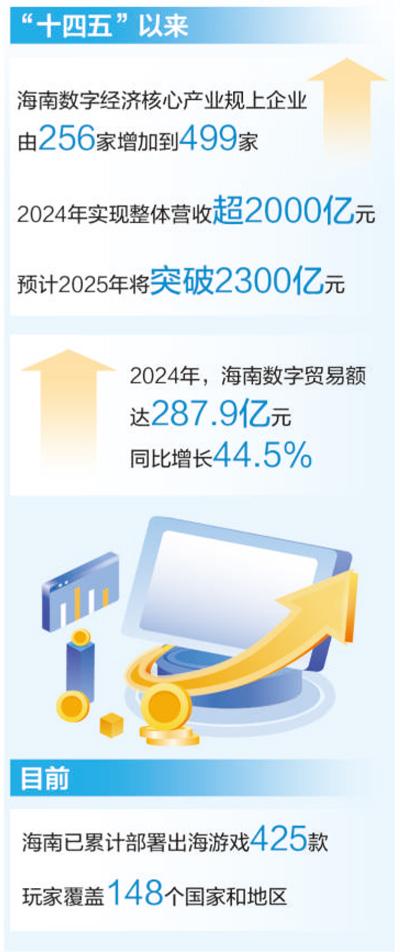
“十四五”以来,数字经济核心产业规上企业由256家增加到499家 海南数字经济跑出特色赛道(大数据观察)
Ren Min Ri Bao· 2026-01-14 22:13
Core Insights - Hainan's digital economy is rapidly developing, with the number of core industry enterprises increasing from 256 to 499 since the start of the 14th Five-Year Plan, and projected revenues exceeding 200 billion yuan in 2024 and 230 billion yuan in 2025 [1][2] Group 1: Digital Infrastructure - Hainan has established a robust digital infrastructure, including the completion of undersea cables that significantly reduce latency for international data transfer, enhancing the efficiency of businesses in the region [2][4] - The first commercial underwater data center is operational, providing a 40% increase in energy efficiency compared to land-based data centers, addressing global high-energy consumption challenges [4] Group 2: Digital Trade and Services - The digital trade volume in Hainan is expected to reach 28.79 billion yuan in 2024, marking a 44.5% year-on-year increase, driven by advancements in digital services and infrastructure [4] - Hainan's game export public service platform has facilitated the launch of 201 games, with over 10 million overseas registered users, streamlining the process for small teams to enter international markets [5][6][7] Group 3: Policy and Regulatory Environment - Hainan's transparent regulatory framework is a significant draw for businesses, with ongoing innovations in free trade policies aimed at ensuring the secure and orderly flow of data [8][9] - The establishment of a negative list for data export management has simplified compliance for companies, reducing operational costs and attracting both domestic and foreign investments [8][9] Group 4: Future Prospects - Hainan is set to officially close its borders on December 18, 2025, marking a new phase of development that will further enhance financial policies and facilitate easier capital flow for small and medium enterprises [9]
服务业开放提速!宁波、合肥、苏州纳入试点
Guo Ji Jin Rong Bao· 2026-01-13 16:34
Core Viewpoint - The Chinese service industry is accelerating its opening up, with a broader range of benefits, as the Ministry of Commerce has issued a comprehensive pilot task for nine cities, including three in the Yangtze River Delta region, enhancing regional integration and development [1][2]. Group 1: Expansion of Pilot Cities - The number of pilot cities in the Yangtze River Delta has reached six, with the inclusion of Ningbo, Hefei, and Suzhou, which fills key gaps in the regional open layout and forms a comprehensive open network [2][3]. - By the end of 2024, the actual foreign investment in the service sector is projected to reach 8,262.5 billion yuan, with the service industry accounting for 7,845.6 billion yuan, representing over 70% of total foreign investment [2]. Group 2: Regional Economic Development - The expansion of service industry pilot programs is seen as a crucial engine for high-quality regional economic development, particularly in the Yangtze River Delta, which is one of the most active and open regions in China [3][4]. - The pilot program encourages cities to develop unique tasks based on their strengths, fostering a complementary open structure among the cities [4]. Group 3: City-Specific Strategies - Ningbo, leveraging its world-class port resources, focuses on technology services, digital trade, and international shipping, aiming to attract high-end manufacturing enterprises and enhance its cross-border trade environment [4][5][6]. - Hefei is positioned as a regional technology innovation hub, concentrating on reforms in the technology service sector to support high-tech achievements and deepen integration with advanced manufacturing [6][7]. - Suzhou aims to integrate modern services with advanced manufacturing, particularly in the biopharmaceutical sector, and explore mechanisms for efficient and secure cross-border data flow [7][8]. Group 4: Collaborative Development - The inclusion of these three cities in the pilot program is a significant milestone for collaborative opening in the Yangtze River Delta, promoting a multi-layered, differentiated, and high-level open structure [9][10]. - The cities are expected to complement each other, with Hefei focusing on high-tech services, Ningbo on manufacturing and export trade, and Suzhou on service outsourcing, enhancing the overall competitiveness of the region [9][10]. Group 5: National Economic Implications - The pilot exploration in these three cities will support the construction of a higher-level open economy in China, improving international competitiveness and attracting quality foreign investment and talent [11].
影响市场重大事件:四川拟加密北斗卫星导航定位基准站,推进北斗高精度位置服务的应用;工信部印发《推动工业互联网平台高质量发展行动方案(2026—2028年)》
Mei Ri Jing Ji Xin Wen· 2026-01-13 08:52
Group 1 - Sichuan plans to enhance the Beidou satellite navigation positioning reference station network to improve service coverage and accuracy, supporting applications in e-commerce, logistics, precision agriculture, platform economy, and intelligent connected vehicles [1] - The Ministry of Commerce emphasizes expanding pilot programs for value-added telecommunications and foreign-funded hospitals during the 14th Five-Year Plan, aiming for greater openness in service sectors [2][8] - The Ministry of Industry and Information Technology (MIIT) has issued an action plan for the high-quality development of industrial internet platforms from 2026 to 2028, targeting over 450 influential platforms and connecting more than 120 million industrial devices by 2028 [3][6] Group 2 - Jiangsu's "Artificial Intelligence+" action plan aims to enhance biopharmaceutical R&D capabilities by promoting AI applications in drug target screening and molecular design, and establishing a public service platform for small and medium enterprises [4] - The plan also supports the development of an "one-person company" (OPC) model in AI innovation and entrepreneurship, focusing on creating a technology and service system driven by model and data services [5] - By 2030, Jiangsu aims for a 90% penetration rate of intelligent applications and an AI industry scale exceeding 1 trillion yuan, positioning intelligent economy as a key growth driver [7][8] Group 3 - A research team from the Chinese Academy of Sciences has made significant progress in the development of high-performance sodium-ion battery cathode materials, achieving rapid sodium ion transport and excellent cycling stability through a multi-scale modification strategy [9]
商务部部署今年重点工作 深入实施提振消费专项行动居首位
Jing Ji Ri Bao· 2026-01-12 07:48
Group 1 - The core focus of the national business system for 2026 includes eight key areas: consumption, circulation, trade, foreign investment, alignment with international rules, outbound investment, economic and trade cooperation, and risk prevention [1][2] - The first priority is to implement actions to boost consumption, including creating the "Buy in China" brand, fostering new growth points in service consumption, optimizing the old-for-new policy for consumer goods, and enhancing the international consumption environment [1] - The meeting emphasizes the construction of a unified national market, improving the modern market and circulation system, and promoting the integration of domestic and foreign trade [1] Group 2 - To promote trade innovation, the meeting aims to enhance the "Export China" brand by upgrading goods trade, developing service trade, and encouraging service exports [1] - The initiative to enhance the "Invest in China" brand includes expanding service sector openness, improving investment promotion levels, and establishing a robust foreign investment service guarantee system [1] - The meeting also outlines specific measures for aligning with international high-standard economic and trade rules, effectively managing outbound investment, deepening bilateral and multilateral economic cooperation, and preventing and mitigating risks [2]
锐财经丨服务业扩大开放“路线图”上新
Ren Min Ri Bao Hai Wai Ban· 2026-01-12 03:44
Core Viewpoint - The expansion of China's service industry opening-up pilot program is accelerating, with the recent issuance of a roadmap for nine cities, indicating a significant push towards enhancing service sector openness and reform [1][2]. Group 1: Pilot Program Achievements - The national service industry opening-up pilot program has shown remarkable results since its initiation in 2015, with 412.6 billion USD in foreign investment absorbed by 11 provinces and cities in 2024, accounting for 50.2% of the national total in the service sector [2]. - The new pilot cities are expected to promote service industry openness, with the central economic work conference emphasizing the need for orderly expansion of self-initiated openness in the service sector [2]. Group 2: Differentiated Exploration - The pilot cities are encouraged to develop tailored tasks based on their unique resources and industrial strengths, fostering innovation and complementary achievements [3]. - For instance, Ningbo is focusing on technology services and digital trade, while Dalian aims to leverage its position as an international shipping center to support the revitalization of Northeast China [3][4]. Group 3: Project Implementation for Regional Development - The pilot program aims to facilitate regional development through the implementation of specific projects, with the Ministry of Commerce emphasizing the importance of practical execution and coordination among departments [6][7]. - The Ministry will enhance communication with business entities and conduct evaluations of the pilot program's effectiveness to promote high-quality experiences and innovations [7].
服务业扩大开放“路线图”上新
Ren Min Ri Bao Hai Wai Ban· 2026-01-12 02:12
Core Viewpoint - The Chinese service industry is experiencing accelerated opening and expansion, with the recent issuance of a roadmap for comprehensive pilot projects in nine cities, aimed at enhancing foreign investment and promoting reform and development in the service sector [4][8]. Group 1: Pilot Project Implementation - The comprehensive pilot project for service industry opening has shown significant results since its initiation in 2015, with 412.6 billion USD in foreign investment absorbed by 11 provinces and cities in 2024, accounting for 50.2% of the national total in the service sector [4][8]. - The new pilot cities, including Dalian, Ningbo, and others, are encouraged to implement common tasks from the previously issued plan while also developing unique tasks based on their regional advantages and industry characteristics [4][5]. Group 2: Regional Differentiation and Focus Areas - The pilot cities are urged to adopt differentiated exploration strategies tailored to their unique resources and industrial foundations, promoting innovation and collaboration across regions [5]. - Specific support is provided to various cities: Ningbo is focusing on advanced manufacturing and cross-border trade, Dalian is enhancing its role in Northeast revitalization, and other cities are targeting areas such as cultural trade, marine technology, and biomedicine [6][7]. Group 3: Consumer Trends and Policy Implementation - There is a notable shift in consumer behavior from physical goods to service consumption, necessitating further opening of the service sector to cultivate new growth drivers and enhance international competitiveness [8]. - The Ministry of Commerce plans to strengthen communication with business entities, provide targeted policy guidance, and evaluate the effectiveness of pilot projects to ensure successful implementation and promote high-quality development in the service industry [9].

服务业扩大开放“路线图”上新(锐财经)
Ren Min Ri Bao Hai Wai Ban· 2026-01-11 23:00
Core Insights - The article discusses the acceleration of service industry opening in China, particularly through the implementation of a comprehensive pilot program in nine cities, including Dalian, Ningbo, and Suzhou, aimed at enhancing foreign investment and promoting various service sectors [4][5][9]. Group 1: Pilot Program Overview - The pilot program for expanding service industry openness has been significantly effective since its initiation in 2015, with 412.6 billion USD in foreign investment absorbed by 11 provinces and cities in 2024, accounting for 50.2% of the national total in the service sector [5][9]. - The latest pilot program, outlined by the Ministry of Commerce, aims to further enhance the role of the nine cities by implementing common tasks and encouraging tailored initiatives based on local advantages [5][6]. Group 2: City-Specific Initiatives - Each of the nine pilot cities is encouraged to develop unique tasks that leverage their specific resources and industrial strengths, focusing on key service areas such as telecommunications, healthcare, and finance [6][8]. - For instance, Suzhou will explore the import of biomedical research materials, while Shenzhen will optimize its free trade account functions [8][9]. Group 3: Expected Outcomes and Future Directions - The shift in consumer behavior from goods to services necessitates the expansion of service industry openness to cultivate new growth drivers and enhance international competitiveness [9][10]. - The Ministry of Commerce plans to strengthen communication with businesses, provide targeted policy guidance, and evaluate the effectiveness of the pilot programs to ensure successful implementation and regional development [10].

广东出台18条实施意见 推动贸易高质量发展
Zhong Guo Jing Ying Bao· 2026-01-06 09:09
Group 1: Core Views - The Guangdong Provincial Government has released implementation opinions to promote high-level openness in digital trade and service trade, outlining 18 specific measures to drive development in these areas [1][2]. Group 2: Development of Digital Trade - The opinions emphasize the promotion of high-quality service imports in sectors such as healthcare and cultural entertainment, including hosting international film exhibitions and cultural exchange activities [1]. - Support is provided for the establishment of digital trade empowerment centers and comprehensive service platforms in cities like Guangzhou and Nansha, as well as the creation of national service trade innovation development demonstration zones [1]. - Initiatives include the construction of a digital trade port in Dongguan and the implementation of cross-border management trials for research data in Hengqin [1]. Group 3: Innovation in Service Trade - The opinions encourage the establishment of foreign-invested hospitals in cities like Guangzhou and Shenzhen, and the development of legal service clusters [2]. - There is a focus on expanding the import of urgently needed productive services and promoting the development of digital creative and cultural industries in designated cultural export bases [2]. Group 4: International Market Expansion - The "Global Service Trade" plan aims to organize enterprises to participate in domestic and international digital trade and service trade exhibitions to expand their international market presence [2]. - Support is also provided for the establishment of a service outsourcing distribution center in Zhuhai [2]. Group 5: Strengthening Support Systems - The opinions propose the use of diversified financial tools, such as trade finance and equity investment, to support enterprises in exploring international service trade markets [3]. - The implementation of the "Youyue Card" policy aims to facilitate entry and exit for qualified foreign high-level talents [3]. - There is a call for the establishment of a digital trade certification system and the promotion of patent "open licensing" to enhance support for small and micro enterprises [3].
铁幕的终结:CCKS重塑全球自由贸易与数字金融新纪元
Zhong Guo Jin Rong Xin Xi Wang· 2026-01-06 08:36
Core Insights - The global trade and financial system is at a historic crossroads, with the digital revolution reshaping industry and finance, making cross-border data flow the "new oil" driving international trade growth [1][2] - The traditional centralized Public Key Infrastructure (PKI) is increasingly seen as a barrier to the free flow of data, revealing structural flaws that hinder global digital trade [2][4] - A shift towards a decentralized trust model, exemplified by China's CCKS technology, is essential for establishing a new digital infrastructure that ensures data security and respects national sovereignty [3][9] Group 1: Trust Crisis in Global Trade - The centralized PKI system, reliant on a few Certificate Authorities (CAs), is facing structural challenges, including high operational costs and vulnerability to geopolitical influences [2][4][7] - The complexity and cost of maintaining trust chains in cross-border transactions are exacerbated by the reliance on a centralized model, leading to systemic risks [6][8] - The concentration of trust in a few entities creates significant risks, as evidenced by past security breaches that have compromised global trust [6][7] Group 2: Paradigm Shift with CCKS Technology - CCKS represents a revolutionary shift in digital trust, moving from centralized trust institutions to algorithm-based trust, which enhances security and reduces costs [3][9] - The CCKS system provides a unique digital identity for all entities, ensuring authenticity and integrity in data exchanges, thus laying the foundation for a new digital economy [9][10] - CCKS promotes an "inherent security" approach, enabling secure data transactions even in offline scenarios, which is crucial for maintaining trade continuity [10][12] Group 3: Evolution of International Standards - Historically, international standards in the digital domain have been dominated by Western countries, creating a "standard hegemony" that limits the participation of emerging economies [14][15] - China's initiative to develop a series of ISO standards in digital fields aims to create a more balanced international standard system, reflecting diverse needs and enhancing global cooperation [16][20] - These standards, based on CCKS technology, facilitate secure and efficient data flow, providing a framework for global digital trade and addressing long-standing issues of trust and efficiency [22][24] Group 4: Restructuring Digital Financial Infrastructure - Traditional financial infrastructures face challenges such as high transaction costs and exclusion of unbanked populations, necessitating a new approach to digital finance [26][27] - CCKS technology addresses these challenges by enabling secure, low-cost digital wallets and payment networks that can operate efficiently in various environments [33][36] - The integration of CCKS with advanced technologies allows for the creation of a robust digital currency platform that meets the demands of modern trade while ensuring security and inclusivity [38]