奢侈品

Search documents
大行评级丨瑞银:普拉达第三季业绩短期内未能提振投资者情绪 目标价74港元
Ge Long Hui· 2025-10-27 02:31
Core Viewpoint - UBS reports that Prada's third-quarter sales exceeded expectations, with total sales of €1.33 billion and an organic sales growth (OSG) of 9%, both surpassing market consensus [1] Group 1: Sales Performance - Prada's total sales for the third quarter reached €1.33 billion [1] - The organic sales growth (OSG) for the same period was 9%, indicating strong performance [1] Group 2: Market Position and Outlook - Despite the strong third-quarter sales, the growth momentum in retail for Prada is considered moderate compared to peers that have reported results [1] - UBS does not expect this performance to significantly boost investor sentiment in the short term [1] Group 3: Investment Rating - UBS maintains a 12-month target price for Prada at HK$74 and rates the stock as "Buy" [1]

港股异动 | 普拉达(01913)涨超4% 三季度零售销售大致符合市场预期 核心品牌中国市场环比改善
智通财经网· 2025-10-27 01:43
Core Viewpoint - Prada's retail sales for Q3 2025 met market expectations, showing a year-on-year growth of 7.6% at constant exchange rates, with the Prada and Miu Miu brands performing in line with expectations [1] Sales Performance - Prada's retail sales decreased by 0.8% year-on-year, while Miu Miu's sales increased by 29% year-on-year [1] - Over a two-year period, both brands demonstrated stable quarterly performance, with Prada's core brand showing a year-on-year growth of 1% in both Q2 and Q3 of this year, and Miu Miu showing significant growth of 136% and 134% respectively [1] Market Insights - The Chinese market for Prada's core brand is still experiencing negative growth, but there has been a quarter-on-quarter improvement in Q3 [1] - Positive growth was observed in the Americas, Europe, and Japan, driven by strong local demand and slightly improved tourism demand [1] - Management believes that the worst period in China has passed, and sales have continued to improve since October [1] Future Outlook - The management cautioned that the fourth quarter will be challenging due to tough comparisons, and the last six weeks of the year will be crucial for performance [1]
标的注册资本仅1万港元且未营业 老凤祥为何按估值1.26亿美元收购2000股?
Mei Ri Jing Ji Xin Wen· 2025-10-26 14:28
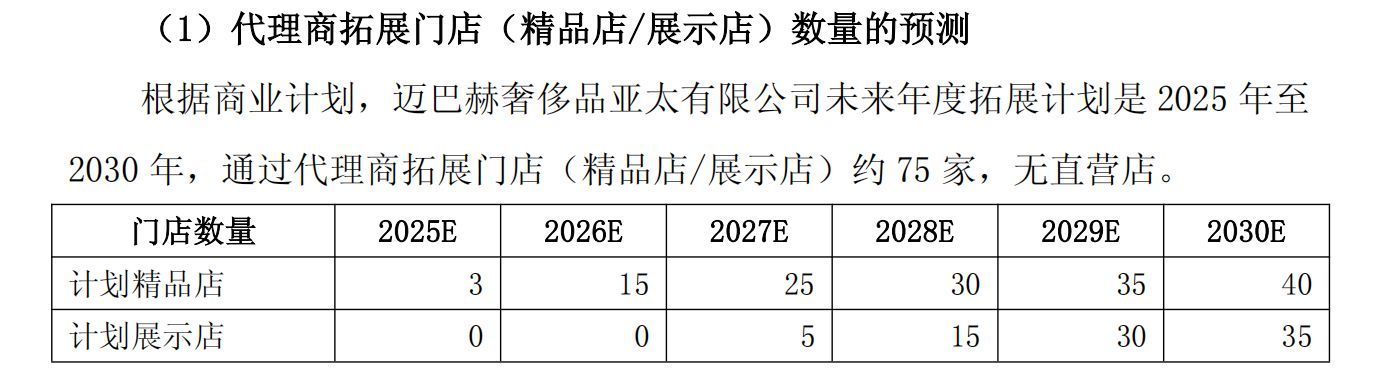
Core Viewpoint - The acquisition of a minority stake in Maybach Luxury Goods Asia Pacific (MAP) by Lao Feng Xiang for $24 million raises questions about the necessity and rationale behind such a high premium valuation, especially since MAP has not yet commenced operations and was only established in February of this year [1][2][5]. Group 1: Acquisition Details - Lao Feng Xiang plans to invest $24 million to acquire 20% of MAP through its subsidiary, Lao Feng Xiang Hong Kong Limited, with the goal of expanding into the luxury market [2]. - The Shanghai Stock Exchange has raised concerns regarding the high premium valuation of MAP, which is reported to have an extraordinary valuation increase of 9,692,207.69% [1][5]. - MAP aims to open 75 stores within six years, leveraging the brand's existing global presence in 75 countries and a compound annual growth rate of 36.5% over the past four years [3][6]. Group 2: Market and Operational Risks - Lao Feng Xiang acknowledges potential risks associated with buyout-style procurement, including unsold inventory and the stability of brand licensing [3][4]. - Cultural differences, market competition, and changing consumer demands are identified as factors that could negatively impact future operations [3][4]. - The investment agreement does not include installment payment terms, which Lao Feng Xiang claims is to mitigate risks associated with transaction completion [4]. Group 3: Valuation Methodology - The valuation report indicates that MAP's equity value is estimated at $126 million using the income approach, with a significant valuation premium compared to its book value of $1,300 [5][6]. - Lao Feng Xiang defends the use of the income approach for valuation, citing the brand's established market presence and the structured distribution model that mitigates retail risks [6][7]. - Experts highlight that the high valuation may reflect the brand's luxury status and the potential growth in the Asia-Pacific luxury market, but caution against the risks of brand value collapse [8].

纺织服饰:专题:奢侈品集体改善
Huafu Securities· 2025-10-26 10:17
Investment Rating - The report maintains an "Outperform" rating for the luxury goods sector [7]. Core Insights - The luxury goods sector is showing signs of recovery, particularly in the Greater China region, with brands reporting varying degrees of improvement in Q3 2025 compared to Q2 [2][3]. - LVMH's Q3 2025 revenue grew by 1% year-on-year to €18.28 billion, with significant improvement in the Chinese market [3][18]. - Hermes reported a 9.6% year-on-year revenue increase in Q3 2025, with growth across all regions [4][24]. - Kering's revenue decline narrowed significantly to 5% year-on-year in Q3 2025, indicating a recovery trend [5][28]. Summary by Sections Luxury Goods Performance - LVMH's revenue in Q3 2025 showed a year-on-year increase of 1%, driven by fashion and leather goods, with notable recovery in the Chinese market [3][18]. - Hermes achieved a revenue of €3.9 billion in Q3 2025, with a 9.6% year-on-year growth, outperforming analyst expectations [4][24]. - Kering's Q3 2025 revenue was €3.42 billion, reflecting a 10% decline year-on-year, but an improvement from previous quarters [5][28]. Regional Performance - In Asia (excluding Japan), LVMH, Hermes, and Kering reported year-on-year revenue changes of +2%, +6%, and -16%, respectively, indicating a mixed recovery across brands [2][3]. - Hermes experienced strong growth in Japan, with a 13.8% increase, while the Americas saw a 14.1% growth [4][24]. Brand-Specific Insights - LVMH's organic revenue growth varied by region, with the U.S. and Asia (excluding Japan) showing improvements of +3% and +2%, respectively [3][18]. - Kering's brands, including Gucci and YSL, reported declines of -14% and -4%, respectively, in Q3 2025, but showed signs of recovery compared to previous quarters [5][28].
居民存款终于离开了银行,但没去消费、没有购房,甚至没流入实体
Sou Hu Cai Jing· 2025-10-26 06:15
Core Insights - The article discusses the paradox of rising household savings in China alongside declining demand for loans and housing, creating significant pressure on banks [1][3][4] Group 1: Deposit Trends - Household deposits increased by 11.28 trillion yuan in the first ten months of the year, but there was a sharp decline of 570 billion yuan in October alone, indicating a puzzling outflow of funds [3][4] - Despite the drop in deposit rates to historical lows, the outflow of funds has not significantly boosted consumer spending or real estate transactions [3][4][6] Group 2: Consumer Market and Real Estate - The consumer market remains sluggish, with no explosive growth in demand for sectors like automobiles and luxury goods, suggesting that the outflow of deposits has not translated into increased consumer spending [4][6] - The real estate market continues to see falling prices with no clear signs of recovery, leading to a lack of investment from household savings into property [6][12] Group 3: Investment Shifts - Many savers are turning to higher-yield financial products, with bank wealth management products offering expected returns of 2.92% compared to a mere 1.65% for one-year fixed deposits, indicating a shift towards more rational investment strategies [9][12] - The A-share market has seen a significant rise, with indices climbing from 2,700 to 3,400 points, attracting substantial capital inflows from households seeking better returns [11][13] Group 4: Mortgage Prepayment Trends - A trend of early mortgage repayment is emerging, as borrowers seek to refinance at lower rates, contributing to the outflow of household deposits from banks [12]

名校校服“撞衫”LV万元大衣?中国官网已下架,网友:86元享同款
Xin Lang Cai Jing· 2025-10-25 05:29
Core Insights - The recent "clothing clash" between a LV coat priced at 16,000 yuan and a school uniform from Changjun High School highlights challenges faced by the LV brand in the Chinese market [2][3][8] - The LV coat is no longer available on the Chinese website and is sold out in most sizes on the overseas site, indicating a potential supply issue or declining demand [2][7] - The school uniform, referred to as "Panda uniform," is available for as low as 86 yuan, showing a stark contrast between luxury pricing and affordable options [2][7] Financial Performance - LVMH reported a 4% decline in total revenue to 39.81 billion euros for the first half of 2025, with a 15% drop in operating profit and a 22% decrease in net profit [8] - The fashion and leather goods segment, which includes LV, saw a 7% decline in organic revenue for the first half of the year, with a 9% drop in the second quarter [8] - The Asia region (excluding Japan) experienced a 9% decline in organic revenue for the first half of 2025, although there was a slight recovery with a 2% growth in the third quarter [8][9] Market Dynamics - The Chinese market, a significant area for LVMH, has shown a decline in consumer confidence, impacting luxury goods sales [9][10] - Cross-border shopping trends, influenced by factors like currency fluctuations, have diverted some consumer spending away from domestic markets [9] - LVMH is actively adjusting its strategies in China, including innovative marketing initiatives to stimulate consumer interest [10]

普拉达(01913.HK):3Q25收入稳健增长 美洲和中国内地加速
Ge Long Hui· 2025-10-24 19:40
Company Update - Prada Group reported a 3Q25 revenue update with a year-on-year growth of +9% at constant exchange rates (CER), or +4% at reported exchange rates, reaching €1.33 billion, slightly above FactSet consensus estimate of €1.31 billion [1] - Retail revenue for 3Q25 showed a decline in Prada brand revenue (-1%) but improved compared to 2Q25 (-4%), while Miu Miu brand revenue grew by +29% despite a high year-on-year base (3Q24: +105%) [1] - In the Asia-Pacific region excluding Japan, revenue grew by +10%, with improved sales trends in mainland China, while the Americas saw a +20% growth, accelerating from +14% in 2Q25 [1] - For the first nine months of 2025, group revenue increased by +9%, driven by same-store full-price sales, with limited contribution from retail space expansion, impacted by approximately 260 basis points of foreign exchange headwinds [1] Comments - The company has ample room for revenue growth and margin expansion through category expansion, including jewelry and beauty products, which are still in early growth stages for both Prada and Miu Miu [1] - Continuous innovation in leather goods, particularly for Miu Miu, may lead to potential best-selling products [1] - Store network upgrades are focused on creating high-specification, high-efficiency flagship stores while streamlining long-tail stores [1] - Caution is advised regarding changes in the competitive landscape, as new designer products from brands like Dior, Chanel, Gucci, and Celine are set to launch in 1H26 [1] Profit Forecast and Valuation - Due to foreign exchange headwinds, revenue and EBIT forecasts for 2025 have been reduced by 6.1% and 6.9% to €5.731 billion and €1.359 billion, respectively [2] - The net profit forecast for 2025 has been lowered by 7.5% to €880 million, reflecting higher financial costs associated with additional loans from the Versace acquisition [1][2] - For 2026, revenue forecasts have been cut by 9.6% to €6.155 billion, with EBIT and net profit forecasts reduced by 13.2% and 14.1% to €1.492 billion and €976 million, respectively, due to increased competition and rising costs [2] - The valuation has shifted to be based on the 2026 net profit forecast, maintaining an outperform rating and a target price of HKD 75, corresponding to a 21.1x 2026 P/E ratio, with a 62.0% upside potential from the current stock price [2]
年轻人开始反向消费,开始“六戒”,说明什么?如何影响经济?
Sou Hu Cai Jing· 2025-10-24 16:34
Core Insights - The article highlights a significant shift in consumer behavior among the younger generation, particularly those born after 1995, who prioritize practicality and cost-effectiveness over brand prestige and luxury items [1][3][19] Group 1: Changing Consumer Preferences - The younger generation is increasingly adopting a mindset of "reverse consumption," focusing on essential spending and avoiding unnecessary expenses, which is reflected in their "six abstentions" lifestyle [3][7] - There is a notable decline in the sales of luxury brands, with Gucci's sales dropping by 51% and LV's overall revenue decreasing by 2% [5] - Domestic brands like Hongxing Erke and Anta are gaining popularity due to their affordability and practicality, surpassing international brands in sales and viewership [5][17] Group 2: Economic Context - The economic conditions faced by the current generation differ significantly from those experienced by previous generations, with many young people earning around 5,000 yuan monthly, leading to a focus on reducing non-essential spending [9][12] - The article references the Kondratiev wave theory, indicating that the current economic climate is in a downturn phase, impacting young people's financial stability and spending habits [10][12] Group 3: Societal Implications - The trend of reduced spending is contributing to lower marriage and birth rates, with marriage registrations dropping by 20.5% year-on-year, indicating a shift in societal norms and priorities [15] - The emphasis on sustainability and practicality is leading to a rise in interest in shared, rental, and second-hand markets, as well as eco-friendly products [17][19] - While the immediate economic impact of this shift may appear negative, it is seen as a step towards a more sustainable and responsible consumption model, promoting environmental awareness [19]
“吃饭像穷人,穿戴像富人”韩国年轻人穷得剩下奢侈品了?
Sou Hu Cai Jing· 2025-10-24 13:55
Market Overview - The luxury goods market in South Korea is experiencing significant growth, with sales from the three major department stores increasing by 7.2% and jewelry sales soaring by 12.5% in the first half of 2025 compared to the previous year [2] - The luxury fashion market is projected to reach $5.2 billion in 2024, with an expected compound annual growth rate of 2.74% from 2025 to 2035, potentially reaching $7 billion [4] - Young consumers aged 20 to 30 account for 31% of luxury goods sales, a 4 percentage point increase from the previous year [4] Consumer Behavior - The MZ generation (those born from the 1980s to the early 2000s) is driving the demand for entry-level luxury products, with a slight price increase of 2% to 3% overall [2] - Social media platforms like Instagram and TikTok play a crucial role in influencing purchasing decisions, with 58% of the MZ generation discovering new products through these channels [6] - The second-hand luxury market is also thriving, with an estimated size of $31.2 billion, and over 40% of transactions involving young consumers [6] Economic Context - Despite the booming luxury market, young South Koreans face significant economic challenges, including high unemployment rates and rising housing costs [12][14] - The average monthly income for young workers is around 2.8 million KRW, with a substantial portion of their income going towards rent, leaving little for discretionary spending [14][18] - The pressure to maintain a certain lifestyle leads to a tendency to prioritize luxury purchases over essential needs, with a low guilt rate of 4% regarding high-end spending [16] Debt and Financial Risks - Household debt in South Korea reached 1,952.8 trillion KRW in the second quarter of 2025, with individuals under 39 years old averaging over 110 million KRW in debt [20] - The delinquency rate stands at 3.2%, with young people experiencing the highest rates of overdue payments [20] - The increasing reliance on luxury goods as a means of social status and self-expression may lead to unsustainable financial practices among young consumers [22] Potential Solutions - The government is implementing measures to address youth unemployment, including job subsidies and increasing public rental housing [22][24] - Companies are encouraged to create more entry-level job opportunities and provide training programs to enhance long-term employment prospects for young people [22][24] - There is a need for a cultural shift towards more balanced consumption patterns, drawing lessons from other countries like China, which emphasizes rational spending and long-term planning [24]

标的注册资本仅1万港元且未营业,老凤祥为何按估值1.2亿美元收购2000股?
Mei Ri Jing Ji Xin Wen· 2025-10-24 11:31
Core Viewpoint - The investment by Lao Feng Xiang in the luxury brand Maybach Asia Pacific (MAP) has raised concerns due to the high valuation of nearly 10 million times, despite MAP not yet commencing operations [1][6]. Group 1: Investment Details - Lao Feng Xiang plans to invest $24 million (approximately 170 million RMB) to acquire a 20% stake in MAP through its subsidiary [2]. - MAP was established in February this year with a registered capital of 10,000 HKD, focusing on luxury goods rather than Maybach automobiles [2]. - The company aims to open 75 stores within six years, with a projected average purchase amount exceeding $2 million per store in the Asia-Pacific region [3][4]. Group 2: Valuation Concerns - The valuation of MAP is reported at $126 million, with a staggering increase of 9,692,207.69% from its book value of $1,300 [6][8]. - Lao Feng Xiang justifies the high valuation using the income approach, citing a compound annual growth rate of 36.5% for Maybach luxury goods over the past four years [3][9]. - There is skepticism regarding the necessity and reasonableness of acquiring a high-priced minority stake in a company that has not yet begun operations [1][6]. Group 3: Market Risks - Concerns have been raised about potential risks associated with unsold inventory due to the buyout procurement model, as well as cultural and market differences impacting operations [4][11]. - Experts warn that the greatest risk in brand-licensed valuations is the potential collapse of the brand's value [11]. - Lao Feng Xiang has retained a valuation adjustment clause in the investment agreement to protect its interests [10].