
银行理财

Search documents
近三成理财产品近一周收益为负,破净率上升
2 1 Shi Ji Jing Ji Bao Dao· 2025-08-26 10:07
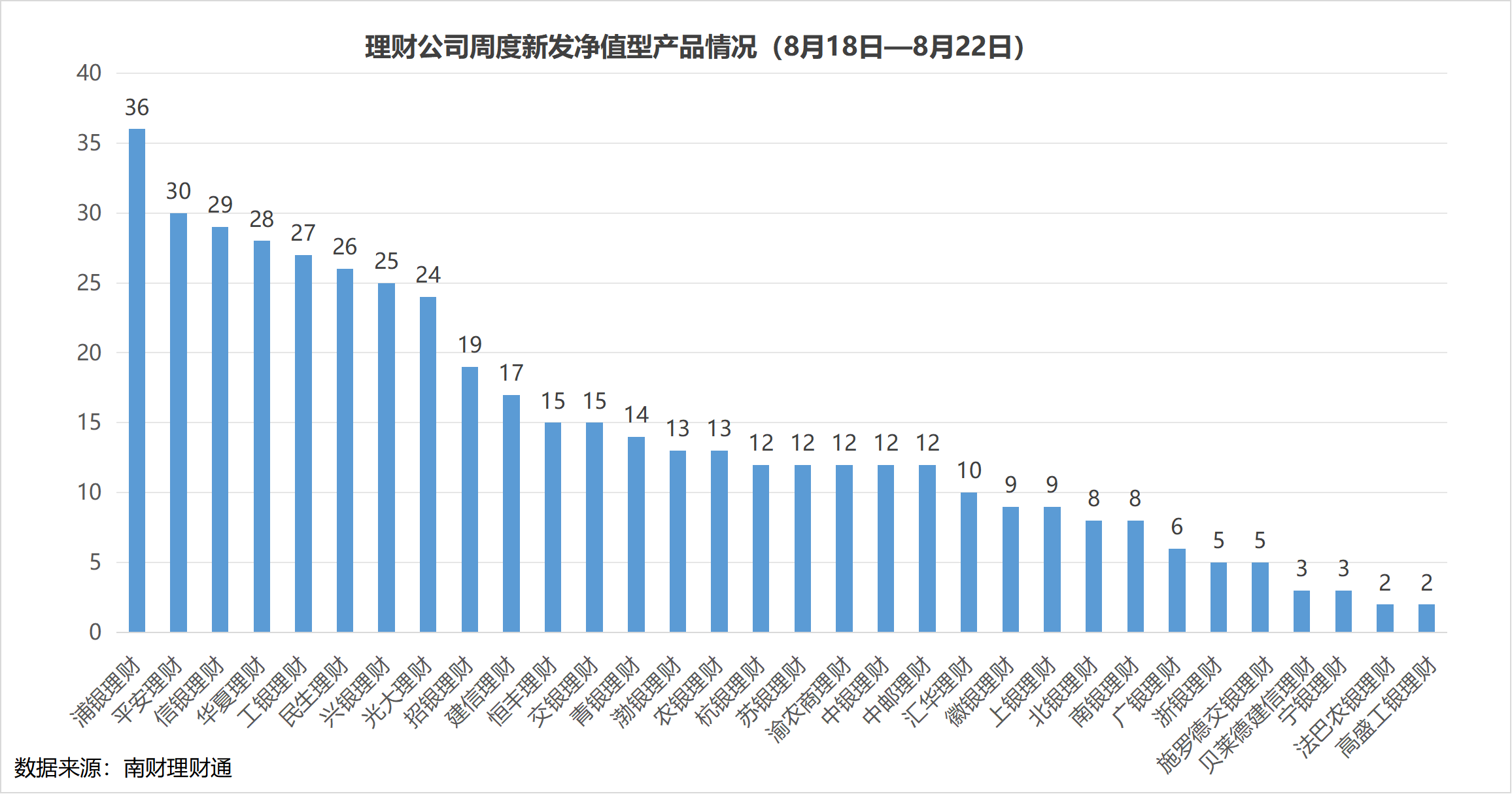
Market Overview - The A-share market saw significant gains last week, with the Sci-Tech Innovation 50 Index, Northbound 50 Index, and ChiNext Index rising by 13.31%, 8.4%, and 5.85% respectively, while the bond market experienced a general pullback [2] - The overall funding environment remained stable, with the weighted average price of DR007 at 1.467% and the yield on 10-year government bonds closing at 1.78% [2] Product Performance - The number of products below par is low, but the rate of products below par has increased, with a total of 25,444 public wealth management products, of which 316 have a cumulative net value below 1, resulting in a comprehensive par rate of 1.24% for bank wealth management [3] - The par rate for fixed income public wealth management products is 1.03%, while equity and mixed products have par rates of 28.57% and 4.5% respectively [3] New Product Issuance - A total of 461 wealth management products were issued by 32 wealth management companies from August 18 to August 22, with the highest issuance from joint-stock banks, including 36 from Ping An Wealth Management and 30 from Shanghai Pudong Development Bank Wealth Management [5] - New products primarily consist of R2 (medium-low risk), closed-end net value type, and fixed income public products, with only 5 mixed products issued and no new equity or derivative products [7] Product Pricing - There was a divergence in pricing for short-term and long-term products, with short-term products maintaining or slightly increasing their pricing, while long-term products saw a decline, particularly those with a maturity of over 3 years, which decreased by 40 basis points to 2.15% [7] Revenue Trends - Fixed income wealth management yields continued to decline, with an average net value growth rate of 0.0252% for fixed income products, while mixed and equity products had average growth rates of 0.2489% and 2.2894% respectively [10] - The highest weekly yield for fixed income products was observed in those with a maturity of less than 1 month, averaging a net value growth rate of 0.0424% [10] Cash Management Products - The average annualized yield for cash public wealth management products in RMB, USD, and AUD was 1.334%, 3.900%, and 2.84% respectively, with an increase in the proportion of negative yield products, particularly in fixed income categories [13] - Approximately 28.92% of RMB public wealth management products reported negative returns last week, with the highest proportion of negative yield products being those with a maturity of over 3 years at 48.84% [13] Industry Trends - Wealth management companies are increasingly partnering with rural commercial banks to tap into the growing wealth management demand in lower-tier cities, with over 35 rural commercial banks collaborating with various wealth management subsidiaries [15] - The focus on providing comprehensive service support beyond just products is emphasized for effective engagement with small and medium-sized banks [15] Company Performance - Ping An Wealth Management reported a net profit of 700 million RMB for the first half of 2025, with total assets of 13.548 billion RMB and a net asset value of 13.174 billion RMB, while the balance of managed wealth management products decreased by 4.47% compared to the end of the previous year [16]

周报 | 近三成理财产品近一周收益为负,破净率上升
2 1 Shi Ji Jing Ji Bao Dao· 2025-08-26 09:57
Market Overview - The A-share market saw strong gains last week, with the Sci-Tech Innovation 50 Index, Northbound 50 Index, and ChiNext Index rising by 13.31%, 8.4%, and 5.85% respectively, while the bond market experienced a correction [2] - The overall funding environment remained stable, with the weighted average price of DR007 at 1.467% and the yield on 10-year government bonds closing at 1.78% [2] Product Performance - The number of products below par is low, but the rate of products below par has increased, with a total of 25,444 public wealth management products, of which 316 have a cumulative net value below 1, resulting in a comprehensive par rate of 1.24% [3] - The par rates for equity and mixed wealth management products are 28.57% and 4.5% respectively, while fixed income public wealth management products have a par rate of 1.03% [3] - Fixed income products with maturities of over 3 years and 1-2 years have higher par rates of 3.98% and 2.27% respectively [3] New Product Issuance - A total of 461 wealth management products were issued by 32 wealth management companies from August 18 to August 22, with the highest issuance from joint-stock banks [4] - The newly issued products are primarily R2 (medium-low risk), closed-end net value type, and fixed income public products, with only 5 mixed products and no new equity or derivative products [4] - Short-term products (less than 6 months) saw stable or slightly rising pricing, with 1-3 month products increasing by 55 basis points to an average pricing of 2.81%, while products over 6 months saw a decline [4] Product Strategy - Several wealth management companies issued dividend strategy products, with a focus on fixed income products benefiting from policy guidance and low interest rates [5] - The overall performance of dividend assets has shown a "slight rise and differentiation" trend, with traditional banking and port sectors performing well [5] - Market experts believe that the pricing logic for dividend assets is shifting from defensive attributes to fundamental improvements, highlighting the importance of supply constraints and policy catalysts [5] Yield Situation - Fixed income product yields continued to decline, with short-term products performing relatively well, showing an average net value growth rate of 0.0252% for fixed income products [6] - Mixed and equity products had average net value growth rates of 0.2489% and 2.2894% respectively, with the highest yield for fixed income products under 1 month at 0.0424% [6] - The average annualized yield for cash public wealth management products in RMB, USD, and AUD was 1.334%, 3.900%, and 2.84% respectively [6] Negative Yield Situation - The proportion of negative yield products increased, primarily due to fixed income products, with 28.92% of RMB public wealth management products yielding negative returns [7] - The negative yield rates for fixed income, mixed, and equity products were 29.63%, 16.23%, and 5.13% respectively, with nearly 30% of fixed income products experiencing losses [7] - The highest proportion of negative yield products was for those with maturities over 3 years at 48.84%, while the lowest was for products under 1 month at 12.82% [7] Industry Trends - Wealth management companies are increasingly partnering with rural commercial banks to tap into the growing wealth management demand in lower-tier markets [8] - As of August 19, several wealth management subsidiaries have collaborated with over 35 rural commercial banks in regions like Zhejiang, Shanxi, and Shandong [8] - Experts suggest that wealth management companies may need to provide comprehensive support services to small banks, covering the entire service process from pre-sale to post-sale [8] Company Performance - Ping An Wealth Management reported a net profit of 700 million RMB for the first half of 2025, with total assets of 13.548 billion RMB and net assets of 13.174 billion RMB [9] - The balance of wealth management products managed by Ping An Wealth Management was 1,159.989 billion RMB, a decrease of 4.47% compared to the end of the previous year [9]
投顾周刊:公募与社保基金连续两季“同框”98只个股
Wind万得· 2025-08-23 22:40
Group 1 - Foreign capital is accelerating its layout in A-shares, with QFII holdings increasing by 8% to approximately 2.5 trillion yuan as of August 21, 2025, compared to 2.31 trillion yuan at the end of 2024, representing 2.72% of the total circulating market value of A-shares [2][4] - Public funds and social security funds have jointly held 98 stocks for two consecutive quarters, primarily in high-growth sectors such as pharmaceuticals and chemicals, with a total market value increase of 3.64% from the first quarter to the second quarter [2][4] - The Shanghai Composite Index has reached a ten-year high, yet 94 actively managed equity funds have not yet returned to breakeven after ten years, with 18 of these funds showing losses exceeding 30% [3][4] Group 2 - The bond market is experiencing rapid sentiment recovery, with funds beginning to adopt a bond-buying strategy, although the stability of the bond market has not yet been established [3][4] - The Federal Reserve's July meeting minutes indicate that nearly all policymakers support maintaining interest rates, highlighting inflation risks and the impact of tariffs on inflation [5][4] - South Korean investors have significantly increased their purchases of Chinese assets, making China the second-largest overseas investment destination for South Korea, with net purchases of approximately $499 million in Chinese stocks this year [5][4]

“固收+”火了!
Guo Ji Jin Rong Bao· 2025-08-22 15:14
Group 1 - The core viewpoint of the articles highlights the rising popularity of "equity-linked" wealth management products as the stock market performs well, leading to increased marketing efforts from financial institutions [1][2][3] - As of August 22, the average annualized yield of "equity-linked" wealth management products has increased to 2.6924%, while mixed products have seen a rise to 4.6670%, indicating a growing investment value in these products [3] - Financial institutions are adapting to the market trends by promoting "equity-linked" products, which are perceived as a balanced tool for managing risk and return [4][5] Group 2 - The recent performance of the stock market has resulted in a decline in yields for pure fixed-income products, making "equity-linked" products more attractive to investors [2][3] - Experts suggest that the recognition of the "equity-linked" strategy is expected to increase further as the equity market stabilizes and bond market rates continue to decline [3][4] - Financial institutions are encouraged to diversify "equity-linked" products by incorporating equity assets while maintaining a significant portion of fixed-income assets to enhance overall returns [5]
农银理财产品规模半年降超2000亿,被光大理财赶超
Sou Hu Cai Jing· 2025-08-22 12:20
Core Viewpoint - The competition landscape among wealth management subsidiaries of banks remains unstable, with varying growth rates in product scales and shifts in investment strategies as of mid-2025 [2][3]. Group 1: Product Scale Changes - As of June 2025, 12 bank wealth management subsidiaries reported their product scale data, with 8 companies showing growth and 4 experiencing declines [3][4]. - Everbright Wealth Management leads with a product scale of 1.79 trillion yuan, an increase of 212.68 billion yuan, representing a growth rate of 13.5% [5]. - Agricultural Bank Wealth Management's product scale decreased by 216.3 billion yuan to 1.75 trillion yuan, marking an 11% decline [5][6]. - Postal Savings Wealth Management entered the "trillion club" for the first time, reaching a product scale of 1.18 trillion yuan, up by 185.47 billion yuan, or 18.6% [4][5]. Group 2: Investment Allocation Trends - The "see-saw" effect between the stock and bond markets has been notable, with many wealth management companies reducing their bond investment ratios as of mid-2025 [7][8]. - Among 12 companies, 9 disclosed their bond investment ratios, with Everbright Wealth Management leading at 70.34%, while Agricultural Bank and Shanghai Bank had the lowest ratios around 35% [7][8]. - The allocation of equity assets has generally decreased, with only a few companies, including Agricultural Bank and Postal Savings, showing slight increases in their equity asset ratios [9]. Group 3: Distribution Channels - Many wealth management subsidiaries are actively expanding their distribution channels beyond their parent banks, with Hangzhou Bank Wealth Management leading with 238 external distribution institutions [9][10]. - The number of products sold through external channels has increased significantly for several companies, with Guangyin Wealth Management seeing a 96% increase in the number of products sold externally [10].

个人养老金提取条件放宽!涉患病、失业及低保人群,下月起实施
Xin Lang Cai Jing· 2025-08-21 00:47
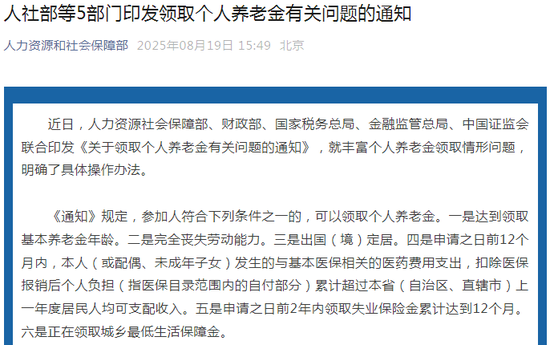
Core Viewpoint - The recent notification from the Ministry of Human Resources and Social Security and other departments introduces three new scenarios for accessing personal pensions, effective from September 1, 2023, aimed at increasing flexibility and accessibility for residents [1][3][6]. Summary by Relevant Sections New Withdrawal Scenarios - The notification adds three new scenarios for personal pension withdrawals: 1. Medical expenses exceeding the previous year's per capita disposable income after insurance reimbursement within the last 12 months for the applicant or their dependents [1][3]. 2. Accumulated unemployment insurance claims for 12 months within the last two years [1][3]. 3. Currently receiving urban and rural minimum living security [1][3]. Application Channels - The notification expands application channels for personal pension withdrawals to include: 1. National Social Insurance Public Service Platform 2. Electronic social security card 3. Mobile app "掌上12333" [1][8]. - Participants can still apply through their bank where their personal pension account is held [8]. Withdrawal Process - The process for withdrawing personal pensions involves verification by social insurance agencies, which will upload results to the personal pension information management service platform [8][9]. - If verified, funds will be transferred to the participant's social security card bank account after tax deductions [8][9]. Flexibility in Contributions - Participants can continue to contribute to their personal pension accounts even after making withdrawals, except when reaching the age for basic pension withdrawal [6][9]. Market Development - The personal pension financial product market is experiencing rapid growth, with over 143.9 million investors opening accounts, a 46.2% increase since the beginning of the year [11]. - The average annualized return for personal pension investors has exceeded 3.4% [11]. - The market is expected to grow further due to increasing demand for long-term, stable, and customized pension financial products [12].
“固收+”产品收益率上升!这些银行理财产品7月上榜
Zhong Guo Zheng Quan Bao· 2025-08-20 13:15
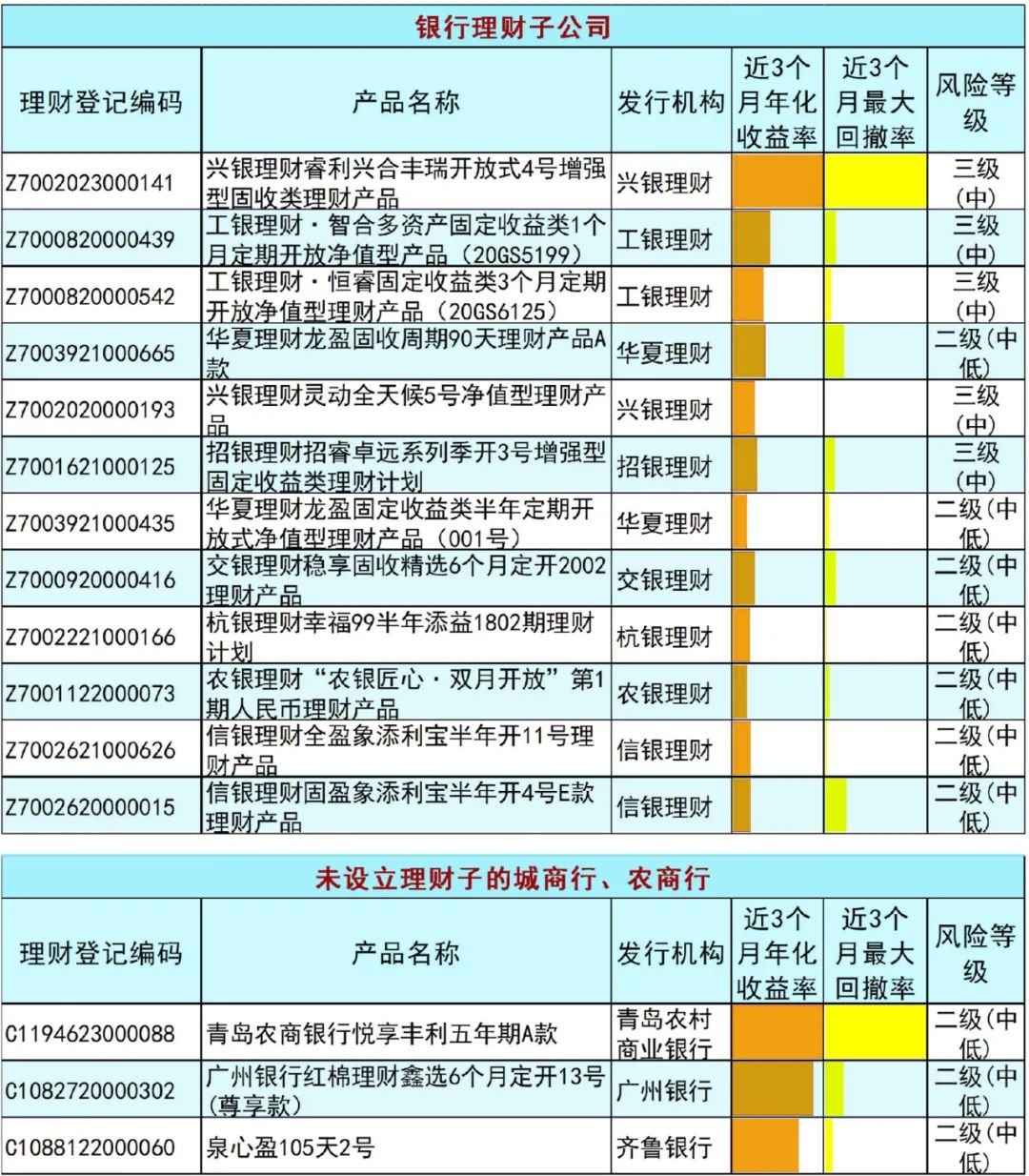
Group 1 - The bond market faced pressure in July, with the yield on 10-year government bonds rising by 5 basis points to 1.70%, stabilizing by the end of the month [1] - The Shanghai Composite Index increased by 3.74% for the month, while the ChiNext Index surged by 8.14%, indicating a preference for growth styles in the market [1] - The total number of bank wealth management products reached 42,629 by the end of July, an increase of 776 from June [1] Group 2 - The average annualized return of the listed products approached 10%, with volatility rising significantly compared to June [6] - The average scale of the listed products was approximately 4.79 billion yuan, a decrease of 34.92% month-on-month [6] - The proportion of products with a risk level of three (medium risk) accounted for one-third of the listed products, indicating a shift in risk profile [6] Group 3 - The average weighted annualized return of the listed products in the mixed category reached 17.86%, with a notable increase in volatility [22] - The average scale of these products was about 4.83 billion yuan, down 40.88% from June [22] - The allocation to equity assets became a significant source of returns, with a focus on technology growth styles [22] Group 4 - The overall risk level of the listed products increased, with 50.48% of products rated at level three (medium risk) or higher [27] - The products primarily invested in high-grade interest rate bonds and bank capital tools, maintaining a focus on liquidity [18] - The investment strategy reflected a "high proportion of fixed income + moderate liquidity" approach [18]
【银行理财】多元资产配置新浪潮,银行理财涌现哪些新范式?——2025年7月银行理财市场月报
华宝财富魔方· 2025-08-20 10:18
Core Viewpoint - The article discusses the ongoing transformation of bank wealth management towards diversified asset allocation, driven by low interest rates and asset scarcity, necessitating a restructuring of risk-return strategies [3][8]. Group 1: Regulatory Policies and Industry News - The transition to diversified asset allocation is characterized by a shift from "fixed income" to "fixed income+" strategies, which includes expanding investment regions, asset types, strategies, and scenarios [3][10]. - Recent developments include the launch of the "Xinghui+" multi-asset product system by Huibin Wealth Management, which integrates various investment strategies [7]. - The collaboration between Xingyin Wealth Management and the Straits Equity Exchange Center marks a significant step in equity registration services [7]. Group 2: Market Trends and Performance - As of July, the total market size of wealth management products saw a slight increase of 1.75% to 31.28 trillion yuan, with a year-on-year growth of 5.90% [4]. - The annualized yield for cash management products decreased by 9.81 basis points to 1.35%, while pure fixed income products yielded 1.87%, down by 0.79 percentage points [4]. - The new issuance of wealth management products declined in July, reflecting a contrast to the issuance peak in June, with most performance benchmarks being adjusted downward [4]. Group 3: Product Performance and Standards - The compliance rate for closed-end wealth management products reached 85.89% in July, showing a slight increase from June, while the compliance rate for open-end products was 70.13% [5].

【银行理财】资管年会谋篇市场新生态,债市波动引理财净值回调——银行理财周度跟踪(2025.8.11-2025.8.17)
华宝财富魔方· 2025-08-20 10:18
Core Viewpoint - The article discusses the recent developments in the asset management industry, highlighting the impact of regulatory changes and market dynamics on investment strategies and product offerings [3][4][6]. Regulatory and Industry Dynamics - The "2025 Asset Management Annual Conference" was held in Shanghai, focusing on the theme "Breaking the Deadlock and Restructuring - Rebuilding Competitiveness in Asset Management" [3][6]. - Various executives from wealth management companies shared insights on the future of multi-asset and multi-strategy investments, emphasizing the importance of rebalancing asset allocations [6][7]. - The emergence of AI infrastructure is seen as a significant investment opportunity, with high-dividend assets expected to provide stable returns [6][8]. Innovations in the Industry - The "日鑫悦益" product system by浦银理财 was updated to enhance its cash management capabilities and diversify investment strategies [10]. - 招银理财 launched the SMARP multi-asset allocation index, which aims to optimize asset allocation and manage risks dynamically [10]. Yield Performance - For the week of August 11-17, 2025, cash management products recorded an annualized yield of 1.31%, down 3 basis points, while money market funds yielded 1.20%, down 1 basis point [12][13]. - The yield on 10-year government bonds increased by 5 basis points to 1.75%, reflecting market dynamics influenced by various factors, including U.S.-China tariff concerns and consumer loan policies [13][14]. Tracking of Net Value Decline - The net value decline rate for bank wealth management products rose to 1.52%, an increase of 0.65 percentage points, with credit spreads widening by 2.55 basis points [16]. - The relationship between net value decline rates and credit spreads indicates potential redemption pressures on wealth management products if the decline exceeds certain thresholds [16].

2025年7月银行理财市场月报:多元资产配置新浪潮,银行理财涌现哪些新范式?-20250820
HWABAO SECURITIES· 2025-08-20 09:09
Investment Rating - The report does not explicitly provide an investment rating for the banking wealth management industry Core Insights - The banking wealth management industry is undergoing a transformation towards diversified asset allocation driven by low interest rates and asset scarcity, necessitating a reconfiguration of risk-return strategies [2][12] - The essence of diversified asset allocation is the transition from "fixed income" to "fixed income plus," which includes broadening investment regions, extending asset types, and enhancing investment strategies [3][13] Summary by Sections Regulatory Policies and Industry News Interpretation - The transformation towards diversified asset allocation in banking wealth management is deepening, with new product systems being launched and collaborations with financial institutions being established [11] - The low interest rate environment and asset scarcity are pushing wealth management companies to explore new revenue sources and capture structural opportunities during the interest rate decline [12] Current Status: Scale Growth and Yield Decline - In July, the total market wealth management product scale increased by 1.75% to 31.28 trillion yuan, with a year-on-year growth of 5.90% [23][25] - The annualized yield of cash management products decreased to 1.35%, while fixed income products saw a decline to 1.78% [28][31] New Issuance: Scale Decline and Product Characteristics - The new issuance scale of wealth management products in July fell, with fixed income plus products dominating the market, reflecting a shift towards multi-asset strategies [46][47] - The majority of new product performance benchmarks have been adjusted downwards, indicating a consensus on the long-term low interest rate environment [53] Maturity: Performance Rates - The achievement rate for closed-end products reached 85.89%, while the rate for open-end products was 70.13%, showing a slight improvement from the previous month [55][60]