军工

Search documents
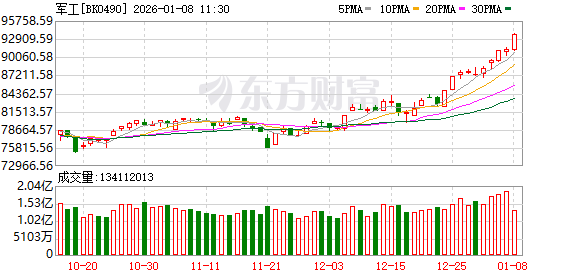
军工ETF(512660)领涨超3%,行业格局转向三轮驱动
Mei Ri Jing Ji Xin Wen· 2026-01-08 06:52
Core Viewpoint - The Chinese military industry has evolved from a model reliant on domestic demand to a new development pattern characterized by "domestic demand foundation, foreign trade expansion, and civilian backfeeding," transitioning from "cyclical growth" to "comprehensive growth" [1] Group 1: Domestic Military Demand - Domestic military demand is focused on "preparing for war" and equipment modernization, with major growth directions being high-precision deterrence and systematic unmanned low-cost solutions [1] Group 2: Military Trade Expansion - China's military trade share continues to increase, leveraging advantages in cost-effectiveness, systematic combat capabilities, and geopolitical strategic cooperation [1] Group 3: Civilian Applications of Military Technology - The dual-use of military technology is giving rise to new trillion-level industries such as commercial aerospace and low-altitude economy, creating a virtuous cycle of "military technology for civilian use, backfeeding military industry" [1] Group 4: Aerospace Activity Projections - By 2025, China's aerospace launch activities are expected to remain highly active, with a projected total of 73 space launch missions, setting a historical record, and the commercial aerospace sector entering a high-frequency networking phase, leading to strong demand in upstream satellite manufacturing and rocket launching [1]
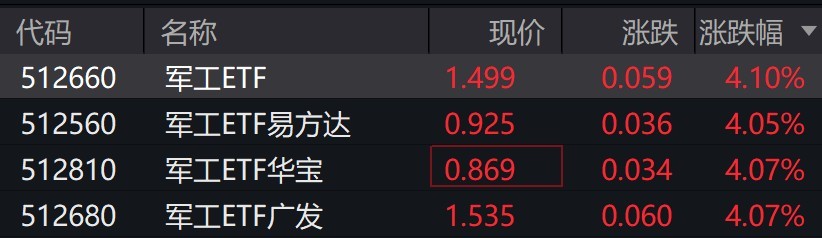
军工概念股走强,军工相关ETF涨超4%
Mei Ri Jing Ji Xin Wen· 2026-01-08 05:57
Core Viewpoint - The military industry stocks have shown significant strength, with notable increases in various companies and ETFs, indicating a positive market sentiment towards the sector [1][2]. Group 1: Stock Performance - Aerospace Electronic reached the daily limit increase, while AVIC Shenyang Aircraft Corporation and AVIC Xi'an Aircraft Industry Group rose over 5%, and China Shipbuilding Industry Corporation increased by over 4% [1]. - Military-related ETFs experienced a rise of over 4% [1]. Group 2: Industry Outlook - A brokerage firm forecasts that by 2026, the military industry will undergo a critical transformation characterized by rigid demand, high-end structural changes, and improved financial health [2]. - Key judgments include: 1. Significant enhancement in order certainty [2]. 2. Accelerated shift in demand structure towards new combat capabilities and consumable combat capabilities [2]. 3. Military trade becoming a second growth curve, with systematic exports opening high-end market ceilings [2]. 4. Deepening military-civilian integration, with commercial aerospace, low-altitude economy, and nuclear fusion achieving "military technology for civilian use, dual empowerment" [2]. 5. Comprehensive improvement in financial quality, with cash flow and profitability entering an upward channel, shifting valuation logic from thematic speculation to fundamental pricing [2].

国防ETF(512670)涨超4.6%,区域局势升温+卫星板块推升军工行情
Xin Lang Cai Jing· 2026-01-08 05:53
Group 1 - The core point of the news is that President Trump proposed a military budget of $1.5 trillion for 2027, representing a 66% increase from the previous budget of $901 billion for 2026, citing the current turbulent and dangerous times [1] - The commercial aerospace sector is experiencing a strong recovery, with defense and military performance outperforming satellites, attributed to the importance of rocket reusability, particularly in engines and electronic control systems [1] - The defense industry is expected to gradually enter a recovery phase by 2026, with an upward trend in military spending anticipated due to new five-year plans and the goal of achieving a century of military development by 2027 [1] Group 2 - As of January 8, 2026, the China Securities Defense Index rose by 4.46%, with significant gains in component stocks such as Aerospace Nanhai (up 19.52%) and Aerospace Electric (up 10.01%) [2] - The Defense ETF closely tracks the China Securities Defense Index, which includes listed companies under major military groups and those providing equipment to the armed forces, reflecting the overall performance of the defense industry [2] - The top ten weighted stocks in the China Securities Defense Index as of December 31, 2025, include Aerospace Electronics and Aero Engine Corporation, collectively accounting for 42.34% of the index [2]


港股早盘收跌 恒指下挫超1%,板块分化科技股承压
Jin Rong Jie· 2026-01-08 05:41
个股方面,根据公开交易数据,部分科技股跌幅居前。在半导体板块,中芯国际、华虹半导体等股票上 涨。航天控股等军工概念股表现活跃。 声明:市场有风险,投资需谨慎。本文为AI基于第三方数据生成,仅供参考,不构成个人投资建议。 香港股市主要股指1月8日早盘收跌,延续前一交易日调整态势。 本文源自:市场资讯 截至午间收盘,恒生指数报26136.49点,下跌1.22%;恒生科技指数报5673.84点,下跌1.13%;国企指 数报9034.76点,下跌1.14%。 作者:观察君 板块表现呈现分化。大型科技股普遍走低,对指数形成拖累,部分个股跌幅超过3%。半导体、军工及 医疗保健设备服务等板块则逆市上扬。三只新股今日在港交所挂牌交易,均实现上涨,其中精锋医疗-B 涨幅显著。 ...
午评:沪指震荡微涨 金融板块走低 商业航天概念等活跃
Zheng Quan Shi Bao Wang· 2026-01-08 04:43
Core Viewpoint - The A-share market is experiencing a mixed performance, with the Shanghai Composite Index showing slight gains while other indices like the Shenzhen Component and ChiNext are declining. The market is characterized by sector rotation and structural trends, suggesting a potential continuation of the bull market in A-shares due to favorable economic conditions and policy support [1]. Market Performance - On the morning of the 8th, the Shanghai Composite Index fluctuated within a narrow range, while the Sci-Tech Innovation 50 Index surged nearly 2%. Over 3,700 stocks in the A-share market were in the green [1]. - By midday, the Shanghai Composite Index rose by 0.09% to 4,089.45 points, the Shenzhen Component fell by 0.2%, and the ChiNext Index decreased by 0.52%. The Sci-Tech Innovation 50 Index increased by 1.77%. The total trading volume across the Shanghai, Shenzhen, and North markets reached approximately 1.78 trillion yuan [1]. Sector Performance - The brokerage, insurance, banking, and liquor sectors experienced declines, while the military, real estate, pharmaceuticals, and semiconductor sectors saw gains. Additionally, sectors related to industrial software, controllable nuclear fusion, and commercial aerospace were active [1]. Investment Strategy - According to Caixin Securities, the market is likely to shift towards a structural trend characterized by index fluctuations and sector rotation. Investors are advised to adopt a strategy of focusing on strong sectors while gradually adjusting to the rotation rhythm [1]. - Looking ahead, with resilient overseas economic conditions, likely continued loose dollar liquidity, ongoing domestic "dual easing" policies, and sustained inflation expectations due to "anti-involution," the bull market in A-shares is expected to continue [1].
爆发!这一概念重燃,多股大涨
证券时报· 2026-01-08 04:42
Core Viewpoint - The A-share market experienced mixed performance on January 8, with the defense and military industry sector leading gains while brokerage stocks faced collective adjustments [1][2]. Market Performance - The A-share market continued a narrow fluctuation pattern, with major indices showing mixed results. The STAR 50 index performed relatively well, reaching a maximum increase of over 2.7% during the session [3]. - By the midday close, the Shanghai Composite Index rose by 0.09%, while the Shenzhen Component Index fell by 0.2%, and the ChiNext Index decreased by 0.52%. The STAR 50 index increased by 1.77%, and the North Star 50 index rose by 0.81% [3]. Sector Performance - The defense and military sector led the market with a maximum increase close to 4%, although this gain later narrowed. Notable stocks included Aerospace Nanhu, Hangya Technology, and New Jingang, all of which saw increases exceeding 10% [3]. - The media sector also performed well, with gains exceeding 2%. Stocks such as Yilun Media and Oriental Pearl reached their daily limit [3]. - The computer sector saw significant increases, with HanDe Information hitting a "20cm" limit before opening up. Other stocks like Baoxin Software and ZhiZhen Technology also reached their daily limits [3]. Brokerage Sector - The non-bank financial sector led declines, with a drop exceeding 2%. Several brokerage stocks, including Hualin Securities, faced significant losses, with Hualin Securities hitting the daily limit down [6][7]. - Major brokerage stocks such as Huatai Securities and Guotai Junan saw declines of over 3% [6]. Brain-Machine Interface Concept - The brain-machine interface concept saw a resurgence, with related indices increasing by over 4% in both the A-share and Hong Kong markets [9][12]. - Notable stocks in this sector included Aipeng Medical and Kefu Medical, both of which approached their daily limit up, alongside several others with increases exceeding 5% [11]. - However, many listed companies issued announcements warning of potential risks associated with this concept, clarifying that their main business operations remain unchanged and that they do not currently have mature products related to brain-machine interfaces [14][15].



1分钟20%涨停!10万亿 军工重磅利好突袭!
Zheng Quan Shi Bao Wang· 2026-01-08 03:48
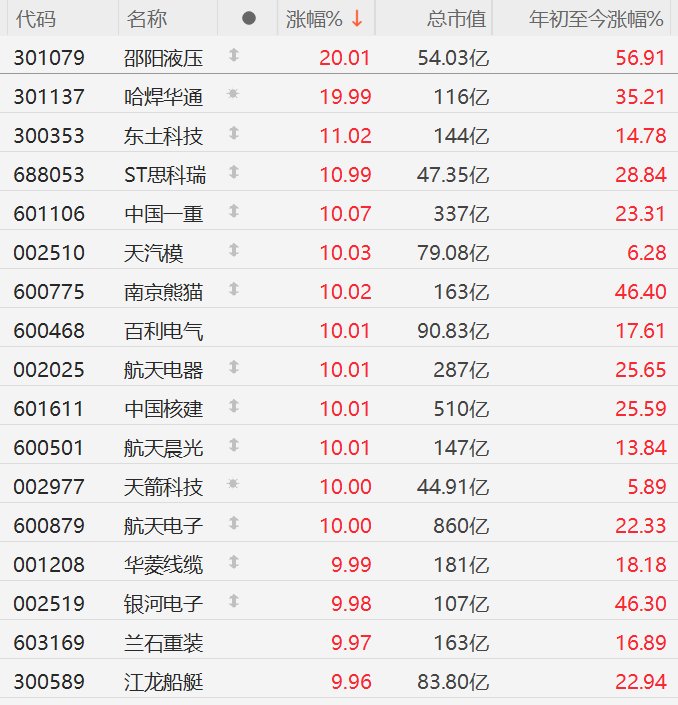
Core Viewpoint - The military sector in A-shares experienced a significant surge following President Trump's proposal to increase the U.S. military budget to $1.5 trillion by 2027, which is a 66% increase from previous levels, aimed at strengthening the military during turbulent times [2][5]. Group 1: Market Reaction - A-shares military stocks saw a broad rally, with the Wind military index rising over 4% by 11:00 AM on January 8, 2023 [3]. - Notable stocks included Shaoyang Hydraulic and Hahong Huaton, both reaching the 20% limit up, while several others like Jianglong Shipbuilding and Dongtu Technology surged over 10% [3][4]. Group 2: Budget Proposal Details - Trump's military budget proposal for 2027 is set at $1.5 trillion (over 100 billion RMB), with the 2026 budget at $901 billion [2][5]. - The proposal is part of a broader strategy to enhance U.S. military capabilities amid perceived global threats [6]. Group 3: Defense Industry Implications - Trump's comments on military spending come alongside threats to defense contractors regarding stock buybacks, indicating a push for reinvestment in military capabilities [7]. - The defense sector in the U.S. saw declines in stock prices for major contractors like Northrop Grumman and Lockheed Martin following Trump's statements [7]. Group 4: Future Outlook - Analysts from Dongfang Securities anticipate a new phase of equipment construction planning, highlighting the potential for growth in the military sector driven by both domestic and international demand [8]. - Guosheng Securities predicts a gradual recovery for the military industry starting in 2026, with an upward trend expected as new five-year plans are implemented [8].




A股午评:沪指涨0.09%,超3700股上涨!脑机接口、可控核聚变板块爆发
Ge Long Hui· 2026-01-08 03:44
A股三大指数涨跌不一,截至午间收盘,沪指涨0.09%报4089.45点,深成指跌0.2%,创业板指跌 0.52%,北证50指数涨0.81%。沪深京三市半日成交额17815亿元,较上日缩量722亿元,全市场超3700 只个股上涨。 盘面上,我国可控核聚变技术持续迎新突破,相关概念股全线大涨,中国核建、融发核电等多股涨停; 脑机接口板块再度活跃,南京熊猫、普利特、创新医疗4连板;美国猛增军费预算,军工股走强,航天 电子涨停。商业航天、短剧游戏、风电设备板块涨幅居前。券商、保险股普遍回调。 ...
美国猛增军费预算,军工股掀涨停潮,航天电子等15股涨停
Ge Long Hui· 2026-01-08 03:09
| 代码 | 名称 | | 涨幅% ↓ | 总市值 | 年初至今涨幅% | | --- | --- | --- | --- | --- | --- | | 301079 | 邵阳液压 | 1 | 20.01 | 54.03亿 | 56.91 | | 301137 | 哈特斯運 | -08- | 19.99 | 116亿 | 35.21 | | 300353 | 东土科技 | 4 | 11.02 | 144亿 | 14.78 | | 688053 | ST思科瑞 | 1 | 10.99 | 47.35 Z | 28.84 | | 601106 | 中国一重 | 1 | 10.07 | 337亿 | 23.31 | | 002510 | 天汽模 | 1 | 10.03 | 79.08亿 | 6.28 | | 600775 | 南京熊猫 | 1 | 10.02 | 163亿 | 46.40 | | 600468 | 百利电气 | | 10.01 | 90.83亿 | 17.61 | | 002025 | 航天电器 | 1 | 10.01 | 287亿 | 25.65 | | 601611 | 中国核建 | 1 | ...
北方导航成交额创2025年7月2日以来新高
Zheng Quan Shi Bao Wang· 2026-01-08 03:06
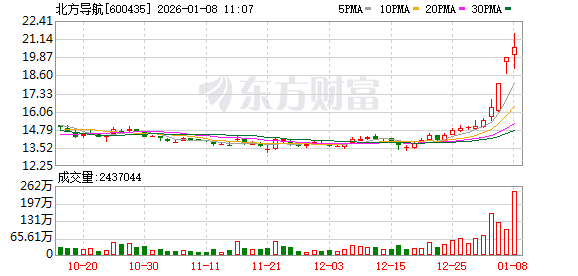
数据宝统计,截至10:08,北方导航成交额30.53亿元,创2025年7月2日以来新高。最新股价下跌 0.86%,换手率10.29%。上一交易日该股全天成交额为19.08亿元。(数据宝) (文章来源:证券时报网) ...